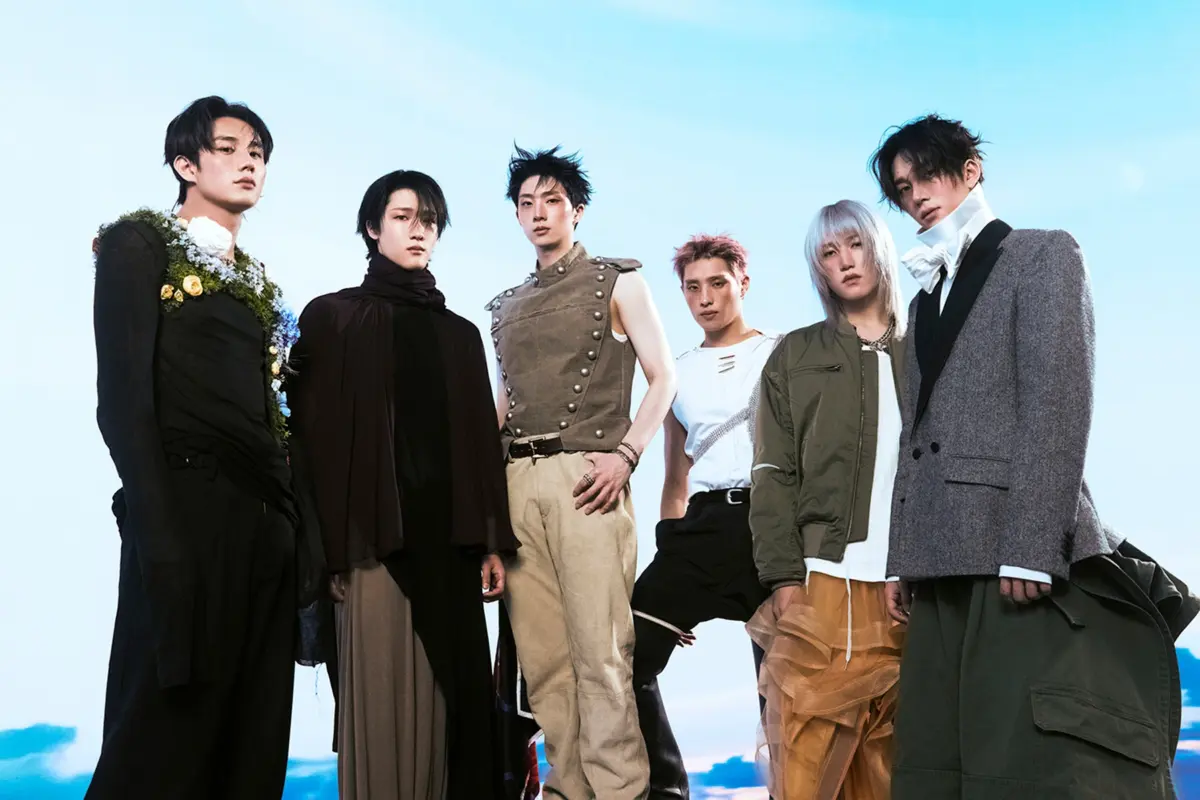
Six years into a high-stakes, hyper-competitive musical ecosystem, the six members of P1Harmony—Intak, Keeho, Theo, Jiung, Soul, and Jongseob—are no longer chasing phantoms. Sitting down for an exclusive interview in a sunlit downtown Los Angeles hotel room just hours before boarding a return flight to Seoul, the K-pop sextet radiates a quiet, hard-earned confidence. Their latest EP, aptly titled BLOW UP, dropped on November 6, serving as both a sonic milestone and a definitive manifesto for where the group stands today.
For the better part of their first half-decade together, P1Harmony endured the relentless treadmill inherent to the global pop industry. They experienced stretches where the frantic pace of production left them questioning the very purpose of their labor. Yet, through steady chart ascent, expanding global concert audiences, and hard-fought creative victories behind closed doors, the narrative has shifted.
No longer passive recipients of label directives, P1Harmony has systematically dismantled the outdated industry myth that K-pop artists lack agency. By pairing methodical career growth with undeniable streaming data, the group has earned a rare level of creative autonomy from their label, FNC Entertainment. As they eye the upper echelons of the Billboard 200 and prepare for a critical juncture in their collective career, P1Harmony’s journey is a masterclass in endurance, self-manifestation, and artistic maturation.
Detailed Chronology: From Uncertain Footsteps to Chart-Topping Momentum
The Formative Years: Running Without a Compass
To understand the triumphant arrival of BLOW UP, one must first reckon with the psychological toll required to survive the early phases of a K-pop career. For Intak, the most grueling obstacle during the group’s initial six years was not the brutal choreography or the grueling hours, but a crisis of existential direction.
"What I felt was hardest in this process was when I couldn’t find a reason for running," Intak reflects. "There were times the company just had us run without a clear purpose or a point to reach… ‘What is our purpose in this moment? What are we running this hard for? Is it even true that running like this will get us there?’ Every time I had moments like that, I’d suddenly feel drained. But even if our steps were really small, we always climbed little by little."
This sentiment of disorientation was compounded by deep-seated cultural adjustments. Keeho, the group’s Toronto-raised leader, faced severe culture shock upon entering the ultra-disciplined Korean trainee system as a teenager. Navigating 10-to-11-hour workdays required a radical sacrifice of personal pride.
"You have to compromise your dignity almost a little bit—you have to kind of let them yell at you and be like, ‘I’m still gonna show you why I belong here,’" Keeho admits. Meanwhile, Soul—who relocated from his native Japan—met the rigorous environment with stoic preparation, noting that the homesickness that once plagued him has finally dissipated.
Charting the Ascent: The Billboard 200 Trajectory
P1Harmony’s perseverance gradually translated into tangible, quantifiable milestones on the global stage. Intak notes that the group’s psychological reassurance comes from watching their chart positions climb step-by-step.
"Before, our goal was just to get onto Billboard," Intak says. "Just the other day we were at No. 60, then we’re getting into the top 20 and now the top 5. Because we achieved these things one by one, I feel reassured now and I think it’s good that we can show our fans we’re artists who can do at least this much."
The group’s historical footprint on the Billboard 200 illustrates an unbroken upward trajectory across six consecutive EP releases:
- Summer 2023: HARMONY : ALL IN marks their debut on the chart at No. 51.
- Early 2024: Killin’ It breaks new ground as their first top 40 album, peaking at No. 39.
- Late 2024: SAD SONG surges to No. 16.
- 2025: DUH! claims the No. 23 spot.
- Fall 2025: Their debut English-language EP, EX, cracks the top 10 at No. 9.
- Earlier This Year: UNIQUE achieves their career-best showing to date, debuting at No. 4 with an impressive 58,000 equivalent album units in its first week.
Full-Circle Moments and Live Validation
This numerical growth found emotional resonance the weekend prior to their interview, when P1Harmony headlined their first U.S. festival slot at 82WORLD: LA.
"The last time we did an outdoor thing was the first time we came to L.A.," Keeho recalls. "It’s been like almost four to five years and that’s a really big, full-circle moment."
Supporting Context & Metrics: Breaking the Mold of Industry Control
A persistent outsider stereotype brands K-pop idols as manufactured commodities stripped of individual expression. Keeho acknowledges that while this description unfortunately applies to some corners of the global music industry—spanning both Seoul and Western major labels—the reality for P1Harmony has evolved dramatically through empirical evidence.
The turning point with FNC Entertainment occurred organically through grassroots fan engagement. When Keeho composed the album track "Pretty Boy" off the DUH! project, it became an unexpected streaming phenomenon. Without any dedicated promotional campaign or single push, the track out-streamed the album’s official title track by 12 million plays on Spotify.
This success forced a cultural shift within the agency. When the members asserted creative control—writing lyrics, designing choreography, and guiding stage direction (an area championed by Theo)—the label could no longer ignore the data.

+-------------------------------------------------------------------+
|               P1HARMONY'S STREAMING PROOFS OF CONCEPT             |
+-------------------------------------------------------------------+
| Track          | Project     | Accolade / Metric                   |
+----------------+-------------+------------------------------------+
| "Pretty Boy"   | DUH! (2025) | Out-streamed lead single by 12M    |
|                |             | streams with zero promotion.       |
+----------------+-------------+------------------------------------+
| "UNIQUE"       | UNIQUE      | 15.5 million Spotify streams.      |
+----------------+-------------+------------------------------------+
| "ICE (VVS)"    | UNIQUE      | 14.5 million Spotify streams.      |
+----------------+-------------+------------------------------------+
| "L.O.Y.L."     | UNIQUE      | 6.9 million streams (member-       |
|                |             | directed visual budget allocation).|
+----------------+-------------+------------------------------------+
With UNIQUE, the sextet successfully lobbied their label to allocate marketing budgets toward tracks they knew would resonate. They pushed for visuals for "L.O.Y.L." (exploring uncharted artistic territory) and "ICE (VVS)," correctly predicting that audiences would gravitate toward the latter. The Spotify metrics vindicated their foresight: "UNIQUE" pulled in 15.5 million streams, "ICE (VVS)" secured 14.5 million, and "L.O.Y.L." earned 6.9 million.
Official Statements and Member Perspectives
Crafting BLOW UP and Navigating the System
This hard-earned track record of creative intuition directly informed the creation of BLOW UP. While the members admit they do not dictate every executive decision—particularly regarding lead singles—their leverage has fundamentally transformed.
"We don’t get to call the shots in everything by any means, especially with our lead single," Keeho notes. "But I think it’s more like we can manipulate the system a little bit better now. It’d be more like, ‘Actually, I think this song’s a little better’ and we can really communicate our thoughts and ideas. But after that, it’s kind of up in the air."
Youngest member Jongseob champions the stylistic direction of the new single: "We’ve never done anything this rhythmical. I get more of a youthful feeling. This time is for a new chapter and challenging something new. That’s why we especially think BLOW UP is better than the other options. We love BLOW UP."
The Dualities of Youth and Maturity
Musically, BLOW UP balances hyperpop-infused, TikTok-ready hooks ("We vibin’, we feinin’, we mobbin’") with a sobering lyrical maturity. Intak, who shares writing credits across every track on the EP alongside Jongseob, deliberately subverted the track’s upbeat exterior to explore the anxieties of rapid career scaling.
"When we first heard BLOW UP, a lot of the keywords the members picked out first were about youth," Intak shares. "Rather than the bright side people see, I wanted to reveal more of the painful side hidden behind it. So, with the lyrics, I thought of it as walking a tightrope. Some people take a plane or a helicopter or an escalator to get somewhere higher. But I thought of us as walking a tightrope, climbing so cautiously it feels like we could fall, and wrote the flow of the song with that in mind."
Individual Compromises and Personal Growth
Beneath the collective unit, each member has navigated distinct internal reconciliations:
- Theo balances his personal affinity for indie-rock guitar music with his role as a high-octane dance performer, though he playfully singles out the heavy-hitting Afro-house cut "MOMENTUM" as his personal favorite from the new era.
- Jiung has worked extensively to separate his identity from the stage, letting go of the impossible expectation of absolute perfection. "I was trying too hard to be a perfect singer," the 25-year-old admits. "Not only as a singer, but also as a human being… So now I know how to accept it and how to express myself. I found the balance and it’s great."
Future Outlook: Longevity, Perspective, and the Road to 2027
The thematic tension of aging within a youth-obsessed industry is explored on the BLOW UP deep cut "t.o.t.y" (an acronym for "too old too young"). When prompted on what they feel too old or too young for, Jiung captures the group’s ongoing philosophical evolution: he feels too old to keep running without purpose, yet too young to over-calculate every move. Jongseob, turning 21 this month, reflects on leaving formal schooling at age 14 to pursue his craft, calling it "a little too young" to live through such accelerated milestones.
Keeho, meanwhile, draws profound inspiration from veteran artists who have defied traditional industry expiration dates. Citing a recent attendance at Charli xcx’s BRAT tour—prompting him to look up her age (34) and reflect on Kelela’s commentary regarding industry pressures—Keeho rejects the toxic narrative that an artist must peak by their late teens or vanish forever.
"It’s never too late because everyone has their own timing," Keeho asserts. "Sometimes in the six years there have definitely been moments, like, ‘Damn, did we kind of lose our momentum? Did we peak? Are we just stagnant now and do we have to be satisfied with where we are?’ But I think we’re way too young to even think about that."
With the standard seven-year K-pop contract renewal window looming on the horizon, P1Harmony has zero intention of slowing down. Their blueprint for 2027 and beyond includes aggressive international touring, expanded solo covers, and deeper explorations of individual artistry.
"It’s another time to really push even harder, make people sick of us almost," Keeho jokes.
Ultimately, the decision to name their release BLOW UP six years into their journey is an act of deliberate self-manifestation. As Keeho concludes:
"People might find it weird that we’re manifesting to ‘blow up’ six years down into our career. But I feel like it’s always a slow burn and a slow foundation that really causes something to pop. It creates longevity… we really wanted to talk about blowing up in a sense that it’s a self-manifestation for us. That even if it isn’t with this song, that one day we will blow up and become bigger than what we already are."