Executive Overview
In the contemporary landscape of global independent music, geographic borders are dissolving faster than ever, driven by digital distribution, cross-cultural collaborations, and tastemaking institutions that champion regional authenticity. Few moments capture this paradigm shift as vividly as the recent collaboration between Jakarta-based instrumental outfit Basajan and Seattle’s legendary public radio station, KEXP.
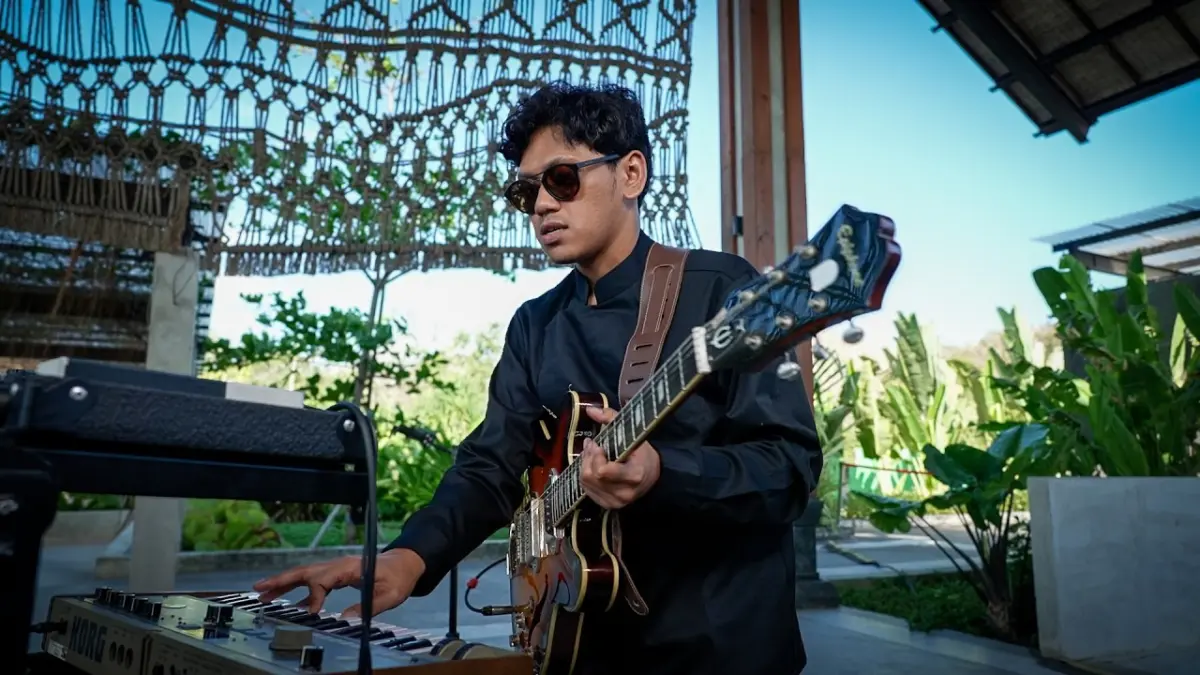
Closing out their breathtaking six-song live session with "Waas"—a haunting, three-minute instrumental that also serves as the emotional crescendo of their debut full-length album, Béwara—Basajan delivered a masterclass in modern cultural synthesis. Filmed against the dramatic backdrop of the cliffs above Jimbaran in Bali at the Locca Sea House, the session was captured on August 28 and premiered globally on October 29. More than just a live performance, this showcase represents a historic milestone: KEXP’s very first production project in Asia.
This landmark initiative was realized through a strategic partnership with the AXEAN Festival, Southeast Asia’s premier music industry showcase and conference held in Bali. By placing twelve diverse acts from across the region directly in front of KEXP’s cameras, the collaboration bridged a long-standing gap between Southeast Asia’s vibrant underground scenes and the Western indie music consciousness.
At the center of this movement is Basajan, a quartet of musicians hailing originally from Kabupaten Bandung—the regency enveloping the cultural heartland of Bandung in West Java—who now base their operations in the bustling capital of Jakarta. Comprising guitarists Adhitama Putra Prakarsa and Reyhan Gyanie (who also handles synthesizer), bassist Dinan Indrayana, and drummer Dandy Rizkiawan, the band has carved out a singular niche they proudly term "Priangan Psychedelic Groove." Named after the historic designation for the lush, mountainous Sundanese highlands, Basajan’s music marries the mind-expanding textures of psychedelic rock with the deeply rooted polyrhythms, mythologies, and spiritual traditions of West Java.
Their arrival on the international stage is neither accidental nor sudden. It is the culmination of meticulous artistic vision, relentless touring across Asia, and a profound respect for indigenous aesthetics. As Béwara continues to make waves globally following its April 10, 2026 release via Bahasa Ibu Records—an imprint of the prominent Jakarta label demajors—Basajan stands at the vanguard of a new wave of Indonesian artists proving that local traditions possess universal resonance.
Detailed Chronology
To understand the trajectory of Basajan is to trace a deliberate path from regional preservation to international export. The band’s recent milestones chronicle a meteoric rise fueled by critical acclaim, innovative songwriting, and strategic global partnerships.
December 2025: The Genesis of International Recognition and "1971"
Basajan’s ascent onto the global stage officially began in December 2025, when the band made their international debut at Thailand’s renowned multidisciplinary festival, Wonderfruit. Performing amidst the sprawling art installations and eco-conscious ethos of the festival, Basajan introduced international audiences to their hypnotic blend of Sundanese melodies and driving dance grooves.
Simultaneously, the band dropped their pivotal single, "1971". Released in December 2025, the track served as a sonic manifesto for their forthcoming album. Written using daminatilada—the traditional five-note pentatonic scale intrinsic to Sundanese musical heritage—"1971" is a conceptual piece. It tells the haunting tale of a stranger who wanders into a night-market ghost house, only to emerge trapped indefinitely in the cultural and temporal ether of that specific year. The single showcased the band’s unique ability to weave dense, cinematic narratives without uttering a single vocalized lyric.
February 2026: Deepening the Folklore with "Nadoman"
Continuing their pre-album rollout, Basajan released "Nadoman" in February 2026. If "1971" demonstrated their conceptual storytelling, "Nadoman" proved their reverence for spiritual pedagogy. The track takes the traditional nadoman—the sung verses of moral and religious guidance that Sundanese children memorize in neighborhood prayer houses (madrasah or langgar)—and filters them through overdriven, coarse fuzz guitars and cavernous echoing reverbs. By juxtaposing sacred communal memory with heavy, distorted instrumentation, Basajan created a bridge between ancestral discipline and contemporary counterculture.
April 2026: The Release of Béwara and the Japanese Tour
The momentum crested on April 10, 2026, with the official release of their debut album, Béwara, via Bahasa Ibu Records. Launched in 2023 by the influential Jakarta independent label demajors, Bahasa Ibu Records was specifically established to champion musicians working within Indonesia’s diverse regional languages and artistic traditions. Béwara—meaning "announcement" or "proclamation" in Sundanese—fully realized the band’s sonic ethos across ten meticulously crafted tracks.
In tandem with the album’s release, Basajan embarked on an extensive tour of Japan in April 2026, introducing Japanese indie-rock and psych-scene audiences to the infectious rhythms of Priangan Psychedelic Groove.
August to October 2026: The KEXP Sessions in Bali
Following their return from East Asia, Basajan participated in the historic KEXP recording sessions on August 28, 2026, at the picturesque Locca Sea House on the cliffs of Jimbaran, Bali. Captured as part of KEXP’s landmark partnership with the AXEAN Festival, the six-song session showcased the band’s formidable live prowess. When KEXP officially published the footage online on October 29, 2026, it cemented Basajan’s status as standard-bearers for modern Indonesian music. The session culminated with a stirring rendition of "Waas," a track that encapsulates the melancholic beauty of the album’s thematic arc.
Late 2026: Conquering Domestic Frontiers at Rock in Celebes
Never resting on their laurels, Basajan transitioned directly from global media triumphs to foundational domestic festival circuits. Marking a major milestone in their national tour history, the band performed for the first time at Rock in Celebes, held at the historic Fort Rotterdam in Makassar, South Sulawesi.
Supporting Context & Metrics
The Philosophy of Tri Tangtu and "Waas"
To fully appreciate the depth of Basajan’s artistry, one must examine the conceptual framework underpinning Béwara. The album’s ten tracks serve as a sonic cartography of Tri Tangtu, an ancient Sundanese philosophical framework that divides the universe into three interconnected realms:
- Buana Nyungcung: The sacred upper world, associated with divinity, origins, and cosmic order.
- Buana Larang / Buana Panca Tengah: The middle world of daily human existence, action, and social relations.
- Buana Luhur / Buana Larang (Darker Realms): The underworld or shadowy domain associated with endings, transitions, and the subconscious.
The album’s closing track, "Waas," operates within the heavier, reflective emotional parameters of the record. In the Sundanese language, waas denotes a very specific, untranslatable emotional state: the sweet, aching nostalgia or bittersweet pang of remembering something or someone that is now permanently out of reach. Driven by hypnotic guitar interplay and driving percussion, "Waas" brings the listener full circle, leaving them suspended between the joy of memory and the sorrow of transience.
The Mechanics of "Priangan Psychedelic Groove"
Basajan’s self-styled genre tag is more than a catchy moniker; it is an analytical blueprint of their instrumentation and arrangement style:
- The Priangan Heritage: Named after the Priangan (or Parahyangan) highlands, the mountainous region surrounding Bandung where Sundanese culture flourished for centuries.
- The Sonic Architecture: Adhitama Putra Prakarsa and Reyhan Gyanie utilize intricate guitar tunings and psychedelic modulation pedals to mimic the microtonal bends of the kacapi (zither) and suling (bamboo flute). Meanwhile, Gyanie’s synthesizers introduce cosmic washes that dialogue with traditional melodies.
- The Rhythm Section: Bassist Dinan Indrayana and drummer Dandy Rizkiawan anchor these ethereal, folkloric melodies with hypnotic, danceable grooves influenced by global funk, krautrock, and traditional Kendang (Sundanese drum) patterns.
The Significance of the KEXP x AXEAN Partnership
KEXP’s expansion into Asia represents a major turning point in global music journalism and cultural exchange. Historically, Western tastemaking institutions have focused heavily on North American, European, and select Latin American or East Asian markets. By partnering with the AXEAN Festival in Bali, KEXP has recognized Southeast Asia as one of the most vibrant, culturally diverse, and underexposed musical ecosystems in the world.
For Indonesian independent music, this platform validates years of grassroots archiving, DIY touring, and regional language revival. It proves that international audiences are increasingly hungry for music that does not pander to Western pop homogeny, but instead offers genuine, localized cultural storytelling wrapped in universally compelling sonic packages.
Official Statements & Perspectives
While the band members—Adhitama Putra Prakarsa, Reyhan Gyanie, Dinan Indrayana, and Dandy Rizkiawan—prefer to let their intricate instrumentals speak primarily for themselves, their artistic ethos has been clearly articulated through their alignment with cultural guardians like demajors and Bahasa Ibu Records.
In foundational statements regarding the establishment of Bahasa Ibu Records, representatives of demajors emphasized the urgent necessity of preserving and modernizing Indonesia’s linguistic and regional heritage. As globalization threatens to homogenize local cultures into a singular urban monoculture, imprints like Bahasa Ibu provide a vital commercial and artistic ecosystem for musicians who sing, write, and conceptualize in regional tongues such as Sundanese, Javanese, Minang, and Batak.
Basajan’s integration of traditional daminatilada scales and Sundanese philosophical concepts like Tri Tangtu directly operationalizes this mission. By refusing to abandon their regional identity in pursuit of generic English-language alternative rock, Basajan has inadvertently found international success precisely because of their hyper-local focus.
Furthermore, organizers of the AXEAN Festival have repeatedly highlighted the mission of their Bali showcase: to dismantle the infrastructural barriers preventing Southeast Asian artists from accessing global booking agents, international radio syndication, and cross-border festival circuits. The collaboration with KEXP serves as the realization of that mission, validating the festival’s decade-long advocacy for the region’s creative community.
Future Outlook
As Basajan closes out 2026 with high-profile domestic performances at Rock in Celebes and continues to enjoy the global glow of their KEXP live session, the horizon for the band looks exceptionally bright.
Expanding the Global Footprint
Following successful festival debuts in Thailand (Wonderfruit), touring in Japan, and global broadcasting via Seattle, Basajan is uniquely positioned to secure extended international touring residencies throughout Europe, North America, and the broader Asia-Pacific region in 2027. The appetite for contemporary psychedelic music that incorporates non-Western musical systems—such as Turkey’s Anatolian rock revival or the global explosion of Thai phin-the-future bands—has created a primed, enthusiastic audience for Basajan’s Priangan Psychedelic Groove.
The Evolution of Regional Language Imprints
The commercial and critical success of Béwara under Bahasa Ibu Records signals a robust future for regional-language art in Indonesia. As younger generations of urban Indonesians seek deeper reconnections with their ancestral roots, bands like Basajan provide a vital cultural bridge, proving that traditional philosophies and vernacular scales can coexist harmoniously with modern fuzz pedals, synthesizers, and post-rock structures.
Continuing the Sonic Journey
For fans eager to dive deeper into the band’s sonic universe, Béwara is currently available for purchase and streaming across major independent music platforms via Bandcamp, and their historic KEXP session can be streamed in full on YouTube. As Basajan continues to map the realms of Tri Tangtu through sound, one thing is certain: the highlands of Priangan have found a voice that resonates far beyond the mountains of West Java, echoing across global radio waves and captivating the world stage.