Executive Overview
In the contemporary music landscape, few artists command cultural gravity quite like Charli XCX. Following the seismic, paradigm-shifting success of her 2024 cultural phenomenon, Brat, the Essex-born pop auteur returned with her seventh studio album, Music, Fashion, Film, on July 24. While the album has continued her streak of commercial dominance and critical acclaim—debuting at No. 1 on the Official U.K. Albums Chart and cracking the top tier of the Billboard 200—it has simultaneously ignited a very different kind of discourse across digital platforms.
Upon announcing a tightly curated, six-show 2027 arena run spanning Dublin, Glasgow, Manchester, London, Amsterdam, and Paris, the pop star was met with an immediate wave of fan frustration over the limited itinerary. Rather than ignoring the digital backlash or hiding behind corporate public relations teams, Charli chose a path of radical transparency. In a heartfelt statement shared via Instagram, the singer addressed the underlying realities of her career, laying bare the profound physical and emotional toll that large-scale, high-octane touring extracts from her psyche and body.
This tension between consumer demand and artist well-being highlights an increasingly urgent conversation within the modern music industry. As fans grapple with scarce ticket availability and high-stakes pricing wars, artists are beginning to push back against the grueling, conveyor-belt nature of global touring schedules. Charli XCX’s candid refusal to compromise her mental health for the sake of hyper-extended arena treks serves as a watershed moment for a generation of performers redefining what it means to be a working artist in the streaming era.
Detailed Chronology: From Brat Summer to the Music, Fashion, Film Era
To understand the context of Charli XCX’s current touring philosophy, one must retrace the meteoric trajectory that preceded it. The year 2024 will forever be etched into pop history as the dawn of "Brat Summer"—a cultural epoch defined by lime-green minimalism, internet-native irony, and sweaty, underground club hedonism. The record not only cemented Charli’s status as an avant-garde pop visionary but also thrust her into international superstardom on a scale she had not experienced since her early mainstream breakthroughs like "Boom Clap."
Capitalizing on this momentum without missing a beat, Charli pivoted rapidly. Rather than resting on the laurels of her commercial breakthrough, she dove headfirst into her next creative iteration. On July 24, she released her seventh studio album, Music, Fashion, Film. The record marked a sharp stylistic departure from the hyper-pop and club-centric mechanics of Brat, steering instead into darker, grittier, and more visceral rock-infused sonic landscapes.
The rollout for Music, Fashion, Film was as calculated as it was explosive. The album stormed the Official U.K. Albums Chart, claiming the No. 1 spot and securing Charli’s fourth chart-topping record in her home country. More impressively, the feat crowned her as the first British female artist to secure two new No. 1 albums within the same calendar year—a historic milestone that underscored her relentless creative output. Stateside, the album debuted at No. 3 on the Billboard 200 while simultaneously capturing her first-ever No. 1 placement on Billboard’s Top Album Sales chart.
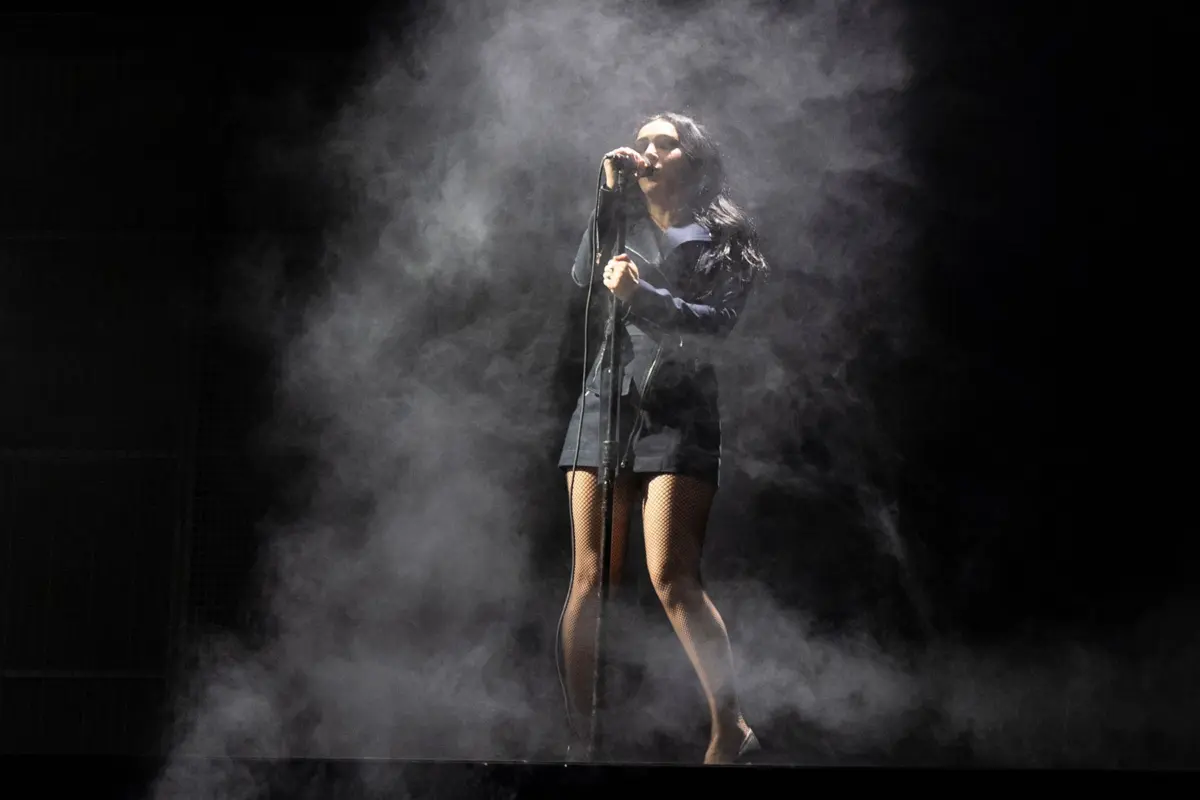
Following a landmark summer festival season—highlighted by a triumphant, career-defining headline set at the Reading Festival—Charli turned her attention to the live stage. On Friday, September 11, she kicked off the North American leg of her tour in Philadelphia. The 12-date arena trek features immersive production and support from electronic artist Underscores, taking in major markets including New York, Toronto, Boston, Atlanta, and Los Angeles before culminating in a grand finale in Las Vegas on October 23.
However, it was the subsequent announcement of her truncated 2027 UK and European arena run—covering just six cities (Dublin, Glasgow, Manchester, London, Amsterdam, and Paris)—that provoked acute anxiety and outcry among international fans accustomed to sweeping, multi-month continental tours.
Supporting Context & Metrics: The Economics and Realities of Modern Touring
The friction between Charli XCX’s fan base and her scheduling choices underscores a broader structural crisis within the live entertainment industry. In the post-pandemic era, touring has transformed from a promotional vehicle for recorded music into the primary economic lifeline for musicians. With streaming revenues famously failing to adequately compensate mid-tier and major artists alike, the pressure to mount extensive, high-capacity tours has never been more intense.
Yet, the physical and psychological costs of this economic necessity are rarely discussed with transparency. The modern arena tour is an exercise in extreme endurance. It requires artists to navigate grueling travel schedules, sleep deprivation, vocal strain, and relentless public scrutiny, all while performing at an elite athletic standard night after night.
Charli XCX’s commercial metrics amplify this paradox:
- U.K. Dominance: Music, Fashion, Film debuted at No. 1 on the Official U.K. Albums Chart, marking her fourth chart-topper.
- Historical Milestone: The achievement made her the first British female artist to land two new No. 1 albums in a single calendar year.
- U.S. Impact: The record opened at No. 3 on the Billboard 200 and secured her first-ever No. 1 on the Billboard Top Album Sales chart.
- Tour Scope: The current North American arena trek spans 12 dates, while the newly announced 2027 UK and European leg is strictly limited to six flagship cities.
Despite commanding numbers that would traditionally justify extended, multi-leg global excursions spanning upwards of fifty to a hundred dates, Charli has deliberately chosen to cap her exposure. This intentional throttling of supply directly impacts ticket scarcity, driving demand to fever pitch and pricing out casual listeners while alienating those who feel entitled to local tour dates.

Official Statements: Radical Transparency vs. Fan Expectations
Faced with mounting criticism in her social media comment sections, Charli XCX did not deploy a PR firm to issue a sanitized, boilerplate apology. Instead, she took directly to Instagram to address her supporters with unvarnished honesty. Her statement serves as a masterclass in boundary-setting within the hyper-accessible digital age.
"I know there’s a lot of frustration in the comments about the fact that I am not doing lots of dates," Charli wrote, confronting the backlash head-on. "I am really sorry if you feel disappointed, but I have to honor my truth as an artist: touring is really emotionally and physically hard for me."
Rather than projecting false equivalence or victimhood, she carefully separated her personal limitations from the capabilities of her peers, offering a refreshing perspective on the realities of live performance stamina:
"I am not looking for sympathy and I have a huge amount of respect for artists who can handle it at an intense, lengthy and high-octane level, but I am just not one of those human beings and I never have been."
She noted that this self-awareness directly influenced the intentionally condensed nature of her current North American routing. Acknowledging the emotional weight of feeling like one is letting down a devoted global community, she added:
"I’m sorry if you feel I am letting you down; I really am. Perhaps one day I will be built for the kind of touring you expect from me, but right now I am not."
Concluding her statement, Charli expressed hope that both she and her fans would ultimately find joy in the live experience, promising that she would "try my best to stay in a healthy and positive mindset" throughout the upcoming performances.
This candid admission challenges the parasocial contract of modern pop stardom, wherein fans often feel they own an artist’s time, body, and emotional labor. By explicitly drawing a line in the sand, Charli reframes touring not as an infinite resource to be extracted by consumers, but as a finite, high-cost expenditure of personal energy.
Future Outlook: A Paradigm Shift for Artist Well-Being
Charli XCX’s handling of the 2027 tour backlash may well signal a broader cultural shift within the music industry. For decades, artists have been encouraged—and often contractually compelled—to tour to the point of severe physical exhaustion and mental burnout. High-profile cancellations due to "exhaustion" have become increasingly common across the pop and rock spheres, signaling that the traditional touring model is fundamentally unsustainable.
By openly acknowledging her limitations before booking a massive, multi-year routing, Charli is pioneering a proactive approach to mental health management in music. Rather than waiting for a mid-tour collapse or a sudden cancellation of remaining dates, she is calibrating her workload to match her human capacity from the outset.
Looking ahead, this strategy could redefine how upcoming generations of musicians approach their live careers. As the industry grapples with the fallout of hyper-inflated ticket prices, dynamic ticketing controversies, and soaring travel costs, the future of live music may lean increasingly toward quality over quantity. Curated, high-impact residencies and tightly focused boutique runs—much like Charli’s six-show European itinerary—may replace the grueling, endless-road ethos of the 20th and early 21st centuries.
For Charli XCX, the path forward is clear: art and innovation will continue to take precedence over sheer endurance. While some fans may be left waiting at the gates for a local stop that will never come, those fortunate enough to secure a ticket to her exclusive arena performances will be witnessing an artist operating entirely on her own terms—healthy, grounded, and fiercely protective of her creative soul.