Executive Overview
In the upper echelons of vintage electronic music gear, few instruments command the legendary, near-mythical status of the Roland System 700. Originally manufactured in limited quantities in the mid-1970s, it was Roland’s magnum opus—a massive, modular synthesizer system so complex, massive, and exorbitantly expensive that it remained out of reach for almost every musician of its era. Original units are now virtually impossible to acquire, with surviving complete systems commanding astronomical six-figure sums on the rare occasions they surface on the second-hand market.
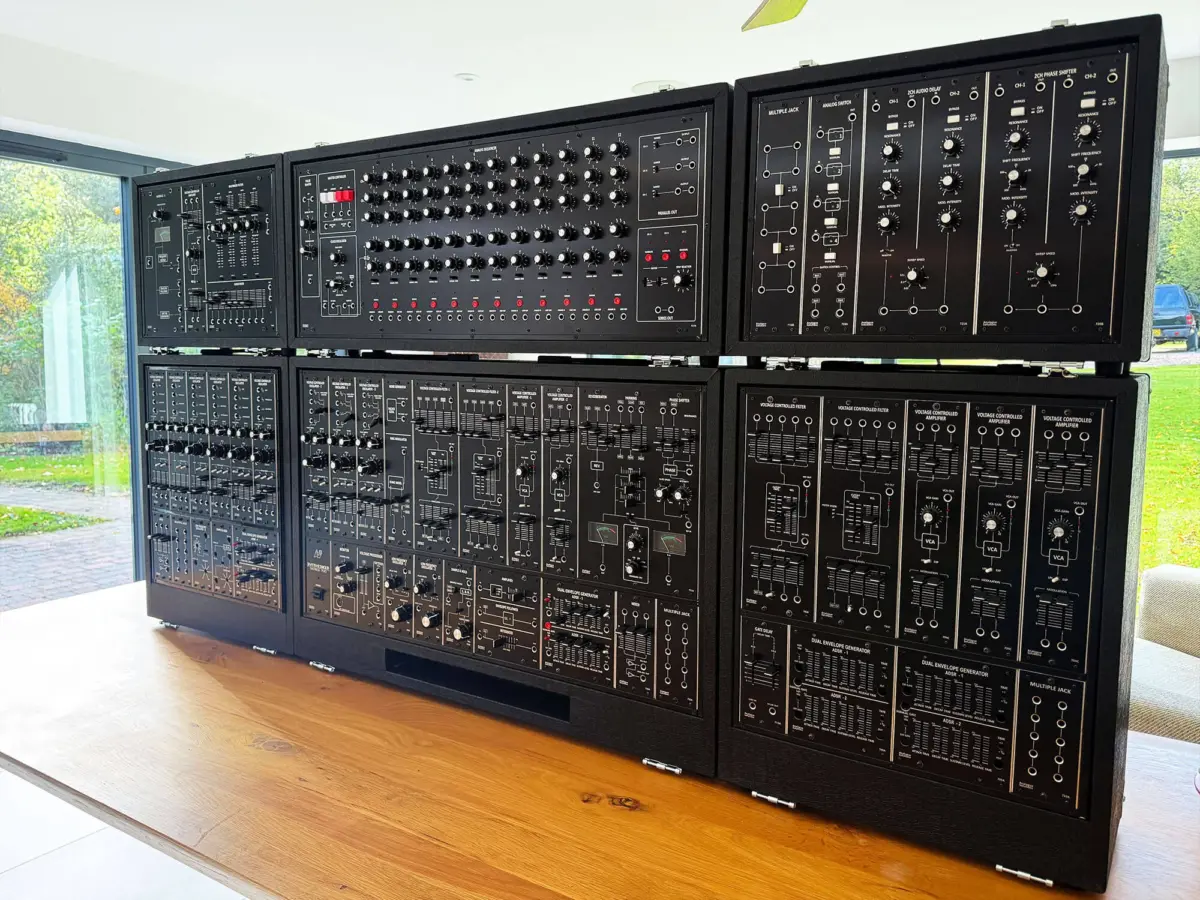
Now, British boutique synthesizer manufacturer Analogue Solutions has achieved what many considered impossible. With the official announcement and launch of the Series 700, the company has delivered a meticulous, component-accurate recreation of Roland’s elusive holy grail. Priced at a staggering £33,000 for a full six-block configuration, this release is not merely a modern homage or a software plugin; it is a monumental hardware achievement designed to bring the exact architectural brilliance, sonic footprint, and physical grandeur of the 1970s back into production.
Staying fiercely faithful to the original mid-century engineering, Analogue Solutions has reconstructed almost every circuit from vintage schematics. While minor adaptations were made strictly out of necessity due to component obsolescence, the soul of the machine remains entirely untouched. For elite sound designers, institutional studios, and elite collectors, the Series 700 represents a once-in-a-generation opportunity to interact with an authentic piece of synthesizer history—rebuilt from the ground up for the modern era.
Detailed Chronology and Historical Context
To understand the weight of Analogue Solutions’ achievement with the Series 700, one must trace the history of the original Roland System 700. Released in 1976, the System 700 was Roland’s first professional, large-format modular synthesizer. At a time when modular synthesis was dominated by American monoliths like Moog and ARP, Roland sought to prove that Japanese engineering could compete at the highest level of laboratory-grade electronic music equipment.
The result was a monumental modular beast. Unlike standard portable synths, the System 700 was built as a series of distinct, heavy-duty wooden cabinets wrapped in Tolex, equipped with strap carry handles and striking blue-lined lids. It was the most expensive synthesizer Roland ever produced—easily eclipsing the cost of their later, highly revered Jupiter-8 polyphonic synth. Because of its prohibitive cost, it was primarily purchased by institutional university electronic music studios, high-end commercial facilities, and a tiny elite of progressive pop artists.
Most notably, the System 700 played a defining role in the shaping of early 1980s synth-pop. It became a crown jewel in producer Martin Rushent’s Genetic Sound studio, where it formed the sonic backbone of The Human League’s seminal 1981 masterpiece, Dare. The swirling textures, fat basslines, and otherworldly sequencer lines that defined tracks like "Don’t You Want Me" and "Open Your Heart" bore the unmistakable fingerprint of the Roland modular architecture.
Despite its cultural impact, the System 700 faded into obscurity simply because so few were ever made. Finding one today is akin to unearthing a rare fine art piece, with verified secondary market values frequently soaring past £150,000. Analogue Solutions’ decision to resurrect this leviathan bridges a decades-long gap in synthesizer heritage, making a lost chapter of electronic music history accessible once again to those with the means to acquire it.
Engineering and Design: Staying True to the Original Spec
Recreating a system as intricate as the Roland System 700 requires an extraordinary level of dedication and engineering prowess. Analogue Solutions has made it clear that shortcuts were not an option. The company set out to match the mid-1970s design philosophy as closely as humanly possible, avoiding the temptation to "modernize" the core architecture with digital screens, patch memory, or extensive menu-diving.

Circuitry and Components
Almost every single circuit board within the Series 700 has been meticulously reproduced directly from original factory schematics. Modifications were made exclusively in instances where original 1970s components have been out of production for decades and are entirely unobtainable. Even so, Analogue Solutions sourced or manufactured replacement parts that mirror the exact electrical behaviors and tolerances of the originals, ensuring the raw analog warmth, instability, and harmonic richness of the 1970s are fully preserved.
The sole functional deviation from the historical specification is the inclusion of a basic, single-channel MIDI-to-CV converter. This modern concession was added primarily out of practical necessity: to allow modern studio setups to easily sync the system’s native 3 x 12-step analog CV sequencer to a contemporary DAW or MIDI clock.
Ergonomics, Aesthetics, and Hardware
The look, weight, and tactile feedback of the Series 700 faithfully mimic the 1970s aesthetic. Analogue Solutions went to great lengths to commission custom-made hardware components. This includes bespoke knobs—such as the classic dual-concentric fine and coarse tune controls for the Voltage-Controlled Oscillator (VCO) waveforms—as well as custom slider caps, heavy-duty switches, and high-grade potentiometers.
The physical housing is equally authentic. Built into rugged, Tolex-wrapped wooden cabinets featuring sturdy strap carry handles and blue-lined lids, the cabinets echo the touring-grade durability of vintage gear. True to the original layout, Block One retains the signature letterbox-style slot built directly into the chassis, perfectly sized for storing patch cables or technical manuals.
Furthermore, the physical footprint matches the historical dimensions of its Roland counterpart down to the millimeter:
- Block One (Main Console): 860 x 560 mm
- Block Three (Sequencer): 860 x 362 mm
- Blocks Four, Five, Six, and Seven: 460 x 362 mm each
- Depth: All blocks measure precisely 310 mm deep with the lid attached (reducing to 255 mm without the lid).
Because of internal patching architectures within each cabinet, every block’s internal configuration is fixed. Analogue Solutions has confirmed that it currently has no plans to sell individual modules for use in vintage, original System 700 chassis. While the front panels share the same physical dimensions as Roland’s originals, retrofitting them into a vintage System 700 would require custom power connection modifications.
Inside the Blocks: A Modular Breakdown
The Series 700 is partitioned into specialized blocks, each serving a distinct function within the overarching modular ecosystem. Here is a detailed breakdown of what is housed inside each cabinet:
Block One: The Core Console
Block One is the largest and most comprehensive single enclosure in the entire system. Serving as the primary command center, it is heavily packed with sound sources, modifiers, and modulation tools. It features:

- Three Voltage-Controlled Oscillators (VCOs)
- A dedicated noise generator and ring modulator section
- Two Voltage-Controlled Amplifiers (VCAs)
- A comprehensive reverb, panning, and phase shifter section complete with retro analog VU meters
- Two Low-Frequency Oscillators (LFOs)
- A Sample & Hold circuit
- A dual envelope generator
- A three-channel audio mixer
Block Three: The Sequencer and Master Controller
Serving as the rhythmic brain of the setup, Block Three houses the 717A analogue sequencer and master controller. This is where intricate, hypnotic multi-step voltage patterns are generated, manipulated, and routed to drive the various oscillator banks.
Block Four: The VCO Bank
For those requiring massive sonic layering and complex polyphonic/paraphonic potential, Block Four expands the sound palette exponentially by adding six additional voltage-controlled oscillators.
Block Five: The VCF/VCA Bank
Shaping and dynamics are handled in Block Five, which offers an expanded array of filters (Voltage-Controlled Filters), three additional VCAs, and a precision gate delay for advanced rhythm manipulation.
Block Six: The Interface and Mixer
Block Six acts as an essential utility hub, featuring an interface and mixer layout complete with a specialized multicode filter section for advanced signal routing and frequency splitting.
Block Seven: Time-Based Effects
Adding ambient depth and spatial movement, Block Seven contains an analog switch, a two-channel audio delay, and a lush two-channel phase shifter, allowing users to achieve the shimmering, liquid modulation heard on classic 1970s recordings.
The Missing Piece: Block Two (The 701 Keyboard Controller)
Astute observers will note the absence of a "Block Two" in the standard modular lineup. Block Two traditionally designated the 701 keyboard controller. Analogue Solutions is currently developing this component separately as an optional, high-end upgrade.
Based on Roland’s original 701A 61-key controller, the upcoming modern iteration is slated to add four-CV-channel polyphony, velocity CV output, comprehensive MIDI In/Out/Thru capabilities, and minijack connections designed for seamless integration with modern Eurorack setups, other external modular systems, and vintage monophonic synthesizers.
Supporting Context and Financial Metrics
A £33,000 price tag places the Series 700 firmly in the ultra-luxury tier of musical instrument manufacturing. To contextualize this investment, one must look at the economics of boutique, hand-wired analog hardware production in the 21st century.

Building a system of this physical and electronic scale requires an immense amount of manual labor. Sourcing custom-tooled knobs, fabricating heavy wood-and-Tolex cabinetry, matching vintage electronic components, and hand-soldering thousands of connections cannot be automated on a mass-production assembly line.
For institutional buyers, Hollywood film scoring facilities, world-class recording studios, and dedicated private collectors, £33,000 is paradoxically viewed as a bargain when compared to the alternative: hunting down a decaying, 50-year-old original Roland System 700 that risks catastrophic component failure and demands thousands of dollars in specialized vintage maintenance.
Furthermore, Analogue Solutions has structured purchasing flexibility into the rollout. Buyers who cannot—or choose not to—purchase the entire six-block system in a single transaction can pre-order individual blocks or custom combinations directly from the manufacturer. The standalone pricing structure is delineated as follows:
- Block One (Main Console): £13,000
- Block Three (Analogue Sequencer): £6,000
- Block Four (VCO Bank): £7,000
- Block Five (VCF/VCA Bank): £6,000
- Block Six (Interface/Mixer): £3,000
- Block Seven (Phase Shifter/Audio Delay): £4,000
Official Documentation and Production Logistics
Because the Series 700 adheres so strictly to the original Roland blueprint—down to the internal wiring topologies and signal paths—Analogue Solutions has made a deliberate decision regarding user documentation. Rather than authoring an entirely new, modern-style operating manual from scratch, the company will provide buyers with access to high-resolution scans of the original Roland System 700 manual. This will be paired with a concise, custom-authored supplementary guide detailing the minor modern additions, such as the MIDI-to-CV integration and power specifications.
Pre-Order and Waitlist Mechanics
Pre-orders for the Series 700 are officially open via the Analogue Solutions website. Because production is strictly limited and heavily labor-intensive, securing a unit is not a standard e-commerce transaction:
- Interested buyers must place a formal deposit to secure an official slot in the manufacturing queue.
- Upon order placement, Analogue Solutions contacts the buyer directly to provide exact payment breakdowns, estimated build timelines, and specialized freight shipping costs.
- Due to the bespoke nature of the build and the varying sizes of orders (ranging from single blocks to complete six-block monsters), wait times fluctuate dynamically depending on queue positioning and production capacity.
Future Outlook and Legacy
The launch of the Series 700 marks a watershed moment in the revival of vintage electronic instrumentation. For decades, the synthesizer community has seen countless emulations, software plugins, and miniaturized "reissues" designed for mass-market consumption. Analogue Solutions has taken the opposite path: an uncompromising, full-scale industrial resurrection of an instrument that defined the zenith of 1970s analog engineering.
While the £33,000 price tag ensures that the Series 700 will remain an exclusive tool reserved for top-tier studios and dedicated collectors, its existence matters to the entire electronic music ecosystem. It proves that the demand for uncompromising, pure analog hardware built to historical standards remains vibrant and robust.
As the first units move from Analogue Solutions’ British workshop into the studios of the world’s elite sound architects, the legendary sonic signature of the Roland System 700 is finally stepping out of the museum archives and back into active musical service. For synthkind, it is indeed one giant, thunderous leap forward.