Executive Overview
Long before the advent of modern epidemiology could isolate and name the invisible microbial pathogens ravaging Victorian Britain, the collective public consciousness forged a terrifying, tangible face for contagion: the vampire.
A landmark cultural exhibition currently open at the University of Leeds’ Treasures of the Brotherton Gallery, titled Quite Shameless: Cultural Reflections on the Vampire, delves deeply into this chilling historical intersection. The exhibition traces how a mythical, supernatural predator evolved into a powerful cultural stand-by—a literary vessel for the era’s deepest, most paralyzing anxieties regarding pestilence, unsanitary urban infrastructure, and toxic air. By curating a rich tapestry of rare manuscripts, historical books, prints, period medical instruments, and theatrical memorabilia—including prized artifacts from the Bram Stoker collection—the gallery illuminates how nineteenth-century society processed its darkest fears through the lens of Gothic horror.
At its core, this cultural phenomenon exposes a fundamental human imperative: when confronted by unseen, microscopic devastation, society requires a physical antagonist. By transforming abstract epidemiological threats into walking, breathing, and biting monsters, the Victorians made the intangible tangible. In doing so, they engineered a threat that could be understood, confronted, and ultimately fought.
Detailed Chronology: Industrialization, Miasma, and the Birth of a Monster
The Industrial Pressure Cooker and the Era of Miasma
Throughout the nineteenth century, the relentless march of the Industrial Revolution catalyzed a historic demographic shift. Millions of rural citizens flooded into British urban centers in search of employment, causing cities like London, Manchester, and Leeds to swell far beyond their structural capacities. This unprecedented population density occurred in an era of fragile, inadequate sanitation infrastructure. Piles of human waste, industrial effluence, and decomposing organic matter choked city streets and waterways.
Crucially, the medical landscape of the early-to-mid nineteenth century lacked a foundational understanding of germ theory. While pioneering scientists were beginning to ask questions, the revolutionary work of Louis Pasteur and Robert Koch did not achieve widespread scientific or public acceptance until the final decades of the century.
In the absence of a verified microbial framework, medical professionals and laypeople alike relied on the dominant epidemiological paradigm of the era: the miasma theory. Under this belief system, infectious diseases such as cholera, typhoid, and tuberculosis were not transmitted through direct contact or contaminated water, but rather through "bad air"—foul-smelling vapors exhaled by decaying matter, stagnant water, and overcrowded slums.
The Great Stink and the Visual Personification of Death
The terrifying climax of this miasmatic worldview materialized during the suffocating summer heatwave of 1838, and again on an even grander scale during the infamous "Great Stink" of July and August 1858. During these periods, soaring temperatures combined with historically low river levels turned the River Thames into an open, festering sewer. The waterway was heavily polluted with rotting industrial effluent, domestic refuse, and the unburied corpses of both humans and animals.
As the river baked under the blazing sun, the resulting stench was so unbearable that parliamentary sessions were nearly suspended, with politicians draping window curtains in chloride-soaked sheets in a desperate bid to neutralize the toxic vapors. Tragically, contemporary society attributed the ensuing, devastating waves of cholera and typhoid epidemics to the vile smells wafting from the Thames, entirely overlooking the city’s dangerously contaminated shallow wells and water pumps.
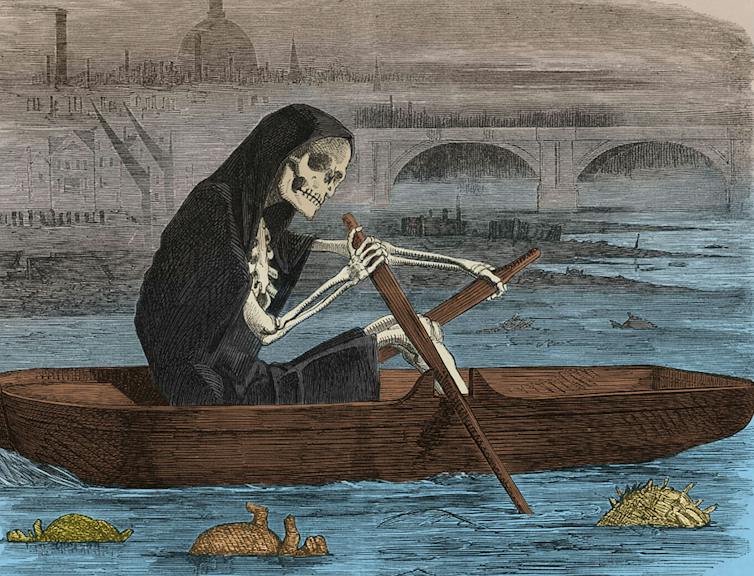
These visceral public health crises deeply inspired contemporary satirists. Among the most iconic cultural responses was John Leech’s famous 1858 illustration for Punch magazine, titled The Silent Highwayman. The cartoon depicts a grim-reaper-like skeleton rowing a small boat through a graveyard of floating animal carcasses in the shallow, sludge-choked waters of the Thames. The chilling caption—"Your money or your life"—served as a direct, aggressive indictment of government inaction, demanding that Westminster invest heavily in public sanitation infrastructure or forfeit thousands more lives to preventable disease.
From Miasma to the Master of the Undead
Just as John Leech personified disease as a skeletal reaper navigating toxic waters, literary masters of the late Victorian era channeled identical anxieties through the vampire archetype.
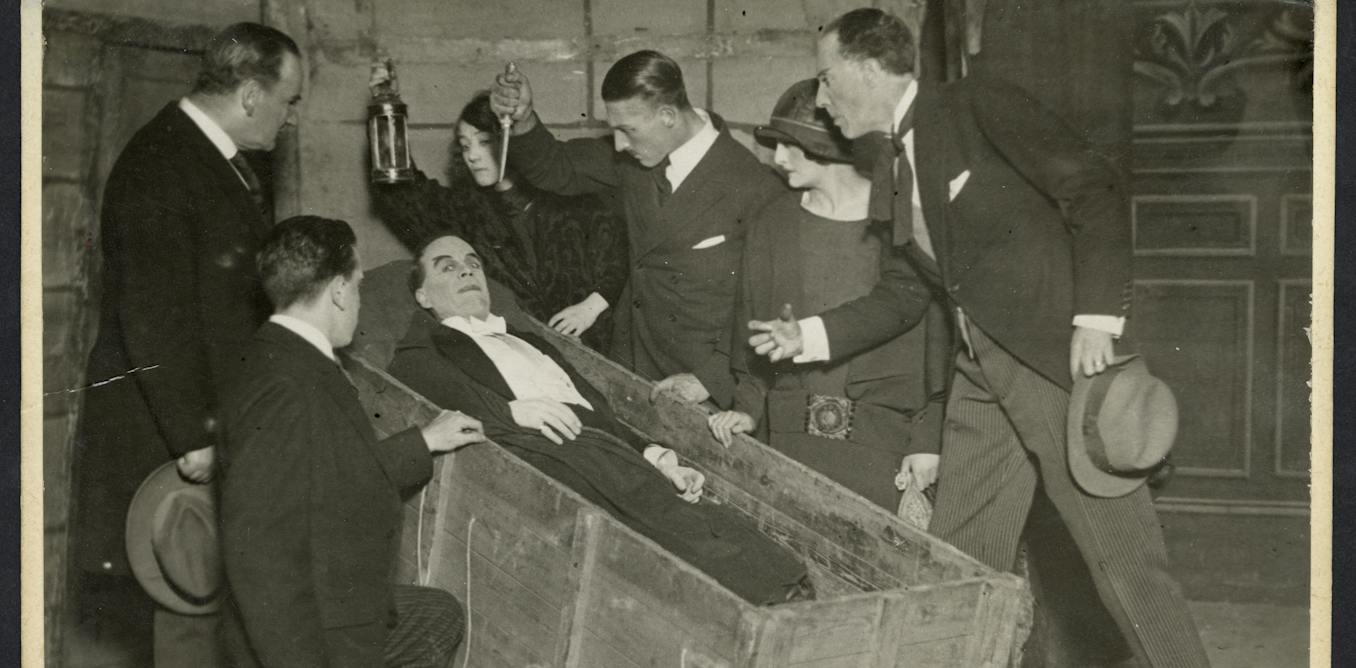
In Bram Stoker’s seminal 1897 Gothic masterpiece, Dracula, the titular vampire’s castle and subterranean chambers are explicitly defined by an overwhelming, toxic miasma. When the protagonist, Jonathan Harker, first confronts the count’s private quarters, he describes an atmosphere "composed of all the ills of mortality and with the pungent, acrid smell of blood." Stoker’s vampire was not merely a magical creature of folklore; he was a walking reservoir of pestilence, carrying the physical and atmospheric stench of decay across borders.
Supporting Context & Metrics: Cholera, Xenophobia, and the Stoker Family Legacy
The Human Toll of Nineteenth-Century Pestilence
To fully understand why the Victorian public was so susceptible to visceral, monster-based metaphors for disease, one must examine the staggering human cost of contemporary epidemics. Throughout the nineteenth century, the UK was repeatedly battered by successive waves of cholera, a bacterial infection that induced rapid, agonizing dehydration and death within hours of symptom onset.
- 140,000 Deaths: Historians estimate that cholera alone claimed approximately 140,000 lives across the United Kingdom during the course of the nineteenth century.
- Geographic Spread: Outbreaks repeatedly swept through industrial hubs, disproportionately ravaging impoverished working-class communities where clean water and adequate housing were luxuries.
Xenophobia and the Specter of the Foreign Carrier
As the nineteenth century drew to a close, bad smells were no longer the sole scapegoat for the transmission of epidemic diseases. A rising tide of socio-political anxiety directed public blame toward migrants, foreign travelers, and international trade vessels entering British ports. Disease was increasingly conceptualized as a foreign invader threatening the sanctity of the British Isles.
A prime historical example of this xenophobic epidemiological anxiety is preserved in John Tenniel’s striking 1892 Punch cartoon, titled "Back!". Published during a major European cholera outbreak that tragically claimed roughly 260,000 lives in Russia and 7,600 in Hamburg, the illustration personifies cholera as a ghastly, skeletal spectral figure attempting to smuggle itself across British borders aboard a foreign merchant ship. Britannia is depicted standing firm at the shoreline, holding out her hand to forcefully reject the migrant disease and protect the domestic population from contamination.
Bram Stoker and the Trauma of Sligo
This cultural conflation of the foreign traveler with deadly pestilence was deeply personal for Bram Stoker, whose worldview was forged in the shadow of historical trauma. Stoker’s mother, Charlotte Thornley Stoker, grew up witnessing a catastrophic cholera outbreak as a teenager in her hometown of Sligo, Ireland.
The epidemic struck with terrifying velocity: in a mere six weeks, approximately 640 local residents perished. In an era devoid of rational scientific explanations, panic-stricken communities desperately sought scapegoats, quickly pointing the finger at itinerant travelers whom they accused of importing the contagion.
In her harrowing personal memoir, Charlotte Thornley Stoker recounted the brutal, inhumane treatment inflicted upon suspected carriers by terrified locals:
"One I vividly remember, a poor traveller was taken ill on the roadside […] [the people of Sligo] dug a pit and with long poles pushed him living into it and covered him up alive."
These horrific narratives of marginalized outsiders hunted by panic-driven communities left an indelible mark on the young Bram Stoker. When he penned Dracula, he mirrored these exact historical traumas: the count is fundamentally a foreign traveler arriving at an English port town (Whitby), clandestinely smuggling an invisible, inexplicable plague into the heart of the British Empire.
Furthermore, much like the real-world cholera outbreaks of the 1800s, the "disease" of vampirism in Stoker’s novel is systematically analyzed, tracked, and fought against not by religious zealots alone, but by rational, empirical medical men—most notably the Dutch physician and scientist Professor Abraham Van Helsing and his former pupil, Dr. John Seward.
The Rodent Connection: Nosferatu and "The Great Death"
The thematic overlap between migration, vermin, and biological pestilence reached its cinematic zenith in F.W. Murnau’s iconic 1922 silent expressionist masterpiece, Nosferatu.
In this unauthorized cinematic adaptation of Stoker’s work, the vampire—renamed Count Orlok and portrayed masterfully by Max Schreck—travels from the remote mountains of Transylvania to the heart of Germany aboard a merchant ship heavily infested with rats. Orlok brings with him an unspecified, indiscriminate plague known in the film as "the great death."
While modern epidemiology notes that historical cholera was spread primarily through water rather than fleas and rats, the association between rodents and catastrophic disease was deeply ingrained in the early-twentieth-century psychological mindset following centuries of plague history. Murnau capitalized on this by designing Count Orlok with explicitly rodent-like physical attributes, including elongated, prominent incisors that mimicked a rat’s teeth, cementing the visual metaphor of the migrant pestilence-bringer.
Official Statements and Curatorial Insights
Scholars and curators at the University of Leeds emphasize that the contemporary relevance of the Quite Shameless exhibition extends far beyond literary history. By exploring how past societies externalized microscopic biological realities into supernatural fiends, researchers aim to prompt modern audiences to reflect on society’s ongoing psychological mechanisms during public health crises.
Dr. Fiona Becket, a leading literature specialist associated with the exhibition, noted in early preview statements:
"When a society faces a threat that it cannot see, touch, or fully understand, it inevitably turns to storytelling to regain a sense of agency. The Victorians utilized the vampire not merely to frighten themselves, but to construct a narrative framework around contagion, pollution, and foreign intrusion. By giving an invisible killer a face, fangs, and a specific address, they converted sheer panic into an enemy that could be analyzed, resisted, and ultimately defeated."
Curators further stress that the inclusion of original Bram Stoker materials alongside period medical instruments—such as nineteenth-century bloodletting tools, apothecary jars, and sanitation pamphlets—creates a vital dialogue between the humanities and the history of science. It underscores the reality that Gothic literature was never written in a vacuum; rather, it functioned as the dark, pulsing mirror of contemporary public health policy, municipal corruption, and social paranoia.
Future Outlook: The Enduring Legacy of the Medicalized Monster
As Quite Shameless: Cultural Reflections on the Vampire remains open to the public at the Treasures of the Brotherton Gallery until May 29, 2027, the exhibition serves as a timely reminder of the cyclical nature of human anxiety.
In an era where modern society continues to grapple with global health uncertainties, the psychological impulse to personalize, politicize, and demonize vectors of contagion remains remarkably potent. The Victorian vampire endures not simply as a pop-culture icon of cinematic horror, but as an enduring monument to humanity’s historical struggle to comprehend the microscopic forces of life, death, and disease.
Visitors wishing to experience the exhibition firsthand can access free tickets by booking directly through the University of Leeds library portal. The exhibition runs through May 29, 2027.