Executive Overview
The trajectory of the split-toe shoe—universally known as the tabi—represents one of the most fascinating case studies in modern fashion history. Tracing a path from its functional roots in 15th-century Japan to its 1988 conceptual reinvention by Belgian designer Martin Margiela, and finally to its 2026 saturation across social media feeds and suburban high streets, the tabi has completed a full lifecycle. Once celebrated as a divisive marker of elite taste, deep pockets, and insider fashion knowledge, the shoe has officially entered a new phase of cultural reckoning.
Recent dispatches from New York Fashion Week have declared the trend "over," but this obituary for a footwear silhouette misses a larger sociological truth. The tabi has not vanished from sidewalks; rather, it has suffered a more permanent fate in the eyes of the sartorial elite: it has become entirely legible.
Through the analytical lenses of cultural theorist Roland Barthes and sociologist Pierre Bourdieu, this article investigates how the tabi transitioned from an intellectual signifier of distinction to a democratized consumer item. By exploring the mechanisms of digital culture, influencer economies, and algorithm-driven trend cycles, we examine how social media accelerates the death of exclusivity, forcing the fashion industry to confront a new reality where an object can remain commercially viable long after its cultural currency has been entirely spent.
Detailed Chronology: From Feudal Japan to the Digital Runway
To understand the current cultural crisis of the tabi, one must trace its complex and multi-centuried evolution. The shoe’s history is a study in appropriation, subversion, and globalized style diffusion.
The 15th Century: Functional Origins in Japan
Long before it graced the runways of Paris or the feet of fashion public relations executives, the split-toe design was born out of pure utility in 15th-century Japan. Traditional Japanese tabi were ankle-high socks featuring a separation between the big toe and the other toes, designed specifically to be worn with traditional footwear such as zori or geta.
Later, the design evolved into the jika-tabi (literally "tabi on the ground"), a heavy-duty, rubber-soled boot worn by construction workers, farmers, and rickshaw pullers. These shoes provided enhanced grip, tactile feedback, and flexibility. Within this traditional framework, there was nothing inherently avant-garde, intellectual, or luxurious about the split-toe silhouette. It was a pragmatic garment rooted in the daily realities of Japanese labor.
1988: The Margiela Revolution
The transformation of the Japanese working-class staple into a high-fashion icon occurred in 1988. Martin Margiela, celebrated for his deconstructive ethos and institutional iconoclasm, introduced the split-toe silhouette for his brand’s inaugural runway collection in Paris.
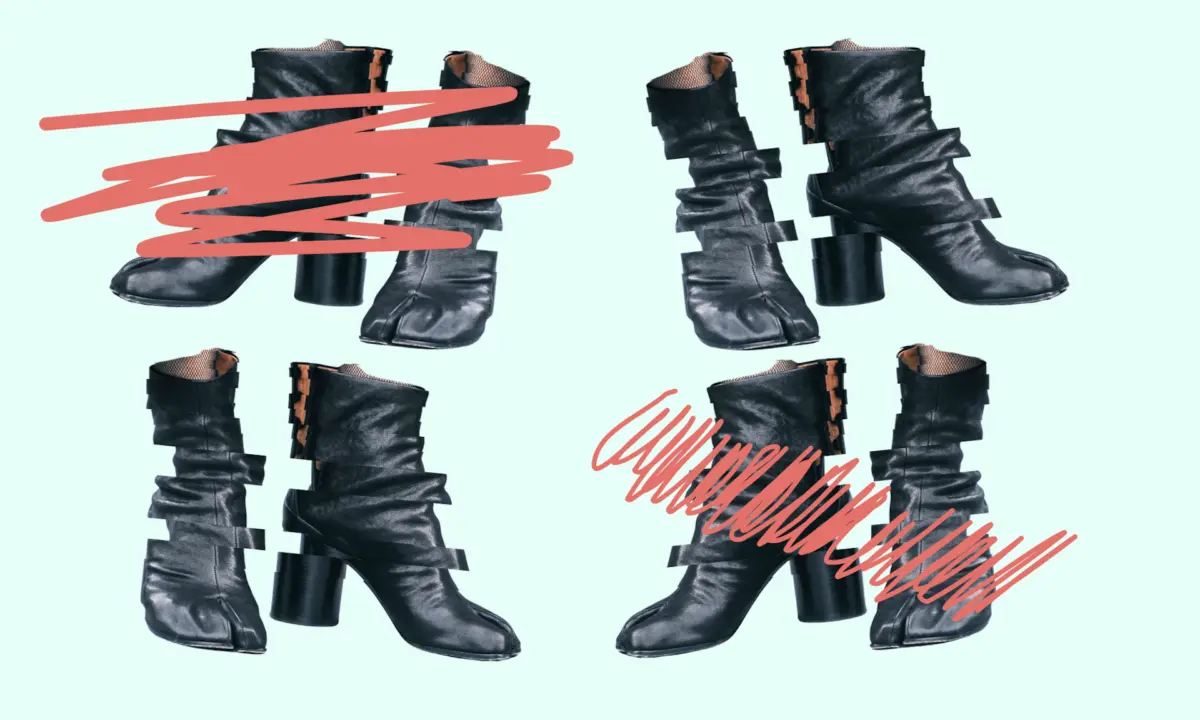
Margiela’s version—a striking, high-heeled leather boot that mimicked the cloven hoof of an animal—was intentionally jarring. Painted in signature white paint that chipped away over time, the boot challenged conventional notions of beauty, luxury, and footwear construction. Because of its historical and cultural origins in Japan, the silhouette could not be legally or culturally copyrighted by a single Western fashion house. Yet, through sheer force of design repetition and avant-garde positioning, the tabi became indelibly linked to the House of Margiela.
The 2010s to 2024: The Cult Eras of Esoteric Taste
For decades following its runway debut, the tabi remained an insider secret. It was adopted by an exclusive set of stylists, editors, and conceptual fashion enthusiasts. During this period, wearing a pair of tabi boots communicated a very specific type of cultural literacy. It signaled that the wearer possessed deep knowledge of fashion history, an appreciation for radical design, and the disposable income required to invest in luxury footwear that the uninitiated often dismissed as ugly or bizarre.
2025–2026: Peak Tabi-Mania and Mainstream Saturation
The dam broke between 2025 and 2026. What was once an esoteric marker of good taste transitioned into a widespread commercial phenomenon. High-street brands, independent direct-to-consumer labels, and luxury competitors rushed to release their own iterations of the split-toe shoe, expanding the silhouette from boots into loafers, ballet flats, and sneakers.
By the summer of 2026, publications like Good Housekeeping noted that tabi shoes were "everywhere," marking their definitive migration from fashion-insider favorite to mainstream staple. Simultaneously, British Vogue codified the aesthetic, using phrases like "tabi flats, capri pants, slicked-back hair" as shorthand for the uniform of the modern London fashion PR professional. By July 2025, Vogue was explicitly describing the shoe as "unexpectedly mainstream."
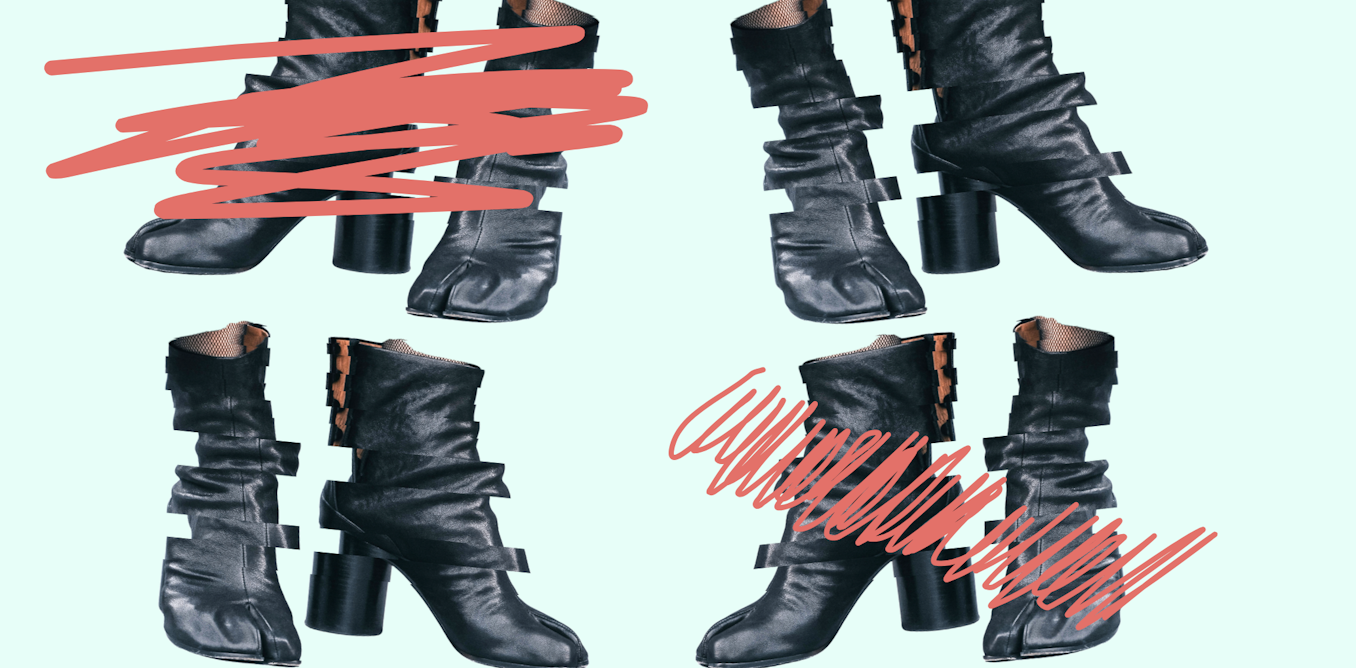
However, this commercial victory planted the seeds of cultural destruction. By September 2026, at New York Fashion Week, Teen Vogue published a street-style dispatch with a blunt and definitive headline: "Tabis Are Over." One disillusioned attendee captured the sentiment of the elite crowd, remarking that "tabis should have been kept in the past."
Supporting Context & Metrics: Decoding the Semiotics of Style
To analyze why the mainstreaming of the tabi led to such a swift backlash, cultural theorists rely on foundational frameworks established by Roland Barthes and Pierre Bourdieu.
Roland Barthes and the System of Signs
In his seminal 1967 work The Fashion System, cultural critic Roland Barthes examined clothing not merely as a utilitarian barrier against the elements, but as a complex system of signs. Barthes demonstrated how garments acquire layers of meaning far beyond their physical construction through media representation, advertising, and editorial framing.
Applying this theory to the tabi reveals that the shoe’s cultural power was entirely socially constructed. Through decades of repetition in runway shows, editorial photography, celebrity endorsements, and critical discourse, the tabi shed its association with historical Japanese workwear. It was recoded as a signifier of experimental, intellectual, and unconventional modern global style.
Pierre Bourdieu and Cultural Capital
French sociologist Pierre Bourdieu expanded on how taste functions as a mechanism of social differentiation in his 1979 masterpiece Distinction. Bourdieu introduced the concept of "cultural capital"—non-financial social assets, such as education, intellect, style, and specialized knowledge, that promote social mobility and distinction within a stratified society.
In the ecosystem of luxury fashion, the tabi functioned as a high-yield instrument of cultural capital. Unlike a designer handbag stamped with an oversized, easily recognizable monogram, the tabi relied on subtlety and shared visual codes. Recognizing a split-toe shoe required specialized knowledge.
As the author’s academic research on luxury fashion influencers and Instagram highlights, fashion meanings are constantly produced through repeated images, performances, and visual codes. Wearing tabis signaled to peers that you were not a passive consumer following top-down trends, but a discerning tastemaker. It was the sartorial equivalent of appreciating abstract expressionism or Brutalist architecture while the uninitiated stood by asking, "I don’t get it, why is it ugly?"
The Role of Social Media in Meaning Dilution
When social media platforms entered the trend-forecasting ecosystem, they fundamentally altered how fashion objects circulate. As noted in contemporary media research, social media platforms do not just circulate physical fashion objects; they circulate exhaustive explanations of them.
When a micro-influencer posts an outfit featuring tabi shoes, a cascading digital reaction occurs:
- Followers identify the shoe.
- Style commentators explain its 15th-century origins and Margiela heritage.
- Content creators publish step-by-step styling tutorials.
- The silhouette is rapidly integrated into a globally shared, easily digestible visual vocabulary.
This democratization of knowledge killed the tabi’s cult status. The shoe did not necessarily become physically unappealing, but the knowledge attached to it became entirely frictionless to acquire. Once the insider secret was broadcast to millions of feeds daily, the meaning of wearing it—exclusivity, rebellion, and superior taste—was entirely diluted.
Official Statements & Industry Perspectives
The rapid lifecycle of the tabi has sparked intense debate across fashion journalism, trend forecasting agencies, and consumer forums. Industry insiders and cultural commentators have increasingly weighed in on what the death of the tabi signifies for the future of trend adoption.

-
The Street-Style Consensus (New York Fashion Week, September 2026):
Street-style chroniclers and attendees at the major global fashion weeks noted a palpable fatigue surrounding the silhouette. While generations of early adopters championed the shoe’s unique profile, contemporary showgoers expressed frustration over its ubiquity. As one prominent New York-based stylist observed during fashion month: "When every fast-fashion retailer and corporate office worker is wearing a cloven-toe shoe, the subversion is gone. It no longer feels like an artistic statement; it feels like a corporate uniform." -
Fashion Media Reflection:
Publications that once championed the tabi as the ultimate badge of insider cool have had to pivot in their editorial framing. While outlets like British Vogue previously utilized the shoe as shorthand for avant-garde chic, recent commentary acknowledges that the item has crossed a threshold from which elite circles cannot easily return. The narrative has shifted from celebrating the shoe’s daring aesthetic to analyzing how digital saturation burns through avant-garde markers at an unprecedented velocity. -
Academic and Semiotic Perspectives:
Researchers studying digital fashion cultures argue that the backlash against the tabi is a natural byproduct of late-stage capitalism and algorithmic homogenization. Cultural analysts point out that social media has compressed the trend cycle to such a degree that an item’s introduction, peak, and overexposure now occur within months rather than decades. Consequently, objects are stripped of their symbolic value faster than ever before.
Future Outlook: What Does It Mean for a Trend to Be "Over"?
The current plight of the tabi forces a fundamental re-evaluation of what it means for a fashion item to be "over" in the digital age.
Historically, when a trend died, it was discarded, relegated to charity shops, or hidden away in storage until a retrospective revival decades later. The tabi occupies a much stranger and more modern position. It has not vanished from the retail landscape, nor have consumers universally stopped purchasing it. Instead, its death is purely semiotic.
The Survival of the Object Beyond Its Meaning
Social media has not killed the physical shoe; rather, it has worn out the shoe’s ability to communicate exclusive fashion knowledge. The tabi is no longer a secret handshake among the sartorial elite. It is mainstream. To purists, being mainstream and being dead are one and the same.
However, this mass recognition may ultimately render the object more culturally powerful, even if it is discarded by the tastemaking avant-garde. The tabi has been permanently embedded into the global visual lexicon.
The Post-Trend Paradigm
As we look toward the future of fashion consumption, the trajectory of the tabi offers a profound lesson for consumers and designers alike. Once an object can no longer prove that a wearer is early, highly knowledgeable, or uniquely chic, continuing to wear it becomes an entirely different kind of choice.
Consumers who continue to lace up or slip into their split-toe shoes are no longer hiding behind the protective armor of cultural capital or insider status. Stripped of its subversive shock value and its elite signaling power, wearing a tabi today comes down to a simpler, more honest motivation: we simply wear it because we like it.
In an era where every garment is algorithmically dissected, explained, and commodified, choosing an item purely for personal aesthetic pleasure may be the most radical fashion statement left to make.