Executive Overview
Step through the doors of London’s prestigious Saatchi Gallery into The Raw and the Cooked, and you are immediately confronted by an arresting dialogue between antiquity and the avant-garde. Dominating the gallery’s far wall is a singular, monumental painting that instantly sets the tone for an exhibition unafraid of morbid historical curiosities. Harry Jones London’s The Punishment of Richard Roose (2026) serves as the curatorial anchor for a profound exploration of how contemporary artists summon, distort, and repurpose the medieval imagination.
Far from being a dusty retrospective of the Middle Ages (conventionally dated from 500 to 1500 CE), The Raw and the Cooked investigates the persistent cultural gravity of a period that refuses to stay in the past. The exhibition brilliantly demonstrates that what society labels "medieval" is rarely a historically precise epoch. Instead, it is a flexible, highly evocative reservoir of tropes—ranging from the artisanal and the spiritual to the shockingly brutal.
Through sculptures crafted from everyday luxury goods, skeletal effigies baked from bread, and plate armor evoking futuristic cyborgs, the artists featured in this exhibition interrogate themes of mortality, transience, and human fragility. Running until September 11, The Raw and the Cooked captures an undeniable cultural zeitgeist: a contemporary resurgence of medievalism in visual art that invites viewers to reflect not only on history, but on the anxious contours of the present day.
Detailed Chronology & Curatorial Highlights
To understand the scope of The Raw and the Cooked, one must trace the historical threads and artistic interventions that map out the exhibition’s narrative arc. The journey moves deliberately from Tudor-era retributions to futuristic armor, and finally to modern meditations on mortality.
The Tudor Atrocity: The Punishment of Richard Roose (2026)
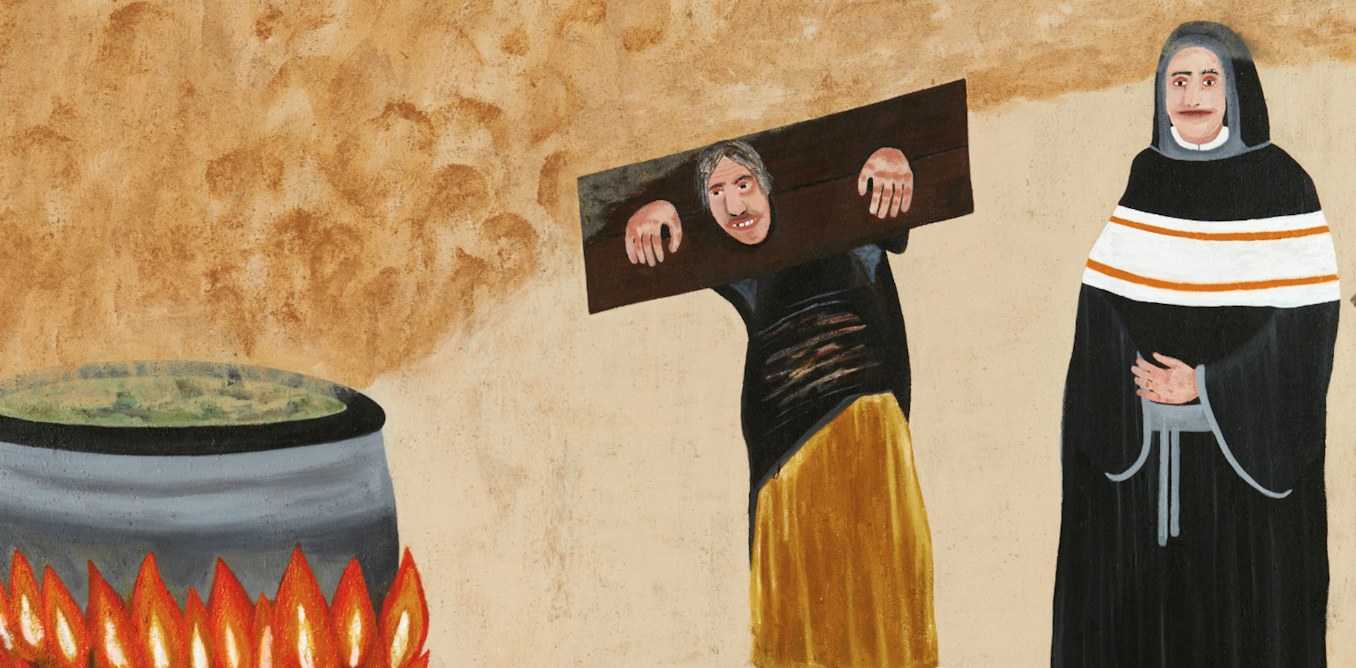
Upon entering the gallery, visitors face Harry Jones London’s massive, museum-scale painting depicting a chillingly obscure episode of English history. At the center of the composition stands a boiling cauldron, venting a toxic, menacing cloud of steam—the imminent fate of a figure trapped by his head and hands in wooden stocks. Surrounded by stylized, life-sized monks, men-at-arms, heraldic banners, and sinister hounds, the tableau is a masterclass in theatrical punishment.
Yet, this striking scene introduces a fascinating historical paradox. The victim is Richard Roose, a royal cook convicted of poisoning, who in 1532 became the first person in England executed by being boiled alive under a special act of Parliament. While the horrific spectacle of the "cooked cook" reduces a human consciousness to mere meat—seemingly validating Umberto Eco’s definition of the "barbaric" medieval—it actually occurred well after the Middle Ages, during the reign of Henry VIII. It is a Tudor atrocity enacted under laws that medieval England would have fundamentally rejected.
Chivalry Meets Cybernetics: Jessica Luostarinen’s Fitting (2024–2025)
Moving deeper into the gallery, the boundaries of historical periods dissolve entirely. Jessica Luostarinen’s striking paintings, Fitting (2024) and Fitting – 2 (2025), bridge the gap between chivalric knightly adventure and futuristic science fiction.
In these works, viewers observe an androgynous figure being encased in plate armor. The meticulous rendering of the metal plates, straps, and clasps evokes both the traditional craftsmanship of a medieval blacksmith and the sleek, alien precision of a contemporary cyborg. By merging the archaic defense of the knight with post-human iconography, Luostarinen suggests that our anxieties regarding bodily vulnerability and technological enhancement are timeless.
Memento Mori and the Prada Death Mask: Jakob Rowlinson (2024)
The exhibition also engages deeply with the medieval lament for the transience of worldly things—a sentiment famously captured in the 13th-century English lyric, "Where ben they bifore us were" (Where are they who lived before us?).
Jakob Rowlinson’s sculpture The Apogee of Foolishness (2024) offers a witty, biting reimagining of the traditional memento mori. Rowlinson has transformed a luxury Prada shoe into a grotesque death mask. By fusing high-fashion consumerism with historical warnings of inevitable mortality, the artwork forces viewers to confront the absurdity of attaching eternal significance to transient earthly goods.
Similarly, metal artist Caitlin Hazell explores fragility through Pilgrim Badge Replicas (2024). These pieces begin as sharp, highly detailed initial castings mimicking the mass-produced badges medieval pilgrims purchased at holy shrines, but deliberately deteriorate into indistinct, fragmentary forms—a physical metaphor for the erosion of memory and time.
Supporting Context & Metrics: The Medieval Resurgence
The fascination with the medieval in contemporary art is not an isolated anomaly at the Saatchi Gallery; it represents a broader cultural phenomenon documented across major British institutions over recent years.
The Cultural Landscape of Medievalism
- The National Gallery (2023): Hosted the critically acclaimed Saint Francis of Assisi exhibition, exploring how a 13th-century friar’s message of poverty, environmentalism, and spiritual radicalism continues to resonate with modern audiences.
- Green and Stone (2025): Presented Medieval Relics, an exhibition investigating the modern fetishization of holy fragments, material history, and sacred objects.
- The Sainsbury Centre, Norwich (Current): Features Living by the Rule: Contemporary Meets Medieval, placing contemporary installations in direct dialogue with monastic traditions and rules of communal living.
Defining the "Artisanal" Middle Ages
According to the foundational statement of intent for The Raw and the Cooked, the exhibition relies less on strict chronological boundaries and more on a curated set of cultural tropes. Chief among these is the concept of an "artisanal medieval age"—a tactile universe defined by the physical world of the handmade:
- Materials: Leatherwork, metalwork, woodwork, traditional painting, and ceramics.
- Processes: Baking, casting, and hand-assembly that contrast sharply with contemporary digital alienation.
- Spirituality: A reconnection with the foundational human impulse to forge meaning, ritual, and community through physical labor.
Official Statements and Curatorial Perspectives
The intellectual framework of The Raw and the Cooked challenges traditional academic gatekeeping while validating the emotional resonance of creative anachronism.
Curator and artist Harry Jones London, alongside contributing artists, has orchestrated an environment where historical accuracy takes a backseat to psychological truth. The exhibition’s thesis boldly asserts: "There is an undeniable resurgence of the medieval in contemporary art and culture—and especially in contemporary visual art."
Academic medievalists have largely embraced this creative license. Rather than policing historical timelines or complaining about the romanticized distortions of their field, scholars increasingly recognize that imagination can grasp emotional truths that rigorous scholarship sometimes misses.
This philosophy is beautifully embodied in Caitlin Hazell’s Unknown Individual (2024, rebaked 2026). Displayed in a museum vitrine alongside an assortment of pebbles, shells, and driftwood, the work appears at first glance to be a genuine archaeological find: a life-sized human skeleton. Upon closer inspection, however, the viewer discovers that the skeletal remains are entirely baked from bread. It is a brilliant, tactile joke and a poignant relic of an imaginary past.
A similar emotional frisson is achieved by Emmanuel Awuni in his sculpture Sankofa (2022). Drawing its title from a word in the Ghanaian Akan language that evokes the vital importance of reflecting on the past to build the future, Sankofa features a sculpted head broken open to reveal a glowing golden leaf and a delicate cowrie shell. Despite the implicit violence of the fractured skull, the expression remains serene—presenting a profoundly vulnerable, tender, and precious meditation on memory, identity, and history.
Future Outlook: The Relevance of the Past in Modern Culture
As The Raw and the Cooked prepares to close its doors at the Saatchi Gallery on September 11, its broader implications for the art world and cultural criticism remain potent.
The exhibition proves that the "medieval"—however vaguely or creatively defined—retains a unique capacity to act upon the present day. In an era dominated by hyper-digitalization, virtual reality, and disposable mass consumerism, humanity’s hunger for the tactile, the handmade, and the mortal has never been more acute.
By channeling medieval tropes of craft, community, brutality, and memento mori, contemporary artists are finding new languages to express timeless anxieties. Whether through a Prada death mask mocking modern luxury, a bread skeleton lying silently in a glass case, or a Tudor cook facing a boiling cauldron, these works remind us that we are perpetually haunted—and enriched—by the ghosts of the societies that came before us.
Mapping the contours of what artists do with the medieval is far more productive than policing historical boundaries. As The Raw and the Cooked triumphantly demonstrates, looking backward remains one of the most radical, imaginative ways we can navigate our uncertain future.