
Executive Overview
David Fincher’s 2010 masterpiece The Social Network concluded with an image of profound, poetic devastation. Mark Zuckerberg, having amassed unprecedented global power, status, and digital dominion, sits alone in a sterile room, repeatedly refreshing a friend request sent to the college ex-girlfriend who discarded him. Though an admitted piece of dramatic license—Zuckerberg was already in a relationship with his now-wife, Priscilla Chan, at the time—that final sequence served as a biting cultural indictment. It diagnosed the modern tech autocrat: deeply uncharismatic in the physical world, these architects of digital reality had successfully gamed global social capital, treating the human need for connection like a cheat code for an elite popularity contest.
More than a decade later, Aaron Sorkin—who penned the original film’s razor-sharp screenplay—returns to the digital panopticon with The Social Reckoning. Stepping into the director’s chair for this quasi-sequel, Sorkin tackles a vastly different era of corporate malfeasance. Gone are the hyper-ambitious Harvard dorm rooms and Silicon Valley startup garages; in their place are congressional hearings, whistleblower depositions, and massive investigative journalism drops.
Led by Jeremy Strong as a chillingly detached Zuckerberg, alongside Jeremy Allen White as Wall Street Journal reporter Jeff Horwitz and Mikey Madison as data-engineer-turned-whistleblower Frances Haugen, The Social Reckoning aims to pull back the curtain on the mechanics of modern platform radicalization. Yet, where Fincher’s direction found psychological nuance in awkwardness and ambition, Sorkin’s directorial debut in this universe leans heavily into didacticism. Trading cinematic exploration for a high-budget PowerPoint presentation, the film relives the harrowing revelations of "The Facebook Files" without uncovering deep narrative or psychological insights. As it hits cinemas, The Social Reckoning forces a critical evaluation of how cinema translates modern technology’s most urgent institutional crises.
Detailed Chronology: From Dorm Room Mythos to Corporate Reckoning
To understand the narrative terrain of The Social Reckoning, one must trace the institutional evolution of Facebook—now Meta—from a hyper-targeted campus directory into a planetary information utility. Sorkin’s new film skips the formative years entirely, picking up the timeline in the wake of the watershed journalistic investigations and internal document leaks that shook Silicon Valley in the early 2020s.
The Genesis of "The Facebook Files"
The factual backbone of Sorkin’s script draws heavily from investigative reporting—specifically, Jeff Horwitz’s seminal Wall Street Journal series, "The Facebook Files." The real-world investigation revealed that Meta’s leadership was acutely, demonstrably aware of the systemic harms perpetuated by its flagship applications. Internal research leaked by whistleblowers demonstrated that the platform’s core algorithms—specifically those engineered to prioritize user engagement via reshares and algorithmic amplification—actively stoked societal division.
In The Social Reckoning, this journalistic crusade is embodied by Jeremy Allen White’s portrayal of Jeff Horwitz. Sorkin crafts Horwitz as an analogue purist, complete with a cinematic affection for classic cinema that serves as a tired metaphor for his detachment from automated, algorithmic living. The chronology of the film tracks Horwitz’s methodical piecing together of internal documents, tracing how metrics designed to maximize "meaningful social interactions" (MSI) systematically prioritized outrage, anger, and extremist mobilization over civil discourse.
The Haugen Whistleblowing Arc
Parallel to Horwitz’s investigative tracking is the harrowing trajectory of Frances Haugen, portrayed with volatile, defensive intensity by Anora Oscar-winner Mikey Madison. Haugen, a former data engineer within Meta’s civic integrity unit, walked out of the company with tens of thousands of pages of internal corporate research.
In Sorkin’s dramatic timeline, Haugen’s operational transition from loyal tech worker to international whistleblower is depicted through brisk, episodic beats. Armed with internal PowerPoint decks and impact studies, Haugen attempts to sound the alarm on platforms that she realized were putting profits over public safety, particularly regarding the mental health impacts of Instagram on teenage girls and the cross-border incitement of ethnic violence in developing nations. Sorkin gives Haugen a singular psychological marker—she constantly wears fingerless gloves, a nod to her coeliac disease-induced cold hands, which clumsily doubles as a visual cue for her emotional self-preservation.
The Congressional Interregnum and Rehearsal Chambers
The film’s structural centerpiece pivots away from the offices of journalists and whistleblowers and into the sterile, high-stakes preparation rooms of Zuckerberg’s inner circle. Here, Jeremy Strong’s Zuckerberg is flanked by high-priced crisis communications advisors, played by Bill Burr and Wunmi Mosaku.
Rather than focusing solely on the theatricality of the congressional hearings themselves, Sorkin lingers on the meticulous, highly choreographed rehearsal sessions. These scenes show a corporate machinery attempting to inoculate its chief executive against liability. Zuckerberg is coached on micro-expressions, robotic denials, and practiced evasions, transforming the narrative into a claustrophobic study of institutional damage control.
Supporting Context & Metrics: The Anatomy of Algorithmic Radicalization
While Sorkin’s cinematic approach relies heavily on dialogue-heavy exposition, the real-world metrics that inspired The Social Reckoning paint an empirical picture of systemic corporate negligence. The digital architecture examined in the film is supported by documented metrics, internal memos, and structural design choices that transformed social media from a networking tool into an ideological engine.
The Mechanics of Engagement Maximization
At the heart of the whistleblower disclosures was a fundamental design choice implemented in 2018: the algorithmic re-weighting of the News Feed. Internal Meta documents revealed that modifying the algorithm to heavily favor user reshares—treating a share with a comment as worth five standard likes—exponentially increased platform engagement. However, internal data science teams quickly realized a glaring side effect: content that evoked high-arousal negative emotions, particularly outrage and moral indignation, traveled significantly faster and farther through the network.
- The Radicalization Loop: Internal research shown to securities regulators and Congress indicated that new users could be recommended extremist content within days of joining groups, simply by following mainstream political pages.
- The Teen Mental Health Crisis: Internal Instagram studies—suppressed or downplayed externally—revealed that among teenage girls who reported suicidal ideation, 13% of British users and 6% of American users traced the desire to worsen on Instagram, a platform heavily structured around visual social comparison.
- Global Harm: Whistleblower disclosures underscored how under-resourced moderation teams in non-English speaking markets allowed hate speech and incitement to ethnic violence to proliferate, with algorithms mechanically accelerating content that threatened physical safety in regions like Myanmar and Ethiopia.
Cinematic Translation vs. Empirical Reality
Sorkin’s film struggles to visually articulate these abstract metrics. Where Fincher’s The Social Network used the kinetic energy of algorithm creation, rowing regattas, and high-stakes legal depositions to dramatize intellectual property theft, The Social Reckoning treats its data points like term papers.
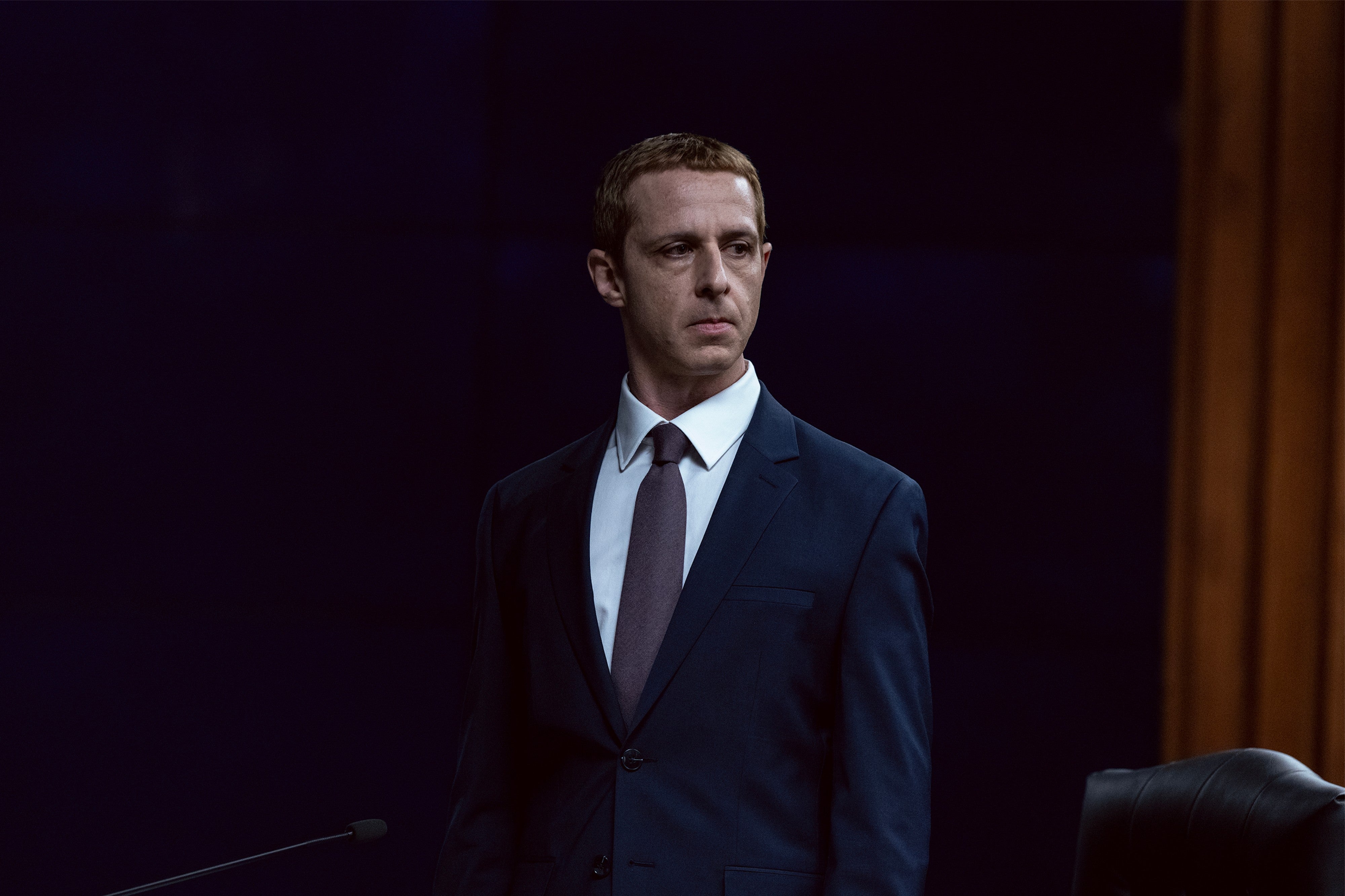
Cinematographer Jeff Cronenweth returns to lens the sequel, yet the visual grammar is markedly different. Instead of Fincher’s steady, cold, deliberate compositions, Cronenweth’s camera in The Social Reckoning frequently pans and tracks restlessly across rooms, seemingly operating on the assumption that continuous camera movement is the only barrier keeping the audience from disengaging.
Official Statements and Institutional Responses
The fallout from "The Facebook Files" and Frances Haugen’s congressional testimony prompted a wave of defensive public relations maneuvers, legislative posturing, and corporate statements that Sorkin weaves directly into the script of The Social Reckoning.
Meta’s Public Defenses
Throughout the real-world disclosures, Meta’s official stance consistently pushed back against the characterization that the company intentionally traded public safety for financial gain. In public statements, congressional testimonies, and direct posts from Mark Zuckerberg himself, the corporate line emphasized that platforms merely reflect human behavior rather than manufacture it.
"At the heart of these accusations is a false premise," Zuckerberg stated during his congressional appearances. "If we wanted to ignore safety and well-being in favor of engagement, we wouldn’t build systems that continuously filter out billions of pieces of harmful content every single day. We care deeply about the safety of our community."
In The Social Reckoning, Jeremy Strong embodies this corporate armor. He weaponizes perceived emotionlessness, delivering flat, rehearsed denials that mirror public-facing corporate statements. Yet, Sorkin’s script traps Strong in an endless loop of defensive talking points, occasionally flattening a potentially complex portrait of modern autocracy into something resembling a satirical sketch.
Legislative and Regulatory Fallout
The revelations dramatized in the film also triggered intense legislative scrutiny across Washington D.C. and the European Union, leading to landmark regulatory frameworks such as the EU’s Digital Services Act (DSA). Lawmakers from both sides of the aisle seized upon the internal documents to challenge Section 230 protections and demand sweeping transparency reports regarding algorithmic curation.
Despite these legislative efforts, critics of the tech sector—and by extension, critics of Sorkin’s superficial dramatization—argue that institutional reforms have lagged far behind the rapid evolution of algorithmic systems, particularly as generative artificial intelligence begins to further automate information ecosystems.
Future Outlook: The Next Frontier of Tech Governance and Cinematic Critique
As The Social Reckoning enters wide release, it arrives at a historical crossroads. The institutional questions raised by the film—concerning who controls the digital public square, how algorithms shape geopolitical stability, and whether corporate accountability is achievable under late-stage capitalism—are more urgent than ever. Yet, the film’s artistic limitations point to a broader challenge for contemporary storytelling: how to dramatize invisible, systemic, and abstract digital harms without reducing them to talking-head lectures.
The Limits of Didactic Filmmaking
Sorkin’s career has long been defined by rapid-fire dialogue, hyper-articulate characters walking down long institutional corridors (The West Wing, The Newsroom), and a profound faith in the power of moral argument to shift political realities. But the modern tech autocrat cannot be cornered by a clever rhetorical flourish in a congressional hearing room. The systems of surveillance capitalism operate at a scale and velocity that defy traditional dramatic resolution.
By failing to venture into the interior psychological landscape of Mark Zuckerberg—leaving him entirely devoid of private moments, internal conflict, or existential doubt—The Social Reckoning stops short of true cinematic inquiry. It tells the audience what they already read in the newspapers, set to a mournful orchestral score by Alexandre Desplat, without interrogating the deeper pathologies of a generation that traded the physical world for algorithmic validation.
Looking Forward: Regulation, AI, and the Public Square
Looking ahead, the battles depicted in Sorkin’s film are merely prologue. As artificial intelligence models assume greater control over content generation, search recommendations, and personalized media diets, the mechanisms of platform radicalization are set to accelerate.
- The AI Horizon: Future regulatory battles will likely shift from passive algorithmic amplification (the focus of "The Facebook Files") to generative synthetic media, autonomous agentic networks, and deepfake proliferation.
- Decentralization vs. Consolidation: The push for decentralized protocols and federated social networks challenges the centralized monopoly models of Meta and its peers, though capital concentration remains a formidable barrier.
- The Future of Tech Cinema: Filmmakers attempting to reckon with Silicon Valley will need to move past the courtroom drama and the whistleblower memo. They must find cinematic languages capable of depicting the psychological alienation, cognitive reshaping, and systemic inertia of a world governed by code.
The Social Reckoning serves as a competent, deeply infuriating cinematic record of a major corporate scandal. But as the credits roll, one is left longing for the cold, unblinking artistic bravery of a Fincher-esque gaze—one willing to look past the talking points, step inside the algorithmic machine, and stare unflinchingly at the empty digital void left in its wake.