Executive Overview
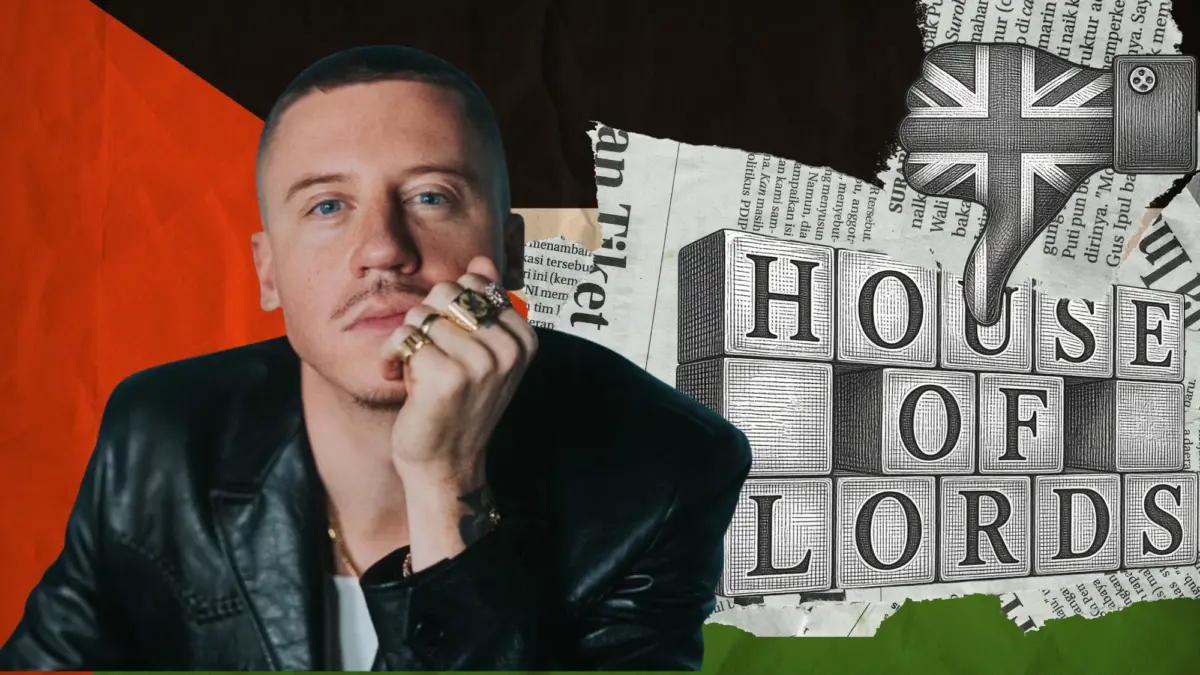
American rapper Macklemore finds himself at the center of a burgeoning geopolitical and cultural storm as his controversial European "Free Palestine" tour prepares to reach London. Fifty members of the British House of Lords have formally petitioned Foreign Secretary Shabana Mahmood to intervene and block the artist from entering the United Kingdom.
The parliamentary intervention does not target Macklemore’s own vocal criticisms of Israeli military action—which recently cost him a lucrative support slot on Ed Sheeran’s U.S. stadium tour—nor does it seek to censor his musical catalog. Instead, the cross-party group of peers is objecting to the rapper’s financial support for a designated beneficiary of the tour: the Palestinian Youth Movement (PYM).
According to the letter spearheaded by parliamentarians, the PYM has a documented record of glorifying terrorism, justifying the October 7, 2023, Hamas attacks on Israel, and employing coercive intimidation tactics against elected officials in the U.K. through aggressive local constituency protests.
With the London date at Wembley Arena slated for later this week, the government faces mounting pressure to decide whether to revoke the artist’s travel authorizations. The situation draws sharp parallels to the government’s earlier refusal to grant entry to Kanye West ahead of his scheduled festival appearances. Yet, navigating the delicate balance between free expression, public safety, and foreign policy involvement presents a significant test for the newly established administration.
Detailed Chronology: From U.S. Stadiums to British Parliament
The Ed Sheeran Tour Fallout
The sequence of events leading up to the current U.K. political showdown began in the United States, where Macklemore had been performing as a major support act on pop superstar Ed Sheeran’s extensive tour. However, the rapper’s outspoken on-stage advocacy for Palestine and his sharp criticisms of Israeli military operations quickly drew intense scrutiny from venue operators and concert promoters.
The flashpoint occurred at Gillette Stadium in Foxborough, Massachusetts. Owned by billionaire businessman and prominent pro-Israel philanthropist Robert Kraft, the venue—along with pressure from other prominent stakeholders—insisted that Macklemore be dropped from the tour line-up. Sheeran and his management ultimately yielded to these demands, removing the rapper from the bill.
The decision provoked an immediate backstage crisis. In solidarity with Macklemore, all remaining support acts pulled out of the tour. Despite performing without any opening acts, Sheeran’s schedule was further complicated when his two planned performances at Kraft’s Gillette Stadium were ultimately canceled due to severe weather.
The Launch of the "Free Palestine" Tour
Rather than stepping back from public platforms, Macklemore pivoted to mounting his own independent "Free Palestine" concert series across Europe, explicitly directing portions of the proceeds to pro-Palestinian advocacy organizations, including the Palestinian Youth Movement.
Last week, the rapper played his first live set since being dismissed from the Sheeran tour at Colorado’s iconic Red Rocks Amphitheatre. Addressing the audience, Macklemore framed his humanitarian stance in universal terms:
"Being a human being in this moment is not complicated. It is not political. It is human to have a heart, to watch others suffering and to say, ‘not anymore!’ So I say, free Palestine. I say, free Palestine!"
Expanding his critique to global crises, he added:
"I say free Sudan. I say free Congo, Lebanon, to Haiti, to all the people that are affected by ICE in America, who are afraid to leave their houses… The message will always be love."
Despite these broad humanitarian appeals, the announcement of his European mini-tour—kicking off in Dublin, moving to Paris, and culminating at London’s Wembley Arena—drew immediate and fierce pushback from British Jewish leadership organizations and parliamentarians.
Supporting Context & Metrics: The Controversy Surrounding the Palestinian Youth Movement
At the heart of the U.K. political opposition is the Palestinian Youth Movement (PYM). Describing itself as a grassroots, independent organization that mobilizes Palestinian and Arab youth to struggle for Palestinian liberation, the group has become a lightning rod for controversy in Western political circles.
Allegations of Extremism and Justification of Violence
The 50 peers who signed the letter to the Foreign Secretary argue that Macklemore’s tour functions as a vehicle to "raise money, from a British audience, for an organisation whose record of glorifying terrorism and of intimidating elected representatives should concern any government."
These allegations are substantiated by statements and publications issued by the PYM and its affiliates following the October 7, 2023 attacks led by Hamas. Critics point to public statements from the movement describing the attacks as "justified" and characterizing the hostage-taking of Israeli civilians as "legitimate" and "effective." For British lawmakers, channeling funds generated on British soil to an entity holding such positions crosses a critical threshold.
The "Siege on Labour" Toolkit
Beyond ideological statements regarding the Middle East, domestic security concerns have been heightened by the PYM’s activist strategies within the United Kingdom. The group previously circulated a document referred to as a "siege on Labour" toolkit.
This guide outlined tactical approaches for pro-Palestinian campaigners aiming to lobby members of the ruling Labour Party. Crucially, it encouraged sustained protests outside local party offices, including the private constituency offices of individual Members of Parliament.
The Lords’ letter addresses this tactic directly, noting:
"Constituency offices are where MPs and their staff are most exposed… organizing crowds to lay ‘siege’ to those offices is not ordinary protest. It is an attempt to coerce members of Parliament through fear."
Lawmakers argue that allowing an international artist to fund an organization linked to such domestic intimidation campaigns compromises the safety and democratic integrity of the U.K.’s political infrastructure.
Official Statements and Stakeholder Reactions
The House of Lords Intervention
The parliamentary push is led by high-profile figures across the political spectrum. The primary letter was authored by John Woodcock, a crossbench peer whose involvement has itself attracted scrutiny. Investigative queries by the Good Law Project and Compassion in Politics recently filed a complaint to the House of Lords Commissioner for Standards regarding Woodcock’s alleged links to arms manufacturer Leonardo, which maintains extensive contracts with the Israeli military.
Co-signatories to the letter include prominent political figures such as Sir Eric Pickles, who serves as the chair of the Conservative Friends of Israel group in the House of Lords; former Northern Ireland First Minister Baroness Arlene Foster; former senior Conservative MP Sir Graham Brady; and former Attorney General Lord Peter Goldsmith.
In their correspondence, the peers carefully distinguish between suppressing free speech and regulating foreign fundraising. They emphasize that blocking the London concert:
"…would not prevent anyone in this country supporting the humanitarian organizations that are being backed by Macklemore, nor would it restrict access to his music."
Instead, if Foreign Secretary Shabana Mahmood intervenes, she would be:
"…simply declining to grant a foreign national the privilege of raising funds on British soil for an organization" with the PYM’s track record.
Jewish Leadership Council Position
The Jewish Leadership Council (JLC) has also stepped forward to demand accountability from event organizers. Directing their concerns toward live entertainment giant Live Nation, which is marketing the Wembley Arena show, the JLC issued a public statement:
"Macklemore is entitled to advocate for Palestinian rights. However, concerns arising from the imagery that he has used and material in his recent performances must be taken seriously."
The JLC has formally asked Live Nation to detail how it assessed the security risks associated with the event and what specific protocols are being implemented to ensure that Jewish audiences and staff feel safe and welcome within the venue.
Future Outlook: Government Precedent and Policy Dilemmas
As the clock ticks toward Friday’s scheduled performance at Wembley Arena, the British government faces a complex policy dilemma with significant legal and diplomatic ramifications.
The Precedent of Kanye West
The mechanism to block Macklemore’s entry into the U.K. is readily available. The Home Office and Foreign Office possess the authority to withdraw or deny electronic travel authorizations (ETAs) to foreign nationals whose presence is deemed not conducive to the public good.
A direct precedent was set earlier this year when the U.K. government blocked American rapper Kanye West from entering the country following a series of highly publicized antisemitic remarks ahead of his planned Wireless Festival appearances.
The Fine Line Between Antisemitism and Foreign Policy Advocacy
However, applying this precedent to Macklemore presents distinct challenges. Legal experts and civil liberties advocates note that equating Macklemore’s vocal criticisms of Israeli government policy with the explicit, systemic antisemitism exhibited by West is legally and culturally contentious.
Recognizing this nuance, the House of Lords letter strategically sidestepped Macklemore’s personal rhetoric. By grounding their demand entirely in the financial beneficiary of the tour—the PYM—the peers have attempted to construct a more defensible administrative barrier based on national security, public order, and the prevention of domestic political coercion.
The Decision Ahead for the Foreign Secretary
For Foreign Secretary Shabana Mahmood, the decision requires balancing competing pressures. Granting entry risks alienating parliamentarians, Jewish community organizations, and security officials concerned about domestic public order and the financing of controversial activist networks. Conversely, barring the artist risks drawing accusations of political censorship, potentially fueling broader debates over free speech, foreign policy dissent, and the boundaries of artistic expression in the United Kingdom.
As ticket holders prepare for the weekend, all eyes remain fixed on Whitehall, where a final determination on Macklemore’s visa status is expected imminently.