Executive Overview
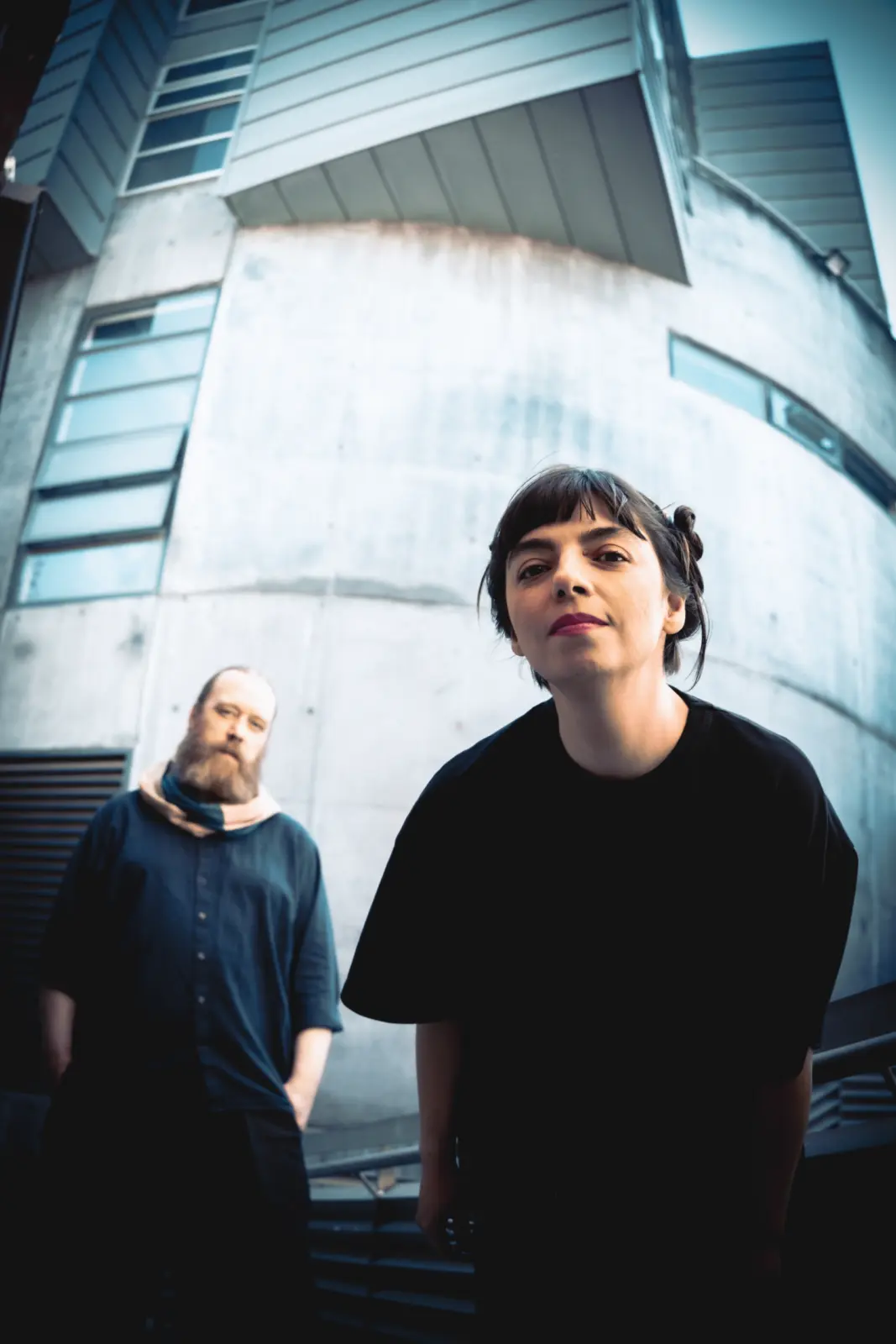
In an era dominated by hyper-produced, algorithmic perfection, the transcontinental experimental duo ZöJ operates as a radical act of acoustic rebellion. Comprising Iranian-born vocalist and kamancheh player Gelareh Pour and Australian percussionist Brian O’Dwyer, the duo builds every single performance live, on the spot, using nothing more than a spike fiddle, a human voice, and a drum kit. Nine years into their ongoing collaboration, ZöJ has transcended the traditional boundaries of world music and free improvisation, forging a dynamic sonic language that is genuinely unpredictable—even to its creators.
As they prepare to spearhead the prestigious Musical Road to WOMEX series ahead of their official showcase selection in Las Palmas de Gran Canaria (October 21–25), ZöJ represents a vital voice in modern experimental art. Their acclaimed 2024 album, May The Devil’s Ear Be Deaf—recorded in a single live pass at the Banff Centre for Arts and Creativity—encapsulates their philosophy: music as a living, breathing conversation that refuses to be fixed, bottled, or repeated. This deep-dive feature explores their migratory journeys, their revolutionary approach to live improvisation, the cultural weight of Iranian women’s voices in diaspora, and what it means to make fragile, radical art in a fragmented world.
Detailed Chronology: From Tehran’s Narrow Lanes to the Global Stage
The story of ZöJ—whose name translates simply to "pair" in Persian—is fundamentally a story of migration, cultural synthesis, and profound artistic resilience.
The Formation and Foundations
Gelareh Pour’s musical genesis began in Tehran, Iran, a city brimming with sonic heritage where she was surrounded by deep musical traditions and extraordinary artists. However, growing up as a young woman in post-revolution Iran meant navigating an intensely restrictive landscape, particularly regarding the performing arts. For women, the path to a professional singing career ran through exceptionally narrow, heavily policed lanes; solo public vocal performance by women was largely prohibited or heavily curtailed. Pour carried this deep-seated awareness—that music is a fragile, precious commodity requiring fierce protection and iron determination—with her when she eventually migrated to Australia.
In Australia, Pour crossed paths with Brian O’Dwyer, a drummer deeply embedded in the worlds of jazz and free improvisation. O’Dwyer brought to the table a rare, open-eared curiosity about where ancient traditions could migrate next. Together, they realized that their divergent musical histories—Persian classical modalities meeting Western contemporary drum-kit mechanics—could form the bedrock of an unprecedented sonic dialogue.
Critical Acclaim and the Banff Sessions
Over the next decade, ZöJ methodically built a reputation for riveting, high-wire live performances. Their refusal to use loops, backing tracks, or pre-composed structures quickly made them darlings of Australia’s avant-garde and experimental music communities.
The year 2024 marked a watershed moment for the duo. ZöJ was awarded the prestigious Art Music Award for Excellence in Experimental Practice by APRA AMCOS, validating their uncompromising methodology on a national scale. Shortly after, the duo travelled to the internationally renowned Banff Centre for Arts and Creativity in Alberta, Canada. Immersed in the inspiring landscapes of the Canadian Rockies, they recorded their third studio album, May The Devil’s Ear Be Deaf. True to form, the entire album was captured in a single live pass, committing every spontaneous twist and turn directly to tape without the safety net of post-production editing or overdubbing.
Supporting Context & Metrics: Decoding May The Devil’s Ear Be Deaf
The title of ZöJ’s celebrated third album is derived from an old Persian protective ritual and phrase—spoken quietly after uttering something intensely beautiful, precious, or fortunate, serving as a talisman to ward off the malicious gaze of envy.
The Mechanics of Spontaneity
To understand ZöJ’s metric of success, one must discard standard music industry parameters. There are no hit singles designed for streaming playlists, no standardized verse-chorus structures, and no repeated setlists. Instead, their metrics are measured in presence, deep listening, and the ephemeral energy exchanged within a specific room.
- Instrumentation: 1 kamancheh (an ancient Persian bowed spike fiddle with a piercing, deeply emotional timbre), 1 human voice (carrying the weight of Persian microtonal vocal traditions and contemporary abstraction), and 1 minimalist drum kit (supplying rhythmic counterpoint, textural noise, and percussive breathing room).
- Production Methodology: 100% improvised; zero overdubs; captured in single live takes.
- The Third Point of the Triangle: The audience. ZöJ explicitly positions the listener not as a passive consumer, but as an active structural pillar whose collective attention shapes the direction of the unfolding performance.
Official Statements & Duo Insights
In an exclusive conversation, Gelareh Pour and Brian O’Dwyer opened up about the philosophy guiding their art, the weight of their cultural intersections, and their anticipation for the upcoming WOMEX showcase in the Canary Islands.
On the Nature of Live Improvisation
"Every ZöJ performance begins with listening. Before there is sound, there is attention—to each other, to the room, to the audience, to the things that cannot be planned," the duo explains.
"We don’t approach the stage with a fixed script; we bring our shared musical language and trust. Then we allow the music to reveal itself in the moment. The kamancheh, voice, and drums don’t accompany one another; they are in a constant conversation. Sometimes they whisper, sometimes they challenge, sometimes they leave space for silence to speak."
Bridging Two Worlds: The Iranian Diaspora
For Pour, the migration from Iran to Australia was not a process of shedding one identity to adopt another, but rather an expansion of creative territory.
"Growing up in Iran, I was surrounded by music, but I understood from an early age that there were limits on what a musical future could look like for me. Singing publicly as a woman wasn’t an open path. Migrating to Australia gave me the freedom to explore music without those constraints, while carrying with me everything I had learned."
"ZöJ lives in the conversation between those worlds. My Iranian heritage, my research into women’s voices in diaspora, and Brian’s openness as an improviser come together in a space where memory meets discovery. It’s not about choosing between cultures or traditions, but allowing them to meet with honesty, curiosity, and deep listening."
Navigating the Canary Islands and Hybrid Identities
As ZöJ prepares to take the stage at WOMEX in Las Palmas de Gran Canaria—an archipelago defined by its Berber indigenous roots, Spanish colonial layers, and centuries of Latin American migration—they see a profound parallel between their music and the host territory.
"Most of us carry multiple histories, languages, and homes within us. Those intersections aren’t fragmented; they are places of creativity and possibility. The Canary Islands feel like a place where many currents meet. At a time when the world often asks us to choose one identity over another, we’re interested in making music that embraces complexity and connection."
Future Outlook: Beyond WOMEX
As ZöJ looks toward the horizon—fusing the windswept vistas of their natural inspirations with the volcanic landscapes of Gran Canaria—their trajectory points firmly toward continued exploration.
- Touring May The Devil’s Ear Be Deaf: The immediate future involves bringing their uncompromising live show to international festival circuits, allowing the record to continue evolving organically through physical performance.
- New Recording Sessions: True to their restless creative spirit, the duo is continuously archiving new improvised material, expanding their sonic vocabulary across genres and borders.
- Cross-Cultural Collaborations: ZöJ remains actively open to experimental partnerships with artists from vastly differing artistic backgrounds, provided there is a mutual dedication to genuine communicative risk-taking.
An Invitation to Las Palmas
For delegates and attendees at WOMEX 2026, ZöJ offers a final, welcoming directive:
"Dear friends, if you come to our concert, you won’t hear a performance that has been repeated many times before. You’ll hear something that exists only in that room, on that evening, created together with everyone present. Bring your curiosity. Bring your imagination. Bring your silence as well as your applause. Let’s discover what becomes possible when we truly listen to one another."
Catch ZöJ performing their Official Showcase Selection at WOMEX in Las Palmas de Gran Canaria, running from October 21 to 25.