By the Investigative Watch Desk
Published by ChronoStreet
Executive Overview
In the upper echelons of luxury horology and street culture alike, the "iced-out" watch—a timepiece completely encrusted with diamonds or other precious gemstones—has long been the ultimate status symbol. From platinum-cased Rolex Day-Dates shimmering under club lights to custom-bezeled Audemars Piguet Royal Oaks worn by elite athletes and musicians, a genuine diamond-set timepiece commands immense respect and carries an astronomical price tag.
However, the rapid democratization of high-grade synthetic stones and increasingly sophisticated counterfeit craftsmanship have turned the secondary market into a minefield. Unsuspecting buyers regularly drop tens of thousands of dollars on timepieces adorned with cheap cubic zirconia, low-grade moissanite, or poorly secured stones held together by industrial adhesives.
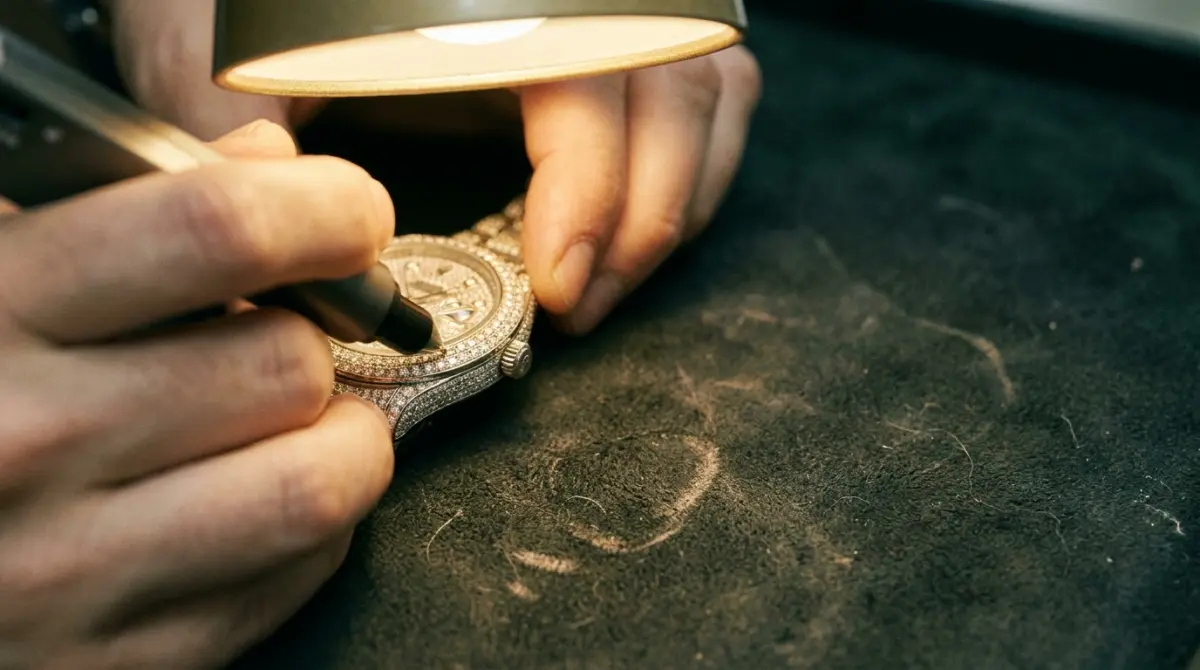
To help collectors, investors, and enthusiasts navigate this perilous landscape, we sat down with Aiman Moner, a master luxury watch authentication and repair expert at ChronoStreet. According to Moner, evaluating an iced-out watch requires moving past the superficial allure of the sparkle and examining the granular details of craftsmanship, gemological properties, and provenance.
"Real diamonds on an iced-out watch look bright white, sit in tight metal settings, and come with a report or receipt from a jeweler," Moner explains. "Fakes like cubic zirconia throw rainbow flashes, go cloudy within months, and often sit in glued channels. A dual diamond and moissanite tester, plus a 10x loupe, settles it in minutes."
This comprehensive investigative report outlines the precise diagnostic framework required to authenticate diamond-encrusted watches, detailing the physical properties of luxury stones, the critical differences between factory-set and aftermarket modifications, and the essential questions every buyer must ask before wiring funds.
Detailed Chronology: The Evolution of Aftermarket Customization and Counterfeit Fraud
To understand why iced-out watch authentication has become so complex, it is necessary to examine how the market evolved over the last four decades.
The Era of Independent Artistry (1980s–1990s)
In the golden age of hip-hop and luxury conspicuous consumption, custom jewelers like Jacob Arabo (Jacob & Co.) in New York’s Diamond District pioneered the art of "icing out" factory timepieces. During this era, collectors routinely bought base stainless steel or gold watches—such as the Rolex Submariner or Datejust—and commissioned independent master jewelers to hand-set VVS-grade diamonds into the bezels, dials, and bracelets. These pieces were celebrated for their bespoke nature, and the craftsmanship was typically executed to a high standard, utilizing solid gold seatings and hand-paved prongs.
The Mass-Market Synthetic Boom (2000s–2010s)
As chemical vapor deposition (CVD) and high-pressure high-temperature (HPHT) technologies advanced, lab-grown diamonds and high-grade moissanite flooded the market. Concurrently, manufacturers in overseas production hubs mastered the art of mass-producing cheap thermal conductors and simulated stones. The secondary market was flooded with low-cost "iced-out" replicas that could easily fool an untrained eye under dim lighting or smartphone filters. Watch modification shifted from a high-end bespoke craft to a high-volume, low-cost enterprise characterized by glued-in stones and base-metal casings.
The Modern Authentication Crisis (Present Day)
Today, buyers face an unprecedented level of deception. Counterfeiters no longer rely solely on glued rhinestones; many use low-grade moissanite or lab-grown stones that can bypass basic thermal diamond testers. Furthermore, the blurring lines between factory-set models (timepieces where gems are set by the original manufacturer like Rolex or Patek Philippe) and custom aftermarket modifications have created massive valuation gaps. A watch with aftermarket stones may feature genuine diamonds, but its market value can be a fraction of an identical reference featuring factory-original gem-setting.
Supporting Context & Metrics: The Anatomy of a Genuine Diamond vs. Imitations
When evaluating a diamond-encrusted watch, buyers must understand the optical, physical, and structural differences between various types of stones and setting techniques.
1. Look at the Setting Before You Look at the Stones
Most novice buyers make the critical mistake of staring exclusively at the brilliance and sparkle of the gems. Professional authenticators, however, immediately look at the metalwork.
- Quality Work (Pave / Prong Setting): On luxury-grade timepieces, each individual stone sits in its own meticulously carved metal seat. Tiny metal beads or prongs are pushed over the edges of each stone to lock it securely in place. The rows line up with geometric precision, and the tops of the stones sit completely level, resembling a professionally paved city street.
- Cheap Work (Channel / Glued Setting): Counterfeit or low-end custom work tells a starkly different story. Stones often sit at varying heights because the metal was not properly seated. Under a 10x loupe, inspectors can frequently spot dried industrial glue, dark gaps at the base of the channels, or rows that drift out of alignment near the watch lugs and clasp.
Furthermore, luxury watch expert Aiman Moner advises checking the metal walls under a bright light held at an angle: "Good setting work shows clean metal walls between stones. Bad work shows a gray, muddy look because the stones are packed in with filler."
2. Comparative Stone Analysis Matrix
To assist buyers in identifying stone types during an inspection, reference the diagnostic matrix below:
| Stone Type | Basic Thermal Tester | Dual Electrical Tester | Optical Appearance in Bright Light | Long-Term Durability & Aging |
|---|---|---|---|---|
| Natural Diamond | Reads "Diamond" | Reads "Diamond" | Crisp white flash with subtle fire | Excellent; retains brilliance indefinitely |
| Lab-Grown Diamond | Reads "Diamond" | Reads "Diamond" | Identical to natural diamond | Excellent; identical physical properties |
| Moissanite | Reads "Diamond" | Reads "Moissanite" | Heavy, pronounced rainbow fire | Very good; highly durable |
| Cubic Zirconia (CZ) | Fails / Low Reading | Fails | Bright initially, turns cloudy and dull | Poor; attracts oils and clouds within months |
Official Statements & Expert Guidance: The Diagnostic Toolkit
Relying on eyesight alone is never sufficient when evaluating luxury assets worth tens or hundreds of thousands of dollars. Aiman Moner outlines the essential toolset and diagnostic tests every serious collector should employ.
What a Diamond Tester Can and Can’t Tell You
- The Basic Handheld Thermal Pen: A standard diamond tester measures thermal conductivity. It is effective at identifying glass and cubic zirconia, which dissipate heat slowly. However, it will fail when confronted with high-grade moissanite. Moissanite conducts heat remarkably well and will trigger a "diamond" positive reading on cheap pens.
- The Dual Tester (Thermal + Electrical): To reliably separate diamonds from moissanite, a dual-action tester is mandatory. Moissanite is a semiconductor and allows an electrical current to pass through its lattice structure; natural and lab-grown diamonds are electrical insulators and do not conduct electricity.
- The Natural vs. Lab-Grown Distinction: Neither handheld pen can distinguish between a mined diamond and a lab-grown diamond, as their chemical and optical properties are identical. Determining origin requires specialized spectroscopic screening equipment. While this distinction has a massive impact on engagement rings, its effect on iced-out watch valuations is secondary—though it must still be disclosed and priced accordingly.
Factory Stones vs. Custom Ice: Understanding the Valuation Gap
Prestigious houses such as Rolex, Audemars Piguet, Patek Philippe, and Cartier exercise rigorous quality control. When these brands set stones at the factory, that specific configuration is permanently recorded in the watch’s reference number, certificate, and archives.
Conversely, a custom jeweler can take a standard stainless steel Rolex GMT-Master II and aftermarket-set VVS diamonds of identical clarity and color. While the physical materials may be high quality, the watch is legally and horologically considered "modified" or "aftermarket."
Practical Implications of Factory vs. Custom:
- Resale Liquidity: Factory-set pieces hold collector prestige and trade at steep premiums. Aftermarket iced-out watches often trade at a steep discount compared to their unadorned stock counterparts because purists view modifications as a degradation of the original movement and case integrity.
- Servicing Restrictions: Official brand service centers (such as Rolex Service Centers) will frequently refuse to service or return watches featuring aftermarket custom gem-setting, or they will insist on replacing the modified components with factory-original parts at the owner’s expense.
How to Spot a Factory-Set Watch From a Custom One
- Case Engravings & Serial Numbers: Factory-set diamond watches feature case geometry and serial/reference numbers that explicitly denote gem-setting. If the reference number indicates a smooth steel bezel, but the watch is covered in diamonds, it is an aftermarket modification.
- Metal Precision: Factory gem-setting leaves zero room for error. The spacing between lugs, case bevels, and bracelet links is integrated seamlessly into the manufacturing process. Aftermarket modifications often require cutting, drilling, or altering the original metal casing, which can be detected under magnification.
Future Outlook & Essential Buyer Protection Protocols
As lab-grown diamond technology becomes virtually indistinguishable from mined stones and counterfeit operations grow more sophisticated, the market for iced-out watches is tightening its standards. Institutional authentication houses and high-end platforms are investing heavily in advanced spectroscopic screening to protect buyers.
Before parting with your capital, protect your investment by utilizing the following due diligence checklist.
Red Flags in Online Listings
- Vague Descriptions: Terms like "blinged out," "iced," or "custom diamonds" without specification of carat weight, color, or clarity.
- Stock Photos Only: Refusal to provide high-resolution macro photography of the watch settings, case backs, and inner clasps.
- Below-Market Pricing: An iced-out Rolex or AP offered at or near the price of a standard, unadorned model. Gold, platinum, and genuine diamonds carry intrinsic material value; if the price seems too good to be true, the stones are almost certainly synthetic or glass.
The 5-Point Questionnaire: What to Ask Before You Pay
Copy, paste, and send these five precise questions to any seller before wiring funds or meeting in person:
- "Are these diamonds factory-original to the reference number, or were they set aftermarket by a custom jeweler?"
- "Can you provide independent gemological documentation, a jeweler’s receipt, or an appraisal detailing the total carat weight, color, and clarity of the stones?"
- "Will you permit an independent inspection by a certified watchmaker and gemologist of my choice prior to final settlement?"
- "Has this timepiece ever been submitted to an official manufacturer service center, and were any components replaced during servicing?"
- "What is your explicit return and refund policy in the event that the stones fail a dual diamond and moissanite test?"
A seller who answers all five without hedging is usually telling the truth. One who dodges question 3 or 4 is telling you something vital.
How to Protect Real Stones After Purchase
If you successfully acquire a genuine diamond-encrusted timepiece, proper maintenance is critical to protect your investment:
- Annual Acoustic Checks: Set stones can loosen over time. Once a year, hold the watch close to your ear and gently tap the bezel or bracelet with a clean fingernail. A faint rattling sound indicates a loose stone—and a loose stone will inevitably fall out and be lost, as Aiman Moner warns.
- Avoid Ultrasonic Cleaners: Never place a glued or heavily paved watch into an ultrasonic jewelry cleaner. The high-frequency vibrations can disintegrate adhesives or dislodge tightly set pavé stones. Stick to warm water, a single drop of mild dish soap, and a soft-bristled toothbrush to clear away skin oils and debris.
- Wear Restrictions: Remove the watch during rigorous physical activity, heavy weightlifting, or gardening. A single high-impact knock against a granite countertop or metal gym equipment is enough to shatter a diamond’s girdle.
- Specialized Insurance: Standard homeowners or renters insurance policies typically cap jewelry claims at a fraction of a luxury watch’s value. Secure a professional written appraisal detailing carat weight, color, clarity, and setting quality, and add a dedicated scheduled rider to your policy to ensure full financial protection.