Executive Overview
In the modern landscape of music production, the tools available to aspiring creators have never been more advanced, yet the psychological hurdles have never felt more daunting. While thousands of digital audio workstations (DAWs), virtual studio technology (VST) plugins, sample libraries, and MIDI packs cater to sound design and composition, the foundational architectural framework of a track—its arrangement—has long remained an isolated art form. Producers are universally told to "reference your favorite tracks," but they are left entirely to their own devices when attempting to dissect, map, and replicate the structural DNA of a commercially viable song.
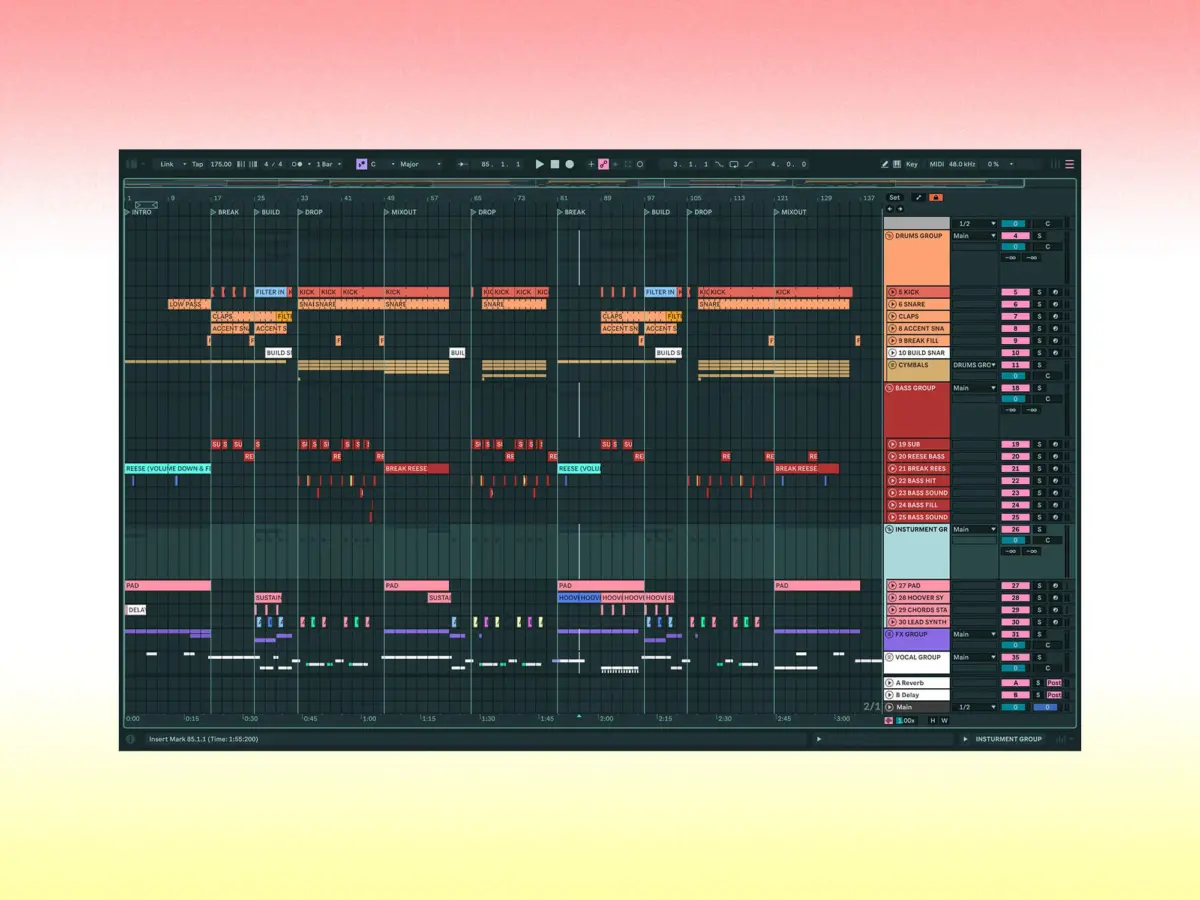
Enter Los Angeles-based music education brand Color With Live. Co-founded by producers Kevin Rea and Grant Hunter, the brand has introduced a radically simple yet profoundly effective innovation called Stencils. Functioning essentially as a coloring book for Ableton Live, Stencils are soundless arrangement maps modeled after globally recognized, dancefloor-tested hits across multiple electronic and urban genres.
By providing a fully structured session view complete with empty, labeled clips, structural markers, and embedded arrangement instructions—free of actual audio or MIDI data—Stencils bridge the chasm between structural theory and practical execution. Designed to combat the paralyzing "blank canvas syndrome" that disproportionately affects bedroom producers juggling full-time jobs, this tool transforms passive listening into active spatial learning. With a library now boasting over 250 Stencils spanning UK Garage, Dubstep, Tech House, Drum & Bass, Techno, and Hip-Hop, Color With Live is spearheading a quiet revolution in how the next generation of producers learns to build songs from the ground up.
Detailed Chronology & The Genesis of Stencils
The Producer’s Curse: Facing the Empty Session
To truly understand the impetus behind Stencils, one must examine the daily reality of the contemporary independent music producer. For Rea and Hunter, the journey mirrored that of countless creators worldwide: a grueling balancing act of working demanding full-time day jobs followed by late-night studio sessions.
The most exhausting part of this routine was rarely the lack of musical ideas. Rather, it was the crushing inertia that accompanied opening a blank Ableton Live project file at 10:00 PM after a grueling nine-to-five shift. With an infinite horizon of possibilities—unlimited tracks, countless plugins, and zero structural boundaries—the cognitive load required simply to decide where the second verse should begin or how long a bridge needed to be often choked the creative spark before a single note was recorded.
The industry-standard advice given to producers struggling with arrangement has historically been straightforward: "Pick apart your reference tracks." Producers are routinely instructed to drag a professionally mixed and mastered song into their DAW, drop markers on the timeline, and try to eyeball where the drops, breakdowns, and transitions occur.
However, Rea and Hunter quickly realized the glaring flaw in this traditional workflow. Listening to a finished, polished track and attempting to reverse-engineer its arrangement visually in a DAW is like asking an architecture student to look at a completed skyscraper and instantly understand the internal scaffolding, load-bearing walls, and hidden wiring. Without a structural blueprint, the reference track remains an opaque wall of sound. Producers could hear the change, but they lacked a standardized, visual method to check their own work against professional benchmarks.
From Frustration to Innovation
Recognizing a glaring market void, the co-founders asked a paradigm-shifting question: Producers can download Serum preset packs to master sound design and complex MIDI packs to learn advanced music theory, so why doesn’t a dedicated equivalent exist for song arrangement?
This realization sparked the development of Stencils. The concept was refined through months of testing, trial, and structural analysis of dominant club records. Instead of creating another passive video tutorial or static PDF cheat sheet, Rea and Hunter leveraged Ableton Live’s native session and arrangement environment to build interactive structural skeletons.

They stripped away all audio stems, synthesizer patches, and drum samples, leaving behind a pristine timeline of silent, color-coded clips. Each clip was meticulously mapped to reflect the exact length, positioning, and organizational hierarchy of a proven hit record. Furthermore, they embedded textual cues and instructions directly into the session—such as reminders to roll off low-frequency content before a drop or instructions on when to introduce a counter-melody—transforming a blank DAW window into an interactive masterclass.
Supporting Context & Metrics: The Mechanics of a Stencil
How Stencils Work in Practice
At its core, a Stencil is a soundless Ableton Live Project (.als) file. When a user opens a Stencil, they are greeted by a fully populated session view that looks identical to the project file of an A-list producer who just wrapped up a career-defining festival anthem.
For example, imagine loading a Stencil modeled after a high-energy Skrillex, Fisher, or Dimension track. The project features organized, pre-named tracks laid out across standard industry conventions:
- Kicks and Sub-Basses
- Percussion and Top Loops
- Lead Synths and Plucks
- Vocal Chops and Spoken Word Hooks
- FX, Risers, and Downlifters
However, when the user hits the spacebar, absolute silence ensues. The clips occupying the arrangement timeline contain no audio data or MIDI notes. The user’s objective is to fill these empty vessels with their own sounds, loops, and musical ideas while strictly adhering to the spatial boundaries defined by the Stencil.
[Traditional Workflow]  -> Open Blank DAW -> Stare at Infinity -> Overthink Arrangement -> Burn Out
[Color With Live Model] -> Open Stencil   -> Follow Blueprint   -> Inject Custom Sounds  -> Finish Track
This methodology leverages the educational psychology of constraints. By removing the burden of deciding when things happen, the producer’s mind is freed up to focus entirely on what sounds good within those structural boundaries. It functions as a dynamic coloring book: the lines are already drawn by masters of the craft, but the color palette, shading, and texture belong entirely to the user.
Genre Diversity and the Current Library
What began as a localized experiment to solve their own workflow bottlenecks has rapidly expanded into a comprehensive educational ecosystem. Color With Live has meticulously engineered over 250 individual Stencils spanning a diverse spectrum of modern electronic and urban music genres.
The library caters to a broad church of beatmakers and electronic musicians, covering:
- UK Garage (UKG): Focusing on the syncopated rhythms, subtle swing, and deep basslines characteristic of the underground British scene.
- Dubstep: Highlighting the tension-and-release dynamics, massive sub-bass automation windows, and chaotic mid-range sound design architectures essential for heavy-hitting drops.
- Tech House: Emphasizing hypnotic rolling percussion, minimalist arrangement structures, and extended groove builds designed to hypnotize peak-hour club crowds.
- Drum & Bass (DnB): Mapping out breakbeat manipulation, high-velocity transitional elements, and soaring atmospheric breakdowns.
- Techno: Providing rigid, industrial frameworks optimized for hypnotic, long-form hypnotic mixing and subtle sonic evolution.
- Hip-Hop: Structuring beat switches, vocal arrangements, and space-conscious drum loops designed to support a lyrical flow rather than crowd out a vocalist.
To lower the barrier to entry and allow producers to test the waters, Color With Live launched a targeted promotional campaign offering a complimentary welcome pack containing three industry-standard Stencils:
- "Flip It" by Levity
- Fisher’s rework of "World Hold On" by Bob Sinclar
- "Once In A Lifetime" by Dimension
Official Statements & Industry Philosophy
The ethos driving Color With Live is rooted in sustainable, long-term artistic growth rather than perpetual dependency. Co-founder Kevin Rea is vocal about the brand’s core mission and educational philosophy, ensuring that the tool is viewed as a bridge rather than a crutch.

"Producers download Serum packs to practice sound design and MIDI packs to practice music theory. We were blown away that nothing like that existed for arrangement," explains Rea. "The advice is always to pick apart your reference tracks, but there’s nothing visual to check your work. Our mission isn’t for our stencil to be a crutch that you rely on for every song, but instead something that you can learn from and then apply to future productions."
This distinction is crucial for understanding the true value proposition of Stencils. In an era where online music production tutorials often border on prescriptive "paint-by-numbers" courses that discourage critical thinking, Color With Live positions Stencils as an experiential training ground.
By repeatedly walking through the physical topography of world-class arrangements—feeling the exact duration of a 16-bar build-up, experiencing the physical emptiness of an 8-bar breakdown, and understanding the precise moment a vocal pre-chorus needs to widen in the stereo field—producers build muscle memory. Over time, this structural awareness internalizes. A producer who works through dozens of Stencils stops needing a blueprint because the architectural intuition of hit-making has been hardwired into their creative workflow.
Co-founder Grant Hunter echoes these sentiments, emphasizing that the tool was born out of empathy for the modern creator’s time constraints. "When you’ve worked eight or ten hours at a regular job, coming home to an empty session file is the ultimate creative killer," Hunter notes. "Stencils give you the immediate momentum you need to bypass the psychological barrier of the blinking cursor. You sit down, you know exactly where your elements go, and suddenly you’re actually finishing tracks instead of deleting loops at 3:00 AM."
Future Outlook: The Next Frontier in DAW-Based Education
As the music production software market continues to evolve toward deeper integration, AI-assisted tools, and modular learning ecosystems, the approach taken by Color With Live represents a refreshing return to fundamental craftsmanship. While artificial intelligence tools increasingly promise to auto-generate entire arrangements or mix tracks at the press of a button, Stencils take the opposite approach: they empower the human creator by teaching them how and why great music is organized.
Looking ahead, the potential expansion for the Stencils framework is vast. While current offerings are deeply integrated into Ableton Live—the industry-standard DAW for electronic music production—the underlying pedagogical model could theoretically scale to rival digital audio workstations such as Logic Pro, FL Studio, and Pro Tools. Furthermore, as electronic music subgenres continue to fracture and evolve at a breakneck pace, maintaining an agile library of Stencils that capture emerging trends will keep Color With Live at the bleeding edge of music technology education.
Ultimately, the triumph of Stencils lies in its profound simplicity. It does not attempt to replace the artist’s creativity, sound design skills, or emotional expression. Instead, it builds a sturdy, reliable runway for those ideas to take flight. For the countless bedroom producers, late-night beatmakers, and aspiring mix engineers staring down the barrel of an empty session file, Color With Live has provided the ultimate map to navigate the wilderness of song arrangement—proving that sometimes, the best way to learn how to build your own house is to walk through the blueprints of a masterpiece.