Executive Overview
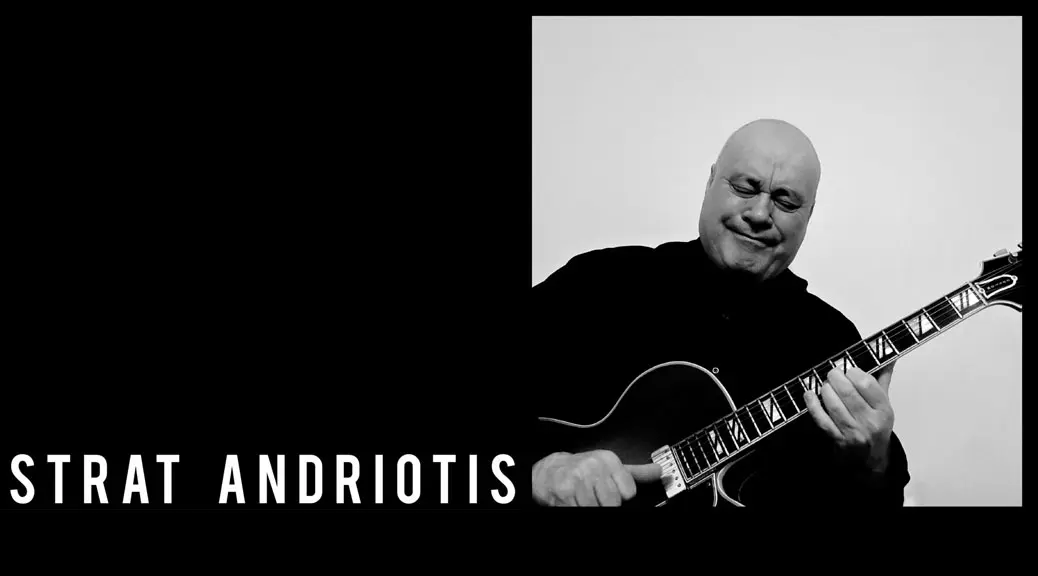
In the sprawling landscape of contemporary improvised music, few figures operate with the deliberate, self-contained autonomy of Strat Andriotis. With eight acclaimed albums as a leader, multiple Hamilton Music Awards, and a devoted following anchored in Ontario’s vibrant urban centers, Andriotis remains an anomaly: a celebrated regional virtuoso whose reputation has yet to detonate on the global stage. For many seasoned jazz critics and aficionados, encountering his catalog for the first time induces a familiar mix of self-reproach and sudden conversion. How does an artist with such formidable technical command and compositional rigor remain a well-kept secret outside of Canada?
The release of Andriotis’s latest studio project offers a definitive lens through which to examine his aesthetic. Recorded with a tightly knit, road-tested trio featuring electric bassist Vince Di Francesco and drummer Alex Karcza, the album presents nine original compositions executed with unblinking clarity. There are no safety nets here—no jazz standards to anchor the listener, no borrowed melodies against which to measure interpretive choices, and no stylistic detours. Every track is an original penned by Andriotis; every note is delivered through a solitary Gibson guitar plugged faithfully into a Princeton amplifier, maintaining a single, unshifting sonic tone from the first track to the last.
Yet, this uncompromising focus cuts both ways. The album unfolds as a masterclass in linear precision, yet it challenges conventional expectations of dynamic tension and interactive heat within a trio setting. In a fascinating conceptual twist, the tracks are sequenced in strict alphabetical order—from "Bullets" to "Sorry"—subverting traditional dramatic arcs in favor of a detached, formal symmetry.
This review-essay examines the trajectory of Strat Andriotis: tracing his roots from the ancient streets of Elefsina to the industrial pulse of Hamilton, analyzing his idiosyncratic compositional architecture, dissecting the mechanics of his rhythm section, and weighing the merits of an uncompromising artistic vision that prizes absolute control above all else.
Detailed Chronology: From Elefsina to the Hamilton Scene
To understand the crystalline geometry of Andriotis’s guitar playing, one must trace the geographic and sonic migrations that shaped his musical consciousness. Born in Elefsina, Greece—a city steeped in ancient mythology and industrial grit—Andriotis was uprooted at an early age when his family immigrated to Hamilton, Ontario. This transition from the Mediterranean basin to the steel city of the Golden Horseshoe provided a stark backdrop for a developing creative mind.
The Classical Foundation and the Rock Detour
Like many instrumentalists of his generation, Andriotis’s initiation into music began at the piano. He underwent four rigorous years of classical training, absorbing the discipline of notation, harmonic structure, and finger independence. However, the cultural tremors of the late 1960s and early 1970s proved irresistible. As a teenager, he was pulled sideways into the burgeoning countercultural rock scene, intoxicated by the transformative power of British heavy blues and psychedelic experimentation. Cream and Jimi Hendrix served as his primary gateways, tearing down the rigid walls of his classical upbringing and introducing him to the visceral thrill of electrical amplification and unbridled improvisation.
The Epiphany of Miles Davis
The pivotal turning point in Andriotis’s artistic evolution occurred at age seventeen, when he encountered Miles Davis’s 1969 landmark fusion masterpiece, In A Silent Way. For the young guitarist, listening to John McLaughlin, Herbie Hancock, and Joe Zawinul wove an entirely new paradigm. Chords and scales ceased to be mere building blocks for rock anthems; they transformed into infinite plastic mediums to be studied, bent, and meticulously worked. The record acted as a gateway from adolescent rock pyrotechnics toward the intellectual expanse of modern jazz and neoclassical composition.
Building a Catalog: Dekatria Records and Classical Acclaim
For decades, Andriotis honed his craft quietly, building a formidable technical vocabulary before stepping into the spotlight as a bandleader. The mid-2010s marked a dramatic ascent into neoclassical guitar composition. His ambitious releases, Liars Incorporated and Less Off Patient, showcased a composer bridging the chasm between classical counterpoint and fretboard dexterity. The former swept the 2015 Hamilton Music Awards, capturing honors for Instrumental Record, Classical Composition, and Classical Recording.
Rather than succumbing to the whims of major labels or traditional distribution networks, Andriotis took total ownership of his output. He established Dekatria Records—dekatria translating to "thirteen" in Greek—serving as his personal publishing and recording imprint. Beginning with 2018’s Night Manager, Dekatria became the exclusive vessel for his jazz explorations.
Over the years, Andriotis has acted as an ambitious casting director, inviting world-class luminaries into his orbit. Night Manager featured performances by fusion royalty Jerry Goodman and piano titan Gonzalo Rubalcaba. Subsequent projects enlisted elite voices like saxophonist Aaron Heick, and his previous outing, Exits, utilized two distinct rhythm sections to realize its architectural ambitions. Yet, for his latest project, Andriotis abandoned the revolving-door approach in favor of absolute internal cohesion.
Supporting Context & Metrics: Anatomy of a Modern Trio
The anatomy of Andriotis’s latest record is defined by a rigorous dedication to live-work testing. Before entering the studio to commit these nine original compositions to tape, the core trio—Andriotis, bassist Vince Di Francesco, and drummer Alex Karcza—took the material directly to audiences. Throughout the scorching summer of 2025, the group held residency-style weekend runs at Henry’s in Hamilton, culminating in a targeted series of performances at Toronto’s revered Emmet Ray in November of that year.
This grueling live-work schedule is plainly audible in the immaculate fit of the ensemble. Unlike Exits, where drummer Alex Karcza shared duties across multiple configurations, Karcza anchors every single track here, locking in alongside electric bassist Vince Di Francesco.
The Sonic Monolith: Gear and Tone
One of the most striking technical aspects of the record is its unswerving sonic palette. The liner notes explicitly state that the guitar was channeled directly through a Fender Princeton amplifier. More impressively, whatever Gibson guitar Andriotis had in his hands at the onset of the recording sessions remained his exclusive instrument throughout. There is no mid-album shift to a hollow-body jazz box for cleaner tones, no acoustic interludes, and no cascading pedal effects to alter the spatial dimension.
This unwavering consistency defines the listening experience. Every track exudes the same immaculate clarity, the same muscular command, and the same unhurried certainty. The titles themselves—"Bullets," "Caretaker," "Collisions," "Sorry"—are stark, unadorned monosyllables that contrast sharply with the elaborate, winding architectural lines unfurled across the fretboard.

The Alphabetical Subversion
Perhaps the most intriguing metric of the album’s conceptual design lies in its sequencing. A casual listener might assume that the track listing reflects a carefully calibrated emotional journey, building to a dramatic climax before winding down to a reflective denouement.
Examine the running order:
- Bullets
- Can’t Help Myself
- Caretaker
- Collisions
- Delivery
- For Alex
- Great Forgiveness
- Letters
- Sorry
From "Bullets" to "Sorry," the tracks follow strict alphabetical order. This is no mathematical coincidence; it is a deliberate, conceptual choice. By surrendering the sequencing to the alphabet, Andriotis strips away traditional narrative momentum. No piece occupies its position for a harmonic, dramatic, or rhythmic reason. The longest track on the album—clocking in at a substantial seven minutes—sits casually in the middle rather than serving as a grand finale. The final track, "Sorry," closes the record simply because the letter S succeeds L. The sequencing makes no rhetorical argument, forcing the listener to confront each piece as an isolated, self-contained monument.
Official Statements & Critical Perspectives
While Andriotis himself is famously reticent—preferring to let his intricate fretboard work and sparse liner notes speak for themselves—critics and collaborators within the Ontario jazz ecosystem have long wrestled with the paradox of his artistry.
Industry observers note that Andriotis’s approach represents an uncompromising adherence to artistic autonomy. In an era where contemporary jazz artists frequently chase genre-bending collaborations, streaming algorithms, and high-concept crossover appeals, Andriotis remains an island of absolute self-reliance. Every composition is entirely his own; there are no nostalgic nods to standard jazz repertoires, nor are there concessions made to modern commercial accessibility.
However, this absolute control has sparked robust debate among critics regarding the dynamic equilibrium of the trio. The traditional jazz piano or guitar trio relies on a delicate, conversational democracy—a continuous push-and-pull where the rhythm section acts not merely as a supportive foundation, but as an active, provocative counterweight to the lead voice.
On this record, the application of the traditional trio method is executed with almost monastic strictness. Vince Di Francesco and Alex Karcza lock into a supportive role behind Andriotis’s lead guitar, consistently complementing the harmonic shape while steadfastly declining invitations to step out into the forefront.
This generates a compelling critical tension. On one hand, the level of craftsmanship is staggering; the interplay is seamless, and the execution is virtually flawless. On the other hand, seasoned listeners familiar with the telepathic chemistry forged during months of live performances at Henry’s and the Emmet Ray might find themselves yearning for a greater degree of sonic friction. Rather than loosening up in the studio, the deference of the rhythm section appears to have hardened into an unyielding rule. The resulting dynamic showcases immense craft, but occasionally suppresses the raw, spontaneous heat that defines the genre’s highest peaks.
Future Outlook: The Next Phase for Canadian Jazz
As Strat Andriotis looks toward the future, his trajectory poses profound questions about the mechanics of regional jazz distribution, the preservation of uncompromising instrumental mastery, and the potential evolution of his collaborative ethos.
The Live Experience as the Ultimate Proof
Recorded artifacts can only capture one dimension of an artist’s output. For skeptics who find the studio recordings overly pristine or emotionally restrained, the live arena remains the ultimate proving ground. Those fortunate enough to catch Andriotis, Di Francesco, and Karcza during their live club residencies in Hamilton and Toronto report a vastly different energy—one where the physical presence of the musicians and the acoustic resonance of the room bridge the gap between technical brilliance and visceral warmth. As word spreads across Canada’s cultural corridors, bridging the gap between his live intensity and his studio output will be crucial for broader national and international recognition.
Breaking the Cape: Unleashing the Rhythm Section
Looking ahead, the central artistic dilemma for Andriotis’s ninth album and beyond centers on liberation. Andriotis possesses a master’s grasp of the guitar; his technical vocabulary could effortlessly sustain a solo unaccompanied recording if he so chose. Yet, having enlisted musicians of the caliber of Di Francesco and Karcza, the future health of his ensemble writing may well depend on loosening the reins.
Allowing the rhythm section to step out from under the shadow of the lead guitar—to talk back, challenge, and contest the harmonic terrain—would elevate his intricate compositions to explosive new heights. Without standard tunes or external signposts to measure against, the trio must rely entirely on internal dialogue.
Conclusion
Strat Andriotis remains a vital, fiercely independent pillar of Canadian improvised music. He is an artist who wears his metaphorical cape and stands entirely still, letting the purity of his tone and the complexity of his lines do the heavy lifting. If listeners can look past the rigid alphabetical sequencing and appreciate the austere beauty of his vision, they will discover a guitarist of rare pedigree. And if, in future projects, he decides to let his brilliant rhythm section off their administrative leash, there is no telling how far they might fly.