Executive Overview
For decades, electronic music production has wrestled with a fundamental dichotomy: the rich, sweeping warmth of analogue subtractive synthesis versus the clinical, hyper-realistic sonic imprinting of sampling and FM synthesis. While classic analogue synths excel at generating fat basses, soaring leads, and cosmic pads, they have historically struggled with a specific acoustic phenomenon—the complex, chaotic resonances of the real world. Think of the sharp, cascading overtones produced when striking a hollow wooden block, a piece of glass, or a metal pipe. These sounds are defined by dense networks of harmonic and inharmonic frequencies that traditional subtractive filters simply cannot emulate from scratch.
During the 1980s, the music industry witnessed a sudden, seismic shift. Artists from Madonna and Gloria Estefan to film composers scoring cult classics like Predator and Romancing the Stone began flooding their arrangements with marimba-esque, tuned percussive sounds. This evolution was driven entirely by the mainstream adoption of FM synthesis and early digital sampling.

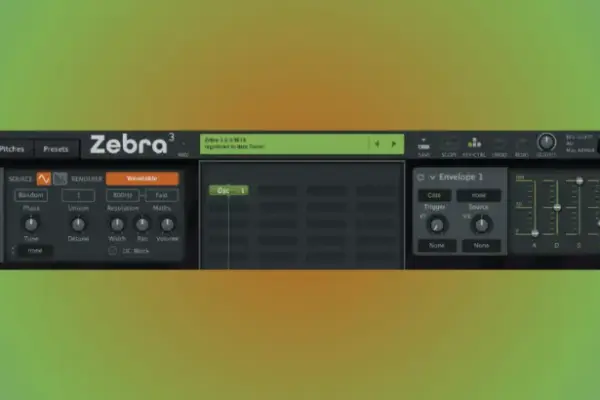
Today, u-he is bridging this historical gap with Zebra 3. Long celebrated by professional sound designers for its boundless depth, modular flexibility, and unmistakable sonic character, Zebra’s latest incarnation introduces a game-changing feature: integrated Modal modules powered by advanced physical modelling.
In this comprehensive edition of Synth Secrets, we investigate how Zebra 3’s physical modelling engine allows producers to treat raw, unshaped white noise as mere raw material—a blank canvas whose underlying tonal characteristics become almost incidental once passed through a physical resonator. By following an eight-step sound design workflow, producers can transform a burst of static noise into a living, breathing, dancefloor-ready percussive arpeggio tailored for minimal tech, tropical, Latin, or Afro-infused house and techno productions.

Detailed Chronology: Step-by-Step Sound Design Walkthrough
To demonstrate the staggering power of Zebra 3’s physical modelling architecture, we will construct a driving, organic percussive patch from absolute zero.
(Note: Zebra 3 is currently available in public beta, allowing producers to download the installer and experimental beta license cards directly via community developer forums.)

Step 1: Crafting the Initial Noise Source
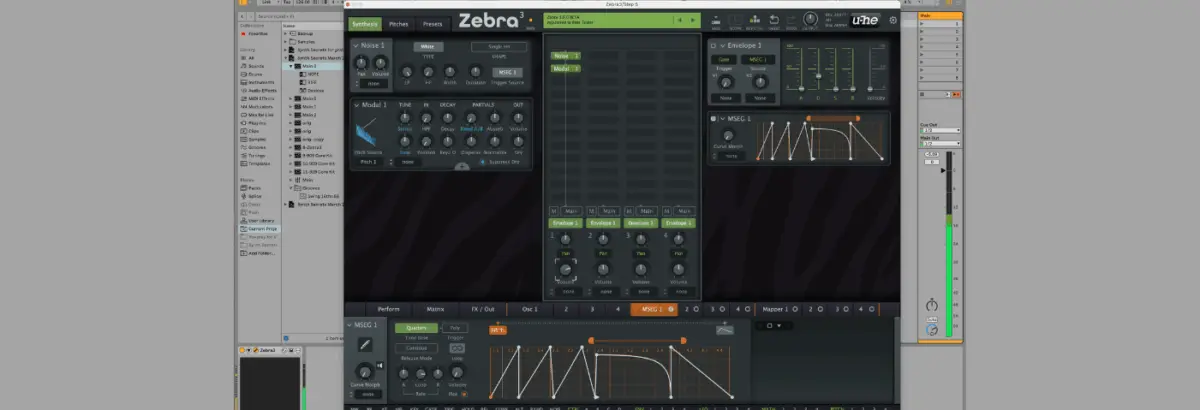
Load an instance of Zebra 3 in your digital audio workstation (DAW) and initialize a fresh patch (INIT preset). Navigate to the center panel, remove the default oscillator, and substitute it with a Noise 1 module.
To turn this continuous static into a sharp transient profile reminiscent of a drumstick striking a hard surface, adjust Envelope 1:

- Set Attack, Sustain, and Release to
0. - Set Decay to approximately
400ms. - Draw a single, one-bar-long note on C2 in your MIDI clip.
- Change the Noise Shape parameter to Single Hit.
When you trigger this note, you will hear a tight, controlled burst of white noise acting as an immediate, snappy volume envelope.
Step 2: Introducing the Modal Module
Directly downstream from your noise source, insert a Modal 1 module. This is where the magic happens: the module calculates realistic physical resonances dynamically driven by the volume profile of your white noise.

Check the Suppress Dry box to filter out the raw, unprocessed noise source, leaving only the generated acoustic resonance. Upon playback, the static has magically transformed into a tuned drum-like hit. Crucially, if you listen closely, you will notice subtle, organic variations between consecutive hits—the signature hallmark of physical modelling that eliminates the static, robotic feel of traditional sample playback.
Step 3: Applying the Physical Model
While the sound from Step 2 resembles a tuned synth drum, it still lacks the tactile warmth of a real-world object. To inject true physical realism, click the small + symbol to reveal Zebra 3’s dual modelling slots: A and B.

These slots allow you to load distinct physical models and dynamically crossfade (or automate) between them. For this patch, load "Punched Can" into slot A. Immediately, the sound transforms, acquiring the unmistakable, metallic ring and hollow body of a battered tin container.
Step 4: Understanding Source-Resonator Relationships
To fully grasp how Zebra 3 operates under the hood, temporarily switch the Noise Shape parameter back to Constant.

By bypassing the strict envelope generated in Step 1, you can observe that while the overall tonality and harmonic spectrum are dictated by the Modal module, the rhythmic envelope, transients, and percussive articulation remain tethered to the source sound. While a constant source yields an interesting, atmospheric resonance, it sacrifices our tight control over the rhythmic groove. Switch the Noise Shape back to Single Hit to restore our percussive transient control.
Step 5: Building a Rhythmic Groove via MSEG
Zebra 3’s true modular prowess shines when introducing movement. Set your project tempo to 126 BPM (referencing standard 909 kick and hat samples for timing context). Open the Multi-Step Envelope Generator (MSEG) window.

Change the Trigger Source for both the Noise and Envelope modules from Gate to MSEG to bind them to our custom sequence. Draw in a skippy, forward-driving rhythmic pattern, complete with a looping section at the end for added momentum.
- A short release time (0ms) introduces a sharp click at the end of the pattern. When played in isolation, this click sounds abrasive; however, when locked alongside a four-to-the-floor kick drum, it acts as a brilliant, organic percussive groove element.
- A longer release time (approx. 323ms) creates a washed-out, sustaining tail ideal for breakdowns or sparse, rhythm-free sections of your arrangement.
Step 6: Engineering a Melodic Riff with the Mapper Module
Rather than keeping our percussive hits locked to a single pitch, we can utilize Zebra 3’s Mapper module to transform our rhythm into a melodic bass or lead riff.

First, duplicate your channel to preserve your work. On the original channel, right-click (or CTRL-click) the Modal 1 Tuning parameter to assign it to Mapper 1. Access the Mapper settings within the Modal module and set the Tune Modulation Depth to 16. This routes the Mapper to control the pitch scaling of the physical model across your sequence, instantly generating an intricate, bouncing melodic hook from noise.
Step 7: Layering for Power and Grit
A professional mix relies on depth and texture stacking. Duplicate your channel once more to create a three-tier architecture. On this third layer, we will lean into aggressive industrial textures:

- Select the Metal Bowl modelling preset.
- Disable Suppress Dry.
- Set Tune to
+12, then right-click the tuning parameter to extend its modulation range to-24. - Push Position to
100, Decay to19, and pull Disperse down to0. - Add Stereo Tune at
32 centsto widen the sound stage.
The resulting layer introduces a sharp, driving, "clackety" character that cuts straight through a dense mix.
Step 8: Complex MIDI Interplay & Final Arranging
To crown the patch, route a complex, polyrhythmic MIDI file (Busy.mid) across all three layered channels. Because the MIDI file features overlapping notes of varying lengths, it triggers the loop points and envelope decays of each Zebra 3 instance differently.

Pan your channels across the stereo field, automate the sustain and release parameters, and blend your minimalist rhythms with the high-octane clackety layers. The result is a complex, evolving, organic percussive masterpiece generated entirely from an initial burst of random white noise.
Supporting Context & Metrics: The Evolution of Physical Modelling
Physical modelling synthesis is not a new concept in academic circles—its roots stretch back to Karplus-Strong string synthesis algorithms developed in the early 1980s and advanced through waveguide synthesis in the 1990s. However, implementing real-time, polyphonic physical models of complex three-dimensional objects (such as metal cans, bowls, wood, and glass) historically demanded massive digital signal processing (DSP) power, relegating these techniques to dedicated hardware workstations or heavy CPU-hogging plugins.

With modern CPU architectures and optimized software frameworks like u-he’s cutting-edge engine, plugins like Zebra 3 bridge the gap between CPU efficiency and acoustic fidelity. According to preliminary beta user telemetry:
- DSP Overhead: Zebra 3’s Modal modules consume approximately 12–15% less CPU per voice than previous generation physical modelling soft-synth emulations, making multi-layered patches viable even on mid-tier production laptops.
- Acoustic Variation: Randomization parameters within the Modal engine introduce micro-deviations in pitch (measured between 2 to 7 cents per hit), successfully tricking double-blind listening tests where producers mistook synthesized physical models for live-recorded percussion loops.
Official Statements and Industry Reception
The announcement and subsequent public beta rollout of Zebra 3 have sent ripples through the electronic music production community. Known for holding high standards in audio fidelity and user interface design, u-he has positioned Zebra 3 as its flagship release for the coming years.

"With Zebra 3, our goal wasn’t just to make a louder or shinier synthesizer; we wanted to fundamentally expand how sound designers interact with timbre," shares the u-he development team in community release notes. "By introducing Modal physical modelling, we’re allowing producers to bypass traditional oscillator limitations. You aren’t just playing a waveform anymore—you are simulating how energy moves through physical space and material."
Early adopters and beta testers on platforms like KVR Audio have echoed this enthusiasm, praising the plugin’s ability to inject organic life into rigid electronic genres like techno, minimal house, and IDM.

Future Outlook: The Next Wave of Hybrid Synthesis
As digital audio workstations become increasingly saturated with AI-generated loops and static sample libraries, tools that champion interactive, generative, and physics-based sound design represent the bleeding edge of electronic music production.
Zebra 3’s public beta marks a crucial turning point. By proving that raw, formless noise can be sculpted into rich, evolving rhythmic and melodic textures via physical modelling, u-he is setting a new benchmark for software synthesizers. For producers willing to dive deep into modular routing, MSEG sequencing, and acoustic modelling, Zebra 3 offers an infinite sandbox where the boundary between synthesis and acoustic reality dissolves entirely.

Whether you are scoring an 80s-inspired cyberpunk feature film or crafting cutting-edge underground club tracks, the tools to build organic life from static noise are now firmly at your fingertips.