Executive Overview
Long before the decisive clash at the Battle of Hastings in 1066 forever altered the trajectory of English history, William of Normandy and Harold Godwinson were not mortal enemies—they were brothers in arms. Beneath the weight of political ambition and eventual bloodshed lies a largely forgotten, deeply human chapter of medieval history: an episode of shared peril, military alliance, and mutual rescue along the treacherous border of Normandy and Brittany.
This dramatic narrative, preserved in the intricate embroidery of the famed Bayeux Tapestry, comes to the forefront of cultural consciousness as the masterpiece prepares for a landmark display at the British Museum in London this September. For medieval historians, the tapestry is more than a conqueror’s propaganda piece; it is a visual chronicle of profound tragedy. It captures the exact moment when two powerful leaders stood shoulder-to-shoulder against nature itself, only to be driven apart by a fateful oath and the unyielding demands of medieval kingship.
This article explores the deep history behind the Bayeux Tapestry’s lesser-known panels, tracing the journey from the mudflats of Mont Saint-Michel to the tragic fields of Hastings, and examining what this remarkable artifact reveals about human nature, political manipulation, and the inescapable pull of destiny.
Detailed Chronology: From Shipwreck to Sanctuary and Betrayal
1064: The Accidental Arrival
The saga of how an English nobleman and a Norman duke became inextricably linked begins not with a grand diplomatic mission, but with the caprice of the sea. In 1064, Harold Godwinson—arguably the most powerful and influential noble in late Anglo-Saxon England—found himself shipwrecked on the coast of Ponthieu in northern France.
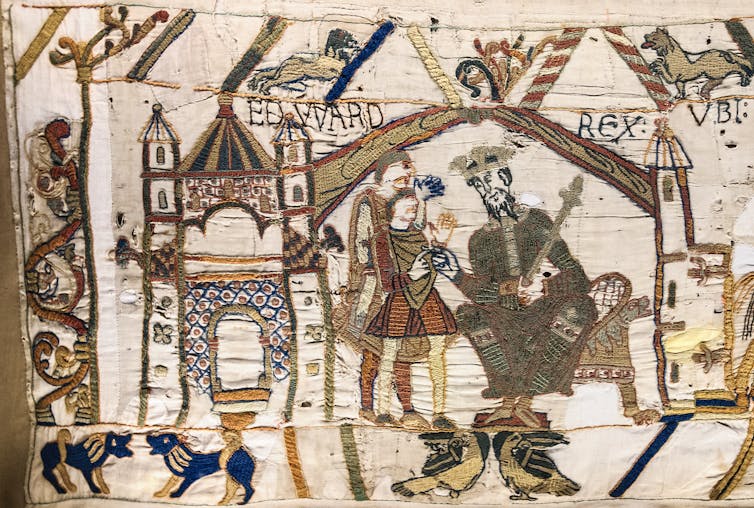
At the time, the political stability of England hung by a thread. The reigning monarch, King Edward the Confessor, was aging, frail, and entirely without direct heirs. The succession was an open, volatile question, with multiple factions positioning themselves to seize the crown. Recognizing the immense strategic value of the stranded English lord, Guy of Ponthieu captured Harold. However, William, Duke of Normandy, quickly intervened, demanding that the valuable hostage be handed over to his custody.
William’s motives were clear. Capturing Harold provided the Norman duke with unprecedented leverage in the looming succession crisis. Yet, rather than treating Harold merely as a prisoner of high value, William integrated him into the upper echelons of his court—setting the stage for a complex psychological dynamic of hospitality, coercion, and camaraderie.
The Brittany Campaign and the Quicksands of the Couesnon
Shortly after Harold’s arrival in Normandy, William launched a military campaign against Duke Conan II of Brittany. Harold was compelled to ride alongside the Norman army, occupying the ambiguous and precarious status of guest, hostage, and combatant all at once.
As the campaign progressed, William and Harold’s forces reached the border separating Normandy from Brittany near Mont Saint-Michel. The natural barrier between the two territories was the river Couesnon, an expanse of water flanked by vast tidal flats and notorious, shifting quicksands (sables mouvants).
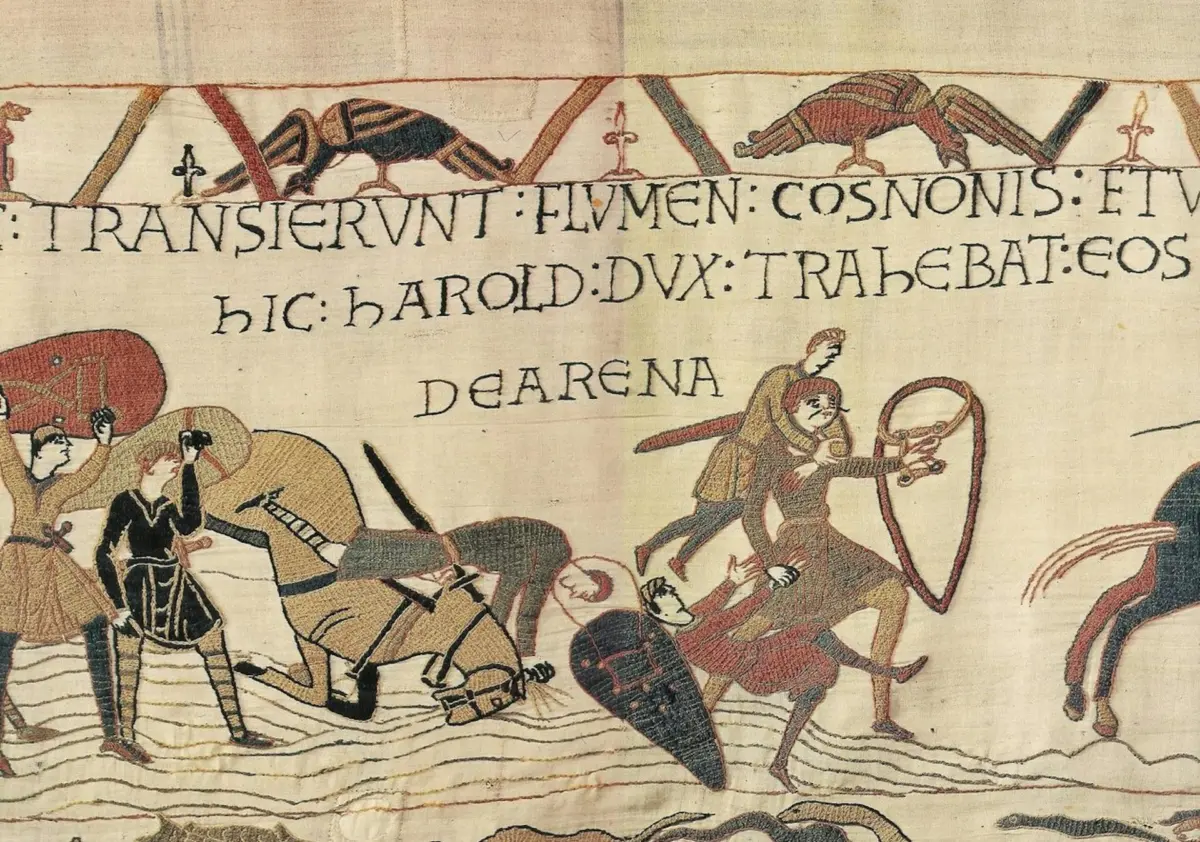
What transpired next is immortalized in the Bayeux Tapestry with stunning clarity. As the heavily armored Norman army waded into the river basin, disaster struck. The collective weight and tramping feet of the soldiers disturbed the fragile, waterlogged silt, setting off a chain reaction of liquefaction. Men staggered as the ground gave way beneath them; shields were hoisted high in frantic efforts to maintain balance; horses panicked, stumbled, and threw their riders into the sucking mud. Chaos and terror gripped the vanguard.
The Hero of Mont Saint-Michel
In the midst of this unfolding disaster, it was not a Norman knight who saved the day, but the English hostage.
The Bayeux Tapestry records the rescue with the Latin inscription: "Hic Harold dux trahebat eos de arena" ("Here Duke Harold dragged them out of the sand"). In the embroidered panel, Harold—instantly distinguishable from the clean-shaven Normans by his luxuriant, flowing Anglo-Saxon moustache—grips his shield in one hand while using the other to haul a drowning soldier from the abyss. Behind him, another foot-soldier clings desperately to Harold’s back as he is carried to firm ground.
For a brief, shining moment, Harold was the undisputed hero of the Norman army. Modern historians who have retraced these steps across the Bay of Mont Saint-Michel attest to the terrifying reality of the terrain. Even today, navigating the flats without an expert guide is a fatal gamble. Experiencing the quicksand firsthand—where minimal movement causes the sediment to lock around the legs like concrete—makes Harold’s physical feat all the more staggering. He did not merely rescue anonymous soldiers; he preserved the momentum of William’s campaign.
Supporting Context & Metrics: Decoding the Bayeux Tapestry
Measuring roughly 68.3 meters in long and 50 centimeters in height, the Bayeux Tapestry is an unrivaled historical document. While its main register depicts the high politics of the Norman Conquest—the councils, the ship-building, the battles, and the bloodshed—scholars increasingly emphasize the rich, multifaceted commentary hidden within its upper and lower borders.
The Eels, Eagles, and Wolves of the Border Panels
To fully understand the tapestry, one must look away from the central narrative and examine the decorative margins. These borders are populated by fables, animal motifs, and visual metaphors that comment ironically or prophetically on the main action.
In the borders flanking the quicksand scene, natural wildlife mirrors the biodiversity of the Couesnon estuary—birds and fish abound. However, they are accompanied by a swarm of writhing, twisting eels. In the embroidered margin, a human figure reaches out to grasp them, only for the slippery creatures to evade his grip entirely.
Historians interpret this as a brilliant piece of visual subtext regarding Harold Godwinson himself: charismatic, capable, and heroic in the moment, yet ultimately as slippery and elusive as an eel when it came to political commitments. Directly adjacent to the eels, the presence of predatory eagles and wolves introduces a chilling note of violence and foreboding. Even as Harold plays the savior, the tapestry weaves in a persistent premonition of his eventual doom at Hastings.
Chronicling the Man: Orderic Vitalis’s Assessment
The dual nature of Harold—admired for his physical prowess yet dogged by questions of honor—was captured decades later by the medieval chronicler Orderic Vitalis. Writing of the English earl, Vitalis noted:
"He was very tall and handsome, remarkable for his physical strength, his courage and eloquence, his ready humour and acts of bravery."
Yet, capturing the moral ambiguity that medieval writers attached to Harold’s later political maneuvers, Vitalis added a cutting caveat:
"What were all these gifts to him without honour, which is the root of all good?"
This tension between personal heroism and ultimate political treachery forms the emotional core of the Norman narrative. Following the successful campaign against Duke Conan—which saw Conan surrender the keys to the citadel of Dinan at the tip of a lance—William rewarded Harold richly, gifting him arms in a gesture resembling a fraternal embrace.
The Fateful Oath at Bayeux
The climax of Harold’s stay in Normandy occurred at Bayeux, where William engineered the political trap that would justify the 1066 invasion.
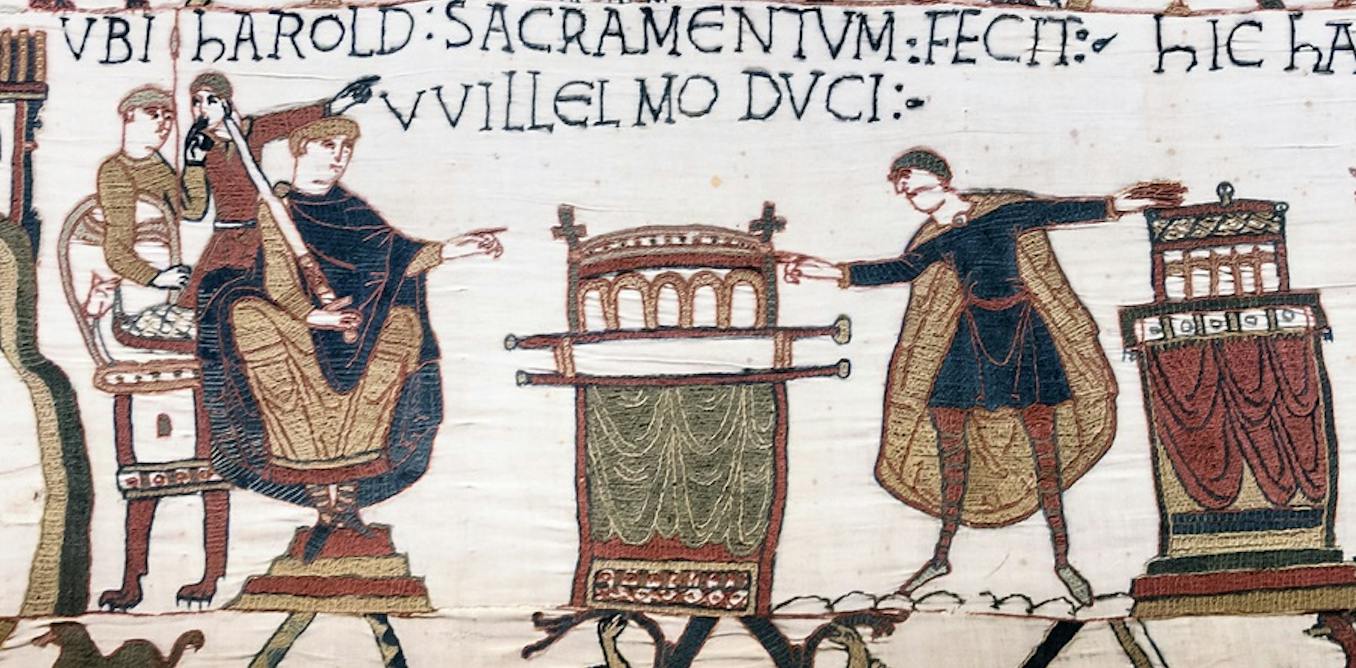
The tapestry shows Harold placing his hands upon sacred holy relics to swear an oath of fealty to William, recognizing the Duke as the rightful successor to the English throne. Whether Harold fully understood the binding nature of the oath, or whether he was coerced under duress, remains a subject of intense academic debate. Regardless of the legal nuances, the oath was viewed by Normandy as a sacred pact. When King Edward the Confessor died in January 1066 and Harold claimed the English crown for himself, the oath was broken—transforming brother-in-arms into existential enemies.
Official Statements & Curatorial Insights
The upcoming exhibition of the Bayeux Tapestry at the British Museum has drawn intense interest from international heritage organizations, cultural ministers, and medieval scholars alike.
Dr. Catherine Clarke, a prominent medieval historian and author who has extensively studied the material culture of the Norman Conquest, emphasizes the emotional resonance of viewing the artifact through a lens of lost friendship rather than inevitable slaughter:
"We are so conditioned by the tragic ending at Hastings—the arrow in the eye, the mutilated corpses, the fleeing English infantry—that we forget the complex human relationships that preceded the war," Dr. Clarke notes. "When you stand before the panels depicting Mont Saint-Michel, you are looking at a genuine human bond forged in mortal peril. It is a tragedy in the classical sense: two capable, extraordinary men whose mutual respect was crushed by the ruthless demands of medieval power politics."
Curatorial teams at the British Museum have underscored that the loan of the tapestry represents a rare, monumental diplomatic and conservation achievement. While the physical artifact requires rigorous climate control and meticulous handling, bringing the masterpiece to London allows millions of contemporary viewers to engage with the intricate needlework up close.
A spokesperson for the British Museum released the following statement regarding the exhibition:
"The Bayeux Tapestry is one of the world’s greatest cultural treasures. By presenting it to the British public, we are not merely displaying a monument to a military victory; we are opening a window into the twelfth-century worldview. The tapestry functions as an epic graphic novel, balancing high-stakes geopolitics with subtle human emotion, irony, and tragedy. We hope visitors will look beyond the famous battle scenes to discover the rich, nuanced backstories woven into every square inch of this masterpiece."
Future Outlook: Preservation, Exhibition, and Historical Legacy
As preparations for the British Museum’s autumn exhibition enter their final phases, conservators, scientists, and historians are utilizing cutting-edge imaging technologies to study the tapestry’s linen foundation and woolen threads. These non-invasive analyses continue to reveal new insights into the medieval workshop practices of the embroiderers—likely working in England under Anglo-Saxon or Norman patronage—shedding light on the speed, skill, and collaborative effort required to create a work of such staggering scale.
Beyond the museum walls, the physical landscapes that inspired the tapestry are also facing modern challenges. The Bay of Mont Saint-Michel and the shifting channels of the Couesnon river remain dynamic, heavily monitored ecological zones. Efforts by French environmental authorities to restore the maritime character of Mont Saint-Michel—including the removal of old causeways and the regulation of tidal flows—ensure that visitors today can experience an environment remarkably similar to the one traversed by William and Harold in 1064.
Ultimately, the enduring fascination with the Bayeux Tapestry lies in its refusal to offer simplistic moral binaries. It records a world of fierce loyalties and brutal betrayals, where heroism and political cunning were two sides of the same coin. As modern audiences prepare to crowd the galleries in London, the stitched figures of William and Harold will once more remind the world of a complex truth: that history is written not just by abstract forces of statecraft, but by real human beings caught in the swift, unforgiving currents of time.