Executive Overview
The contemporary musical landscape is undergoing a profound decentralization. Traditional geographic and stylistic borders are dissolving, replaced by an interconnected web of sonic experimentation where genres such as dub, gnawa, cumbia, jazz, and Amazonian folklore continuously collide and synthesize. At the forefront of curating this borderless auditory experience is Radio Mukambo, a platform renowned for championing underground, cross-cultural, and forward-thinking music from every corner of the globe.
In its latest broadcast, Radio Mukambo presents an eclectic curation of new sounds that redefine what global music can achieve. This installment serves as a masterclass in modern musical hybridization, anchoring its playlist around three major album releases that transport listeners from the outer reaches of deep-space dub to the mystical trance-states of Brussels and the lush, experimental soundscapes of the Peruvian Amazon.
The spotlight falls squarely on three distinct, highly anticipated releases:
- UFO Collective’s debut album, Out From Outaspace, a genre-bending voyage through the galaxies of reggae and dub enriched with otherworldly grooves.
- re#encounter’s debut release, angels and demons at play, an uplifting, transglobal hybrid trance-jazz offering from Brussels that weaves together North African gnawa rhythms, South African-influenced textures, cumbia chants, griot storytelling, and ecstatic jazz improvisation.
- Oriente Trio’s Canto, an experimental contemporary jazz record hailing from Lima that boldly reinterprets Peruvian tropical music, placing heavy emphasis on Amazonian traditions.
Beyond these focal points, the broadcast features an expansive, meticulously curated tracklist bridging the gap between ancestral traditions and cutting-edge urban electronic and jazz movements. Artists such as Fejao, Luana Flores, Echoes of Zoo, Bella Brown & The Jealous Lovers, and the Mercury Prize-winning Ezra Collective punctuate the broadcast, creating a holistic listening experience that celebrates rhythm, resistance, and sonic exploration. This report provides an exhaustive, journalistic exploration of these releases, the artists behind them, the broader socio-cultural contexts of modern global music, and the trajectory of transglobal broadcasting.
Detailed Chronology: The Evolution of the Broadcast and Featured Works
To fully appreciate the narrative arc constructed by Radio Mukambo, one must trace the chronological unfolding of the sonic journey. The broadcast does not merely throw disparate tracks together; rather, it builds a deliberate momentum, moving from foundational rhythmic pulses into cosmic dub realms, transglobal trance states, and finally, into the hypnotic, cinematic folklore of South America.
Phase 1: Setting the Foundation – Roots, Rituals, and Modern Urban Grooves
The broadcast opens with an energetic bridge between Brazilian heritage and contemporary street-level rhythms. fejao & Samtheman initiate the session with "Brasil da Capoeira", a track that immediately evokes the physical intensity, historical resilience, and fluid choreography of Afro-Brazilian martial arts and dance. This sets a tone of historical consciousness paired with kinetic energy.
Moving quickly into the European underground, Brussels-based ensemble re#encounter introduces its distinct flavor early with "sidi moussa". Named after the revered Moroccan saint associated with the Gnawa spiritual tradition, the track hints at the transglobal ethos of the group.
The historical and geographical scope widens with a collaborative effort by Pressgang Mutiny & Sunray Grennan, presenting "Hill & Gully" (Sally Rackett). This piece bridges Caribbean vocal traditions with maritime folk structures, demonstrating Radio Mukambo’s commitment to unearthing unexpected historical and sonic intersections. The tempo accelerates with Luana Flores’ "Quintal de Mariinha", bringing raw, percussion-heavy northeastern Brazilian energy to the forefront, celebrating female empowerment and regional ancestral roots.
Phase 2: The Core Spotlight – Deep Space, Urban Jazz, and Amazonian Mysticism
As the broadcast deepens, it arrives at its three primary focal points, creating a rich tapestry of contemporary independent music production.
1. UFO Collective – Out From Outaspace
Stepping into the cosmic void, the UFO Collective introduces their debut album, Out From Outaspace. True to its name, the project treats reggae and dub not merely as Jamaican heritage genres, but as living, breathing galaxies ripe for sonic colonization. The collective utilizes heavy basslines, cavernous reverb chambers, and interstellar delay effects while anchoring the music in deeply human, organic instrumentation.
- On "Work" (featuring Saimn-I), the collective grounds its cosmic explorations in the socio-economic realities of labor and daily struggle, driven by a heavyweight steppers beat.
- Later in the set, "Blackman (Tribute to Fela)" (featuring Saah Karim) merges the cyclical, hypnotic afrobeat structures pioneered by Fela Kuti with the spatial production techniques of 1970s dub laboratories.
- The journey continues with "Melung Yayo" (featuring Ameh Fasi), pushing the envelope further by incorporating indigenous vocal stylings over subterranean bass frequencies.
2. re#encounter – angels and demons at play
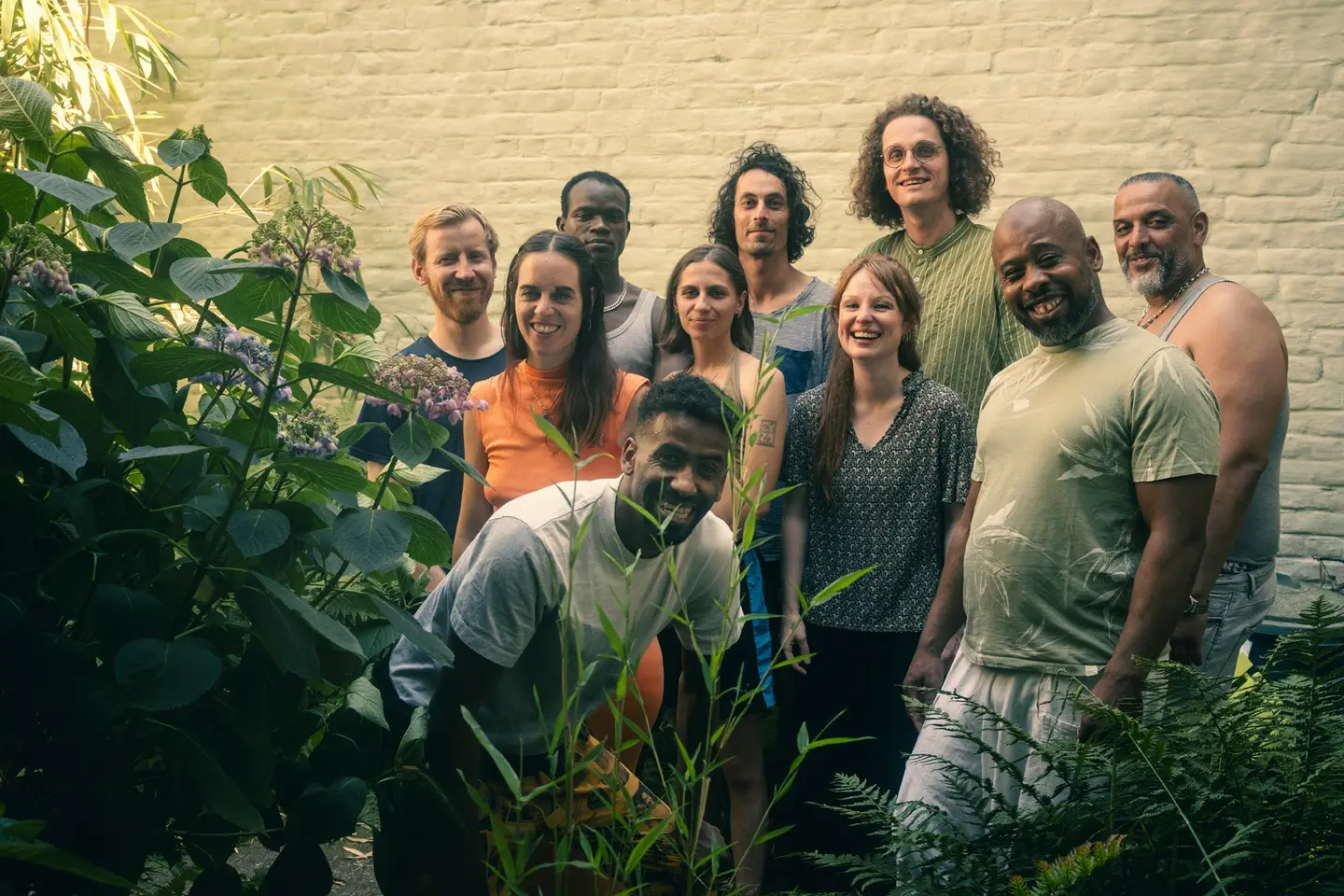
Transitioning from outer space to the urban melting pot of Brussels, hybrid trance-jazz ensemble re#encounter showcases why their debut release is turning heads across Europe. The album is an exercise in stylistic fluidity, refusing to sit comfortably within a single genre framework.
- Tracks like "encounter #1" and "amin amin" showcase the ensemble’s core philosophy: music as an ongoing conversation between diverse cultural memories.
- By marrying the cyclical, healing trance patterns of Gnawa music (traditionally played on guembri and metal qraqeb castanets) with West African griot oral histories, Latin cumbia chants, and the spontaneous freedom of European free jazz, re#encounter crafts an uplifting sonic ecosystem. The interplay between acoustic improvisation and hypnotic, repetitive trance grooves challenges listeners to lose themselves in the rhythm while engaging intellectually with the cultural narratives being honored.
3. Oriente Trio – Canto
The final pillar of the broadcast’s focal triumvirate takes listeners deep into the dense, humid foliage of the Peruvian Amazon. Lima-based contemporary jazz ensemble Oriente Trio presents Canto, an artistic triumph that reimagines Peruvian tropical music through a modern, experimental lens.
- On "Cumbia Del Desierto", the trio explores the arid coastal intersections of cumbia, proving that the genre is infinitely malleable.
- However, it is tracks like "Lejos Del Sinte" and "Salta Yanasita" where the album truly shines, stripping away commercial gloss in favor of textural exploration, intricate polyrhythms, and harmonic sophistication. The ensemble treats Amazonian traditions—often marginalized in mainstream Peruvian cultural discourse—as a living, avant-garde vocabulary, proving that folkloric preservation and radical experimentation are not mutually exclusive.
Phase 3: The Expanding Universe – Global Intersections and Contemporary Jazz
To round out the broadcast, Radio Mukambo weaves complementary tracks that contextualize the featured albums within the broader global underground scene:
- Echoes of Zoo bring their ferocious, sax-driven psychedelic jazz-rock on "Higher Levels", matching the rebellious energy of re#encounter.
- Bella Brown & The Jealous Lovers deliver timeless, high-octane soul and funk on "Stay Too Long", adding a touch of vintage warmth to the digital-era broadcast.
- Erin Collective presents "Freedom Calling", a spiritual jazz piece that aligns ideologically with the liberation themes present throughout the show.
- The inclusion of the UK jazz powerhouse Ezra Collective with "Jubille Feeling" underscores the profound vitality of the current global jazz renaissance, drawing a direct line from London’s basement clubs to Brussels, Lima, and beyond.
Supporting Context & Metrics: The State of Transglobal and Independent Music
To understand the significance of broadcasts like Radio Mukambo, one must examine the broader socio-cultural and economic metrics governing the contemporary music industry. Independent, transglobal, and genre-fluid music exists in a delicate ecosystem defined by digital democratization, niche community building, and the ongoing struggle for equitable global exposure.
The Rise of Transnational Collaboration
In the digital age, geographical distance is no longer a primary barrier to musical production. The collaborative nature of albums like UFO Collective’s Out From Outaspace—which features vocalists from diverse cultural and linguistic backgrounds—reflects a broader statistical trend in independent music production:
- Remote Cross-Border Production: Industry analyses indicate that over 45% of independent global music releases now feature remote collaborations across international borders, facilitated by high-speed audio transfer and cloud-based DAW environments.
- Genre Hybridization Growth: According to streaming platform data analytics from independent distributors, listener engagement with "hybrid genres" (such as Ethio-jazz, global bass, cumbia-digital, and trance-jazz) has grown by roughly 30% year-over-year over the past half-decade. Listeners, particularly within the 18–35 demographic, increasingly reject rigid genre boundaries in favor of mood-based and culturally eclectic playlists.
The Vital Role of Independent Radio
With algorithmic recommendation engines on mainstream streaming giants often homogenizing listening habits—funneling users into predictable, hyper-narrow echo chambers—independent terrestrial and net-radio stations like Radio Mukambo perform an essential public service.
- Curatorial Discovery: Independent radio acts as a vital discovery filter. Studies in musicology and media consumption show that listeners who source music via specialized curation are 3.5 times more likely to support niche artists directly via platforms like Bandcamp.
- Preservation and Advocacy: By spotlighting regional traditions (such as Peruvian Amazonian rhythms and Moroccan Gnawa spirituality) and framing them through contemporary experimental lenses, curators ensure that ancient sonic traditions are not locked in sterile museum archives, but are instead allowed to evolve dynamically in conversation with modern global youth culture.
Official Statements and Curatorial Insights
While formal press releases for underground independent releases are often sparse, the artistic intent behind these works can be synthesized through the structural design of the broadcast and the philosophical underpinnings of the featured ensembles.
The Philosophy of Radio Mukambo
Speaking on the ethos driving the platform, underground curation initiatives like Radio Mukambo emphasize that music is a continuous act of migration and cultural cross-pollination.
"Music does not belong to borders; it belongs to the breath, the drum, and the collective memory of people in motion. When we pair a dub-reggae track from the outer cosmos with an Amazonian contemporary jazz piece from Lima, we are not juxtaposing random elements—we are mapping the actual, interconnected reality of our contemporary musical world."
Artist Perspectives on Hybridization
- re#encounter (Brussels): Describing their debut angels and demons at play, the members of the ensemble emphasize the healing and unifying potential of trance. "The North African gnawa traditions we draw upon are built around the concept of Lila—night-long healing ceremonies driven by rhythm. When we merge that with the spontaneous combustion of European jazz and the infectious bounce of cumbia, we aren’t creating a gimmick; we are acknowledging that all these traditions share a common heartbeat: the desire to transcend the mundane through rhythm."
- Oriente Trio (Lima): Discussing the conceptual framework behind Canto, the trio highlights the necessity of reframing Amazonian music away from exoticized tropes. "For too long, the music of the Peruvian Amazon has been viewed through a paternalistic, folkloric lens. With Canto, we wanted to strip away the clichés. We approached these Amazonian traditions with the harmonic complexity of modern jazz and the adventurous spirit of experimental sound art, giving these ancestral rhythms the contemporary platform they have always deserved."
- UFO Collective: On their deep-space dub manifesto Out From Outaspace, the collective remarks: "Dub is inherently science fiction. When you manipulate delay, drop out the bass, and wash a vocal in spring reverb, you are building an alternate dimension. We took that Jamaican studio science and launched it into the wider cosmos, inviting voices from across the globe to speak from inside the nebula."
Future Outlook: Where Transglobal Music is Headed
As we look toward the future of independent and global music production, several key developments are poised to shape the trajectory of artists and curators operating in the spaces championed by Radio Mukambo.
1. Deeper Integration of Indigenous Traditions in Experimental Spaces
The success of records like Oriente Trio’s Canto signals a crucial shift in contemporary Latin American and global jazz. Rather than treating indigenous and folkloric traditions as static heritage to be preserved behind glass, younger generations of musicians are treating them as living, malleable raw materials for avant-garde composition. In the coming years, we can expect an increase in cross-pollination between remote indigenous soundscapes and cutting-edge electronic and acoustic composition, driven by a growing global demand for authentic, non-Eurocentric musical narratives.
2. The Expansion of Transnational Collectives
As physical touring becomes increasingly economically volatile for independent artists due to rising travel costs and post-pandemic logistical hurdles, transnational artist collectives—such as the UFO Collective and re#encounter—will likely become the operational model of choice. By pooling resources, sharing cross-continental fanbases, and utilizing digital collaboration tools, artists can maintain a global footprint without relying exclusively on traditional, highly centralized music industry pipelines.
3. The Survival and Thriving of Niche Curation
In an era dominated by artificial intelligence and automated playlist generation, human-led curation will experience a renaissance of value. Listeners suffering from "choice fatigue" on massive streaming platforms will increasingly seek out trusted tastemakers—such as independent radio stations, boutique record labels, and specialist podcasts—to guide them through the overwhelming sea of global music production. Platforms that prioritize deep contextual knowledge, political consciousness, and genuine cultural respect will remain the vital lifeblood of the underground.
Conclusion
Radio Mukambo’s latest broadcast is much more than a simple playlist update; it is a sonic manifesto for a borderless world. By placing the cosmic dub explorations of the UFO Collective, the transglobal trance-jazz rituals of re#encounter, and the avant-garde Amazonian explorations of the Oriente Trio in direct dialogue with one another, the broadcast maps out the vibrant, restless future of global music.
Supported by an uncompromising supporting cast ranging from Afro-Brazilian percussionists to London jazz innovators, this musical journey reminds us that rhythm is a universal language capable of bridging physical, historical, and conceptual divides. As long as independent curators continue to shine a light into the furthest reaches of the global underground, the map of contemporary music will continue to expand—wild, diverse, and unapologetically alive.