Executive Overview
The Viljandi Folk Festival stands as a singular cultural monument in Northern Europe, bridging the chasm between ancient pastoral heritage and modern, boundary-pushing avant-garde sound design. Over four transformative days in July, the historic ruins and green hills of Viljandi, Estonia, became a crucible where forgotten repertoires, diaspora anthems, and high-energy electronic reinterpretations collided.
Despite not breaking raw attendance records—reeling in a massive peak of 11,000 visitors on Saturday—the 2026 edition achieved something far more vital: a profound artistic depth. Curated with a fearless reverence for living history, the festival balanced heavy metal folk infusions and hypnotic acid-house runic songs with delicate chamber performances and the poignant preservation of displaced traditions.
From the resilient fiddle tunes of the evacuated Swedish island of Ruhnu to Cape Verdean morna, the festival proved that traditional music is not a museum piece preserved under glass, but a living, breathing, and violently adaptive organism. As the final notes of local reggae-rock outfit Angus faded into the Sunday downpour, it was clear that Viljandi had once again defined the pulse of global folk culture.
Detailed Chronology
Friday: Roots, Resurrections, and Heavy Metal Folk
The festival opened in the early afternoon with a powerful act of cultural salvage: Sounds and Stories from Ruhnu Island. Ruhnu, a remote speck in the Gulf of Riga known as Runö in Swedish, sustained a few hundred ethnic Swedes and their unique fiddle tradition until the Soviet advance emptied the island almost overnight in 1944. Left alive only on tape, this endangered repertoire was brought back to life by fiddlers Karoliina Kreintaal and Lee Taul alongside storyteller Kairi Leivo.
Joined by Ruhnu-born Jüri Keskpaik, who recounted the island’s weddings, feasts, and church life from the inside, the performance was underscored by archival footage of Ruhnu’s shoreline and dances. Adding global weight, members of the Nordic supergroup Groupa—fiddler Mats Édén, flautist Jonas Simonson, and percussionist Terje Isungset, who builds instruments from wood, stone, and ice—collaborated on the set before headlining their own later that day.
As dusk approached, the festival embraced family lineage and cross-cultural lineage. Amaro Duho, assembled in 2021 by Matild Dobi from her own children, brought authentic Oláh Roma traditions to the stage. Dobi, four decades after co-founding the legendary Ando Drom, utilized guitar, tambura, and accordion to preserve a heritage that feels as natural as sitting around a family kitchen table.
However, Estonian tradition can be handled with abrasive force, as Mandoterror brilliantly demonstrated. Frontman Kristjan Kuusmik and mandolinist Tanel Sakrits—backed by a distorted rhythm section—ripped through tracks from their record Nõiajaht and the anthem "Oru Leeni." They traded gentle acoustic picking for Nordic-metal weight, proving that ancient folk melodies easily withstand bone-rattling volume.
The night’s true combustion occurred at the Song Festival Grounds with Zetod. Formed in Värska in 2003, the band takes Seto leelo—the polyphonic singing of Estonia’s southeastern borderlands—and injects it with the speed and fury of a punk band. Frontman Jalmar Vabarna, who also serves as the ülemsootska (the earthly stand-in for the Seto king), drove the performance with four interlocking fiddles, accordion, bass, and drums. The crowd transformed the front rows into a churning mosh pit, shouting every Seto-dialect line back with fierce regional pride.
Saturday: Peak Crowds, Cross-Border Polkas, and Midnight Raves
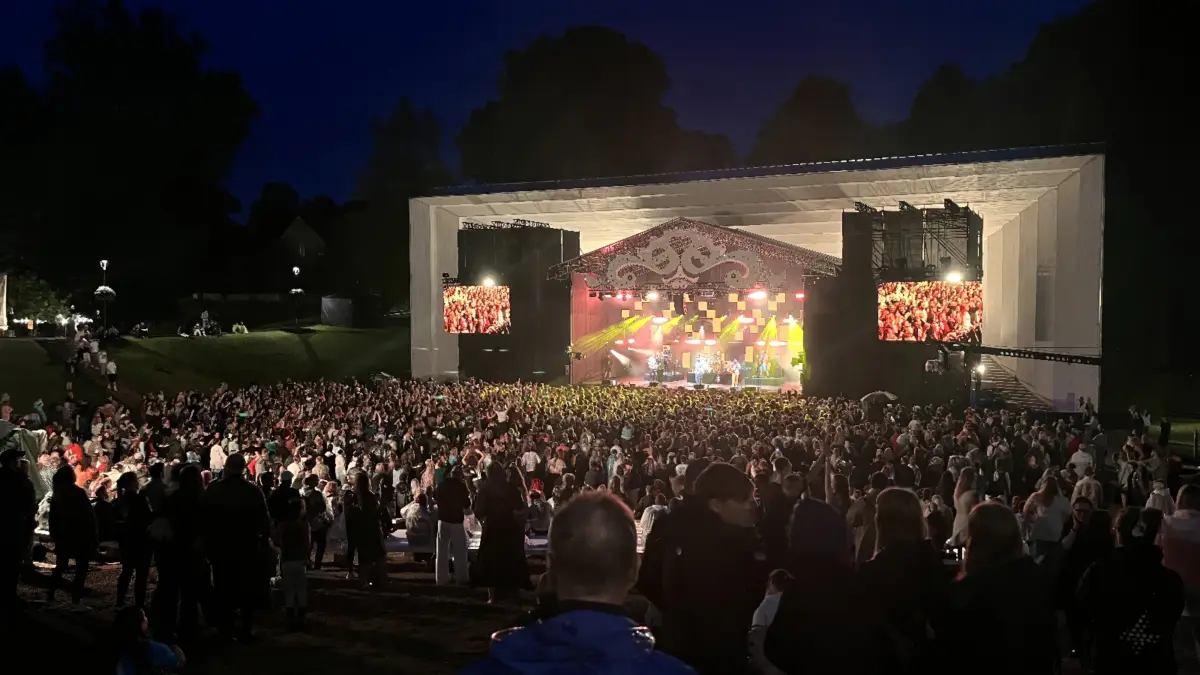
Saturday drew the weekend’s largest crowd, with 11,000 festival-goers packing the winding paths between stages. The energy spilled onto the Song Festival Grounds, where Polish-Ukrainian band HrayBery summoned the ghosts of the San river valley. Clad in the Sunday best of a century ago—straw boaters, waistcoats, and high-collared blouses—the band drove kolomyjkas, mazurkas, and polkas with hammered dulcimers and dual fiddles, orchestrating massive, concentric human chains across the concrete arena.
On II Kirsimägi, Orkesta Mendoza dissolved the boundary between stage and dirt. Led by Sergio Mendoza—who grew up in Ambos Nogales, the town split by the US-Mexico border—the band synthesized mambo, cumbia, and ranchera with surf guitar and psychedelia. When Mendoza shouted "¡Derecha! ¡Izquierda!", thousands of hands moved in synchronized precision.
As night fell, Puuluup commanded an 8,000-strong crowd. Ramo Teder and Marko Veisson manipulate the talharpa (a bowed lyre nearly extinct outside Vormsi) through loopers, creating knocking, creaking rhythms. Joined intermittently by drummer Tõnu Tubli, the deadpan duo mixed deadpan humor with deep musicianship. Celebrating Veisson’s 50th birthday, the crowd erupted into song, prompting Veisson to joyfully hurl himself into the arms of the crowd-surfing audience.
Immediately following, OOPUS pushed the grounds into full rave territory. Mari Meentalo fed bagpipes, jaw harps, and regilaul vocals into a looper that interfaced directly with Johannes Ahun’s Roland analog synths. The result was thousand-year-old runic songs transformed into blistering acid house, driven by Aleksander Sprohgis’s pulsating lighting design and Raho Aadla’s hyper-energetic choreography.
After midnight, the festival split its soul. At Kaevumägi, flute duo Kuula Hetke ("Listen to the Moment") wove delicate soundscapes alongside live painter Okeiko. Simultaneously, the Song Festival Grounds celebrated a decade of Tuulebant+, whose acoustic guitar, fiddle, bass, and lõõts (Estonian button accordion) powered an unyielding late-night dance party.
Sunday: Diaspora, Intimate Virtuosity, and a Mud-Soaked Farewell
Sunday arrived warm and dry before dissolving into a dramatic downpour. The afternoon opened softly with Tell Your Birds, an Estonian, Latvian, and Italian quartet mixing archival Baltic folk recordings into expansive, drifting electronic drones.
Later, Cape Verdean icon Nancy Vieira brought morna to the Viljandi stage for the first time. Born in Guinea-Bissau and raised in Lisbon, Vieira embodies the melancholic displacement central to morna. Backed by minimal instrumentation, her voice bridged fado, Brazilian rhythms, and West African lines before turning the set into an ecstatic celebration with fast-paced Ano Nobo tunes.
The emotional peak of the festival belonged to Scottish pianist Amy Laurenson. Having survived severe flight delays and lost baggage, Laurenson reached Viljandi just in time for her Saturday set. On Sunday, however, placed at a grand piano inside the Ait, she delivered a masterclass. Transposing intricate Shetland fiddle tunes to the keys as a lead voice, she commanded absolute silence from a spellbound audience.
The festival concluded back where it began: in the mud. Local reggae-rock stalwarts Angus, joined by guest vocalist Sofia-Liis Liiv, closed out the Song Festival Grounds under a heavy downpour. Skanking through the puddles to thick dub basslines, the sodden crowd embraced frontman Anton Ventsel’s final parting words: "Have a good evening, a safe journey home, and folk is forever."
Supporting Context & Metrics
- Attendance: Peaked on Saturday, July 25, with 11,000 visitors traversing the grounds. Total multi-day attendance figures reflected steady, sustainable growth prioritizing artistic depth over sheer capacity expansion.
- Geographical Scope: Featured artists hailing from Estonia, Sweden, Hungary, Ukraine, Poland, Mexico, Cape Verde, and Scotland, underlining the festival’s status as a global nexus for traditional music preservation.
- Technological Integration: Marked by an unprecedented fusion of ancient instruments—such as the talharpa and kannel—with modern loop stations, analog synthesizers, and real-time visual projections.
Official Statements
Reflecting on the cultural philosophy driving the 2026 programming, festival organizers emphasized the necessity of active transmission over passive archiving:
"Traditional music is not a relic to be preserved behind museum glass; it is a living language. When we place a centuries-old Seto leelo or an endangered Ruhnu fiddle tune into the hands of modern punk, metal, or electronic artists, we are ensuring its survival. We are giving our ancestors a megaphone for the 21st century."
Closing out the festival, local artist Anton Ventsel captured the emotional ethos of the gathering from the stage:
"Have a good evening, a safe journey home, and folk is forever."
Future Outlook
As the dust settles on the grounds of Viljandi and the temporary stages are dismantled, preparations are already underway for the next iteration. Organizers have officially confirmed that the 27th Viljandi Folk Festival will take place from July 22nd to July 25th, 2027.
Given the soaring critical acclaim of this year’s cross-genre collaborations—exemplified by projects like Duo Ruut³ and OOPUS—the 2027 edition is anticipated to further expand its dialogue between indigenous Baltic roots and international contemporary soundscapes. Early accommodation bookings are already filling up across the town, signaling enduring enthusiasm for one of Europe’s most vital cultural celebrations.