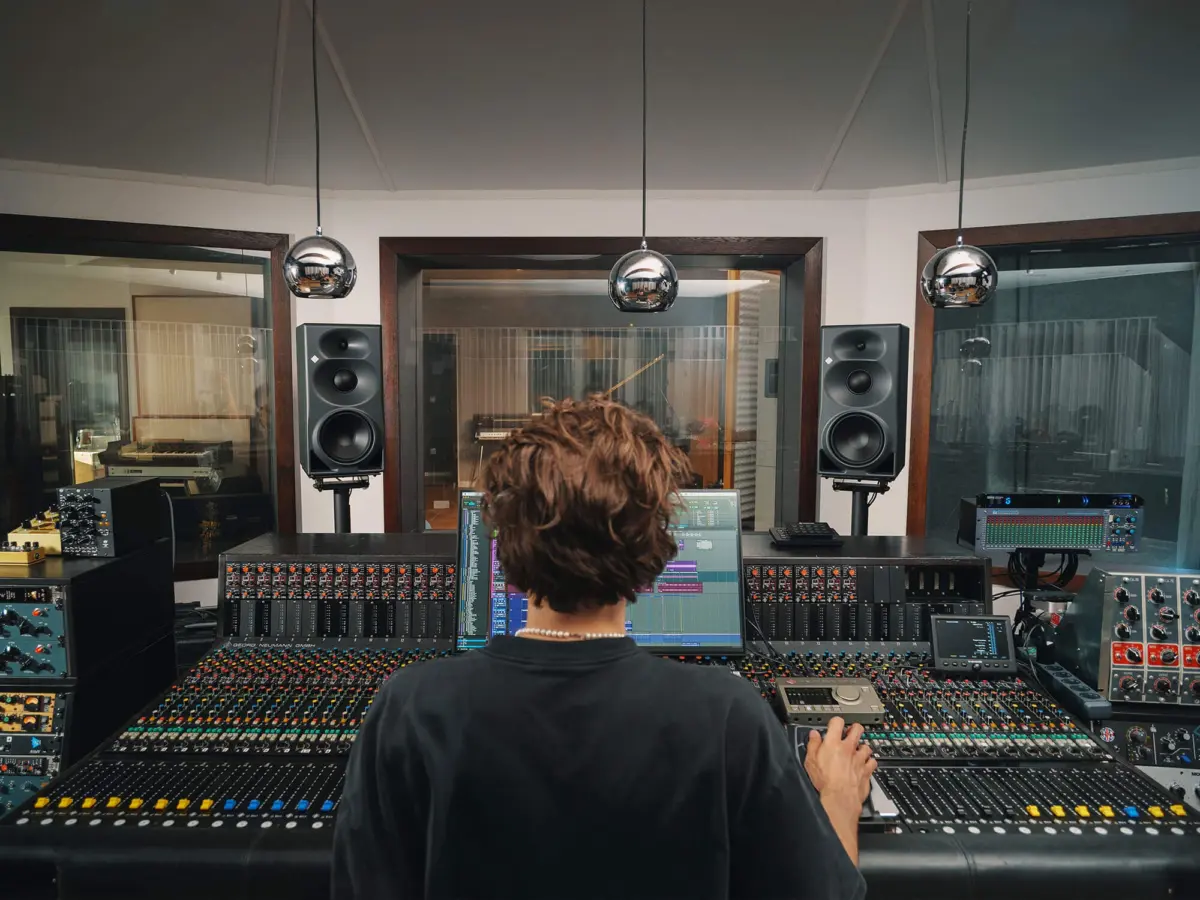
In the fast-evolving landscape of professional audio production, the accuracy of a monitoring environment remains the ultimate bottleneck for creative and technical decisions. Producers, mix engineers, and mastering suites live and die by the translation of their mixes from the control room to the outside world. Entering this high-stakes arena with a formidable pedigree, renowned audio manufacturer Neumann has officially pulled back the curtain on two significant additions to its esteemed catalog of three-way studio monitors: the KH 310 II and the all-new KH 350.
Built upon a robust hardware foundation of proprietary, in-house-engineered drivers and advanced 32-bit digital signal processing (DSP), both new platforms are engineered to deliver uncompromising consistency, pin-point imaging, and reliable translation across an exhaustive variety of professional production workflows.
The KH 310 II steps into the spotlight as the highly anticipated successor to the industry-standard KH 310, preserving the beloved physical footprint of its predecessor while driving performance metrics significantly higher. Meanwhile, the KH 350 emerges as a powerful, full-range monitoring solution explicitly tailored for larger acoustic spaces, filling the crucial gap between the KH 310 II and Neumann’s formidable flagship system, the KH 420.
By unifying these models under a shared acoustic DNA, Neumann is not merely updating its hardware catalogue; it is offering modern audio professionals a modular approach to critical listening—allowing engineers to choose the exact monitoring concept that complements their specific acoustic environment and daily workflow.
Detailed Chronology & Technological Evolution
To understand the weight of Neumann’s latest announcement, one must look at the historical trajectory of the company’s monitoring division—formerly known under the Klein + Hummel banner before fully integrating into the Neumann brand ecosystem. For well over a decade, the original KH 310 stood as an unyielding pillar in commercial recording, broadcast, and mastering facilities globally. Its closed-cabinet design offered tight, articulate low-end transients without the phase anomalies or group delays typically associated with ported bass-reflex designs of a similar scale.
However, modern production requirements have shifted dramatically. Contemporary workflows demand higher SPL (Sound Pressure Level) capabilities to handle dense electronic arrangements, film scores with extreme dynamic ranges, and immersive spatial audio formats like Dolby Atmos. Furthermore, the modern engineer’s workspace is no longer confined to perfectly treated multi-million-dollar mix studios; it spans hybrid production environments, project studios, and mobile setups where acoustic challenges are rampant.
Recognizing these industry shifts, Neumann’s engineering teams embarked on a multi-year research and development initiative. The goal was twofold: modernize the classic KH 310 platform with next-generation processing power and headroom, while simultaneously conceiving an entirely new mid-to-large-format monitor that could bridge the gap between nearfield precision and midfield authority.
The result of this intensive R&D cycle is the simultaneous launch of the KH 310 II and the KH 350. Both systems harness advanced 32-bit DSP architectures that allow for linear phase crossovers, precise driver alignment, and network-based calibration. By implementing these digital processing layers without sacrificing the pristine analog pathways that purists demand, Neumann has successfully bridged the analog warmth of traditional acoustic design with the surgical precision of modern DSP correction.
Architecture, Components, and Deep-Dive Metrics
At first glance, the KH 310 II and the KH 350 share a striking architectural lineage, both utilizing a sophisticated three-way driver configuration comprising a 3-inch soft dome midrange driver, a precision 1-inch high-frequency tweeter, and an 8.25-inch long-throw woofer. However, the implementation of these components varies significantly to accommodate their respective operational parameters and target room sizes.
The KH 310 II: Refining an Industry Icon
The primary engineering challenge for the KH 310 II was improving upon a near-perfect design without alienating the loyal user base that relies on its exact physical dimensions and acoustic response.
Physical Footprint: Neumann successfully maintained the identical cabinet dimensions of the original KH 310. This ensures that current studio owners can swap their aging units for the Generation II monitors into existing flush-mount or console-bridge setups without altering their acoustic architecture or sightlines.
SPL and Headroom: Thanks to redesigned amplifier modules and more efficient voice-coil topologies, the KH 310 II delivers a 5 dB increase in maximum SPL compared to its predecessor. This substantial headroom boost allows engineers to push mixes harder without encountering thermal compression or distortion.
Transient Response: The proprietary 3-inch soft dome midrange driver handles the critical vocal and instrumental fundamental range with exceptional dispersion characteristics, minimizing diffraction and delivering lifelike imaging.
The KH 350: A New Midfield Powerhouse
Positioned squarely between the KH 310 II and the flagship KH 420, the KH 350 is engineered for professionals who require deeper low-frequency extension and greater acoustic projection in larger control rooms.
Cabinet Volume: The KH 350 features a cabinet roughly twice the physical volume of the KH 310 II, enabling it to push air more efficiently and achieve linear low-frequency playback down to a staggering 27 Hz.
Low-End Authority: While the KH 310 II excels in nearfield and tight midfield scenarios, the KH 350 functions as a true full-range monitoring platform. It provides the low-end weight necessary for modern hip-hop, electronic music production, and cinematic sound design without requiring an immediate companion subwoofer.
Connectivity and Digital Integration
Both monitors are equipped with comprehensive connectivity suites, featuring both traditional analog XLR inputs and AES3 coaxial digital inputs. This dual-format approach ensures seamless integration into both legacy analog mixing consoles and modern all-digital monitoring chains.
Crucially, both the KH 310 II and KH 350 feature native compatibility with Neumann’s MA 1 Automatic Monitor Alignment software. The MA 1 system utilizes a precision measurement microphone and proprietary alignment algorithms to analyze the user’s acoustic environment, automatically compensating for boundary loading, room modes, and phase anomalies. This ensures an impeccably flat frequency response and time-aligned stereo or immersive array, regardless of the room’s geometric imperfections.
Official Statements & Industry Perspective
The launch of these two monitoring platforms marks a philosophical milestone for Neumann’s product development division, emphasizing user-centric workflow flexibility over a rigid "one-size-fits-all" approach.
Reflecting on the legacy of the original system and the development hurdles of its successor, Roman Kramer, Product Manager at Neumann, noted:
"The KH 310 has earned an exceptional reputation among recording, mixing, and mastering engineers worldwide. With the KH 310 II, we worked long and hard to retain everything users love about the original while elevating performance in virtually every area. At the same time, the KH 350 opens new possibilities for engineers who need greater low-frequency authority and the flexibility to work confidently across both nearfield and midfield environments."
Echoing this sentiment, Stephan Mauer, Product Management Director at Neumann, highlighted the unifying philosophy behind the simultaneous release:
"The KH 310 II and KH 350 share the same acoustic DNA and commitment to truthful sound reproduction. Today’s engineers work across a wide range of rooms, formats, and production styles. Our goal was to provide two solutions that deliver the same trusted reference standard while allowing users to choose the monitoring concept that best supports their workflow."
Industry analysts and early beta testers within the engineering community have pointed out that Neumann’s strategy addresses a long-standing dilemma in studio design: how to maintain absolute sonic continuity when scaling a monitoring setup from a compact mixing suite to a sprawling tracking room. By ensuring that the crossover points, transient behaviors, and high-frequency dispersion patterns match across the KH 310 II and KH 350, Neumann has eliminated the jarring perceptual adjustments engineers often experience when moving between different rooms in commercial facilities.
Future Outlook & Market Impact
As the professional audio industry hurtles further into an era defined by immersive audio formats (Dolby Atmos, Sony 360 Reality Audio) and hybrid remote/commercial workflows, the demands placed on studio monitors have never been higher. Multi-channel speaker arrays require absolute phase coherence, uniform off-axis dispersion, and deep calibration capabilities to create a stable three-dimensional soundstage.
The introduction of the KH 310 II and KH 350 positions Neumann at the vanguard of this technological evolution. By integrating 32-bit DSP processing and MA 1 calibration natively into robust three-way analog/digital cabinets, Neumann has provided studios with future-proof tools capable of adapting to shifting delivery formats.
For project studio owners looking to upgrade to world-class reference standards, the KH 310 II offers a drop-in performance upgrade without spatial penalties. Meanwhile, commercial studio designers and film scoring mixers now have a formidable new midfield tool in the KH 350—one that delivers the authority of a large-format monitor without sacrificing the pinpoint midrange clarity that Neumann is world-famous for.
As these units begin rolling out to studios globally, they are poised to redefine expectations for what three-way monitor systems can achieve in terms of headroom, translation, and environmental adaptability.