In the high-stakes, hyper-competitive ecosystem of electronic music hardware, independent manufacturers face astronomical odds. The market is historically dominated by heritage brands with deep-pocketed R&D budgets, established distribution chains, and decades of consumer trust. Yet, every so often, a piece of rogue engineering breaks through the noise, challenging the status quo and redefining how artists interact with sound. Enter Audima Labs, an Australian startup founded by two 24-year-old engineering graduates, Isaac Jack and Jeremy Buckley.
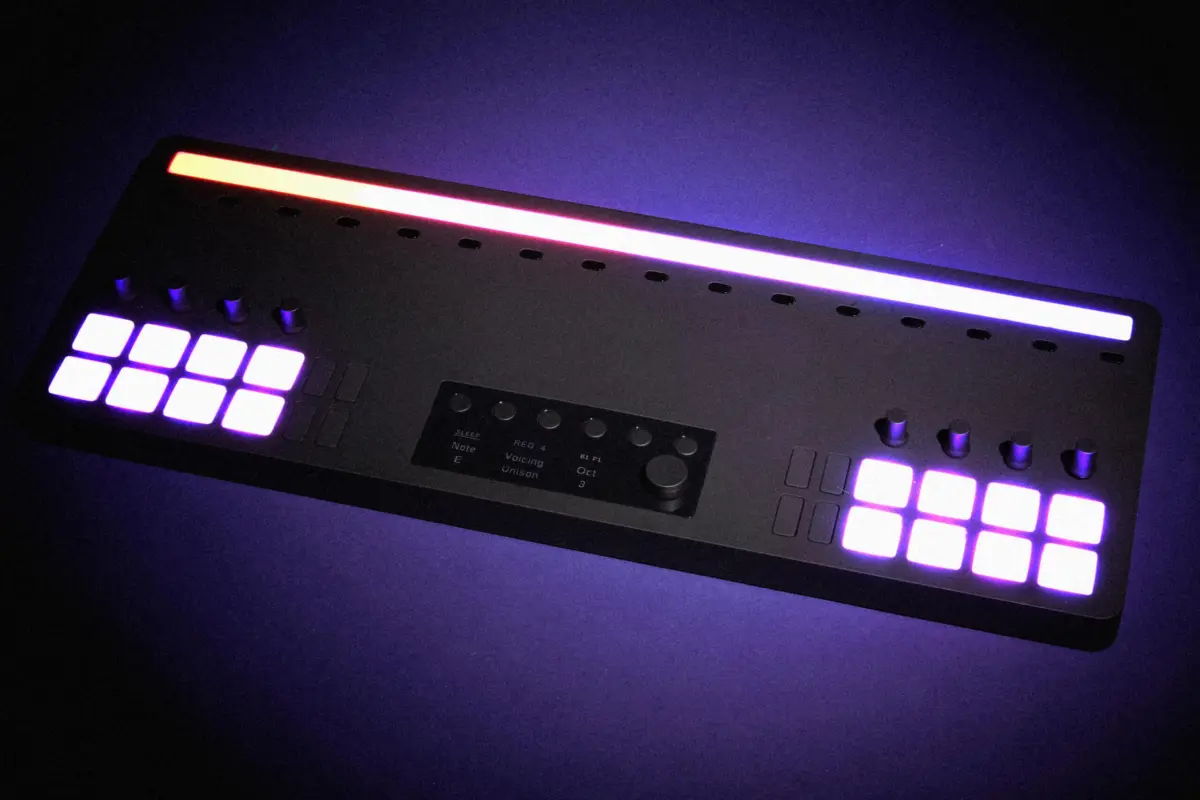
Their debut product, the Sway, is a radical departure from traditional music controllers. Eschewing the conventional tactile paradigms of keys, fretboards, and drum pads, Sway introduces a performance-first interface powered by advanced Time-of-Flight (ToF) infrared sensors. By translating spatial hand movements into low-latency MIDI data, the controller invites performers to sculpt sonic landscapes through theater and motion, bringing a theremin-like fluidity to modern electronic production.
What began as a late-night prototyping experiment in a Queensland dorm room has rapidly blossomed into an international talking point. After securing early backing on Australian television and launching a viral crowdfunding campaign that shattered financial goals, Audima Labs has transitioned from a bootstrapped operation to a bona fide industry player. Most notably, the Sway has graduated from indie forums to the world’s most prestigious stages—including a high-profile deployment by superstar DJ Illenium during his landmark 2026 residency at the Las Vegas Sphere.
This deep dive explores the genesis of Audima Labs, the rigorous engineering behind the Sway, the hurdles of navigating public critique, and what it truly takes for independent makers to carve out a permanent home in the modern music technology landscape.
Detailed Chronology: From Campus Robots to the Las Vegas Sphere
The Spark on the Gold Coast
The story of Audima Labs is rooted in the coastal landscape of Gold Coast, Queensland, where co-founders Isaac Jack and Jeremy Buckley were studying engineering. Like many aspiring innovators, their early projects were far removed from the commercial music industry. Buckley, a lifelong pianist with an ear for electronic music, was experimenting with ultrasonic sound sensors to help small autonomous robots navigate physical spaces.
However, a shared observation of contemporary live electronic music planted a seed of discontent. Watching modern DJs perform, Jack and Buckley noted a distinct paradox: despite controlling some of the most dynamic music on the planet, performers on stage often appeared stagnant, bound to laptops and mixers in what Buckley describes as "anti-social body behavior."
The psychological disconnect between the visceral energy of dance music and the stationary posture of its creators sparked a realization. Humans naturally gesture, sway, and interpret rhythm physically when listening to music—whether driving in a car or dancing in a crowd. Why shouldn’t those instinctive movements be harnessed to create the music rather than merely react to it?
Iteration, Failure, and Prototyping
Armed with this thesis, Buckley approached Jack with a proposal to build a gestural MIDI controller. What followed was an intensive 18-month R&D cycle characterized by DIY ingenuity. The earliest iterations of what would become the Sway looked nothing like a polished consumer product; they were assemblages of cardboard frames, tangled wires, Arduino microcontrollers, and raw enthusiasm documented across the duo’s social media channels.
The engineering challenge was immense. Early prototypes utilized arrays of sensors to map basic X-Y axes, slowly scaling from single-axis triggers to complex multi-sensor grids. At one point, the pair experimented with up to 20 onboard sensors before ultimately refining the hardware down to a precise, highly optimized array of 16 Time-of-Flight sensors.
The Financial Crucible: Shark Tank and Indiegogo
While the prototyping phase proved the technical viability of the concept, transitioning from a workshop proof-of-concept to a shippable commercial unit required capital far beyond the reach of two recent university graduates.
The first major break came when Jack and Buckley successfully auditioned for the Australian edition of Shark Tank. Their polished pitch and compelling live demonstration secured $50,000 AUD in vital seed funding. Yet, hardware manufacturing is notoriously capital-intensive, and that initial injection was only the tip of the iceberg.
To bridge the financial gap and test market appetite, Audima Labs turned to the crowdfunding platform Indiegogo. Positioning the Sway as "the world’s most expressive MIDI controller," the campaign struck a nerve with forward-thinking musicians. The campaign quickly surpassed expectations, pulling in over $200,000 AUD and locking in the financial runway required to manufacture an initial production run of 300 units.
Crossing the Chasm
With manufacturing underway, the young co-founders faced their next major trial: public scrutiny. Releasing a radically new product category to an often conservative gear community invited immediate skepticism. Yet, rather than retreating into corporate secrecy, Jack and Buckley embraced the feedback loop, running in-person sessions with local producers in Queensland to refine the workflow.
By 2026, the trajectory of Audima Labs shifted from promising startup to industry heavyweight. The ultimate validation arrived when electronic music titan Illenium integrated two Sway units into his elaborate production setup for a high-profile, nine-date residency at the architectural marvel that is the Las Vegas Sphere. Suddenly, a device born from cardboard and sensors on the Gold Coast was projecting gestural audio modulation across the largest high-definition screen in the world.
Supporting Context & Metrics: Under the Hood of the Sway
To understand why the Sway has captured the imagination of artists like Illenium, one must examine its hardware architecture and functional design philosophy.
Hardware and Sensor Technology
At a casual glance, the Audima Labs Sway shares superficial similarities with traditional grid controllers. It features a sleek chassis embedded with silicon pads, tactile click buttons, rotary pan knobs, and a vibrant LED matrix. However, the defining architectural feature lies along the front panel: an array of 16 Time-of-Flight (ToF) sensors.
Unlike webcams or external depth-sensing cameras (such as the defunct Microsoft Kinect or the ROLI Airwave peripheral), the Sway’s ToF sensors are integrated directly into the instrument itself. These sensors emit rapid pulses of infrared light, measuring the exact time it takes for the light to bounce off a performer’s hands and return to the unit. This data is converted into spatial coordinates with ultra-low latency, tracking X-Y positioning with pinpoint precision.
Performance Gestures and Customization
The trackable spatial field above the Sway is partitioned into a customizable musical grid. Users can map up to 12 distinct note regions to scales, chords, or audio sample triggers. Because the interaction is touchless, playing a melody transforms into a physical performance characterized by slaps, jabs, sweeps, and hovering modulation.
Audima Labs built six core performance gestures into the hardware architecture to maximize musical expression:
Pulse: A lifting gesture that layers real-time modulation over an active note or chord.
Press: A downward movement utilized to manipulate dynamic intensity.
Strike: Ties the velocity and speed of a hand movement directly to note triggers.
These gestures can be toggled, combined, and saved into user presets via a companion desktop application. This software suite allows producers to remap the motion-tracked grid, adjust melodic scales, and customize the color palettes of the onboard neon LEDs. Furthermore, presets can be hot-swapped mid-performance via tactile buttons or automated using MIDI program change messages sent directly from a Digital Audio Workstation (DAW).
Production Scale and Distribution Metrics
Managing supply chains as an independent startup is notoriously perilous. Rather than overextending manufacturing capabilities through massive, high-risk inventory orders, Audima Labs has adopted a calculated, batch-release strategy:
Batch One (Crowdfunding Launch): ~300 units.
Batch Two: ~500 units.
Batch Three: ~1,200 units.
Batch Four: Currently open for pre-order via a $25 AUD deposit model.
This systematic doubling of output allows the company to scale organically while ensuring that customer support infrastructure keeps pace with global sales—a vital safeguard for avoiding the ghost-town post-sales support that frequently plagues failed hardware ventures.
Official Statements and Industry Perspectives
Bringing a disruptive product to market inevitably invites friction. Reflecting on the early days of marketing the Sway online, co-founder Jeremy Buckley notes the visceral reactions of internet commentators:
“‘Gimmick.’ That was probably the biggest comment. When you challenge the norm, you’re always going to have that pushback.”
Isaac Jack expands on this, noting that while the online reception was occasionally harsh, it served as a brutal yet effective filtering mechanism for product refinement:
“We experienced a lot of rejection from the market through social media early on… but we were trying to get feedback. Saying, ‘Hey, what do you think of this feature? Is this usable in your workflow?’ As we took that feedback on board, we reached out to a bunch of local producers and musicians where we live and ran a bunch of sessions in person using prototypes.”
Buckley emphasizes that the psychological barrier of performing live was a primary driver behind the instrument’s development:
“We were noticing how stagnant the DJ actually was on stage—very anti-social body behavior. We think [Sway’s] appeal is very broad, but where Sway really excels is in the performance space. It’s how we naturally move to music… to move it from being the reaction to music to then have these movements actually create the music was something that did make sense to us.”
Contrasting their standalone instrument philosophy against competing market offerings, such as the ROLI Airwave, Jack points out the core design divergence:
“I would say the ROLI Airwave is designed to be a peripheral. It works alongside other products. Here, we wanted motion control to be the entire interface. You can create music with Sway alone… The Airwave has a camera pointing down, which hides what you’re doing. Sway has always been about the visual aspect of performing and doing the whole thing in one unit.”
Reflecting on the psychological and financial resilience required to bring an independent hardware concept to life, Buckley offers a blunt piece of advice for future inventors:
“Expect a lot of adversity. It’s something you gotta overcome: we pushed through, and were able to develop something pretty beautiful.”
Future Outlook: The Next Wave for Audima Labs
As Audima Labs processes pre-orders for its fourth manufacturing batch, the company stands at a fascinating crossroads. The electronic music instrument market is notoriously fickle; many boutique companies flash brightly with a novel crowdfunding campaign before burning out under the weight of manufacturing overhead, chip shortages, or shifting consumer trends.
However, Audima Labs has successfully navigated the most dangerous phase of startup survival. By proving the commercial viability of the Sway, securing high-profile endorsements from arena-tier artists like Illenium, and maintaining a sustainable, organic growth model through serialized production batches, the Australian outfit has established a secure foothold.
The broader implications of the Sway point toward an evolving paradigm in live electronic performance. As audiences increasingly demand immersive, highly visual live shows, static laptop performances are facing an existential reckoning. Instruments that bridge the gap between kinetic human expression and precise digital audio generation—without relying on cumbersome headsets or external camera arrays—represent the next frontier of controllerism.
For Isaac Jack and Jeremy Buckley, the journey from university robotics labs to global festival stages proves that grassroots innovation is still possible in an industry dominated by conglomerates. Whether the Sway becomes a permanent staple of modern performance rigs or inspires an entirely new sub-genre of gestural music interfaces, Audima Labs has permanently altered the conversation around how we see—and hear—electronic music.