Executive Overview
For decades, the standard anthems of automotive motion have been dominated by the neon-lit mythos of the American highway. From Bobby Troup’s “Route 66” to Kraftwerk’s rhythmic, electronic gaze down the “Autobahn,” and even the high-octane British swagger of the Tom Robinson Band’s “2-4-6-8 Motorway,” songs about travel have typically hitched their wagons to fast cars, high speeds, and urban expansion. Yet, deep in the British countryside, an altogether different kind of tarmac tells a far richer, more winding story.
Forget the pristine, high-speed asphalt of the M5 motorway. Instead, cast your gaze toward the ancient, undulating ribbon of the A38—a Roman-origin thoroughfare stretching an impressive 293 miles from Bodmin in Cornwall all the way up to Mansfield in Nottinghamshire. It was along this historic, slow-burning artery that legendary double bassist Danny Thompson and his genre-defying ensemble, Whatever, chose to burn rubber, metaphorically speaking.
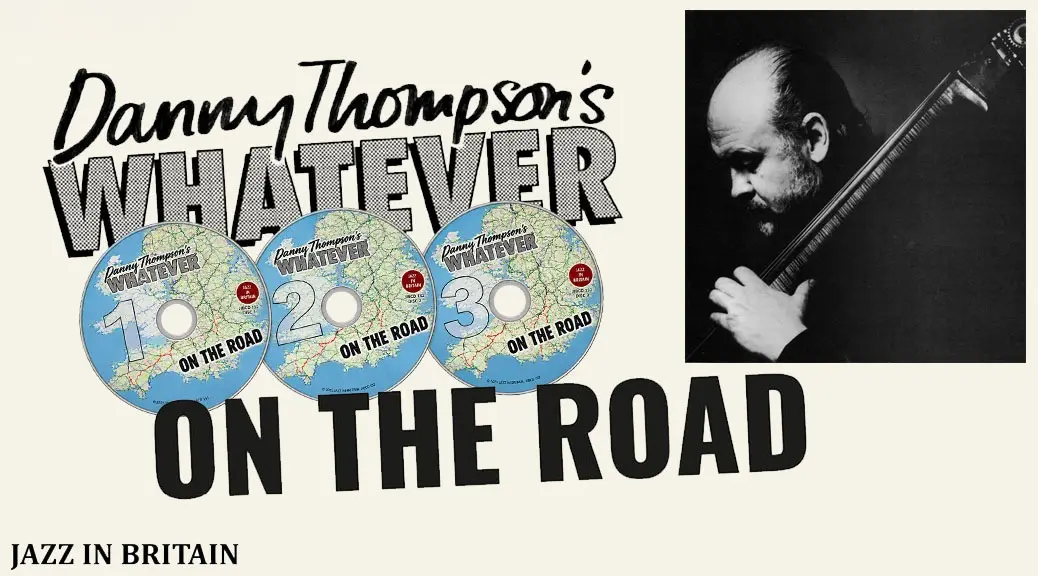
The fruit of this journey is captured in stunning clarity on the third disc of ON THE ROAD, a strictly limited-edition triple-CD box set issued by the specialist archival label Jazz in Britain. Pressed to a mere 500 copies, this monumental release serves as a masterclass in improvisational cross-pollination, capturing a 5-part suite originally commissioned in 1993 by Nottingham City Council. Recorded live at the Barnfield Theatre in Exeter on June 2, 1993, this suite—alongside the two accompanying discs recorded in 1989 and 1992—presents an ambitious, meditative exploration of travel, time, landscape, and British folk-jazz history.
Through a combination of masterful musicianship, wry humor, and an absolute refusal to be boxed in by rigid genre definitions, ON THE ROAD stands as a vital historical document. It honors a maestro whose career spans from foundational folk clubs to the furthest reaches of avant-garde jazz and rock.
Detailed Chronology: The Genesis and Evolution of Whatever
To understand the weight of ON THE ROAD, one must trace the winding trajectory of Danny Thompson’s career and the unconventional birth of his collective, Whatever.
The Naming of a Philosophy: "It’s Whatever"
When Danny Thompson first assembled the group in the late 1980s, the primary artistic objective was to create a seamless, organic fusion between traditional folk music and contemporary jazz. The boundaries were porous, the instrumentation unconventional, and the spirit defiantly free. When interviewers, promoters, and zealous purists inevitably pressed Thompson with the inevitable question—“Is it jazz or is it folk?”—his deadpan, trademark riposte was disarmingly simple: "Well, it’s whatever."
That pragmatic, unpretentious philosophy became the band’s moniker and operational blueprint. Thompson’s signature wit and ability to balance profound musical seriousness with self-deprecating humor are on full display throughout the dialogue captured between songs on the ON THE ROAD collection.
The Three Stops Along the Timeline
The triple-CD retrospective captures Whatever at three distinct milestones across a pivotal four-year span:
- October 1989: Captured live on the road, this first phase of recordings sets the stage, highlighting the group’s early chemistry and foundational repertoire, including heartfelt nods to Thompson’s illustrious past collaborations.
- May/June 1992: Recorded live at the Pavilion Theatre in Bath, the second disc demonstrates a maturing ensemble dynamic, expanding further into international folk traditions and complex rhythmic structures.
- June 2, 1993: Recorded at the Barnfield Theatre in Exeter during a dedicated tour spanning the length of the A38, the third disc is entirely consumed by the monumental, 5-part A38 Suite.
The Anatomy of the A38 Suite
The centerpiece of the entire package is the third disc, an immersive deep-dive into the 293 miles connecting Bodmin to Mansfield. Commissioned in 1993 by Nottingham City Council, band member and multi-instrumentalist Tony Roberts was tasked with penning an ode to this ancient Roman trade route.
The resulting performance in Exeter on June 2, 1993, is not merely a collection of songs, but a cinematic, multi-movement tone poem. Propelled entirely by Thompson’s rhythmic, woody double-bass—affectionately and reliably known as "Victoria"—the suite avoids the crutch of a traditional drum kit. Instead, the percussion is internalized within the pulse of the bass, the scrape of the bow, and the interplay of reeds, strings, and breath.

Supporting Context & Metrics: The Players, the Places, and the Pressures
The Ensemble: Virtuosity Without Ego
Whatever was never a backing band; it was a cooperative of virtuosos capable of shifting from high-energy swing to fragile pastoral reflection in a single bar. The line-up featured on these recordings reads like a who’s who of British folk-jazz royalty:
- Danny Thompson (Double Bass): The gravitational center of the band. Having anchored rhythm sections for everyone from Alexis Korner and John Martyn to Nick Drake and Tim Buckley, Thompson brings a visceral, woody resonance and an uncanny melodic sensibility to the bass.
- Tony Roberts (Small Pipes, Tenor Saxophones): The visionary behind the A38 commission, Roberts bridges the gap between rural British piping traditions and urban jazz sophistication.
- Paul Dunmall (Soprano and Tenor Saxophones, Leicestershire Pipes): A titanic force in British free jazz, Dunmall brings a fiery, muscular intensity that keeps the folk elements permanently tethered to an unpredictable, modern edge.
- Dylan Fowler (Guitar, Oboe): A master of acoustic textures, Fowler provides harmonic warmth and rhythmic counterpoint, navigating complex time signatures with graceful ease.
- Peter Knight (Violin): Best known for his tenure with Steeleye Span, Knight injects a soaring, lyrical folk violin tradition into the mix, capable of evoking both sweet pastoral morning air and disorienting urban transit.
Critical Breakdown of Disc Three: The A38 Journey
The third disc is widely regarded by early reviewers as the most immersive of the set, demanding patience and rewarding attentive listening.
- “A38 Suite – Part 3”: This movement functions as an auditory painting of a long, unhurried cross-country drive. Thompson introduces the theme with a mellow, rounded tone, soon joined by Fowler’s acoustic guitar and Dunmall’s saxophones. There is a distinct, Monk-like angularity and quirkiness to the phrasing. As the piece develops, Knight’s violin and Fowler’s guitar intertwine with a deliberate, slightly unsettling microtonal wariness—evoking the strange, detached sensation of a car-sick passenger watching the world slide past the windscreen.
- The Cinematic Shift in Pace: As the imaginary vehicle transitions from one landscape to another—moving from cramped urban stretches to sweeping rural vistas—the music mutates in real-time. Knight’s sweet, soaring violin tones begin to mirror the hum of a well-oiled mechanical engine.
- The Twilight Transition: Following an epic, eighteen-minute movement, the music dips into a nocturnal interlude. Here, the metaphorical tides of daytime traffic subside, making way for a trance-like, Moorish dreamscape. The transition is so fluid that it bleeds seamlessly into “A38 Suite – Part 4,” demonstrating the ensemble’s telepathic improvisational rapport.
Historical Roots and Collaborative Breadth
To fully appreciate ON THE ROAD, one must look at the rich tapestry of Thompson’s career, which is explicitly referenced throughout the box set.
- The John Martyn Connection: No discussion of Danny Thompson is complete without acknowledging his legendary partnership with the late singer-songwriter John Martyn, particularly on the seminal 1973 album Solid Air. On the first disc of ON THE ROAD, the track “Wildfinger” serves as an explicit dedication to Martyn. Here, Dunmall’s heavy-duty saxophone and Thompson’s commanding bass slug it out alongside guest guitarist John Etheridge. The performance captures the gruff, emotive delivery and physical bulk associated with Martyn’s musical output. Remarkably, the sheer rhythmic drive of the trio makes the absence of a conventional drum kit entirely unnoticeable.
- Paying Homage to Folk Pioneers: The set also features “Lament for Alex Campbell,” honoring the legendary Scottish folk singer whom Thompson credits in his spoken introductions for paving the path for future generations of troubadours like Bert Jansch and John Martyn during Thompson’s formative years.
- Global Folk Explorations: Beyond British shores, Whatever looks outward with deep reverence. The track “Sandansko Oro” tackles a complex, shifting Bulgarian folk dance with astonishing precision, while “Swedish Dance” highlights Nordic melodic traditions. The inclusion of the politically conscious composition “Beirut” demonstrates that the band’s geographical mapping—whether along the A38 or across international borders—carried profound emotional and political resonance.
Official Statements and Archival Significance
The release of ON THE ROAD by Jazz in Britain represents a major victory for music preservation. In an era dominated by algorithmic streaming and fleeting digital playlists, physical archival releases of this caliber provide crucial context to chapters of music history that risk being forgotten.
While Jazz in Britain operates as an independent, niche label, the philosophy behind the release echoes sentiments shared by foundational jazz and folk historians who champion the live performance as the true testing ground for British improvisers. Speaking on the ethos of archival excavation, the label’s custodians emphasize that releases like ON THE ROAD are designed not merely to pander to nostalgia, but to actively recalibrate how contemporary listeners view the porous boundaries between genres in the late 20th century.
Danny Thompson himself has frequently downplayed his own legendary status with characteristic humility, preferring to let his fingers speak through "Victoria." Yet, through spoken-road introductions preserved across these three CDs, listeners are treated to an authentic masterclass in storytelling, where historical anecdotes about early folk clubs in London sit comfortably alongside dry observations about touring life in a van.
Future Outlook: The Legacy of Whatever in Modern Music
As ON THE ROAD circulates among collectors and cognoscenti, its limited press run of just 500 copies ensures it will swiftly become a prized, sought-after artifact on the secondhand market. However, the true significance of the box set extends far beyond its collectibility.
In contemporary music circles, the appetite for genre-fluid experimentation—often marketed under broad umbrellas like "neo-folk," "ambient jazz," or "fourth-world music"—has never been higher. Young musicians today are constantly searching for precedents where traditional acoustic instruments were plugged into improvisational, forward-thinking frameworks without losing their cultural roots. Whatever anticipated this modern cross-pollination by over thirty years.
The legacy of Danny Thompson, Tony Roberts, Paul Dunmall, Dylan Fowler, and Peter Knight serves as a reminder that the most compelling artistic journeys do not happen on super-highways designed for maximum speed and minimum friction. Instead, true artistic discovery happens on the winding, local roads—the A38s of the world—where every bump, detour, and changing landscape demands to be felt, absorbed, and translated into sound.
For those eager to experience a time when British musicians fearlessly tore down the walls between folk tradition and jazz abstraction, hunting down a copy of ON THE ROAD is not merely recommended; it is an essential musical pilgrimage.