Executive Overview
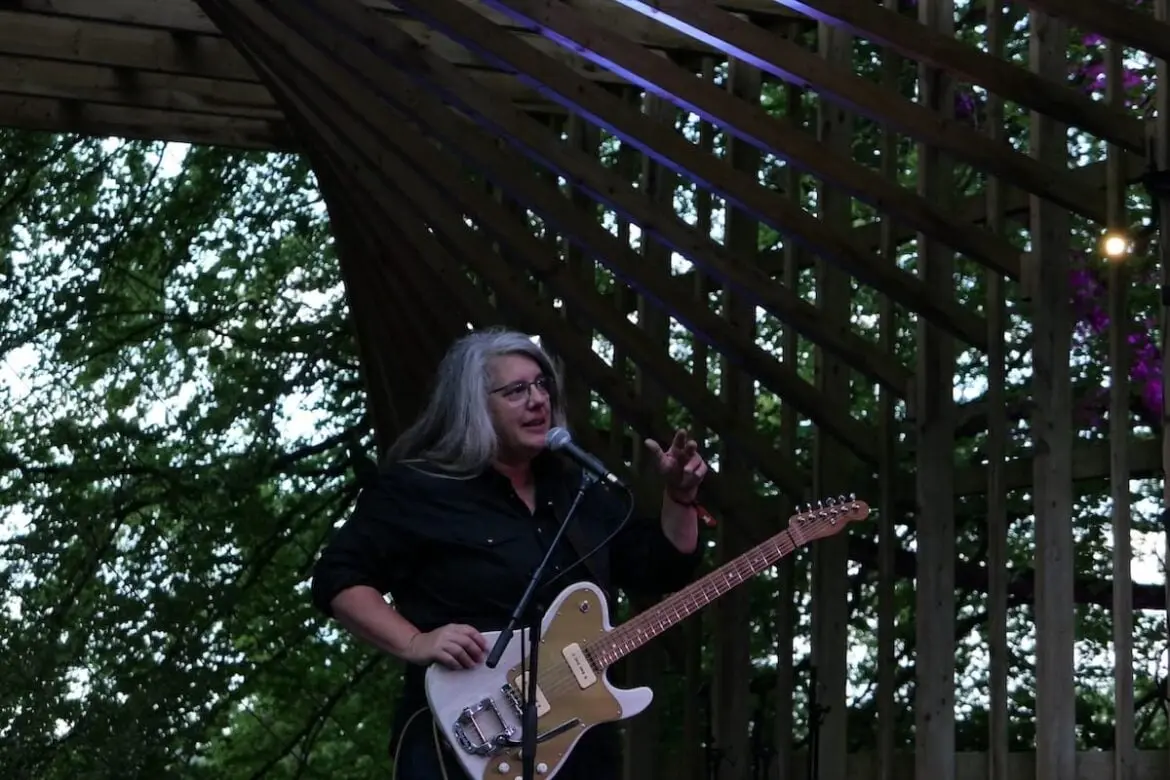
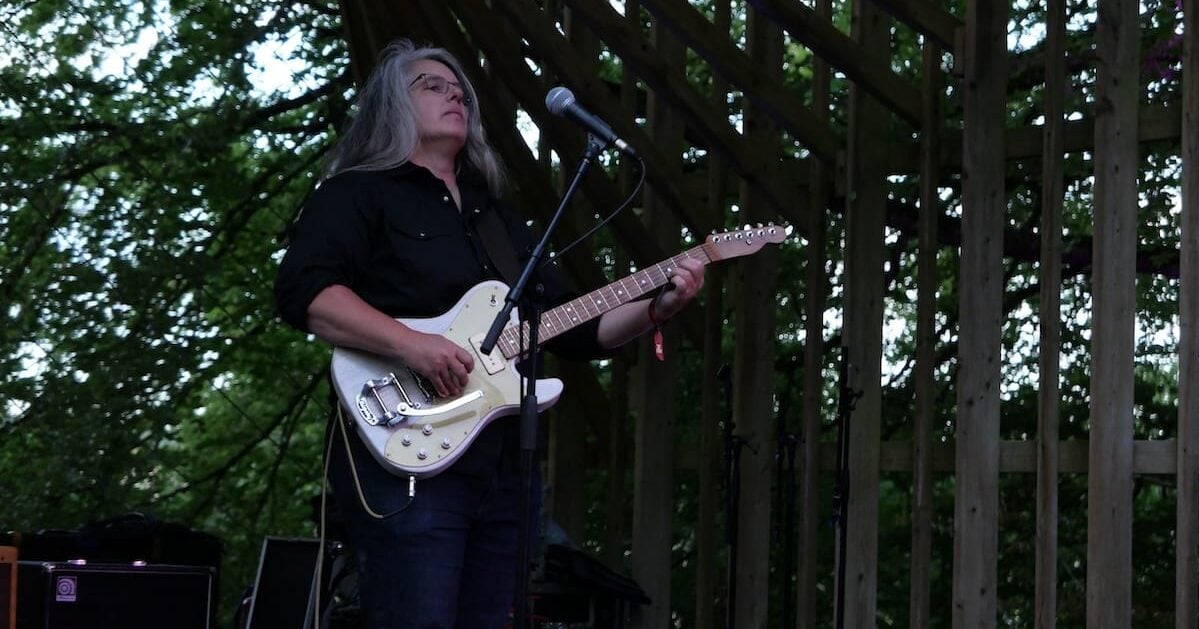
Backstage at the picturesque End of the Road Festival, tucked away within the artists’ compound behind the Garden Stage, Marisa Anderson cuts an intense, focused figure. With an impending performance slated in less than an hour, her pre-show concentration is palpable. For any interviewer, stepping into this private sphere armed with a notebook and a flurry of questions can feel like an intrusion. Yet, the moment introductions are made on behalf of KLOF Magazine, her demeanor shifts instantly, replaced by a warm and conversational openness.
"Oh, KLOF has been doing a really good job of covering the new record," Anderson remarks, referencing her latest masterwork, The Anthology of Unamerican Folk Music. "I am really grateful for that. I like the magazine; I wish I could get it in the States as a paper copy or something. You all over here are doing such a good job—I mean, KLOF and Songlines are so good, we don’t really have that in the US."
This high praise sets an encouraging tone for an interview pressed against the relentless ticking clock of a festival schedule. Despite the tight window, Anderson’s responses are remarkably thoughtful, offering a rare glimpse into the mind of a modern-day folk vanguard. From unearthing obscure ethnographic recordings at the Bob Dylan Center to constructing immersive audio installations rooted in Mayan linguistics, Anderson’s artistic trajectory is as intellectually rigorous as it is sonically captivating. This feature examines her creative philosophy, her navigation of festival culture, her unconventional path through the archives, and her evolving place in the contemporary musical landscape.
Detailed Chronology & Background
Navigating the Festival Circuit
For an artist whose music demands deep, contemplative listening, festivals present a unique paradox. When asked if End of the Road is her first festival experience, Anderson clarifies her selective relationship with the live circuit.
"Yes, it’s my first; I’ve never played this one before," she explains. "I’m only ever at a festival if I am playing it or visiting someone I know who’s playing. Sometimes a friend will be like, ‘Hey, I’m over there, I’ll get you a pass.’ I like music, but I’m like, if I hear one thing I can cruise with that for days, you know? Festivals are overwhelming to me."
This sensory overload naturally dictates a different artistic approach compared to a traditional headlining show. When playing a standard gig, Anderson relies on a shared, implicit contract with the audience.
"If I’m playing a standard gig, I know that those people bought tickets specifically to see me; there’s a context I can assume, and there’s a reason that we are both there," she notes. "Whereas at a festival, people are coming by, trying to catch up; they’re coming by because they are curious, so it’s a little bit of a different approach."
The Road Less Traveled: Formative Years and Grit
Anderson’s uncompromising artistic vision did not emerge in a vacuum; it was forged through a decade of nomadic travel and relentless life experience. Asked if her extensive travels in her youth feed into her strength today, she acknowledges the profound impact of those formative years.
"Oh yeah, I mean, whoever we were in our twenties influences who we are today, right?" she reflects. "If you went to university or worked a job, hitchhiked around the world or whatever, that’s the information that you have to work with moving forward."
Crucially, Anderson emphasizes that her path was defined as much by the choices she rejected as the ones she embraced. "As well as the choices that you did not make—the choices not to go to university, not to get whatever kind of job, not to do a lot of the things that people my age did choose to do, so that influenced me as well: what you do and what you don’t do."
This rejection of conventional paths included grueling manual labor undertaken simply to keep moving forward. "I used to work a factory job overnight to get enough money to keep travelling, so every couple of months I had to find a factory to work in for a week or two. Standing up on a factory line for twelve hours on an overnight shift teaches you quickly what you don’t want to do with your life."
Supporting Context & Metrics: Unearthing Harry Smith’s Final Collection
At the heart of Anderson’s recent work lies The Anthology of Unamerican Folk Music, a conceptual and musical undertaking born from an accidental encounter in Tulsa, Oklahoma. Harry Smith’s legendary 1952 Anthology of American Folk Music is a cornerstone of American vernacular music, built primarily from pre-war commercial 78s. However, Anderson’s project draws from an entirely different, lesser-known archive: Smith’s final, personal record collection, now housed at the Bob Dylan Center.
+-------------------------------------------------------------------------+
|                  THE TWO ANTHOLOGIES: A COMPARISON                      |
+-----------------------------+-------------------------------------------+
| Harry Smith's 1952 Original | Marisa Anderson's Unamerican Folk Music   |
+-----------------------------+-------------------------------------------+
| • Based on pre-war 78s      | • Based on LPs (1970s–1980s collection)   |
| • Focus: Commercial blues,  | • Focus: Global ethnographic field        |
|   jazz, country, gospel     |   recordings, indigenous music            |
| • Artifacts of early 20th C.| • Artifacts of Smith's later years        |
|   American recording industry| • Transformed through guitar interpretation|
+-----------------------------+-------------------------------------------+
Recounting how she gained access to the vault, Anderson reveals a mix of serendipity and sheer tenacity. "I was playing a gig in Tulsa, and I was invited to check out the Bob Dylan Centre, and a friend told me he had heard Harry’s personal records were there. So, the director of the museum, who was showing me around, was like, ‘Well, what do you think?’ I said, ‘I heard you have Harry Smith’s records?’"
The museum director kindly permitted a brief, fifteen-minute viewing window. Unfazed, Anderson pushed the boundaries of hospitality: "Then I just started pushing on a series of doors that were slightly ajar until they were all open, and I got a residency and was able to download them. Yeah, I just kind of talked my way in, I suppose."
Clarifying the distinction between this archive and Smith’s famous 1952 compilation, Anderson notes, "Yes, it’s 100% different because all of these records are his final collection; he died in the nineties. The records that he used to make the Anthology of American Folk Music, which came out in 1952, were pre-war 78s; those were long gone from his life. He was notoriously a person who did not keep a lot of belongings. Most of these records are from the seventies and eighties; they are mostly LPs, they are not 78s or collectables in that sense."
Regarding the curatorial scope of Smith’s later years, Anderson found a treasure trove of global sounds. "Not so random, but, as you could expect, there was American blues, jazz, country, gospel; there was a big stack of native American records and then there were records from all over the world, these ethnographic kind of field recordings, anthologies and compilations—and that’s what I was interested in."
Official Statements & Artistic Philosophy
Translating the Global Archive
When curating and adapting pieces for The Anthology of Unamerican Folk Music—focusing on music from places the US has been in conflict with since 1970—Anderson’s selection process was governed by rigorous musical constraints rather than mere polemics.
"I was looking for, first, if they were possible (laughs), if I could pull it off," she explains. "There were a lot of dead ends, a lot of pieces where I got halfway down the road and felt, right, this isn’t for now. So I was looking to see if it was possible; I was looking for variety, and I wanted distribution across countries and regions. I was looking for variety among the original instruments played on the source recordings; some were based on vocal pieces, some on whistles, some on strings. I wanted variety in that."
This process necessitated constant creative friction. When asked if the material forced her to push against her own musical instincts, she answers unequivocally: "Oh yes, in every single piece. That was kind of the point too, you know?"
Yet, despite her background in free-form improvisational scenes—including a six-year stint in the Evolutionary Jass Band, which explored the avant-garde territory of players like Albert Ayler—Anderson chose a disciplined approach to the source material. "I chose not to leave that space; I chose to stay pretty close to the source material because I wanted to learn from the material rather than impose myself on it."
On Folk, Protest, and Wordless Activism
The conversation inevitably turns to the socio-political resonance of folk music in contemporary America. Given widespread discontent with political administrations, one might look for a resurgence of explicitly political protest folk reminiscent of the 1960s. Anderson, however, draws careful distinctions regarding nomenclature.
"Protest folk? I’m not sure that is a phrase I would particularly use because that doesn’t fall into my definition of folk music, which is maybe a little more specific."
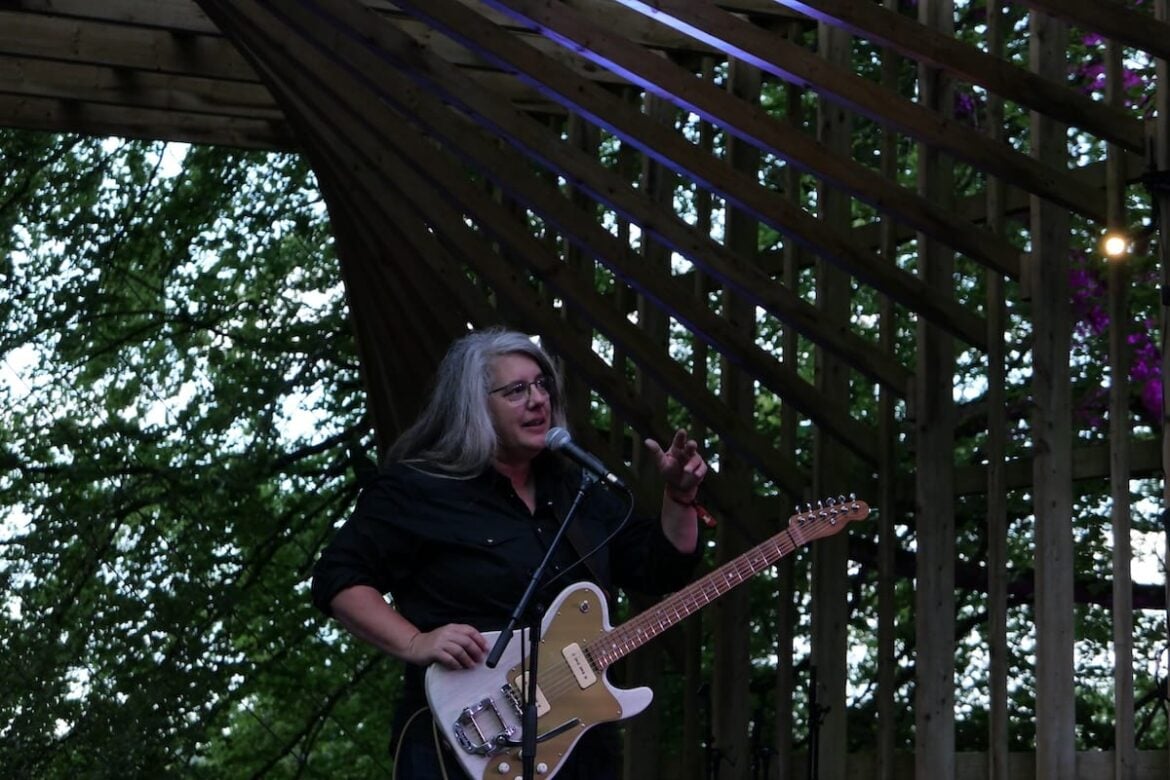
Asked if activism is excluded from instrumental music, she clarifies her stance on wordless art: "Oh, I would never say that. You absolutely can bring activism into wordless music, and I feel like I do that, but there’s something about the phrase ‘protest folk’ that sounds like a record bin! Going through the things at the record store, that is not a label that resonates for me."
Anderson acknowledges the turbulent socio-political climate in the US, hoping for a broad cultural reaction: "I hope there’s a reaction to that in all movements amongst all people; I think it’s everybody’s responsibility to do and say what they can in this machine." At the same time, she maintains a critical scholarly perspective on the genre: "On the other hand, there is also a pretty large body of work that talks about folk culture and the rise of nationalism as being linked, so that’s another reason why I can’t just jump into the phrase."
The Mechanics of Creation: Studio Privacy and Collaboration
Anderson’s creative process relies heavily on solitude, often engineering her own recordings. This self-reliance offers distinct artistic and economic advantages.
"Well, privacy in the process," she notes. "A lot of pieces are recorded and composed at the same time, so it’s kind of this back and forth, and back and forth and back and forth with the recording, and that’s a really personal process. So, there’s that, and there’s the economics of it of course, when the clock is ticking on the studio you are paying for by the hour, by the day, it defines the process in a way that is sometimes helpful and other times not helpful."
While she happily handles electric setups independently—remarking that "it’s just a guitar; it’s not rocket science"—she knows when to defer to specialists for delicate acoustic work. When she does collaborate with peers such as Jim White or William Tyler, her criteria are simple yet demanding: "First of all, can it be fun? Am I going to learn something?"
Future Outlook & Horizon
As Marisa Anderson looks beyond the release of The Anthology of Unamerican Folk Music, her creative horizons continue to expand into multidisciplinary territory. Far from resting on her laurels as a master guitarist, she is actively venturing into contemporary art installations and tonal linguistic experiments.
Her most recent venture bridges music and linguistics in collaboration with artist Patricia Vazquez Gomez in Portland. Part of the Converge 45 Triennial exhibition running through December, the project centers on Gomez’s work with the Mayan community and language.
"We built these pieces together that work as a tonal language, so you can make music with it," Anderson explains with visible enthusiasm. "I worked with her to create four immersive audio pieces that are installed in a listening environment. I’m really happy about that and excited to be able to do more work like that. The opening just happened, which is why I’m excited to talk about it."
Rooted in the foundational influences of her youth—church music, Doc Watson, and J.S. Bach—yet constantly challenged by obscure global field recordings and modern conceptual art, Anderson remains anchored by the simplest of pleasures. Asked what currently inspires her in music, her answer is as pure as it was when she first picked up the instrument at age seven: "I’m just always inspired by playing guitar; any time that I can play, that’s it."
With festival sets to conquer, immersive art installations opening, and a fierce dedication to honoring the marginalized voices hidden within historical archives, Marisa Anderson proves that true folk innovation lies not in nostalgia, but in relentless, respectful inquiry. Before heading off to catch a performance by fellow End of the Road bill-mates Lankum (ÆFN), Anderson leaves behind a standard of artistic integrity that resonates far beyond the festival gates.