Executive Overview
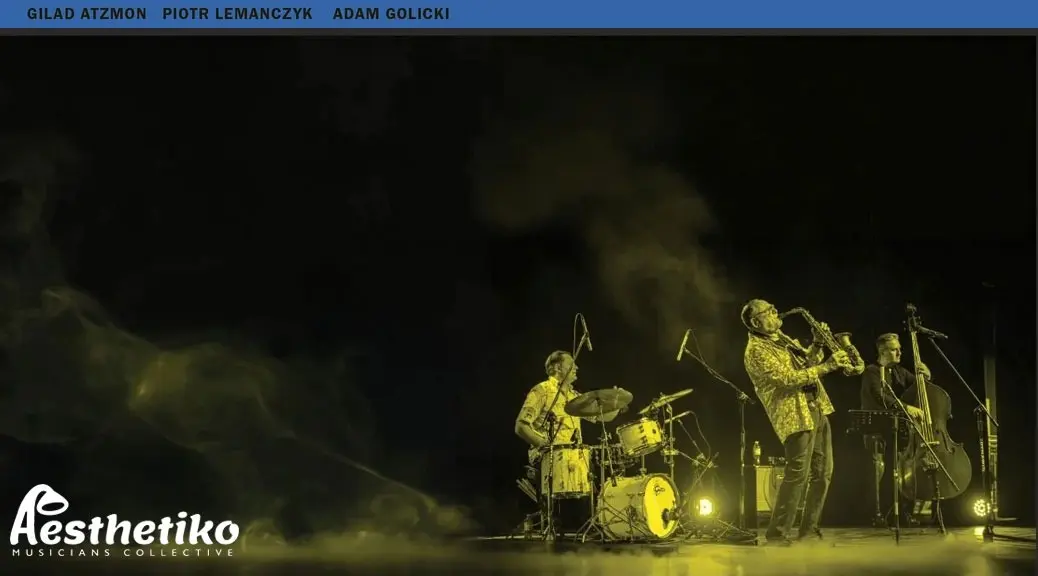
In the ever-evolving landscape of contemporary transatlantic jazz, few releases capture the cross-cultural synthesis quite as intriguingly as Between the Vistula and the Hudson. Issued on compact disc via the artists’ independent collective, Aesthetiko, this dynamic collaborative effort brings together British-Israeli alto saxophonist and clarinetist Gilad Atzmon with two stalwarts of the Polish modern jazz scene: bassist Piotr Lemańczyk and drummer Adam Golicki.
The album’s title functions as a geographical and cultural compass. The Hudson River represents New York City and the foundational American jazz tradition from which this music sprouted, while the Vistula River serves as the home waters for the Polish rhythm section, as well as the watercourse tracing the early roots of Atzmon himself. Recorded at Tall Pine Studio in Kolbudy on the edge of Gdańsk—and expertly mixed and mastered by Atzmon—the project strips away the safety nets of polyphonic harmony. With no piano, guitar, or organ to pad the soundstage, the music relies entirely on the interplay of saxophone, drums, and a double bass that must single-handedly shoulder both the rhythmic pulse and the harmonic framework.
For jazz critics and aficionados alike, this album presents a fascinating study in minimalist audacity. By alternating tightly constructed group originals with meticulously reinterpreted jazz standards, the ALG Trio (Atzmon-Lemańczyk-Golicki) explores the tension between European folk sensitivities and American hard-bop idioms. Yet, as this review will unpack through a comprehensive chronological breakdown, contextual analysis, and an assessment of its future footprint, the recording is as marked by its unwavering stylistic consistency as it is by its moments of breathtaking improvisational brilliance.
Detailed Chronology & Track-by-Track Breakdown
The narrative arc of Between the Vistula and the Hudson is structured with deliberate symmetry, alternating between concise, collectively credited originals and beloved entries from the Great American (and international) Songbook.
The Opening Statements and the Polish-American Bridge
The journey begins with "Like Cats in the Rain," an original composition that immediately justifies its evocative title. The tune unfolds as an erratic, playful, and improvised dance, establishing the foundational dialogue between Atzmon’s biting horn work and Golicki’s nimble percussion.
The momentum shifts gracefully into "On Green Dolphin Street," a choice that crystallizes the album’s conceptual core. Composed by Bronisław Kaper—who was born in Warsaw on the Vistula, studied at the Warsaw Conservatory, and later relocated to Hollywood in 1935 under an MGM contract—the tune made its own transatlantic crossing decades before this trio ever set foot in a studio. Atzmon, who previously tackled Kaper’s "Invitation" on his acclaimed 2013 release The Spirit of Trane, approaches the piece here with an added layer of Latin swagger. It is arguably the first true meeting of the minds on the record, where the rhythmic architecture built by Lemańczyk and Golicki locks seamlessly into Atzmon’s soaring lines.
Fire and Introspection
Following the breezy swagger of Kaper’s classic, the trio plunges headfirst into "The 2nd Liberation." This track marks the first major stylistic flare-up of the session: a quick-fire, combustible improvisation where Atzmon and Golicki trade sharp accents and aggressive statements, stretching the limits of the piano-less trio format.
Conversely, Sammy Fain’s "Secret Love" offers a contrasting palette. As the longest track on the album, it settles comfortably into a laid-back, modern blues groove infused with an unmistakable American vernacular, galvanized by Golicki’s crisp articulation behind the drum kit.
On "The Romantic Lad," Atzmon digs deep into the lower registers of the alto saxophone. His tone becomes so rich and resonant that casual listeners might easily mistake the instrument for a baritone saxophone, weaving a melancholy tale that underscores his mastery of timbre and dynamic control.
Navigating the Chords of Coltrane and Beyond
One of the most daring gambits on Between the Vistula and the Hudson is the inclusion of John Coltrane’s notoriously demanding "Giant Steps." When Atzmon previously recorded this jazz milestone on The Spirit of Trane, he utilized a full piano and string quartet to spell out Coltrane’s dizzying, cycling key centers.
Here, however, the pianist’s safety net is entirely absent. The complex harmonic changes must live or die through the clarity of Lemańczyk’s double bass. The gamble pays off handsomely; the tune is instantly recognizable, and Lemańczyk’s execution wins the day, proving his immense technical facility and deep harmonic understanding.
The sequence continues with "The Philosopher," a fittingly titled, laid-back number that evokes an image of its subject relaxing in a smoking jacket with a pipe and slippers. This is followed by a tender, evocative reading of Gene de Paul’s "You Don’t Know What Love Is," where Atzmon maintains a commanding yet sensitive presence throughout.
The Climax and Closing Circle
Midway through the latter half of the program, "Tension" showcases Atzmon switching to the clarinet. Golicki works feverishly to keep the exploratory tune buoyant and driving.

Yet, the crowning achievement of the album arrives shortly thereafter with "Lonnie’s Lament." Propelled by a brisk, energizing tempo set by the drums, Atzmon’s alto takes flight in what is easily the most visceral and exhilarating performance on the recording. The interplay here is telepathic, capturing the improvisational lightning that fans of modern acoustic jazz endlessly chase.
The album closes with "The 1st Liberation," a moody, atmospheric piece that features Atzmon utilizing circular breathing to sustain an eerie, continuous drone. By concluding the album with "The 1st Liberation" after opening the previous sections with "The 2nd Liberation," the trio loops the narrative back onto itself, enticing the listener to hit repeat and step back into the river.
Supporting Context & Metrics
To fully appreciate the weight of Between the Vistula and the Hudson, one must examine the individual trajectories and collective pedigree of the three musicians involved.
The Players: A Transatlantic Convergence
- Gilad Atzmon: A towering figure in European jazz, Atzmon’s career has been defined by uncompromising artistry. Since relocating from Israel to Britain in 1994 to pursue a master’s degree in philosophy at the University of Essex, he has maintained a relentless output. Landmark recordings like 2003’s Exile (featuring the Orient House Ensemble alongside Reem Kelani and Dhafer Youssef) and The Spirit of Trane have cemented his reputation as a fiery saxophonist with a deep reverence for the jazz canon.
- Piotr Lemańczyk: A foundational pillar of modern Polish jazz, Lemańczyk’s resume stretches back to the mid-1990s, highlighted by prizes at Kraków’s prestigious Jazz Juniors competitions in 1995 and 1996. He has released six albums as a leader—ranging from Follow the Soul to Amhran (featuring Seamus Blake)—and has shared stages and recording studios with American jazz royalty including Jerry Bergonzi, Tim Hagans, and Dave Kikoski. Notably, Lemańczyk founded the band Orange Trane in Kartuzy in 1994—the very year Atzmon arrived in the UK. (Lemańczyk’s history with British alto players also includes bringing Londoner Soweto Kinch onto the 2016 album Interpersonal Lines).
- Adam Golicki: Born in 1980, Golicki is a prominent educator at the Academy of Music in Gdańsk and a fixture of the regional scene, best known for his work with the genre-crossing outfit Confusion Project. His discography spans the fusion-heavy explorations of Ad Shave and Ad Complementum to the intimate acoustic trio dynamics of Reflections. Golicki and Lemańczyk share a telepathic rhythmic bond forged through years of playing together.
The Collaborative Matrix
The genesis of the ALG Trio can be traced back to the Polish rhythm section’s frequent forays across the Atlantic. Their 2024 collaborative album, NYC Session, recorded with guitarist Rafał Sarnecki and featuring guest appearances by Mike Stern and Leni Stern, demonstrated their ability to converse fluently with American idioms. When that trio toured with various guest soloists—including Atzmon—the musical chemistry was undeniable. By removing the guitar and centering Atzmon’s horn, the newly minted ALG Trio was born.
Album Metrics at a Glance
- Release Format: Compact Disc (distributed via Aesthetiko)
- Recording Location: Tall Pine Studio, Kolbudy (Gdańsk region, Poland)
- Production: Mixed and mastered entirely by Gilad Atzmon
- Repertoire: 11 tracks total (6 original compositions credited jointly to Atzmon, Lemańczyk, and Golicki; 5 radical interpretations of jazz standards and international songbook classics)
- Instrumentation: Alto saxophone/clarinet, double bass, drums (Piano and guitar strictly omitted)
Official Statements & Artistic Philosophy
The underlying ethos of Between the Vistula and the Hudson is best understood through the philosophical lens chosen by the artists for the album’s bilingual liner notes (printed in both English and Polish). The project opens with a direct nod to the ancient Greek philosopher Heraclitus: “You cannot step into the same river twice.”
This philosophical grounding is deeply personal for Atzmon, who earned his master’s degree in philosophy at the University of Essex and frequently infuses his artistic statements with existential inquiry. In official press materials surrounding the Aesthetiko collective, the musicians have emphasized that the album is designed as an acoustic stream of consciousness—a flowing body of water that connects the geopolitical and cultural divides of the musicians’ respective homelands.
Furthermore, the decision to release the album exclusively on compact disc through Aesthetiko—an artist-run collective that previously pressed a limited LP for Maja Babyszka and Nikos Sidirokastritis’s In Memory of That Song—reflects a growing industry trend toward total artistic autonomy. By retaining complete control over the mixing, mastering, and distribution pipeline, Atzmon, Lemańczyk, and Golicki have ensured that their unadorned, minimalist vision remains entirely free from corporate dilution.
Future Outlook & Critical Reception
As Between the Vistula and the Hudson gains traction among discerning jazz critics and international audiences, it raises intriguing questions about the future trajectory of the ALG Trio and the Aesthetiko label.
Stylistic Considerations for Future Projects
From a critical standpoint, the album’s primary strength—its unwavering sonic consistency and atmospheric cohesion—also introduces its sole point of debate. As noted in contemporary reviews, the running order maintains a remarkably steady current. Aside from visceral outbursts like "The 2nd Liberation" and the driving momentum of "Lonnie’s Lament," the tempo and emotional temperature hover within a relatively narrow, contemplative band.
For listeners who prefer a relentless stream of flowing, acoustic modern jazz, this unified aesthetic will be viewed as a masterclass in mood and execution. For those seeking explosive stylistic hairpin turns, future iterations of the trio might benefit from expanding their dynamic range even further, leaning into contrasting textures or utilizing extended techniques to break the comforting rhythm of the stream.
Vinyl Prospects and Label Growth
Audiophiles have already begun asking whether Between the Vistula and the Hudson will make the physical leap from compact disc to heavyweight vinyl. Given that Aesthetiko has previously demonstrated its willingness to press high-quality LPs for select collective releases, a vinyl reissue is by no means an idle hope. Just as Atzmon’s 2003 masterwork Exile has spent decades waiting patiently on collector shelves for a vinyl pressing, this new transatlantic collaboration has immediately joined the queue of anticipated audiophile releases.
Conclusion
Ultimately, Between the Vistula and the Hudson stands as a testament to what can be achieved when three veteran musicians strip away extraneous instrumentation and rely entirely on mutual trust, technical virtuosity, and deep cultural resonance. Whether the ALG Trio takes this stripped-down, piano-less format on an extensive international tour or returns to the studio to further explore the confluence of European riverways and American jazz traditions, one thing is certain: they have charted a unique course across the contemporary jazz map that demands repeated listening.