Executive Overview
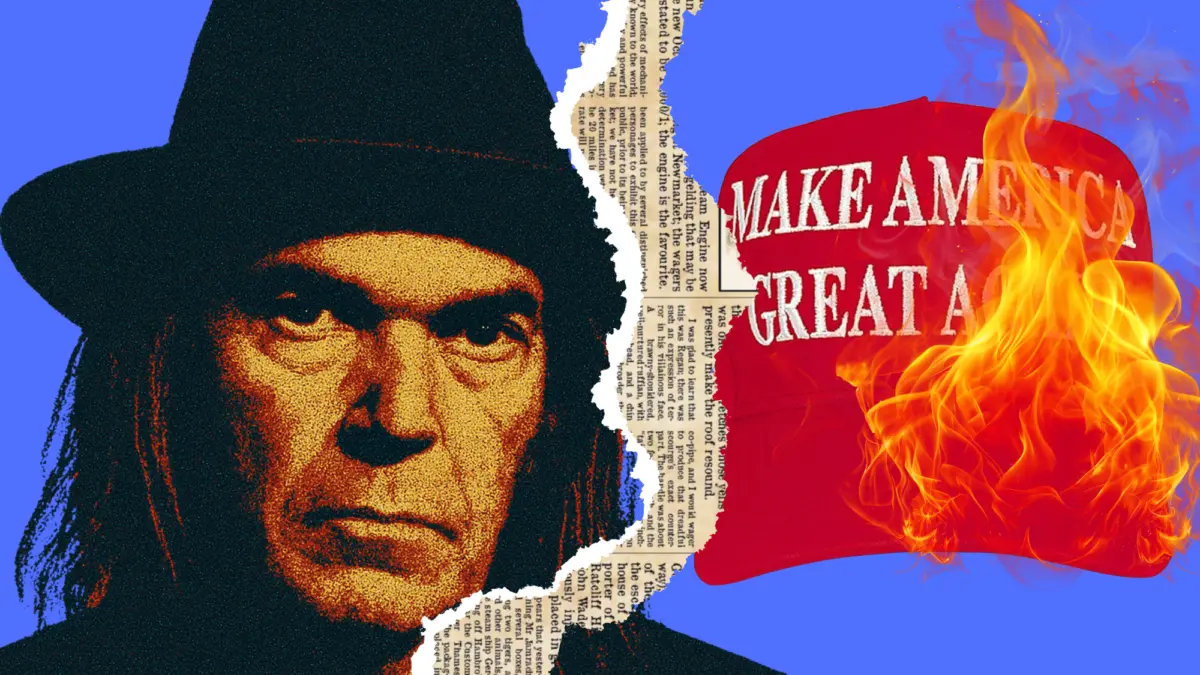
As the United States barrels toward high-stakes midterm elections—with polling indicating a potential shift in congressional power toward a Democratic majority in the House of Representatives—the intersection of American politics and the music industry has once again erupted into legal conflict. In the latest chapter of this ongoing saga, legendary rock icon Neil Young has initiated a fresh copyright infringement lawsuit against Donald Trump and the political fundraising apparatus backing his allies.
At the center of the legal dispute is the unpermitted broadcast of Young’s 1989 classic, “Rockin’ in the Free World,” at a pre-election rally held earlier this month in Youngstown, Ohio. For Young, this is not merely a commercial grievance; it is a profound ideological battle. Legal representation for the Canadian-American songwriter argues that using the song to soundtrack a Trump rally represents "the opposite of everything that Donald J. Trump stands for."
Crucially, this is not the first time Young has had to take legal action against the former president over the very same track. In 2020, Young filed a nearly identical lawsuit, which concluded in a settlement where the Trump campaign allegedly agreed never to use the composition again without explicit permission. By playing the song in Youngstown and at subsequent campaign events, the newly formed Trump 47 Committee has allegedly committed willful copyright infringement, ignoring both explicit legal warnings and the specific terms of previous settlements.
This dispute highlights a broader, recurring phenomenon in modern American political campaigning: the friction between politicians who view rally soundtracks as ambient crowd-pleasers and artists who view their art as deeply personal expressions of political and social conscience. From Eddy Grant’s “Electric Avenue” to the ubiquitous use of the Village People’s “Y.M.C.A.,” campaigns frequently find themselves embroiled in controversies regarding the ideological dissonance of their playlist selections.
Detailed Chronology: The History of "Rockin’ in the Free World" in Politics
To fully understand the gravity of the current legal challenge, one must examine the timeline of how Neil Young’s blistering critique of American socioeconomic policy became a recurring piece of political theater—and a legal flashpoint.
1989–2015: The Birth of an Anthem and Early Political Misuse
Released on Young’s twentieth studio album, Freedom, “Rockin’ in the Free World” was conceived as a visceral response to the policies of the George H.W. Bush administration and the decaying social fabric of late-20th-century America. Featuring stark, unvarnished imagery—including a mother abandoning her infant, drug addiction, and homelessness cast against the backdrop of systemic indifference—the song was never intended as a celebratory anthem.
Despite its explicit anti-establishment themes, politicians of various stripes have historically struggled to parse its lyrics. Most notably, in 1989, Vice President George H.W. Bush’s campaign used the track, prompting a swift public rebuke from Young, who made it clear his work was being co-opted against his wishes.
2015–2020: The First Trump Era and the 2020 Lawsuit
When Donald Trump descended the escalator at Trump Tower in June 2015 to announce his presidential campaign, “Rockin’ in the Free World” blared through the sound system. Young immediately issued a statement through his management, noting that while he had not granted permission for the song’s use, Trump had managed to license it through standard public performance rights organizations (PROs). Nevertheless, out of respect for the artist’s objections, the campaign stated it would stop using the track.
Fast forward to 2020: during a campaign rally in Tulsa, Oklahoma, and other key venues, the song resurfaced on the playlist. Incensed by the continued unauthorized use, Young formally filed a copyright infringement lawsuit against the Donald J. Trump For President organization.
According to court filings associated with the current litigation, the 2020 lawsuit was met with virtually no substantive defense from the Trump campaign. Instead, the organization opted for a swift settlement, agreeing to financial terms and—more importantly—pledging that it would never again utilize “Rockin’ in the Free World” without securing explicit authorization from Young.
October 2022: The Breach and the New Lawsuit
With the midterm elections looming, the Trump campaign—now operating under the banner of the Trump 47 Committee—revived the track during a rally in Youngstown, Ohio. Young’s legal team argues that because the previous organization settled the 2020 dispute, current campaign organizers were fully aware that a license was required and that Young had categorically withheld permission.
Consequently, the new lawsuit frames the use in Youngstown and subsequent campaign stops not as an innocent mistake, but as a "willful" and deliberate violation of federal copyright law.
Supporting Context & Metrics: The Mechanics of Political Music Licensing
The legal battles between artists and political campaigns often hinge on complex nuances within American copyright law and the operational frameworks of Performing Rights Organizations (PROs) such as ASCAP (American Society of Composers, Authors, and Publishers) and BMI (Broadcast Music, Inc.).
Campaign Videos vs. Live Public Performances
From a legal standpoint, music usage in politics generally falls into two distinct categories:
- Synchronicity (Sync) Licensing for Videos: When a campaign uses a copyrighted song in an online video, television advertisement, or promotional clip, federal law requires a specific sync license. Failure to secure this permission constitutes clear-cut copyright infringement. A prime example of this occurred when reggae artist Eddy Grant sued the Trump campaign over the use of his 1982 protest song “Electric Avenue” in a 2020 campaign video. A federal judge ultimately confirmed that the campaign’s failure to secure a sync license rendered them liable for copyright infringement.
- Public Performance Licenses at Live Venues: Live rallies present a murkier legal environment. Typically, concert venues maintain blanket licenses with PROs like ASCAP and BMI. These blanket licenses permit venues to host performances and play recorded music from the organizations’ vast repertoires without negotiating individual permissions for every song.
The Political Campaign Exception and the "Opt-Out" Debate
However, political rallies operate under a unique regulatory exception in the United States. Recognizing the sensitive nature of political endorsements, ASCAP and BMI require campaigns to secure specialized political campaign licenses rather than relying solely on the venue’s general blanket license.
Crucially, these political licenses include an opt-out provision. Songwriters and publishers are legally permitted to instruct PROs to exclude their specific compositions from any political licenses issued to campaigns.
When Neil Young filed his initial actions, ASCAP confirmed that “Rockin’ in the Free World” was indeed covered by its repertoire, but verified that Young had formally exercised his right to opt the song out of all political licenses. Therefore, any political entity using the song at a live rally without a direct, bilateral license from Young is operating outside the bounds of standard PRO coverage.
Despite the widespread utilization of these opt-outs, legal scholars note that the system remains untested in a federal courtroom. The consent decrees regulating ASCAP and BMI have occasionally sparked debates regarding whether PROs possess the legal authority to allow members to selectively carve out political users. Because most targeted artists and campaigns settle out of court—as Trump did with Young in 2020—judicial clarity on the enforceability of political opt-outs remains elusive.
A History of Inappropriate Soundtracks
Young is far from the only artist to express dismay over the auditory landscape of Trump rallies. The phenomenon has frequently crossed ideological and genre lines:
- Eddy Grant (“Electric Avenue”): As noted, Grant’s legal counsel successfully challenged the use of his 1980s British racial inequality protest song, citing a "fundamental misunderstanding" of the work’s core message.
- The Village People (“Y.M.C.A.”): A staple of Trump rallies, the track is widely recognized as a foundational LGBTQ+ anthem—a fact that creates clear irony given the socially conservative platform of the campaign’s base. While original co-founder Victor Willis initially objected to the usage, he later softened his stance, publicly disputing the song’s status as a gay anthem, thereby diffusing potential legal friction.
- Other Notable Holdouts: Artists ranging from The Rolling Stones and Queen to Adele and Rihanna have all issued cease-and-desist letters or public reprimands after discovering their music was being utilized to warm up crowds at conservative political events.
Official Statements and Legal Arguments
The legal documentation filed by Neil Young’s legal counsel provides a scathing critique of the Trump campaign’s curation practices, contrasting the celebratory tone of political rallies with the bleak realism of the song’s lyrical content.
Excerpts from the Complaint
In the newly filed lawsuit, Young’s attorneys emphasize the glaring ideological mismatch between the candidate and the composition:
"The song is a blistering anthem that contrasts the hollow promises of American political rhetoric with the harsh realities faced by the poor, homeless, and forgotten."
The complaint elaborates on the specific street-level narratives woven into the track, noting that its verses paint vivid pictures of "a mother discarding her baby, addicts lost in despair, [and] garbage piling in the shadows of prosperity." According to the filing, the chorus delivers a "savage irony, celebrating freedom that clearly isn’t shared by all."
The core of the legal argument rests on the element of willfulness. Because the previous corporate entity ("Donald J. Trump For President") settled the 2020 litigation without mounting a defense—and allegedly promised never to use the song again—the transition of campaign operations to the "Trump 47 Committee" does not shield the organizers from liability. The lawsuit claims that the current committee "has wilfully proceeded to cause the song to be played despite its lack of a licence and despite its knowledge that a licence is required to do so."
The Trump Campaign’s Counter-Perspective and Alliances
Representatives for the Trump 47 Committee have historically maintained that playing recorded music at massive public rallies constitutes standard operational procedure, arguing that blanket performance rights and crowd-pleasing atmospheres supersede individual artist vetoes. Campaign surrogates have frequently framed these disputes as politically motivated actions by left-leaning artists attempting to score cultural points against the former president.
In a twist that underscores the fluid relationship between the Trump campaign and the modern music industry, recent events have seen the campaign cultivate alliances with contemporary mainstream artists. During a weekend rally preceding the current legal filing, rapper Nicki Minaj—hailed by Trump from the podium as the "queen of rap"—delivered a high-profile speech supporting the campaign. Trump effusively praised Minaj during the event, offering remarks on her appearance that drew significant media attention.
Observers note that unlike Neil Young, artists such as Minaj appear unlikely to withdraw their catalogs from political licensing anytime soon, providing the campaign with a starkly different cultural alignment as it navigates the final stretch of the election cycle.
Future Outlook: Legal Precedents and Political Implications
As this high-profile copyright battle unfolds in the shadow of the midterm elections, several key questions remain regarding the future of music licensing in American politics.
Will This Case Reach a Verdict?
Legal analysts remain skeptical that Young’s current lawsuit will be the one to finally test the validity of PRO political opt-outs in a federal courtroom. Given the history of the 2020 litigation—where the Trump campaign quickly folded and settled rather than engaging in prolonged discovery—observers anticipate a similar trajectory for the Trump 47 Committee.
A likely resolution would involve a financial settlement, an acknowledgment of past infringement, and a renewed, binding covenant ensuring that "Rockin’ in the Free World" is permanently scrubbed from future campaign playlists. However, should the Trump legal team decide to mount a vigorous defense challenging the enforceability of ASCAP’s opt-out rules under federal consent decrees, the case could transform into a landmark intellectual property ruling with far-reaching consequences for the entire music industry.
The Broader Impact on Campaign Operations
Regardless of the courtroom outcome, the ongoing friction between legacy artists and political campaigns highlights a persistent blind spot in campaign management. As digital tracking tools and public awareness grow, political committees are increasingly vulnerable to real-time public relations backlashes when they utilize unauthorized music.
For artists like Neil Young, the legal battle is not about financial remuneration; it is a matter of artistic integrity. As long as politicians continue to treat complex socioeconomic protest anthems as generic background music, the courts will likely remain the ultimate battleground where copyright law and political ideology collide.