Executive Overview
In the sprawling, often insular narrative of post-war British jazz, few figures cast a shadow as long, sharp, and avant-garde as Jamaican-born alto saxophonist Joe Harriott. Celebrated globally as a pioneer of free-form jazz—an innovator working concurrently with, yet entirely independently of, Ornette Coleman in the United States—Harriott pushed the boundaries of musical structure, improvisation, and harmonic freedom. Yet, the final studio dispatch from his classic, definitive quintet was not a screeching, dissonant voyage into the unknown, but an unexpectedly sophisticated, swinging reinterpretation of Broadway show tunes.
Recorded in September 1964 at Denis Preston’s legendary Lansdowne Studios in London, High Spirits—the quintet’s distinctively rendered adaptation of Hugh Martin and Timothy Gray’s musical based on Noël Coward’s Blithe Spirit—has long been viewed as an outlier. For decades, this fascinating chapter in British jazz history was obscured by the mists of time, corporate catalog shuffles, and the lamentable out-of-print status of its original mono LP release.
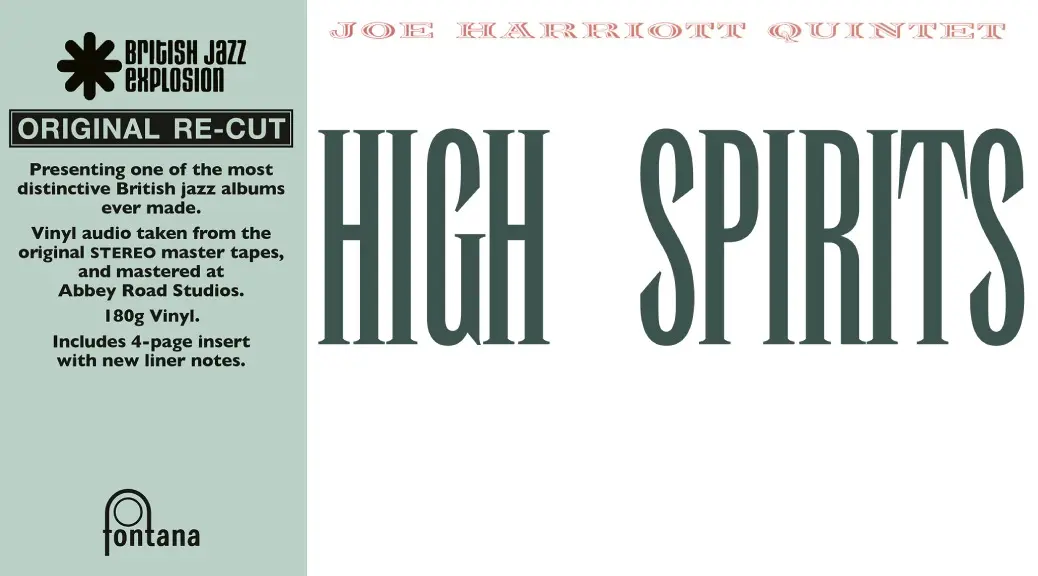
Now, through a meticulous 180-gram vinyl reissue mastered at Abbey Road Studios directly from the original stereo analogue tapes, complete with a comprehensive essay by British Jazz Explosion executive producer Tony Higgins, High Spirits is finally receiving its due. This release is more than a mere curio for collectors; it is a vital re-examination of the final recordings made by Harriott alongside trumpeter Shake Keane, pianist Pat Smythe, double bassist Coleridge Goode, and drummer Bobby Orr. It captures a virtuosic ensemble at the precipice of structural dissolution, demonstrating an uncanny ability to elevate commercial source material into high art without sacrificing a single ounce of improvisational integrity.
Detailed Chronology: From Broadway to Lansdowne Studios
To understand the genesis of High Spirits, one must trace a transatlantic convergence of theatrical ambition and progressive jazz. In April 1964, High Spirits opened on Broadway under the direction of Noël Coward himself. The supernatural farce, adapted from Coward’s 1941 play Blithe Spirit, generated considerable buzz. Following regional try-outs in Oxford and Manchester, the production was slated for a West End run at London’s Savoy Theatre in November 1964.
Recognizing the commercial potential and artistic cross-pollination of the moment, producer Denis Preston orchestrated a bold studio session. In September 1964—the exact same month the stage show’s official cast recorded its score—Joe Harriott brought his peerless quintet into Lansdowne Studios. The lineup was formidable:
- Joe Harriott on alto saxophone
- Shake Keane on trumpet and flugelhorn
- Pat Smythe on piano
- Coleridge Goode on double bass
- Bobby Orr on drums
The resulting album was released in February 1965 by Columbia as part of Preston’s prestigious Lansdowne Series. Ironically, while the jazz sessions were captured with sparkling clarity, the London theatrical run of High Spirits proved short-lived. Harriott, characteristically self-effacing, approached the release with a sense of preemptive irony. His original sleeve notes downplayed the project as merely "a slightly jazzed-up version" of the show’s tunes, explicitly stating an aim to remain "easy on the ear."
Yet, contemporary critics immediately recognized that Harriott’s modesty masked a deeper musical triumph. Reviewing the record for Jazz Journal in March 1965, critic Michael Shera heard zero concessions to commercialism. Instead, Shera lauded the effortless swing driven by Goode and Orr, explicitly noting the astonishing technical and artistic maturation Orr had undergone since joining the outfit.
Supporting Context & Metrics: The Anatomy of a Masterpiece
The brilliance of High Spirits lies in its delicate balance between accessible structural frameworks and uncompromising modern jazz sensibilities. Much of this success rests upon the shoulders of pianist Pat Smythe, who arranged all eight songs on the album.
Smythe’s journey to the center of British modern jazz was unconventional. The son of an Edinburgh solicitor, he spent several years toiling in his father’s law firm before abandoning the legal profession to relocate to London in the late 1950s. Harriott recruited Smythe into the quintet in 1960 precisely because the pianist possessed the intellectual flexibility and harmonic daring required to navigate free-form landscapes.
Musicologists have often noted that Smythe’s pianistic touch provided a crucial structural differentiator between Harriott’s quintet and the contemporaneous, pianoless free-jazz quartets of Ornette Coleman. On High Spirits, Smythe applies this exact harmonic and structural ear to Broadway show tunes, converting them into dynamic vehicles for five fiercely individualistic improvisers.
Track-by-Track Breakdown
- Side One Opens: The album kicks off with "Home Sweet Heaven," where Harriott and Keane’s front line blend so intimately they momentarily mimic the texture of twin saxophones. Supported by the rhythmic foundation of Goode and Orr, the track sets a high-water mark for British group interplay.
- The Stylized Blues: On "If I Gave You," Keane’s inviting trumpet notes are initially accompanied by a delicate triangle before settling into a heavily stylized, deeply atmospheric blues. Here, Harriott intentionally steps back, allowing Smythe’s crisp, articulate piano work to take center stage.
- Rhythmic Metamorphosis: "Go Into Your Trance" showcases the relentless propulsion of Bobby Orr, who infuses the arrangement with an undeniable Latin swagger. This cross-pollination of global rhythms continues on "You’d Better Love Me," which initiates as a buoyant bossa nova before seamlessly sliding back and forth between Brazilian grooves and straight-ahead modern jazz.
- Side Two Dynamics: The flip side leans heavily into post-bop and straight-ahead swing, anchored by the shifting, dynamic tempos of "I Know Your Heart" and "Something Tells Me," which serve as bookends. Sandwiched between them is "Forever and a Day," serving as Smythe’s definitive ballad feature, highlighting his capacity for lyrical tenderness.
The Isolation and Autodidactic Triumph of British Jazz
Evaluating playing of this caliber inevitably invites comparisons to American greats. However, such comparisons obscure the unique socio-historical reality of British musicians of Harriott’s generation. Due to restrictive work-permit policies rooted in a long-running union dispute between the Musicians’ Union and the American Federation of Musicians, American jazz bands were largely barred from performing live on British stages from the mid-1930s until 1956.

Consequently, Harriott, alongside contemporaries like tenor saxophonist Tubby Hayes, had little to no opportunity to hear American masters in person, let alone study their craft at close quarters. The peerless technical mastery, harmonic sophistication, and emotional depth heard on High Spirits were forged almost entirely through isolation, intensive self-practice, and localized collaboration. This context elevates Harriott and his peers from mere practitioners of an imported American art form to pioneering architects who built a distinctively British modern jazz vernacular from the ground up.
Official Statements and Archival Preservation
The journey of High Spirits from a 1965 mono release to a pristine 2024/2026 stereo vinyl edition is a narrative of corporate oversight and eventual archival redemption.
Joe Harriott recorded ten albums for Denis Preston’s Lansdowne Series between 1960 and 1969. Following the shifting tides of the music industry, Preston’s master tapes eventually passed through corporate acquisitions, landing in the vaults of Polygram and later Universal Music Group. Under these massive conglomerates, vast swaths of foundational British jazz history languished out of print, or were made available only through spotty, compressed digital transfers.
The original 1965 release of High Spirits was pressed exclusively in mono. It was not until 2012 that the original stereo tapes surfaced, issued briefly on a Dutton Vocalion CD paired with Harriott’s Movement. However, the current 180-gram vinyl release marks a monumental milestone: it is the album’s first appearance on vinyl since 1965, its absolute debut in true stereo on a vinyl format, and a triumph of modern audio restoration.
Mastered directly from the original stereo analogue tapes at Abbey Road Studios, the release honors the spatial dynamics and acoustic warmth of Lansdowne Studios. Furthermore, the package features an authoritative, beautifully written essay by Tony Higgins across a four-page fold-out insert. Higgins, who serves as the executive producer for Universal’s acclaimed British Jazz Explosion series—which previously resurrected Harriott’s Movement onto vinyl in 2024—notes the profound cultural importance of anchoring these archival treasures back into physical, tangible formats for contemporary listeners.
Future Outlook: The End of an Era and Ongoing Legacy
As historians and jazz enthusiasts reflect upon the legacy of Joe Harriott, 2026 perspective reveals High Spirits not merely as a quirky historical footnote, but as the poignant closing chapter of a golden era.
By 1965, the relentless pursuit of free form had exacted a heavy toll on the quintet. The avant-garde experiments found on masterworks like Free Form (1960), Abstract (1962), and Movement (1963) had alienated portions of the older, conservative British jazz establishment. Worse still, steady live work began to dry up. The economic realities of playing uncompromising modern jazz in mid-1960s Britain made sustaining the quintet untenable.
The definitive blow came in 1965 when Shake Keane accepted a lucrative, high-profile position as a featured soloist with Kurt Edelhagen’s prestigious big band in Cologne, Germany. Keane’s departure effectively tolled the death knell for the classic quintet. While Harriott and Smythe would quickly pivot into new, boundary-pushing territory—most notably joining forces with composer John Mayer to form the groundbreaking Indo-Jazz Fusions double quintet—the chapter of the Joe Harriott Quintet was permanently closed.
A Critical Lament and Future Hopes
Reflecting on the broader cultural footprint of Harriott’s music, critics and curators continue to lament the scarcity of dedicated tributes from modern torchbearers. Recalling a transcendent performance at the Queen Elizabeth Hall in July 2011—where contemporary saxophonist Soweto Kinch delivered a breathtaking, Harriott-inspired set drawing heavily from Abstract—observers note a lingering gap in the modern jazz canon. Despite Kinch’s brilliance, a fully realized, dedicated instrumental album of Joe Harriott’s compositions by a major contemporary artist has yet to materialize. Given the staggering impact of performances like Kinch’s 2011 tribute, the absence of such a recorded homage remains a missed opportunity for the contemporary jazz landscape.
Nevertheless, with the triumphant return of High Spirits to audiophile-grade vinyl, current and future generations of listeners are given unhindered access to the final studio testament of one of the finest small groups the UK has ever produced. Six decades after its initial recording, High Spirits stands as an enduring monument to artistic resilience—proving that true masters can take the most unlikely source material, bend it with uncompromising integrity, and elevate it into timeless art.