Executive Overview
The intersection of aging, celebrity culture, and systemic sexism in the entertainment industry commanded global headlines following the 2026 MTV Video Music Awards (VMAs). Pop icon Madonna, aged 68, delivered a breathtaking, high-octane opening performance at the Peacock Theater on Sunday, September 27, 2026. Her return to the VMAs stage—her first in 23 years—was historic, marked by an unprecedented seven-award sweep that cemented her status as the evening’s most-nominated and most-decorated artist.
Yet, the accolades were immediately accompanied by a familiar, toxic undercurrent of digital hostility. Social media platforms and digital commentary columns lit up not just with praise for her musical longevity, but with intense scrutiny regarding her physical appearance, her choice of choreography, and whether her performance adhered to arbitrary societal expectations of "aging gracefully."
The backlash swiftly galvanized public discourse, culminating in a passionate defense on the September 28 episode of ABC’s daytime talk show The View. The co-hosts forcefully dismantled the pervasive double standards that dictate how women in the public eye are treated as they grow older. Highlighting a broader cultural phenomenon—exemplified concurrently by actress Jasmine Guy facing parallel criticism—the panel argued that women face a lose-lose scenario: condemned as "too overtly sexual" if they retain their vitality, or dismissed if they step back. Ultimately, the cultural debate transformed into a profound meditation on the privilege of aging, reframing the maturation of female artists not as a decline, but as an ongoing testament to survival, resilience, and artistic vitality.
Detailed Chronology: A Historic Night Overshadowed by Regressive Tropes
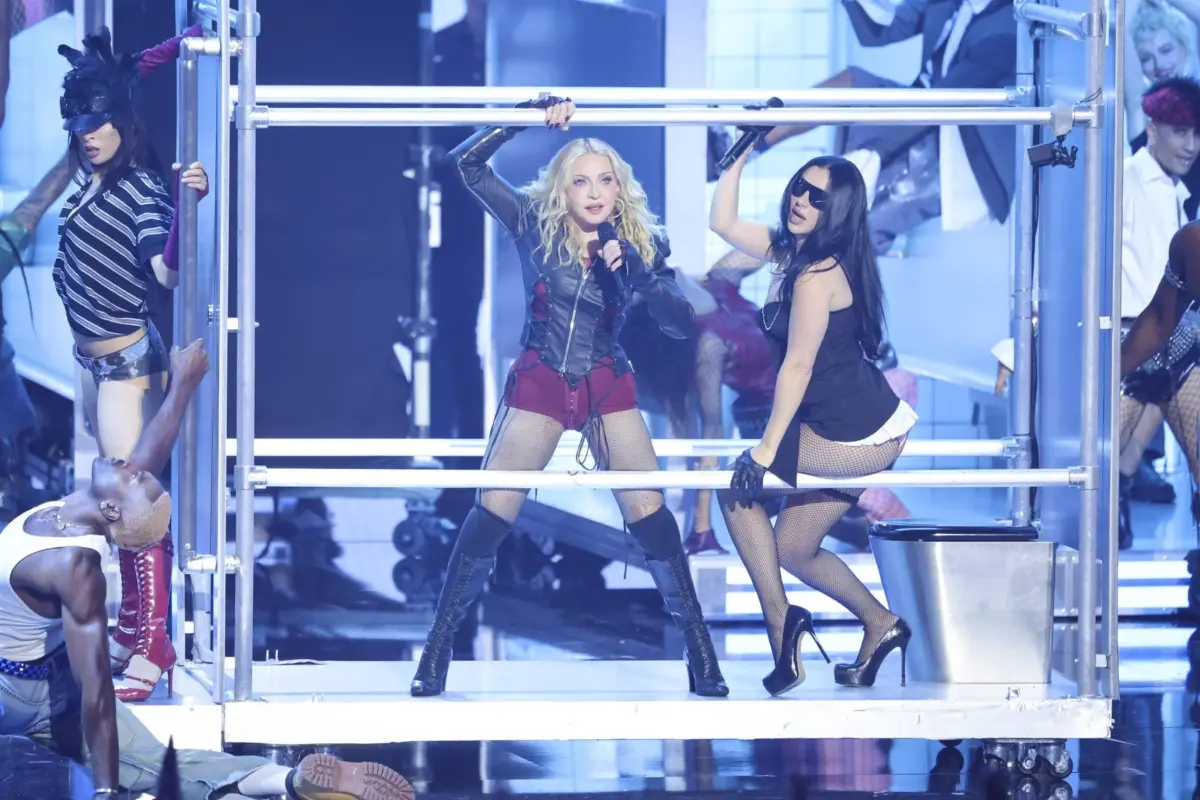
The events of Sunday, September 27, 2026, were designed to be a triumphant celebration of musical evolution and enduring legacy. Broadcast live from the Peacock Theater, the 2026 VMAs opened with a sensory spectacle that immediately established the evening’s tone. Madonna stepped onto the stage for her first VMAs performance since 2003, commanding the arena alongside contemporary hitmakers Sabrina Carpenter and Charli xcx.
The medley was a masterclass in cross-generational pop collaboration. Madonna opened with a searing rendition of "Bring Your Love" alongside Carpenter before transitioning into "Danceteria Afterhours" with Charli xcx. The performance was further elevated by high-profile cameos from actress Julia Garner, musician Sombr, actor Seth Rogen, and longtime collaborator Debi Mazar. The visual and sonic presentation bridged decades of pop culture history, proving that Madonna’s creative DNA remains deeply embedded in the modern musical landscape.
As the evening progressed, Madonna’s dominance was formalized by the voting bodies and industry panels. She shattered personal records by walking away with seven VMAs trophies, making her the night’s most-awarded artist and bringing her career total to historic new heights.
However, the jubilation in the arena was quickly contrasted by the vitriol festering online. Within minutes of her exit from the stage, digital platforms became saturated with commentary that sidestepped her artistic output entirely. Instead, critics fixated on her physical appearance, dissection of her facial features, and critical inquiries into whether a 68-year-old woman should be executing high-energy, provocative choreography. Commentators across various digital domains questioned whether Madonna was trapped in a cycle of attempting to re-create her youth, reigniting a tired, decades-old culture-war debate over how aging female icons are "permitted" to behave in the public eye.
Supporting Context & Metrics: The "No-Win" Scenario for Aging Women in the Spotlight
The societal anxiety and vitriol directed at Madonna are not isolated incidents; rather, they are symptomatic of an entrenched, systemic bias that punishes women for the immutable passage of time. This dynamic was brought to the forefront on the September 28 broadcast of The View, where the co-hosts connected Madonna’s ordeal to a parallel cultural flashpoint involving 64-year-old actress Jasmine Guy.
Guy, celebrated for her iconic role in the classic sitcom A Different World, recently faced her own wave of digital harassment and unsolicited critiques regarding her appearance upon stepping back into the public eye. Highlighting a poignant statement Guy shared on Instagram, Whoopi Goldberg captured the emotional toll of this scrutiny: "The Internet can be brutal to women as we grow older. It asks us to celebrate life while criticizing every sign that we have lived in."
This sentiment laid bare the mathematical impossibility of public aging for women. Alyssa Farah Griffin articulated the explicit "no-win" framework governing the industry:
"So Madonna’s being criticized for being too overtly sexual and trying to look too young. And then Jasmine’s being criticized for trying to age gracefully. It’s like, you can’t win no matter what direction you take it."
This double standard operates on a dual track:
- The Youth-Obsessed Trap: If a woman chooses to embrace bold fashion, sexuality, high-energy performance, or cosmetic procedures to maintain her agency and visual identity, she is labeled "desperate," "embarrassing," or accused of "refusing to age."
- The Invisibility Trap: Conversely, if a woman embraces a natural, subdued aesthetic, withdraws from high-visibility performance, or shows visible signs of aging, she is often sidelined by industry executives, rendered culturally invisible, or subjected to critiques that she has "let herself go."
The metrics of cultural consumption reveal that women over 50 represent one of the fastest-growing demographics in media consumption, yet representation and behavioral latitude for aging female creators remain remarkably constrained. Society demands that women remain vibrant and productive, yet penalizes them the moment their physical reality departs from the unrealistic, airbrushed standards of youth.
Official Statements & Discourse: Perspectives from The View
The conversation on The View transcended standard celebrity gossip, evolving into a passionate, authoritative critique of cultural ageism. The panel utilized their platform to deconstruct the emotional and physical reality of aging, turning the lens back on a society obsessed with eternal youth.
Sunny Hostin introduced a sobering perspective on the biological reality and privilege of growing older, cutting through the superficiality of the internet commentary. Reflecting on her own life milestone, Hostin stated:
"I think that’s what’s so sad about all of this that’s going on about women and aging is, like, what is the alternative? It is such a blessing to be able to age."
Hostin expanded on this by contextualizing aging within the fragile framework of human mortality and health, noting the heavy toll of loss experienced within her own peer group:
"I’m going to be 58 this year. I can’t begin to tell you how many emails I get almost on a monthly basis about someone being widowed in my age group, someone having a stroke, someone having a heart attack. How dare you shame someone for trying to age well and just live?"
Injecting a moment of levity into the heavy discussion, Ana Navarro pointed out the stark gender disparity in how aging is perceived. Comparing herself to Latin music icon Ricky Martin—who delivered a triumphant halftime performance during the Baltimore Ravens-Dallas Cowboys game in Rio de Janeiro on that same Sunday—Navarro joked about their identical age proximity:
"I felt so aged. And then I see all this stuff on Madonna, and I’m like, ‘OK, leave women alone.’ It’s hard."
Navarro’s quip highlighted a fundamental cultural truth: male legacy artists frequently enjoy unencumbered veneration as they age. Gray hair, weathered skin, and physical maturity in male performers are routinely coded as markers of "distinction," "wisdom," and "seasoned mastery." For women, however, those exact same physical markers—or attempts to alter or mask them—are weaponized as evidence of decline or moral failing.
Future Outlook: Redefining Cultural Legacy and the Future of Female Icons
The firestorm surrounding Madonna’s 2026 VMAs appearance signals a critical turning point in how society evaluates female cultural architects. As generations of pioneering women—including Madonna, Cher, Tina Turner, Meryl Streep, and Jasmine Guy—continue to break historical boundaries, the cultural narrative is being forced to evolve.
The defense mounted on platforms like The View indicates that the old playbook—where female artists were expected to quietly fade into obscurity once they crossed an arbitrary age threshold—is no longer going unchallenged. Audiences, cultural commentators, and media personalities are increasingly pushing back against ageist tropes, demanding a mature ecosystem that separates a woman’s artistic output from regressive patriarchal expectations.
Looking forward, the legacy of Madonna’s historic seven-award sweep at the 2026 VMAs will likely be twofold. On one hand, it stands as an elite professional milestone, proving that her commercial and creative pulling power remains undiminished after more than four decades at the apex of pop music. On the other hand, it serves as a watershed moment in the ongoing war against ageism in entertainment.
By stepping onto the stage, claiming her space, and refusing to sanitize her performance for the comfort of critics, Madonna—backed by vocal public defenders—has pushed open the door for future generations. The evolving discourse suggests a future where aging is recognized not as a career expiration date, but as an authentic extension of power, artistry, and the radical, uncompromised right to simply live.