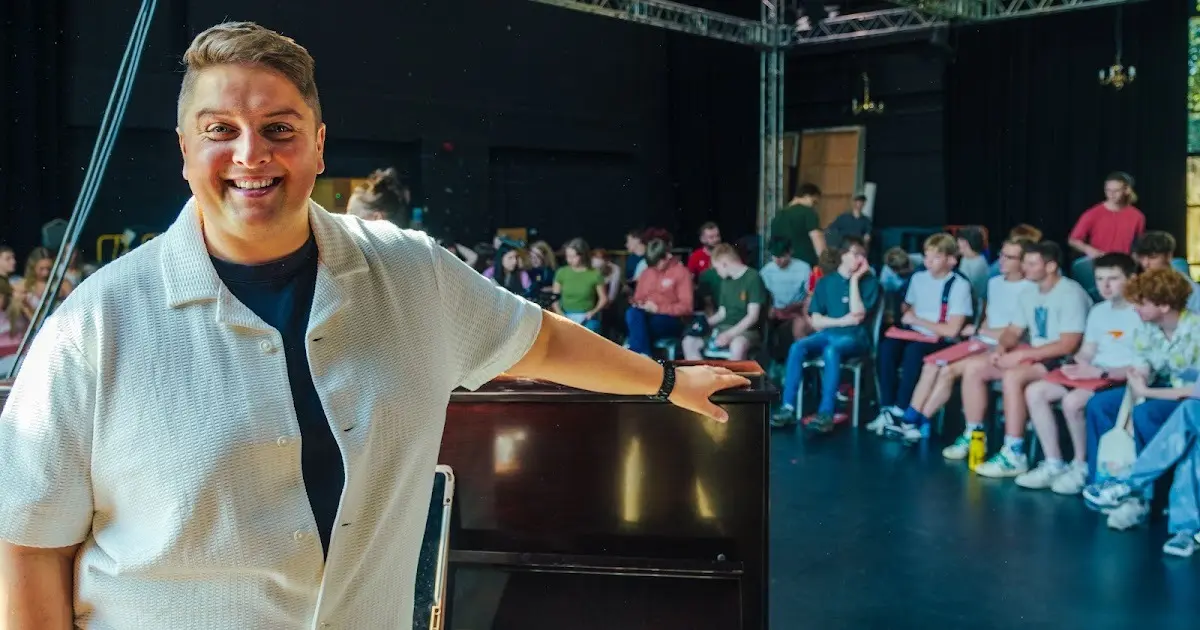
The contemporary classical music landscape welcomes a profound addition this month with the release of i breathe, the debut choral album by acclaimed composer and conductor Nathan James Dearden. Issued on the prestigious Signum Classics label, the record serves as a sonic mosaic of a decade’s worth of artistic exploration, collaboration, and personal identity. Spanning works composed between 2014 and 2024, the album captures the stylistic range and collaborative ethos of a singular voice in modern British composition.
Dearden’s music—characterized by a visceral connection to the breath, narrative economy, and a deep-seated exploration of his Welsh roots—is brought to life on the album by an elite roster of performers. These include the Choir of Royal Holloway (under Rupert Gough), Kantos Chamber Choir (directed by Ellie Slorach), the National Youth Choir of Wales (led by Tim Rhys-Evans), and cellist Maxim Calver. Rather than presenting a uniform studio creation, i breathe acts as an auditory exhibition of musical postcards. It chronicles Dearden’s trajectory from his formative years singing in youth ensembles to his current position as a prominent professional composer and educator.
Beyond the album’s immediate critical acclaim, the release punctuates a broader, rapidly expanding creative chapter for Dearden. His multi-faceted career now intersects with theatrical storytelling, community-driven social engagement, and operatic explorations of marginalized Welsh histories. This comprehensive profile examines the architecture of i breathe, investigates the collaborative networks underpinning its creation, and looks forward to the ambitious projects defining Dearden’s evolving artistic trajectory.
Detailed Chronology: A Decade of Musical Evolution
To understand the emotional and structural weight of i breathe, one must trace the chronological arc of the compositions selected for the release. Curated as a retrospective of sorts, the album bridges a ten-year gap in Dearden’s creative output, juxtaposing early juvenilia with mature, highly focused statements.
Early Roots and Foundational Collaborations (The Mid-2010s)
The oldest works featured on i breathe date back roughly a decade to the early stages of Dearden’s professional emergence. Having transitioned from a teenage chorister in the National Youth Choir of Wales to a professional singer working with ensembles like the BBC, Dearden found his compositional voice organically. Encouraged by mentors at Cardiff University during his undergraduate studies, he began deeply immersing himself in score study, quickly identifying vocal and choral writing as his primary artistic medium. This period established his fascination with the human voice as a primary vector for narrative and communal expression.
Pandemic Resilience: Morals + Interludes (2020)
A central pillar of the album’s middle period is Morals + Interludes (2020). Conceived during the global COVID-19 pandemic in collaboration with the National Youth Choirs of Great Britain Fellowship, the piece was ultimately completed during a creative residency at The Red House in Aldeburgh. Comprising five short choral "postcards," the work emerged from virtual workshops where young singers shared memories and personal narratives from their isolated lives. Dearden transformed these fragments into a poignant meditation on collective memory, exploring how isolated individuals could forge a unified sonic identity during a time of global dislocation.
The year 2020 also saw the composition of The way we go, a striking song written for mezzo-soprano Helen Charlston. For this piece, Dearden set a short-form poem by Katherine Towers, demonstrating his affinity for poetic immediacy, abstract narrative frameworks, and textual clarity.

Maturation and Youth Engagement: Everything about us (2022)
Commissioned for the National Youth Choir of Wales, Everything about us (2022) represents a high-water mark in Dearden’s collaborative composition style. Created through intensive workshops where young choristers actively contributed their own texts, the piece captures the unadulterated energy of youth making music collectively. The commitment of the performers is palpable; during the recording sessions for i breathe, the National Youth Choir of Wales performed the intricate work entirely from memory, infusing the studio takes with an electric, unscripted vitality.
Contemporary Masterpieces: Three Motets (2024)
Bringing the chronology up to the present day, the Three Motets (2024) were written specifically for the Choir of Royal Holloway. Serving as his long-standing artistic home and institutional learning ground, Royal Holloway’s distinctive vocal timbre has heavily influenced Dearden’s sonic palette. These recent motets showcase a mature composer entirely comfortable with nuance, architectural clarity, and emotional directness—qualities that link his harmonic sensibilities to the directness found in minimalist traditions.
Supporting Context & Metrics
The realization of a debut commercial recording of this scale requires navigating significant logistical, financial, and artistic hurdles. Producing an album featuring three distinct, high-caliber vocal ensembles alongside solo instrumentalists places immense strain on funding structures and project management. Yet, Dearden approached these challenges with a clear curatorial vision: to capture the full spectrum of contemporary choral practice, ranging from the raw, untrained energy of youth ensembles to the virtuosic polish of professional chamber choirs.
Ensemble Dynamics and Sonic Profiles
The collaborative bedrock of i breathe rests upon three distinct choral identities, each contributing a unique texture to the album’s thematic framework:
- The Choir of Royal Holloway (Conducted by Rupert Gough): Serving as Dearden’s primary laboratory for vocal writing, this ensemble possesses a specialized, highly refined sound. Their precise intonation and appetite for demanding contemporary repertoire have actively shaped Dearden’s approach to vertical harmony and sustained vocal phrasing.
- Kantos Chamber Choir (Conducted by Ellie Slorach): Renowned for their narrative-driven performances and innovative audience engagement, Kantos brings a dramatic immediacy to Dearden’s work. Hearing Kantos interpret his scores often provides the composer with a transformative listening experience, revealing new facets of his own music.
- The National Youth Choir of Wales (Conducted by Tim Rhys-Evans): Representing the generational bookends of Dearden’s artistic journey, this ensemble injects a raw, youthful dynamism into the project. Their memorized performances emphasize the physical act of singing as a communal, embodied experience.
Linguistic and Textual Architecture
Dearden’s treatment of text is defined by an aversion to superfluous ornamentation—what he characterizes as "hating fluff." Whether sourcing texts independently, collaborating with contemporary poets like Katherine Towers and Siwan Llynor, or writing his own lyrics, Dearden prioritizes narrative transparency and emotional directness.
His bilingual output reflects a complex negotiation between Welsh and English. English is treated with a degree of abstraction, allowing the composer to exploit natural speech pauses and play with structural fluidity. Welsh, conversely, carries a heavier cultural and linguistic weight. Its distinct stress patterns, breathing points, and structural constraints present unique compositional challenges, inspiring Dearden to craft bilingual frameworks that honor both languages’ distinct sonic profiles.
Official Statements and Artistic Philosophy
Reflecting on the overarching themes of i breathe, Nathan James Dearden emphasizes that the album’s conceptual unity emerged organically rather than through rigid pre-planning.

"It was only when I curated the disc that I realized how deeply interconnected these pieces truly are," Dearden notes.
The album’s primary motifs—the Welsh post-industrial landscape, the physiological necessity of breath, and the power of collective expression—serve as threads tying a decade of disparate works into a cohesive artistic statement.
Composing Versus Conducting
Dearden occupies a unique dual role as both a composer and a conductor, though he maintains a strict boundary between the two disciplines. While he stepped onto the podium to conduct the Choir of Royal Holloway for the track suo on the new album, he confesses that he rarely directs his own music.
"As a conductor, I tend to be far too analytical," Dearden explains, noting that viewing his own work through an interpretive lens can occasionally hinder his intuitive connection to the music. Conversely, his compositional process embraces a degree of controlled chaos, frequently integrating improvised elements and aleatoric passages. Across both roles, however, breath remains paramount. The physical mechanics of inhalation, phrasing, and the strategic placement of silence govern how he constructs musical time both on paper and in his internal ear.
Future Outlook: Operas, Community Projects, and Beyond
With i breathe successfully released, Dearden’s creative horizons continue to expand across multiple disciplines, moving beyond pure choral music into large-scale theatrical, operatic, and community-based initiatives.
Mamiaith and the Exploration of Welsh History
Looking toward the broader theatrical landscape, Dearden’s ongoing work on Mamiaith (Welsh for "Mother Tongue") marks a significant pivot toward music theatre. Developed as an expanding collaboration with Music Theatre Wales, Tŷ Cerdd, and the National Eisteddfod Genedlaethol, the project features three opera scenes set to libretto by Siwan Llynor.
The work tackles a visceral, overlooked chapter of Welsh history: the imprisonment of women protesting for the legal equality of the Welsh language. Although Dearden comes from an English-speaking family in a Welsh community and learned Welsh as a second language, he views Mamiaith as a vital platform for marginalized historical voices. Discussions with Llynor point toward the eventual expansion of the piece into a full-length opera, alongside other developing theatrical concepts.

Community Engagement and the Aloud Foundation
Simultaneously, Dearden remains deeply committed to grassroots musical education and social impact. He is currently collaborating with artist Ruth Evans on a multi-phase project spanning the eight ancient counties of Wales. Following an initial community-ensemble residency in Wrexham and subsequent work with schools in Powys, the initiative uses storytelling to amplify local histories and lived experiences.
Furthermore, Dearden is writing for the Only Boys Aloud Choir, an initiative run by the Aloud Foundation that engages boys aged 13 to 19. This project bridges generational divides by pairing young singers with traditional male voice choirs—some featuring miners who have been singing continuously since the 1970s. By fostering these intergenerational collaborations, Dearden helps safeguard intangible cultural heritage while equipping a new generation of Welsh youth with vital vocal and social skills.
The Orchestral Horizon
As for future instrumental milestones, the question of a "Dearden Symphony" remains an open possibility. While he regularly teaches orchestration and collaborates with instrumental ensembles, the symphonic medium is one he approaches with cautious reverence.
"It is not a language I am entirely comfortable speaking as Nathan," he admits candidly, noting that large-scale orchestral writing often leaves him second-guessing his structural choices. Yet, when pressed on whether a symphony lies in his future, his response is characteristically measured: "If you set me in a dark room for a year…"
For now, the classical music world can immerse itself in the vibrant, breathing world of i breathe—a triumphant debut that firmly establishes Nathan James Dearden as one of the most compelling and authentic compositional voices of his generation.