Executive Overview
In the modern landscape of music production, digital audio workstations (DAWs) have become overwhelmingly visual. Producers, beatmakers, and sound designers spend hours staring at grids, automation curves, color-coded clips, and dense plugin interfaces. While this ocular-centric approach has undeniably streamlined the mechanics of making music, it frequently results in severe cognitive fatigue, ear-fatigue’s insidious cousin: visual and creative burnout. When a producer hits a creative wall, the traditional advice is to step away from the screen. But what if the cure for DAW fatigue wasn’t walking away from your workspace entirely, but rather interacting with your software in a completely revolutionary way?
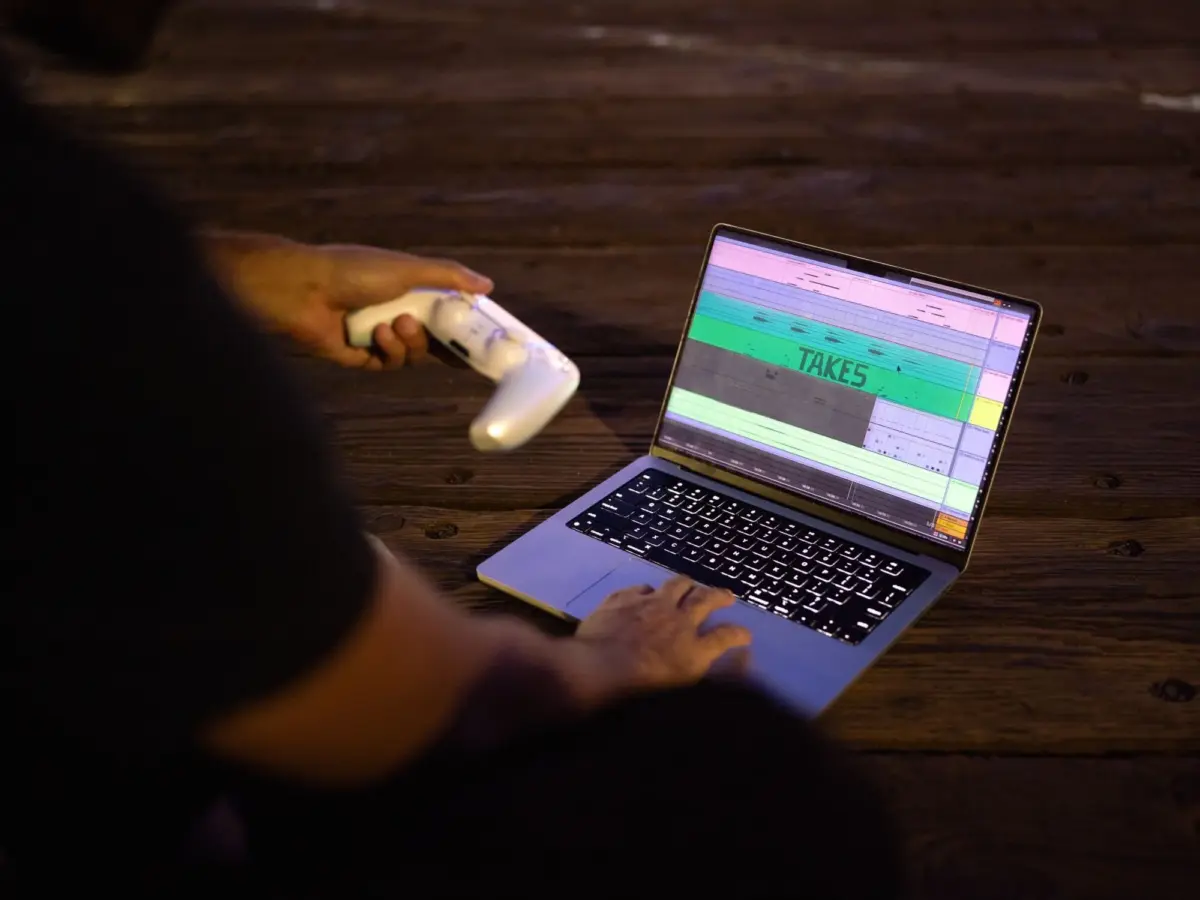
Enter Take 5: The Search for Sound—a groundbreaking, five-minute, audio-driven video game built entirely within Ableton Live by producer and developer Chuck Sutton. Designed as a rapid-fire creative reset, Take 5 strips away the visual interface entirely, plunging users into a pitch-black, non-visual sonic landscape. Navigated exclusively through hearing, standard computer keyboards, or MIDI controllers, the game requires players to traverse virtual forests, fend off abstract enemies by playing specific musical motifs, and solve rhythmic call-and-response puzzles.
Priced at $25 and available now, Take 5 bridges the gap between interactive entertainment and functional music production tools. By forcing the brain to interpret space, distance, and conflict through audio alone, Sutton’s creation bypasses overthought analytical loops, jolting dormant creative sparks back to life. This article explores the genesis of Take 5, the technical intricacies of building a video game inside Ableton Live, the psychology behind audio-only interaction, and what this innovative project signals for the future intersection of gaming, music production software, and creative workflows.
Detailed Chronology: From a Red-Eye Flight to a Sonic Quest
The Mid-Air Epiphany
The genesis of Take 5 reads like a classic tale of necessity being the mother of invention. It did not begin in a multi-million-dollar acoustic treatment studio or a high-tech software development lab; rather, it was conceived at 30,000 feet in the dead of night.
As creator Chuck Sutton recalls, the project was born on an overnight red-eye flight. Cabin lights were dimmed, and the environment was pitch-black. Sutton, driven by an itch to create, faced an immediate hurdle: the ambient darkness made staring at his laptop screen physically painful. Yet, his creative impulse refused to sleep.
"This all started on a red-eye," Sutton explains. "It was too dark to look at my screen without my eyes hurting. But I wanted to play something anyway, and mostly I wanted to do it with my eyes closed. So I built a game you play by listening."
That simple constraint—designing an experience that could be enjoyed entirely without sight—fundamentally inverted the traditional paradigm of video games and DAW usage. Instead of using sound to accompany visual stimuli (the standard formula for nearly every video game since the 1970s), Sutton decided to make sound the environment itself.
Conceptualizing the Audio-Driven World
Upon returning to land, Sutton began conceptualizing how a purely auditory game could function within Ableton Live, a DAW renowned for its powerful Session and Arrangement views, Max for Live capabilities, and flexible routing architecture.
The core challenge was translating spatial awareness into acoustic phenomena. In a visual video game, a player knows an obstacle is ahead because they see it rendered on screen. In Take 5, spatial orientation is handled through clever sound design, panning, volume manipulation, and rhythmic cues. When a player moves forward using a keyboard or external MIDI controller, the virtual footsteps don’t just trigger a static sample; they dynamically alter based on the virtual terrain. Moving closer to an object increases its volume, shifts its stereo field, and introduces subtle acoustic reflections, tricking the brain into perceiving depth and breadth in a pitch-black digital void.
Gameplay Mechanics and Puzzle Design
Take 5 is intentionally brief—designed to last precisely five minutes—ensuring that users do not get sucked into a multi-hour gaming session when they are supposed to be finishing actual music tracks. However, within those five minutes, the gameplay is dense, engaging, and musically rewarding.
- Exploration & Movement: Players traverse abstract sonic forests. Every step forward generates auditory feedback, shifting the player deeper into the soundscape.
- Adversarial Encounters: As players explore, they occasionally encounter "enemies" represented by abrasive or dissonant audio cues. To defeat these sonic foes, the player must play a specific tune or chord sequence on their controller.
- Rhythmic Puzzles: Sprinkled throughout the environment are call-and-response rhythmic challenges. Solving these puzzles unlocks dynamic, evolving melodies and triggers fresh MIDI tracks that the player can co-opt for their own productions.
- The Harvest: As the five-minute timer winds down, the player is left with a collection of unexpected synth lines, earworms, and rhythmic motifs that they would likely never have programmed under normal, conscious working conditions.
Supporting Context & Metrics: The Science of DAW Fatigue and Sonic-First Design
The Ocular-Centric Trap of Modern Production
To fully appreciate the genius of Take 5, one must examine the modern music production ecosystem. For decades, the transition from hardware-based studios to In-The-Box (ITB) mixing and production has shifted the human sensory load heavily toward the visual cortex.
Modern producers monitor EQ curves via frequency analyzers, sculpt transients by looking at visual waveform displays, and arrange tracks by staring at color-coded rectangular blocks on a timeline. While this has democratized music production—making it cheaper, faster, and more portable—it comes with steep psychological costs:
- Analysis Paralysis: Having infinite visual options (plugins, presets, routing paths) often freezes the creative center of the brain.
- Ear Fatigue vs. Visual Fatigue: Staring at high-refresh-rate screens for 8 to 10 hours a day causes severe eye strain, which neurologically bleeds into auditory fatigue, making it harder to make objective mixing decisions.
- Over-Quantization of Emotion: Because we look at music on a grid, we tend to fixate on visual perfection (zeroed-out transients, perfectly snapped MIDI notes) rather than feel.
Why Audio-Only Environments Unlock Creativity
By stripping away the screen, Take 5 forces the user’s brain to engage in echolocation and auditory processing, ancient evolutionary mechanisms that bypass the hyper-critical analytical mind. When you cannot see what is coming, your brain relies entirely on intuition and immediate reaction.
Research in cognitive psychology and music therapy indicates that auditory-dominant tasks activate neural pathways associated with emotional memory and uninhibited play. When producers interact with Take 5, they are tricked into improvising. They aren’t worrying about whether a compressor ratio is set to 4:1 or if an EQ cut is surgical enough; they are simply reacting to a sound, solving a puzzle, and capturing inspiration.
Ableton Live as a Game Engine
The technical foundation of Take 5 is worth noting. While game engines like Unreal Engine or Unity are built for rendering complex 3D graphics, Chuck Sutton leveraged Ableton Live—and likely Max for Live—as an alternative engine where audio is the graphics asset.

Ableton Live’s non-linear session view, robust MIDI scripting, and real-time processing capabilities make it uniquely suited for procedural audio generation. By mapping game states (player coordinates, enemy proximity, puzzle completion) to MIDI parameters, audio effects racks, and sample playback chains, Sutton turned a standard music production DAW into an interactive, gamified compositional environment.
Official Statements and Creator Insights
Chuck Sutton’s philosophy behind Take 5 centers heavily on spontaneity, anti-perfectionism, and ruthless efficiency. In discussing the project, Sutton emphasizes that the game is not meant to be studied, overanalyzed, or mastered over weeks; it is a tactical weapon against creative stagnation.
"In Take 5, you move through a place and react to what you hear, and it keeps handing you things you would never have thought to make on your own," Sutton notes.
This statement highlights the primary value proposition of the software: serendipity. As producers, we often fall into habitual patterns—using the same chord progressions, defaulting to the same synth patches, and writing in the same comfortable tempos. Take 5 disrupts these neurological ruts by injecting randomized, unexpected musical stimuli directly into the creator’s workflow.
Sutton’s instructions for users are refreshingly candid and direct:
"Do not overthink the five minutes. Get in, move, listen, keep what you love, and get back to your music. If you never read a word past the Quick Start, you are doing it right. Have fun in there!"
This no-nonsense approach separates Take 5 from sprawling video games or complex audio plugins that demand hours of tutorials and manual reading. It respects the producer’s time, acting as a rapid palate cleanser for the ears and mind.
Future Outlook: The Intersection of Gaming, DAWs, and Creative Tools
The release of Take 5: The Search for Sound arrives at a fascinating cultural and technological crossroads. As the lines between interactive gaming, virtual reality, and music production continue to blur, projects like Sutton’s hint at a much larger paradigm shift in how we interact with creative software.
1. Gamification as a Workflow Catalyst
For years, the term "gamification" in music production was mostly associated with cheesy mobile apps that taught basic piano chords or rhythm timing to children. Take 5 elevates gamification into the professional sphere, proving that interactive game mechanics can serve as legitimate compositional catalysts for advanced music producers. We may soon see other developers building interactive, game-like utilities directly into DAWs to help producers break out of creative ruts.
2. The Rise of Blind and Spatial Audio Interfaces
With the explosion of spatial audio formats like Dolby Atmos and binaural mixing, producers are increasingly required to think in three-dimensional sonic spaces rather than flat stereo fields. Games like Take 5 that rely entirely on binaural cues and spatialized audio training could become valuable educational tools for engineers learning how to position elements accurately in an immersive mix environment.
3. Combatting Digital Burnout in the Creator Economy
As burnout rates soar among independent musicians, content creators, and bedroom producers, software that promotes mental health and creative longevity will become increasingly vital. Tools that encourage screen-free thinking—even if executed through digital mediums—point toward a healthier future for music creation.
Conclusion
Take 5: The Search for Sound is much more than a novelty Ableton-based minigame; it is a thoughtful, elegantly designed intervention for the modern music producer. By replacing the glaring white light of the computer screen with a pitch-black, audio-driven wilderness, Chuck Sutton has created a sanctuary for fatigued minds.
In just five minutes, players can escape the tyranny of the DAW grid, fight sonic enemies with melodies, solve rhythmic puzzles, and emerge with fresh, unexpected musical ideas ready to be injected into their next track. For $25, it is arguably one of the most cost-effective and creatively liberating investments an Ableton Live user can make today.
As the music technology landscape continues to evolve, Take 5 serves as a timely reminder of why we fell in love with music in the first place: not to stare at screens or obsess over metrics, but to close our eyes, listen deeply, and let the sound guide the way.
Take 5: The Search for Sound is available now for $25 via takefive.quest.