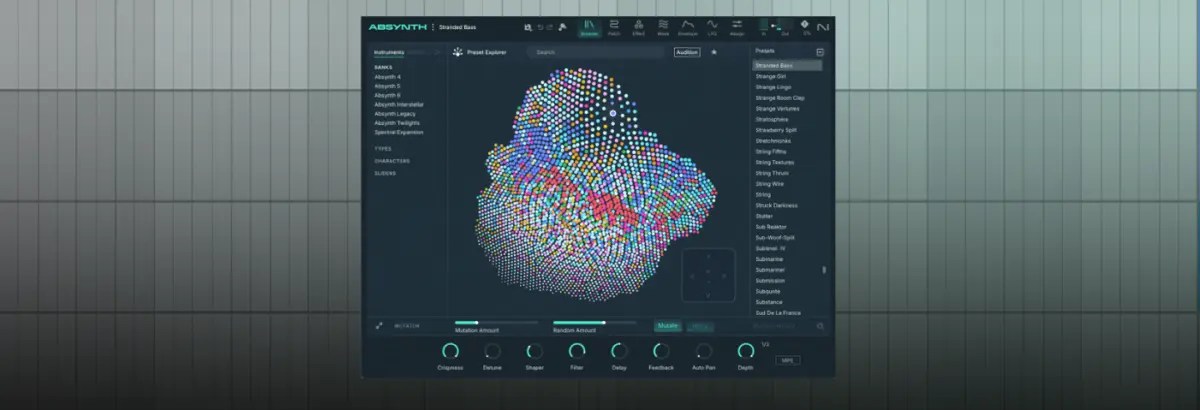
For decades, Native Instruments’ Absynth has occupied a legendary, albeit idiosyncratic, corner of the electronic music production ecosystem. Revered for its deep multi-stage envelopes, complex modulation systems, and an architectural capacity for sprawling, long-form sound design, the softsynth has historically been pigeonholed as a secret weapon for evolving cinematic pads, otherworldly atmospheres, and ambient soundscapes. However, creative sound design rarely obeys rigid genre boundaries.
With the arrival of Absynth 6—unveiled as a marquee inclusion within Komplete 26—Native Instruments has substantially overhauled the instrument’s core infrastructure. By introducing an expanded granular engine, a completely revamped loop section, lush spatial effects like the Aetherizer, and meticulously modelled Moog-style ladder filters, the instrument has unlocked a hyper-aggressive side to its sonic personality.
In this comprehensive production breakdown, we investigate how Absynth 6’s advanced synthesis architecture can be weaponized outside of its comfort zone. Utilizing a single, unassuming one-shot sample of a Peking Opera gong, we explore a step-by-step masterclass in transforming static, organic source material into a driving, multi-layered, performance-ready techno sequence pulsing at a warehouse-ready 129 BPM.
Detailed Chronology: The Step-by-Step Patch Construction
Step 1: Laying the Foundation with the Granular Engine
The journey begins at ground zero: a single audio file. Load up Absynth 6 inside your digital audio workstation (DAW) and program a driving, syncopated MIDI bassline sequence at 129 BPM.
When you initialize a New Preset in Absynth 6 and hit play, you are initially greeted by a stark, unassuming sine wave tracing out your MIDI notes. To pivot away from convention, navigate to the Patch tab, replace this default oscillator with the newly optimized Granular Engine, and load up the Peking Opera Gong one-shot sample. Instantly, the harmonic profile shifts from clinical digital synthesis to rich, metallic resonance, though it still requires substantial structural molding to sit comfortably within a contemporary techno mix.
Step 2: Unlocking the Power of Increased Granular Density
A raw gong sample played back through a basic granular setup lacks the visceral "filth" required for peak-time dance music. To remedy this, transpose the sound down by 12 semitones (one full octave) to plunge its fundamental frequency into sub-heavy territory. Next, switch over to the Grain tab and compress the grain size down to a tight 3ms.
This is where Absynth 6’s overhauled granular engine demonstrates its true engineering pedigree. The maximum density parameter has been doubled to an astonishing value of 32. Cranking the density to this maximum setting smears the individual grains into a dense, continuous wall of metallic texture. To appreciate the engineering leap, dropping the density parameter back down to 4 instantly reveals a thin, grainy, and remarkably limp result—proving that modern density counts heavily when carving out heavy electronic textures.
Step 3: Weaponizing Multi-Stage Envelopes and Pitch LFOs
The true "secret sauce" of Absynth has always resided in its formidable modulation architecture. To inject rhythmic motion into our metallic canvas, click Osc A Amp, access the Transform menu, select Expand to Rhythm, and engage BPM Sync.
Immediately, the static drone is chopped into a rhythmic pulse. To elevate the patch into classic acid territory, click New Envelope and assign it to Osc A Main Pitch. By engaging the LFO button and pulling the initial envelope breakpoint all the way down, you create a dynamic interplay: an envelope aggressively pumping the amplitude married to an LFO modulating the pitch. Remarkably, without adding any traditional synth architecture, a gong sample and an envelope shape have successfully birthed a pulsing acid bassline.
Step 4: Dialing in Nasty Modulation Spikes
With the foundational envelope and LFO framework in place, navigate to the LFO page. To isolate the effect, deselect channels B and C from the LFO’s pitch assignment matrix—ensuring the modulation targets exclusively our primary layer.
Next, push the Pitch slider up to 25, the Time parameter to 1.6919, and the Phase to 32.063. These precise numeric tweaks introduce an unstable, wobbly pitch modulation punctuated by nasty, jagged transient spikes. The result is a genuinely filthy acid-leaning melodic line driven entirely by acoustic percussion data.
Step 5: Sculpting Mid-Range Grit with Moog-Modelling Filters
No acid-adjacent techno patch is complete without aggressive filtering. Absynth 6 introduces a pristine suite of filter emulations, anchored by newly minted Moog-modelled ladder filters.
To carve out the mix and accentuate the boxy, aggressive mid-range, insert a Ladder BP (Band-Pass) filter first, dialing the cutoff to 542.92. This brilliantly zeroes in on the most aggressive harmonic frequencies of the gong. Follow this with a Ladder Low-Pass filter set to 500.56, while driving the resonance up to a scorching 43.875. The filter configuration transforms the patch from a raw generative experiment into a polished, weaponized piece of warehouse hardware emulation.
Step 6: Constructing Layer Two via Retriggered Envelopes
To build a massive, thick techno lead, a single layer is rarely sufficient. Open Channel 2, load another Sample Engine, insert the same Peking Opera Gong sample, and transpose it down a staggering 24 semitones (two full octaves) for subterranean weight. Mute Channel A temporarily to monitor your progress.
Navigate to the envelope section for Osc B Amp, apply the Expand to Rhythm function once more, and change the playback mode to Retrigger.
Step 7: Syncopating the Groove
To establish complex rhythmic interplay, pull the beat length/timing parameter down to 0.250. This immediately generates a frantic, delay-like rhythmic stutter. Next, grab the bottom of the two pink envelope breakpoints and drag them leftward to align with the onset of the second envelope spike.
This programming step instructs Absynth 6 to rhythmically retrigger the amplitude envelope until the second pair of MIDI notes hits, at which point the retriggering ceases and the remainder of the envelope plays out. The resulting groove bridges the gap between programmed sequencing and organic percussion.
Step 8: Spatializing with the Aetherizer Effect
Spatial processing can make or break a techno lead. Absynth 6 introduces the lush, highly anticipated Aetherizer effect. Instead of feeding the effect with the Master output bus, isolate it by routing only the input from our secondary layer (Channel B).
Crank the Feedback parameter to 75 and set the Wet signal to approximately 0.562. For maximum performance flexibility, assign this wet/dry parameter to a macro control for live filter-sweeps. Bring Channel A back into the mix, and you will find that the spatialized echoes of Channel B dance effortlessly around the driving dry core of Channel A.
Step 9: Adding the Final Harmonic Layer and Loop Manipulation
For the coup de grâce, introduce a third layer on Channel C. Load a final Sample Engine running the Peking Opera Gong, temporarily isolate it against a driving techbeat loop, and open Absynth 6’s newly overhauled Loop section.
By setting a loop start point at 5600 and an end point at 12644 within the sample waveform, the engine continuously cycles through micro-segments of the sample. This yields filthy, syncopated micro-repeats that sit on top of the primary riff. Reintroducing the volume levels for Channels A and B locks the three layers into a cohesive, monstrous sonic entity.
Step 10: Performance Integration and Live Jamming
With all three distinct layers balanced, the patch behaves less like a static software synth instrument and more like a modular techno groovebox. Because individual layer volumes, filter cutoffs, and the Aetherizer wet/dry mix can be mapped directly to macro controllers, Absynth 6 emerges as an exceptionally dynamic weapon for live techno performance and on-the-fly arrangement manipulation.
Supporting Context & Metrics: The Evolution of Absynth
To fully contextualize the significance of this sound design exercise, one must examine the developmental trajectory of Native Instruments’ software ecosystem. Released as part of the massive Komplete 26 bundle, Absynth 6 marks a triumphant return for an instrument that many producers feared was quietly consigned to software history following its discontinuation years ago.
Overhauled Aetherizer with discrete sidechain/bus routing
Loop Architecture
Static sample looping
Advanced micro-looping with precise transient point mapping
Industry metrics indicate a surging demand for hybrid sound design tools—softsynths that bridge the gap between organic acoustic sampling and aggressive electronic synthesis. By resurrecting Absynth with modern processing power, Native Instruments has successfully captured the attention of contemporary techno producers who prioritize evolving textures over static, vanilla sawtooth presets.
Official Statements & Industry Reception
The revival of Absynth within the Komplete 26 package has sent ripples through the electronic music production community. Sound designers and mix engineers alike have praised Native Instruments for maintaining the deep, esoteric architecture that made the original instrument a cult classic, while aggressively modernizing its weakest links.
"Absynth has always been an instrument of infinite depth, but for too long, producers pigeonholed it strictly into ambient or cinematic scoring," notes lead product specialist input during the Komplete 26 roll-out. "By expanding the granular density ceiling, integrating zero-delay feedback ladder filters, and refining the modulation envelope matrix, we wanted to prove that Absynth’s architecture is rugged enough to stand shoulder-to-shoulder with the hardest underground techno gear on the market."
Early adopters across underground production forums and professional studio spaces have echoed these sentiments, noting that the ability to drag organic, acoustic source material—such as gongs, bells, and field recordings—through Absynth 6’s modulation pipeline yields a distinct sonic footprint that standard subtractive synths simply cannot replicate.
Future Outlook: The Future of Hybrid Sound Design in Techno
As electronic music production trends continue to favor granular synthesis, modular experimentation, and unexpected sound-source marriages, instruments like Absynth 6 point the way forward. The days of relying on stock preset libraries and predictable plugin chains are rapidly giving way to a culture of bespoke, single-sample sound design.
By taking an acoustic instrument—a Peking Opera gong—and dragging it through granular engines, multi-stage rhythmic envelopes, Moog-style ladder filters, and spatial particle effects like the Aetherizer, producers can forge entirely unique sonic identities. Absynth 6 proves that software instruments with rich histories do not need to be left behind; rather, when paired with forward-thinking engineering and creative workflow execution, they can reinvent the very sound of the underground.