Executive Overview
In the high-stakes arena of reality singing competitions, stepping outside the box is often hailed as the ultimate path to distinction. Yet, as Season 30 of NBC’s The Voice demonstrated during its inaugural live show, creative gambles carry a profound risk of alienating the exact constituency that matters most: the viewing public. On the Monday night (Nov. 9) Y2K-themed broadcast, 25-year-old New Mexico native Lillie Kolich sought to reinvent a millennial pop touchstone, delivering a moody, deconstructed ballad version of Britney Spears’ 1999 Billboard Hot 100 top 10 smash, “(You Drive Me) Crazy.”
While Kolich’s daring reinvention earned immediate, effusive praise from the judges’ panel—including Team Queen mentor Latifah and fellow coach Riley Green—it failed to resonate with the domestic audience casting votes from home. Despite an arresting visual presentation and a vocal performance that leaned heavily into emotional vulnerability, Kolich found herself thrust onto the chopping block. When the tally was finalized, the bold artistry that won over the coaches could not save her from elimination, bringing a sudden halt to a journey that had previously survived the perilous waters of Cut Week thanks to a coach’s save.
This dramatic turn of events highlights the perennial disconnect between critical appreciation and popular appeal in modern televised vocal competitions. As Season 30 progresses, Kolich’s exit serves as a cautionary tale for remaining contestants: honoring a beloved classic requires striking an impossibly delicate balance between bold originality and the nostalgic expectations of the listening public.
Detailed Chronology: A Night of Nostalgia and Miscalculated Risk
The atmosphere inside The Voice studio on Monday, November 9, was thick with Y2K nostalgia. As the series ushered in the first live show of its landmark 30th season, the production leaned heavily into the aesthetics, sounds, and cultural touchstones of the turn of the millennium. For the contestants, the mandate was clear: capture the vibrant, carefree energy of the era while carving out a distinct artistic identity that could cut through a crowded field of 13 remaining artists.
Lillie Kolich, representing Team Queen, faced this challenge head-on. Prior to taking the stage, Kolich shared a deeply personal connection with her song choice with the studio audience. Revealing that she had grown up as a shy child in New Mexico, she credited Britney Spears as a foundational source of inspiration during her formative years, viewing the pop icon as a guiding light while she harbored secret dreams of pop stardom.
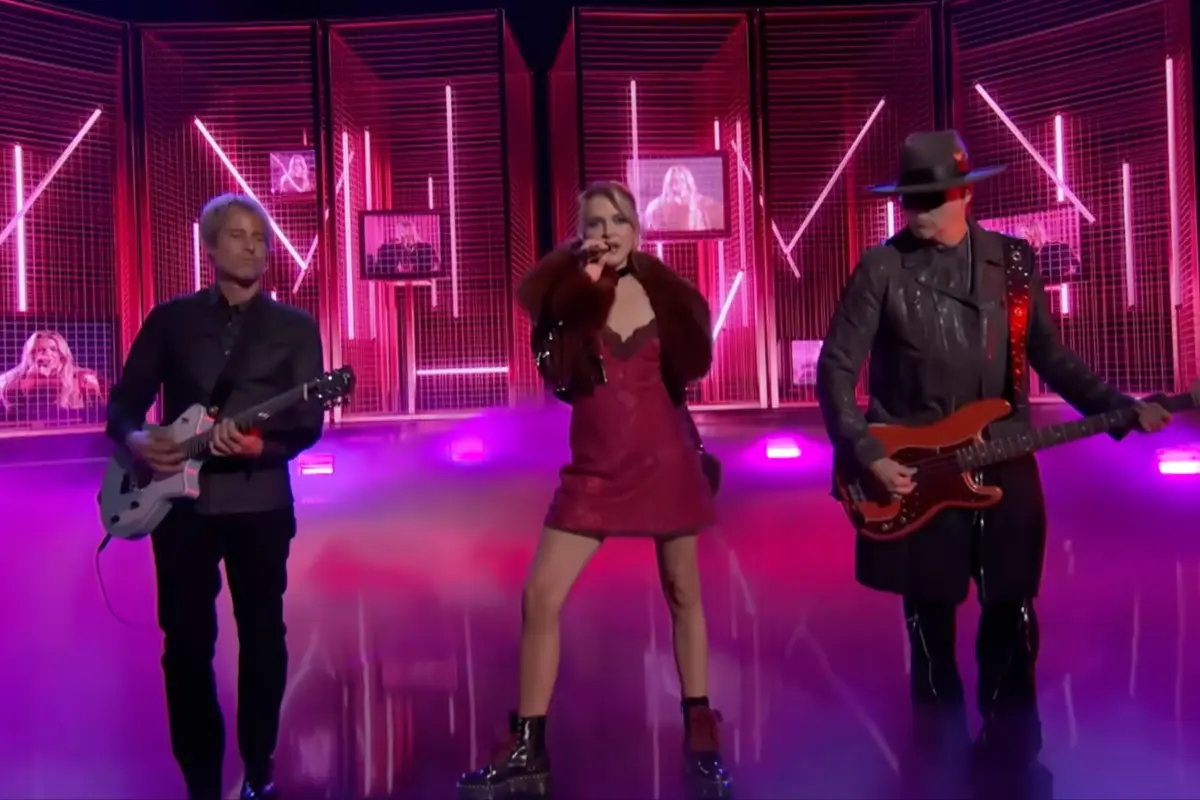
When the stage lights came up, Kolich’s physical presentation paid direct homage to Spears’ iconic visual history. Strutting onto the platform in a thoroughly Spears-coded, blood-red ensemble—complete with a low-cut, lingerie-inspired slip dress, a dramatic deep-red fur shrug, and a matching leather purse—she immediately established a commanding visual presence.
However, the auditory experience diverged sharply from the upbeat, seductive mid-tempo bounce that defined the original 1999 release and its sibling track …Baby One More Time. Eschewing the effervescent pop production that made the track a global phenomenon, Kolich slowed the tempo down to a crawl. Backed initially by a sparse instrumental arrangement and accompanied by two electric guitarists, she transformed the longing pop banger into a sultry, meditative ballad. Delivering the lyric sheet with deliberate phrasing and emotional weight, she withheld the song’s signature rhythmic drive until a brief, late-stage crescendo that approximated the original’s tempo just before the final notes rang out.
While the artistic ambition was undeniable, the execution proved polarizing. The studio audience offered a polite reception, but the real referendum arrived at the close of the evening, when the collective weight of viewer votes determined who would advance and who would pack their bags.
Supporting Context & Metrics: The Anatomy of a Fan-Base Disconnect
To fully understand Lillie Kolich’s sudden exit, one must examine the unique mechanics of The Voice’s live-show voting structure and the historical weight of covering an artist of Britney Spears’ magnitude.
Spears’ "(You Drive Me) Crazy" occupies a sacred space in late-90s pop canon. Released as the third single from her blockbuster debut album …Baby One More Time, the track peaked at No. 10 on the Billboard Hot 100 and became an anthem of the millennial youth culture. For millions of viewers tuning in on a themed Y2K night, the expectation was not necessarily a total deconstruction of the track, but rather an elevated celebration of its infectious, danceable energy.
When a contestant opts to strip the pulse away from a beloved upbeat track, they gamble on the emotional depth of their vocal delivery to carry the performance. Kolich’s transition from a high-energy pop homage to a slow-burn vocal showcase required an immense degree of trust from an audience that had only a brief window to cast their votes.
Furthermore, Kolich’s path to the live shows had already been fraught with tension. Earlier in the season, during the notoriously cutthroat Cut Week, she had found herself vulnerable before being rescued by Latifah. That lifeline bought her a ticket to the top 13, but it also meant she entered the live rounds without the unassailable momentum enjoyed by some of her peers.

As the dust settled on Monday night’s broadcast, the division between Team Queen and Team Adam became starkly apparent. While six singers from these two squads took the stage—with Team Kelly and Team Riley slated to perform the following Monday, November 16—the voting results laid bare the perils of radical reinvention. Kolich’s elimination left her fellow Team Queen members Mia Knight and BigCountry to advance, alongside Team Adam’s formidable trio of Dakota Cohen, Connor Closs, and Lexi Stephens. The metrics of viewer engagement ultimately favored those who maintained an immediate, visceral connection to the rhythms and expectations of the source material.
Official Statements and Mentor Reactions
The disparity between professional appraisal and public reception was highlighted by the enthusiastic responses of the coaching panel following Kolich’s performance. Rather than viewing the slowed-down arrangement as a misstep, the mentors lauded her bravery and technical execution.
Coach Riley Green, whose team would watch from the sidelines until the subsequent week, was quick to commend the young New Mexico native’s ambition. Addressing the studio audience and viewers nationwide, Green remarked:
"It’s awesome… It’s a challenge to take such a popular song and make it your own."
Green’s assessment underscored the central dilemma faced by vocalists on competition shows: the tension between honoring a familiar melody and establishing an individual artistic brand.
Latifah, who had previously intervened to save Kolich during the high-pressure elimination rounds of Cut Week, stood firmly behind her charge’s creative direction. Expressing total confidence in her artist’s choices, Latifah offered a concise and celebratory verdict on the performance:
"Nailed it!"
Despite the unanimous validation from industry professionals who recognized the technical control and emotional nuance required to pull off a stripped-down Spears cover, the validation from the coaching chairs could not translate into the algorithmic safety net of home viewer votes. The coaches’ praise stands as a testament to Kolich’s raw capabilities, even as reality television’s democratic voting system pulled the plug on her tenure.
Future Outlook: Lessons Learned and the Road Ahead for Season 30
As Season 30 of The Voice continues its march toward the coveted crown, Lillie Kolich’s departure offers a vital blueprint for the remaining contenders navigating the live performance rounds. The broadcast schedule—airing Monday nights at 9 p.m. ET on NBC and streaming the following day on Peacock—leaves zero room for error as the competition tightens.
For the artists remaining on Team Queen, Team Adam, Team Kelly, and Team Riley, the lesson of November 9 is clear: reinvention is a potent tool, but it must be wielded with acute awareness of audience expectations. While coaches may reward boundary-pushing choices, the voting public frequently leans toward familiarity, energy, and emotional directness during live elimination windows.
As for Kolich, her journey on The Voice may have concluded prematurely, but her striking visual choices and fearless vocal risks have undoubtedly left a lasting impression on the Season 30 landscape. Having demonstrated the capacity to command a national stage in a high-fashion homage to a pop royalty icon, she departs the competition not merely as an eliminated contestant, but as an artist with a clearly defined theatrical and vocal identity. Whether she pivots toward contemporary pop, indie balladry, or theatrical crossover work, the foundation she built under the mentorship of Latifah provides a launchpad for a promising career well beyond the confines of the television screen.