Executive Overview
Following acclaimed explorations of high-security men’s and women’s prisons, the BBC’s multi-award-winning anthology drama Time turns its unflinching lens onto a young offender institution (YOI) for its third series. Created by veteran writer Jimmy McGovern, the drama arrives at a time of profound crisis within the British penal estate, where chronic underfunding, severe understaffing, and surging levels of violence have brought the system to its knees. In this third installment, McGovern does not merely observe the mechanics of incarceration; he strips bare the institutional rot, moral compromises, and systemic failures that afflict modern youth detention.
Set within the fictional HMYOI Alderwick—a secure facility for troubled teenagers located near Liverpool—the three-part series anchors its narrative on the friction between weary frontline staff and incarcerated youths caught in a cycle of metastatic despair. Led by an impressive ensemble cast featuring David Tennant as a struggling prison officer and Siobhan Finneran reprising her role as the institutional chaplain, Time delivers a searing critique of an under-resourced justice framework.
However, the series also walks a delicate tightrope between gritty social realism and high-stakes melodrama. While its portrayal of the moral ambiguity, institutional compromises, and the psychological toll on both guards and inmates resonates deeply, the production occasionally leans into sensationalized plot twists and repetitive narrative tropes. This tension prompts a critical question: when fiction mirrors a reality already operating at the absolute margins of human endurance, does the amplification of tragedy risk cheapening the very systemic critique it seeks to deliver?
Detailed Chronology & Narrative Arc
The Crucible of Alderwick: A System Under Strain
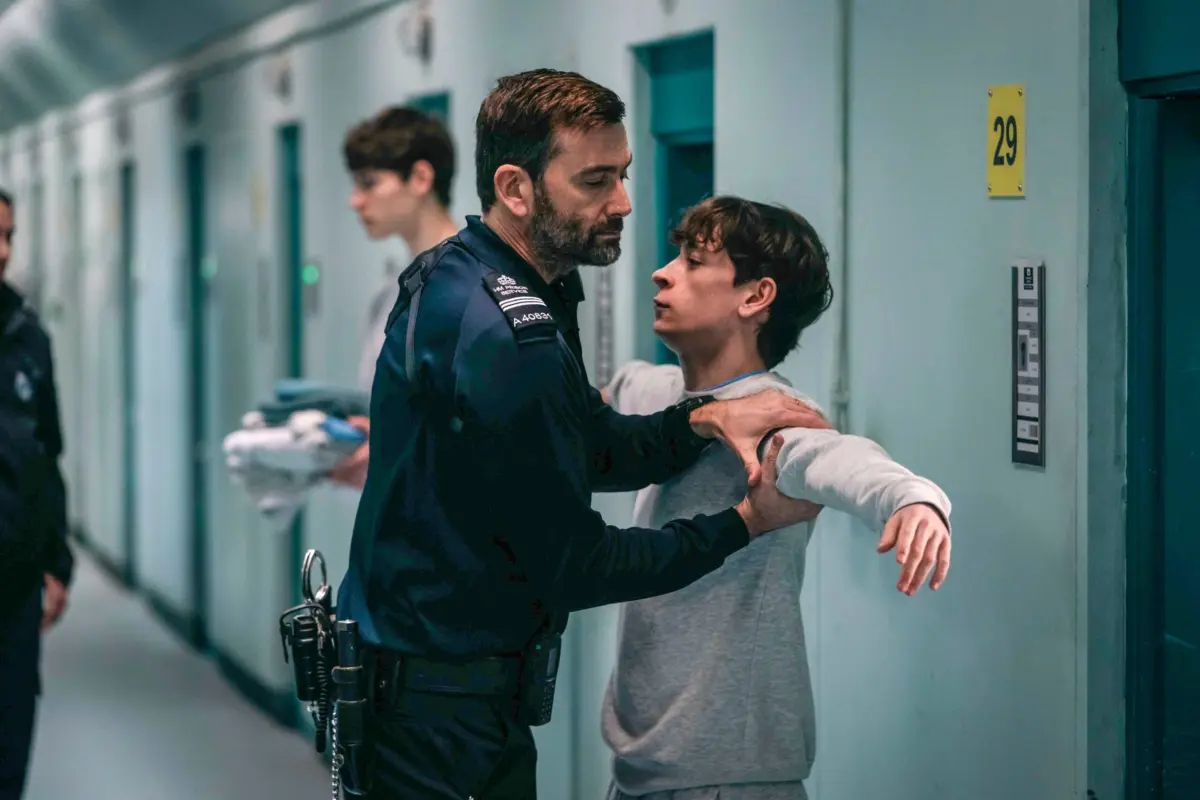
The narrative core of Time Series 3 revolves around Bobby Bailey (David Tennant), a veteran prison officer at HMYOI Alderwick whose professional pressures are mirrored by a collapsing personal life. Struggling to overcome a debilitating drinking problem following his wife’s departure for another man, Bailey represents the archetype of the frontline public servant: ground down by a system that demands absolute vigilance while offering minimal institutional support.
Within the high-tension environment of Alderwick, daily survival requires navigating a minefield of volatile personalities and operational paradoxes. The arrival of new detainees James (Louis McCartney) and Peter (Ollie McNulty) injects fresh volatility into the wing. Concurrently, long-standing resident Christopher (Chukwubuikem Molokwu) grapples with acute identity crises as he attempts to reconnect with his estranged birth mother—a subplot highlighting the profound familial fragmentation common among institutionalized youth.
Anchoring these interlocking narratives is Marie-Louise (Siobhan Finneran), the itinerant chaplain whose presence serves as the moral thread connecting all three seasons of Time. Her faith, already deeply frayed by years of bearing witness to institutional cruelty, is pushed to a breaking point following a random, tragic act of violence. This incident lays bare both the hopeless nihilism of the prison community and the precarious, often contradictory moral framework governing youth detention.
Operational Dilemmas and Moral Compromises
McGovern’s writing thrives on intractable ethical quandaries, and Time Series 3 presents these dilemmas with characteristic nuance. A central narrative conflict emerges around the controversial "keep apart" order—an administrative mandate designed to separate young offenders prone to inter-personal violence.
"If we allow them to mix, they’ll attack each other," Bailey argues defensively to his superiors, pushing back against the restrictions. "There’s no way we can do it."
Conversely, Marie-Louise acts as the institutional conscience, arguing that such rigid segregation strategies compound psychological distress and manufacture artificial tensions within the wing. This fundamental disagreement exposes the impossible choices facing staff. There are no clean victories in Time, mirroring the reality of a system where every administrative decision is a compromise born of scarcity.
When rival factions inevitably collide, the resulting violence is visceral and shocking. Following a particularly gruesome assault, Bailey attempts to rationalize the brutality to his governor: "The attack was violent, not the boy himself." Yet, the hollow ring of his own words betrays his underlying cynicism. This pervasive atmosphere of compromise extends to his relationships with colleagues, such as Freddie Jennings (Daniel Ryan), with whom Bailey must share a daily pact of mutual reliance despite underlying distrust.
The Performance of Machismo and the Trap of Extremes
For the teenage inmates residing at Alderwick, survival demands the adoption of an unearned, performative machismo. Barking robotic affirmations of "yes, boss" at guards like Bailey, their compliance is dangerously superficial. McCartney and the young supporting cast deliver grounded, poignant performances that capture the tragic paradox of these adolescents: they are simultaneously verbose yet profoundly inarticulate, overflowing with raw emotion yet utterly lacking constructive outlets for expression.
Yet, as the narrative progresses across its three episodes, Time occasionally surrenders to a tendency to push its dramatic stakes toward the extreme. Critics of the series have drawn parallels to The Pitt, the critically acclaimed medical drama lauded by emergency physicians for its procedural accuracy, yet criticized for stacking simultaneous crises to a degree that strains statistical plausibility.
While young offender institutions experience high rates of self-harm and localized assaults, fatal incidents within the secure estate for children and young people remain statistically rare—with government data recording three deaths across the entire estate in the decade between 2015 and 2025. By building its plot around repeated external tragedies—such as three separate inmates losing parents on the outside within a compressed timeframe—Time risks prioritizing manufactured pathos over documentary-level authenticity. The inclusion of a gratuitous third-act twist involving a shock death feels particularly misjudged, undercutting the quiet, devastating power of the show’s more quotidian observations.
Supporting Context & Metrics: The Crisis in UK Prisons
To fully appreciate the cultural and political resonance of Time, one must examine the grim statistical reality facing the United Kingdom’s correctional and youth justice systems.
Overcrowding and Capacity Pressures
According to data compiled by the Ministry of Justice and HM Inspectorate of Prisons, adult and youth custodial facilities in England and Wales have operated near or above functional capacity for years. The youth secure estate—comprising Secure Training Centres (STCs), Young Offender Institutions (YOIs), and Secure Children’s Homes (SCHs)—has faced systemic contraction even as the complexity of adolescent behavioral needs has intensified.
| Metric Category | Historical Baseline (c. 2015) | Current Operational Context (c. 2024–2026) | Trend Analysis |
|---|---|---|---|
| Youth Custody Population | ~1,050 individuals | ~600–700 individuals | Population contraction due to facility closures; remaining cohorts display higher risk profiles. |
| Staff-to-Inmate Ratios | 1 staff : 3–4 youths (nominal) | Often 1 staff : 6–8 youths (effective) | Severe staff shortages compromise dynamic security and educational program delivery. |
| Assault Rates per 1,000 Inmates | Elevated baseline | Rising significantly across the secure estate | Violence remains the primary driver of institutional instability and staff burnout. |
| Self-Harm Incidents | High incidence | Reaching multi-year highs among teen cohorts | Reflects widening mental health support deficits within custodial environments. |
The Human Cost of Underfunding
The structural underfunding highlighted in Time directly correlates with skyrocketing rates of staff turnover. Frontline officers face unprecedented levels of physical assault, often exacerbated by the concentration of high-risk youths into shrinking physical footprints. The physical infrastructure of facilities like the fictional Alderwick—characterized by decaying concrete, poor ventilation, and cramped conditions—acts as a physical manifestation of societal neglect.
Criminologists and penal reform advocates frequently point out that incarceration of young people frequently functions as a revolving door, where institutionalization deepens trauma rather than rehabilitating behavior. Time succeeds precisely when it holds a mirror up to this conveyor belt of despair, illustrating how systemic failure precedes and outlasts individual criminal acts.
Official Statements & Industry Perspectives
The release of Time Series 3 has reignited public debate among lawmakers, penal reform campaigners, and entertainment critics regarding the ethical responsibilities of depicting institutional violence.
In a press briefing accompanying the launch, writer Jimmy McGovern emphasized his ongoing commitment to exposing institutional injustice:
"We do not write these dramas to provide easy comfort or tidy moral resolutions. When you lock troubled children inside concrete boxes and starve the system of the resources required to foster genuine rehabilitation, you are manufacturing future tragedies. The characters in Time may be fictional, but the structural neglect they navigate every single day is an indictment of our collective political priorities."
A spokesperson for the Prison Officers’ Association (POA) noted the cultural impact of Tennant’s portrayal:
"Performances like those delivered by David Tennant and the wider cast shed light on the immense, often unrecognized psychological toll carried by frontline prison officers. Working within the youth secure estate requires a level of emotional resilience that goes far beyond traditional security duties. Chronic understaffing means our members are routinely asked to perform miracles with one hand tied behind their backs."
Conversely, children’s rights advocates have expressed cautious concern over the media’s framing of juvenile crime. While praising the empathy driving performances by actors like Louis McCartney, advocacy groups have warned against sensationalized depictions of youth violence that reinforce stigmatizing tropes rather than encouraging systemic reform.
Future Outlook & Critical Legacy
As Time Series 3 draws to a close, its final moments offer a stark reminder of the compromises inherent in prestige television. In a concession to primetime audiences seeking narrative closure, the series concludes on a note of cautious optimism—with characters stepping away from the immediate crucible toward an uncertain horizon. This stylistic choice softens the unyielding rawness that defined the earlier stretches of the narrative, yet it remains a calculated necessity for mainstream broadcast television.
Nevertheless, at its most visceral, Time stands alongside recent cinematic and televisual milestones—such as the acclaimed drama Adolescence—as urgent, necessary viewing. By refusing to look away from the gray concrete architecture of institutional failure, the BBC’s anthology reminds viewers that a court verdict is rarely an endpoint; rather, it is frequently the prologue to an ongoing tragedy. As policymakers grapple with the structural collapse of the British justice system, dramas like Time ensure that the shadows cast behind prison walls remain impossible to ignore.