Executive Overview
The Bayeux Tapestry stands globally as one of the most magnificent and historically consequential artifacts of medieval European material culture. Spanning nearly 70 meters of embroidered linen, this masterwork of storytelling records the tumultuous political events leading up to and culminating in the Norman Conquest of England in 1066. Traditionally, public consciousness has viewed the tapestry as an epic chronicle of kings, noblemen, and clashing armies—a monumental visual record of William, Duke of Normandy, and Harold, Earl of Wessex, locked in a struggle for the English crown.
Yet beneath the martial noise of charging cavalry and flying arrows lies a quieter, vastly under-explored narrative. Recent historical and archaeological investigations have cast a brilliant light on the vital role women played in this masterpiece—both as the master artisans who stitched its very fabric and as pivotal, highly symbolic figures depicted within its panels.
While military and political machinations dominate the foreground, the main body of the Bayeux Tapestry features three distinct female figures: Edith of Wessex, the mourning queen; a mysterious noblewoman identified only as Ælfgyva; and an unnamed mother fleeing a burning building alongside her child. Furthermore, numerous female figures occupy the marginalia (the upper and lower borders), interacting with symbolic motifs that hint at deep political commentary, scandal, and social critique.
By re-examining these women, modern historians are challenging decades of male-centric historiography. This movement coincides with mounting pressure from educational reform groups—such as End Sexism in Schools and Teaching Medieval Women—to correct the systemic underrepresentation of female history within academic curricula. Far from being mere decorative footnotes, the women of the Bayeux Tapestry offer a profound lens through which to view the power dynamics, cultural sophistication, and human costs of the Norman Conquest.
Detailed Chronology of the Tapestry and Its Female Subjects
To understand the women woven into the Bayeux Tapestry, one must first trace the timeline of the artifact’s creation and the historical events it immortalizes.
1064: The Journey Begins
The visual narrative opens circa 1064. King Edward the Confessor dispatches his brother-in-law, Harold Godwinson, on a critical and mysterious diplomatic mission across the English Channel to Normandy. It is within these early scenes of statecraft, oaths, and travels that the tapestry’s complex symbolic language begins to take shape.
1046–1066: The Enigma of Ælfgyva
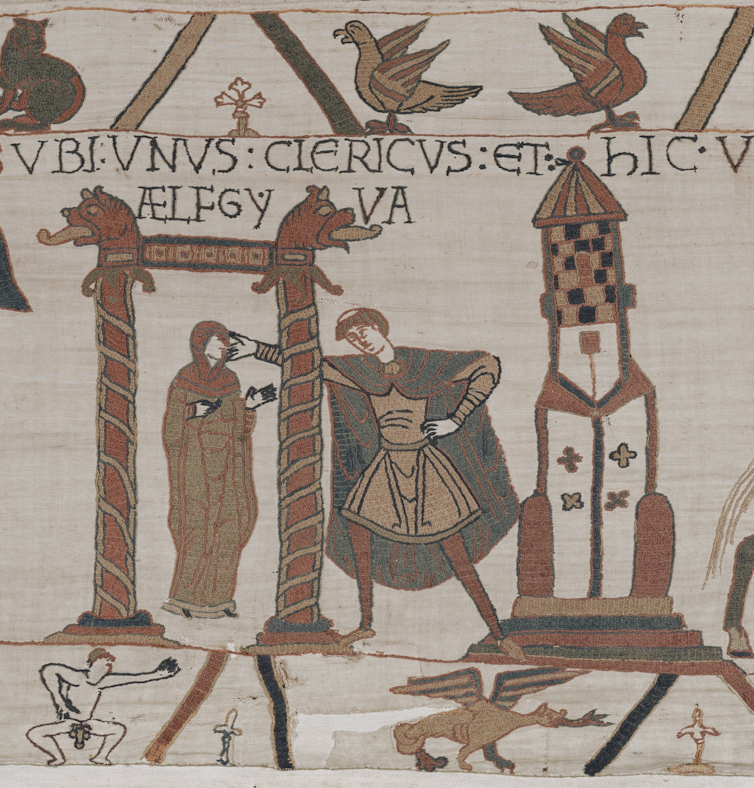
Appearing relatively early in the visual sequence, a mysterious woman stands within an architectural doorway framed by columns, while a cleric reaches out toward her. The embroidered text above reads simply: "Ubi unus clericus et Ælfgyva" ("Where a certain cleric and Ælfgyva").
While Ælfgyva (also spelled Ælfgifu or Aelgyva) was an exceptionally popular name in Anglo-Saxon England, historians have debated her true identity for centuries. Among the leading hypotheses are:
- Ælgyva, Sister of Harold: Some chroniclers suggested Harold had a sister pledged in marriage to William of Normandy. However, prominent historian Ann Williams argues this is a misreading of the Domesday Book, noting that no such sister existed.
- The Abbess of Barking: Because the figure is veiled and standing within a cloistered architectural space, she may represent the Abbess of Barking Abbey, who held office during the Conquest. This theory gains traction when considering the traditional view that elite English convents might have been involved in the needlework.
- Ælfgyva of Leominster: Abducted in 1046 by Swein Godwinson (Harold’s brother), this noblewoman may have borne a son, Hakon, who later became one of the high-ranking English hostages collected by Harold in Normandy.
- Ælfgifu of Northampton: The influential first wife of King Cnut, whose contested succession rumors were recorded generations later by chronicler John of Worcester.
- Emma of Normandy: The mother of Edward the Confessor, who temporarily adopted the name Ælfgifu upon her earlier marriage to Æthelred the Unready. Despite rumors linking her to a medieval bishop, this connection remains chronologically tenuous.
The ambiguity of Ælfgyva is further complicated by the tapestry’s borders. The panels directly above and below this scene feature explicit Christian symbols alongside a naked male figure, heavily implying themes of illicit desire, scandal, or political disgrace.
January 1066: The Death of Edward the Confessor and Queen Edith
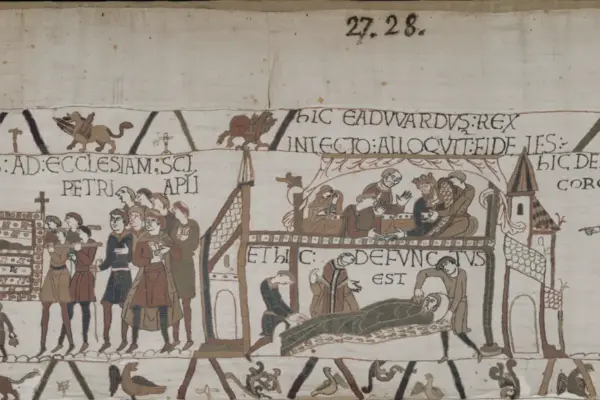
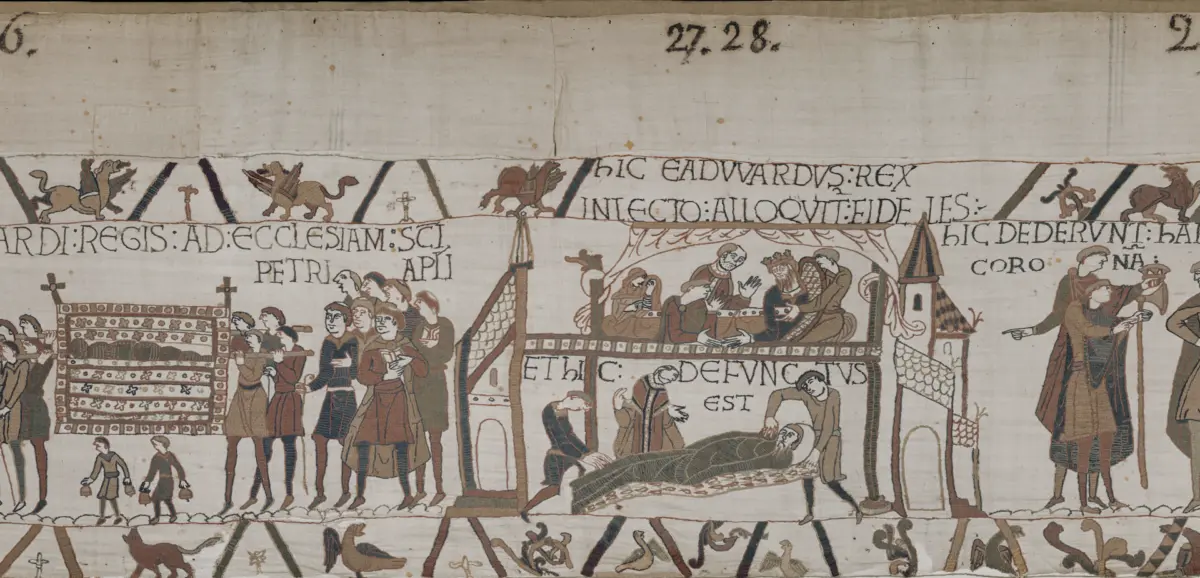
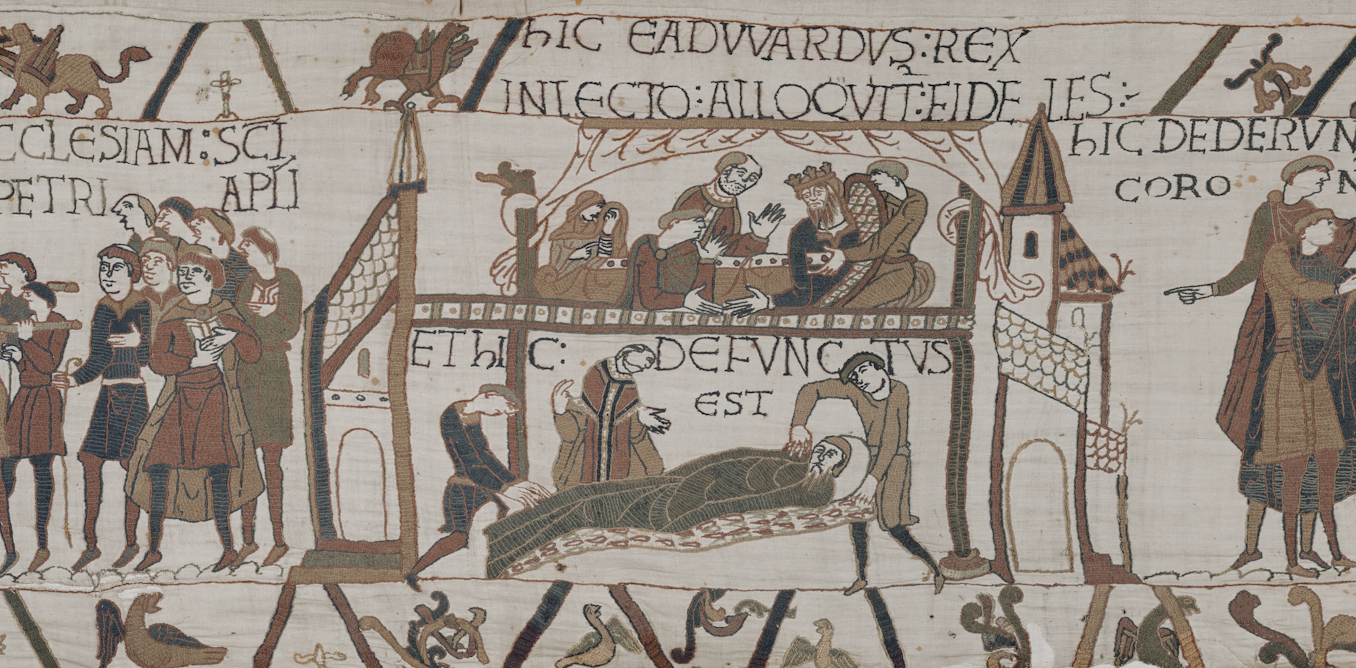
The narrative reaches a solemn turning point with the death of King Edward the Confessor on January 5, 1066. Standing at his deathbed is a weeping, veiled woman widely identified as Queen Edith of Wessex (c. 1023–1075).
Edith, the daughter of Godwin, Earl of Wessex, and Gytha, was an exceptionally powerful and well-educated figure. Raised at Wilton Abbey, she was renowned not only for her patronage of the church and her sharp political acumen, but also for her mastery of needlework—a craft shared by the English women who likely embroidered the tapestry. In this poignant panel, Edith bears witness to the dying king’s final command bequeathing the English crown to her brother, Harold.
October 14, 1066: The Battle of Hastings and the Victims of War
The narrative builds toward the inevitable clash at the Battle of Hastings on October 14, 1066, culminating in the English retreat. Amidst the martial chaos of the campaign, one striking, anonymous scene depicts a woman clutching a child’s hand while fleeing a burning building.
This haunting vignette captures the brutal human collateral of William the Conqueror’s aggressive pacification campaigns and the widespread suffering of the English populace. Strikingly, art historians have noted that this visual motif bears a remarkable stylistic resemblance to classical Roman reliefs, specifically the column of Marcus Aurelius in Rome depicting women fleeing warfare. This suggests that the tapestry’s elite designer—whom some researchers link to Abbot Scolland of St Augustine’s Abbey in Canterbury, a known traveler to Rome in 1071–1072—directly incorporated classical antiquity into his vision of Anglo-Norman conflict.
Post-Conquest Survival: Edith’s Final Years
Unlike many of her male peers who lost their lives or lands following the Norman victory, Queen Edith navigated the transition of power with immense political dexterity. William the Conqueror treated her with notable respect, allowing her to retain her extensive landholdings. Her continued prominence is underscored by her appearance at the Easter 1071 consecration of Walcher, Bishop of Durham. Edith passed away on December 18, 1075, and was entombed with high honors alongside her husband, King Edward, within the sacred walls of Westminster Abbey.
Supporting Context & Metrics: The Crisis of Representation in History
The renewed academic focus on the women of the Bayeux Tapestry arrives at a crucial juncture for educational policy and curriculum design. For generations, historical inquiry into the Norman Conquest has remained overwhelmingly androcentric, sidelining the contributions, agency, and daily experiences of medieval women.
The Educational Landscape
Recent audits conducted by organizations such as End Sexism in Schools and the academic advocacy group Teaching Medieval Women have exposed a systemic vacuum in British education:
- Assessment Gaps: Interim reports analyzing GCSE and A-Level history assessment papers in England reveal a chronic underrepresentation of women’s history, particularly regarding the medieval period.
- The "Battlefield Bias": Standard classroom modules on 1066 tend to hyper-focus on military strategy, weaponry, and royal lineage, entirely omitting the socio-economic roles of noblewomen, female monastic patrons, and the skilled craftswomen responsible for producing high-status textiles like Opus Anglicanum.
- The Tapestry as Evidence: Scholars argue that the Bayeux Tapestry offers an ideal pedagogical tool to correct these imbalances. By analyzing figures like Queen Edith and the anonymous female refugees, educators can teach students that medieval society was not exclusively run by men with swords.
Official Statements and Expert Insights
Leading historians and medievalists have increasingly spoken out about the necessity of reframing our interpretation of the Bayeux Tapestry through a gender-conscious lens.
Dr. Elizabeth C. T. Edwards, a specialist in medieval material culture, emphasizes the importance of the women who manufactured the piece:
"For centuries, popular discourse has treated the Bayeux Tapestry as a neutral historical record dropped from the heavens, ignoring the human hands that brought it to life. Anglo-Saxon women were internationally famed for their exquisite embroidery—known across Europe as Opus Anglicanum. Recognizing that English women likely stitched a Norman-commissioned narrative of their own country’s subjugation adds a layer of profound psychological and artistic complexity to the artifact."
Commenting on the inclusion of marginalized female figures within the main panels and borders, medieval historian Dr. Marcus Vance notes:
"The presence of women like Queen Edith at pivotal state moments—such as Edward the Confessor’s deathbed—reminds us that queenship in late Anglo-Saxon England was an office of immense political weight. Furthermore, including anonymous figures, like the mother fleeing the burning homestead, ensures that the tapestry acknowledges the devastating domestic toll of war. History cannot afford to treat these figures as mere artistic filler."
Future Outlook: Re-writing the Narrative of 1066
As modern conservation efforts and advanced digital imaging techniques continue to unlock new secrets of the Bayeux Tapestry—currently housed in its permanent home in Normandy, France—scholars are pivoting toward a more holistic, inclusive methodology of historical analysis.
The integration of archaeological data, such as Alexandra Lester-Makin’s groundbreaking research on professional Anglo-Saxon embroidery workshops, coupled with rigorous archival work on the Domesday Book, promises to unearth even more forgotten stories of medieval women. By bridging the gap between cutting-edge academic research and secondary school curricula, educational reformers hope to ensure that future generations view the events of 1066 not merely as a tale of two kings, but as a complex societal upheaval shaped by both the men who fought the wars and the women who documented, survived, and rebuilt in their wake.