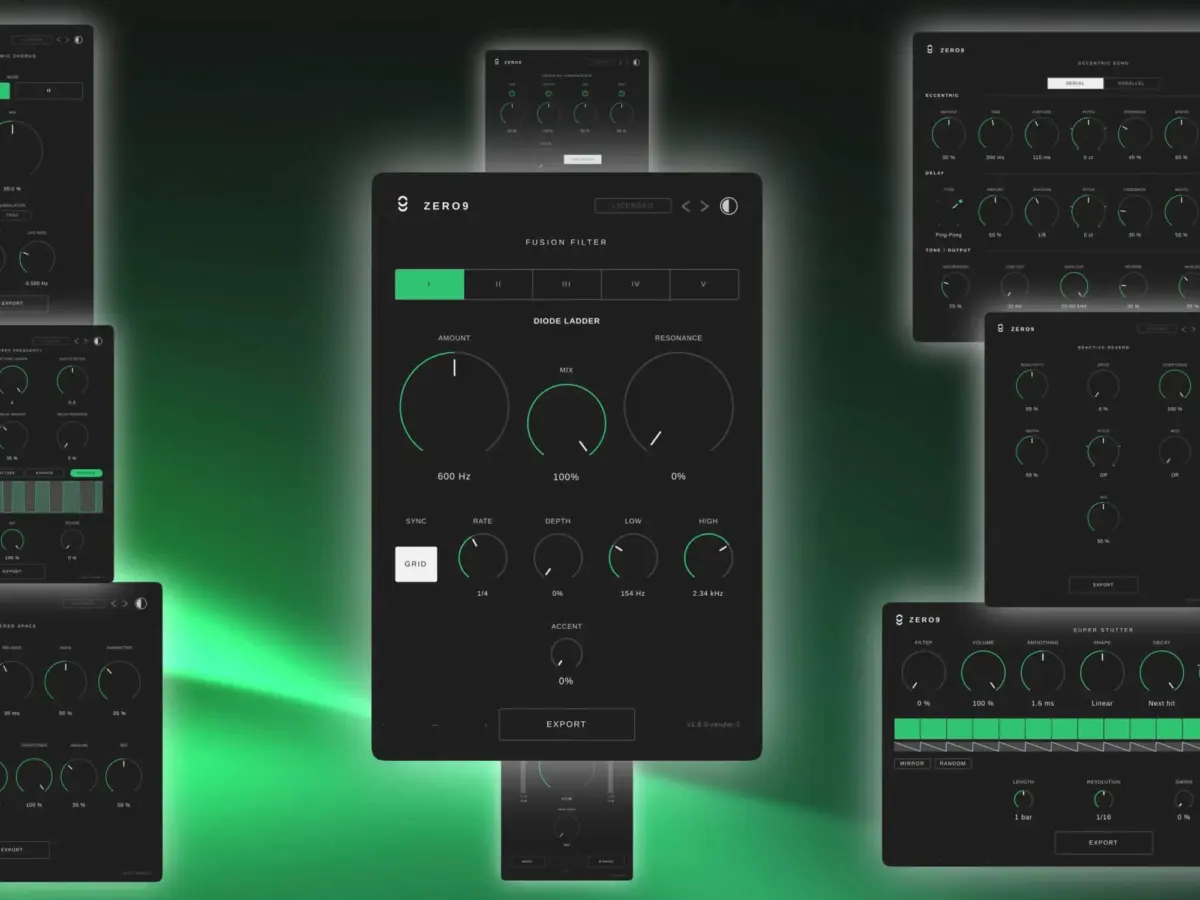
Executive Overview
In the modern digital audio workspace, music producers are frequently overwhelmed by choices. Navigating complex plugin interfaces, poring over multi-page manuals, and tweaking hundreds of microscopic parameters can easily derail a productive studio session. Enter ZERO9, a fresh, highly curated collection of character-driven audio processing tools designed by established electronic music producer James Harcourt.
Built out of a genuine desire to solve real-world production bottlenecks, ZERO9 comprises nine distinct tools: eight creative effects and one essential utility plugin. Rather than reinventing the wheel with overly complicated interfaces, Harcourt and his team have engineered a suite centered around minimalist graphical user interfaces (GUIs), robust internal routing, and heavy sonic character. Every plugin in the range was born from an actual gap in Harcourt’s own professional workflow.
By hiding unnecessary complexity behind streamlined controls, ZERO9 aims to foster a fast, intuitive environment where electronic music producers, mix engineers, and sound designers can make bold, musical decisions without breaking their creative momentum. This deep-dive feature explores the architecture of the ZERO9 suite, the philosophy of frictionless software design, the unique capabilities of each included processor, and what the future holds for this focused audio brand.
Detailed Chronology: The Genesis and Architecture of the ZERO9 Suite
The conceptual groundwork for ZERO9 did not begin in a sterile software development boardroom; it took shape across years of late-night electronic music production, live mixing, and real-world studio troubleshooting. James Harcourt, known for his deep, hypnotic brand of electronic music, continually found himself hitting creative roadblocks due to software bloat. Standard industry plugins often demanded too much cognitive overhead—forcing producers to digest endless menus, complex modulation matrices, and granular settings just to achieve a basic stylistic shift.
Recognizing that these technical hurdles were stifling spontaneous inspiration, Harcourt began conceptualizing tools that prioritized immediate gratification paired with deep, professional-grade processing under the hood.
From Studio Necessity to Product Suite
The development timeline of the ZERO9 range was entirely organic. Each module was initially coded or conceptualized as a bespoke solution to a specific creative hurdle Harcourt faced during record production. If a track needed a unique filtering movement that standard plugins couldn’t deliver efficiently, a prototype was built. If a rhythm section required unconventional parallel compression and transient shaping without crushing the master buss, another tool took shape.
Over time, this collection of internal studio weapons grew into a cohesive suite of nine tools. The collection officially launched to the public with a clear mandate: deliver authentic, track-ready character while keeping the user interface deceptively simple.
The Core Philosophy: Hiding Complexity
At the heart of the ZERO9 chronology is a design philosophy that defies current industry trends. While many software developers compete to offer the most parameters, wavetables, and routing options per window, ZERO9 goes the opposite direction.
As Harcourt notes, the goal is not to make plugins technically simplistic, but rather to deliberately conceal the computational and routing complexity that doesn’t need to be in the user’s way. By stripping away extraneous controls and focusing purely on the parameters that shape core musicality, ZERO9 bridges the gap between deep, esoteric sound design and rapid-fire arrangement workflows.
Supporting Context & Metrics: Breaking Down the ZERO9 Arsenal
The ZERO9 suite is divided into eight characterful audio effects and one foundational utility tool. Each plugin is engineered to inject movement, texture, and density into tracks without requiring endless automation or nested signal chains.
1. Fusion Filter
Filters are among the most heavily utilized tools in electronic music production, yet producers often find themselves cycling through multiple plugins to find the right sonic flavor. Fusion Filter solves this by housing five distinct filter characters within a single, unified workflow.
- Key Feature: Users can seamlessly morph or switch between different filter engines while maintaining identical cutoff amounts, resonance levels, and mix settings. This allows for fluid, dramatic tonal shifts during a transition or drop without altering the structural dynamics of the sound source.
2. Cosmic Chorus
Modulation adds width and dimensionality to synths, pads, and vocals, but traditional choruses can sometimes wash out a mix or introduce phase cancellation. Cosmic Chorus leans into distinct analog-style voicings while offering modern digital flexibility.
- Key Feature: The plugin features two fixed chorus voicings accompanied by a free-running vibrato engine. Dedicated Low-Frequency Oscillator (LFO) controls allow producers to dial in lush, tempo-synchronized undulations that instantly breathe life into static tracks.
3. Eccentric Echo
Delays are foundational to spatial mixing, but standard linear echoes can sound clinical. Eccentric Echo approaches time-based effects from an experimental perspective, utilizing a dual-engine architecture.
- Key Feature: It pairs one continuous delay engine with a granular delay engine, allowing both systems to feed dynamically into one another. The architecture supports flexible serial and/or parallel routing, coupled with granular parameters like echo timing, slicing, pitch shifting, integrated reverb, and analog saturation.
4. Super Stutter
Stutter and glitch effects are staple techniques in modern techno, house, and IDM, but drawing them in manually via automation clips is notoriously tedious. Super Stutter fast-tracks this process.
- Key Feature: Designed for performance and rapid arrangement tweaks, it allows users to visually draw rhythm patterns and instantly transform static loops into dynamic, evolving rhythmic textures.
5. Severed Space
Gated reverbs defined the sound of 1980s production, but contemporary electronic music demands a more refined, spectral approach to tail control. Severed Space is a modern gated reverb designed specifically to clean up dense mixes.

- Key Feature: Equipped with onset-triggered closure, the plugin features built-in spectral declashing to prevent reverb tails from masking dry transients, finished off with subtle analog movement to maintain warmth.
6. Fractured Frequency
Evolving rhythmic textures require complex modulation matrices—unless you use Fractured Frequency.
- Key Feature: This plugin provides a four-stage, tempo-locked glitch chain designed to help producers effortlessly develop evolving rhythmic systems, perfect for adding microscopic audio cuts and stuttered micro-variations to drums and percussion loops.
7. Reactive Reverb
Static algorithmic reverbs can easily clutter a mix. Reactive Reverb offers an intelligent alternative by listening directly to the audio being fed into it.
- Key Feature: Utilizing an input-reactive algorithm, the reverb continuously adapts and reshapes the source material, ensuring the wet signal breathes dynamically with the arrangement rather than sitting statically on top of it.
8. Crushing Compressor
Dynamics control is rarely described as "fun," but Crushing Compressor transforms bus processing into a creative playground.
- Key Feature: Offering four distinct frequency bands of upward and downward parallel compression, it gives producers unprecedented control over the density, punch, and structural weight of drums, synths, and master stems.
9. Signal Switch
Serving as the foundational utility brick of the entire collection, Signal Switch handles essential channel management.
- Key Feature: A straightforward utility plugin dedicated to fine-tuning gain staging, mono compatibility checking, and phase inversion. Notably, Signal Switch is also available as a standalone free download outside the paid suite.
Official Statements: The Creative Vision Behind ZERO9
To truly understand the impetus behind ZERO9, one must look directly at the words of its creator. James Harcourt’s design ethos centers entirely on preserving the fragile state of creative flow during music production sessions.
"A lot of the ZERO9 range started with something I genuinely wanted in my own sessions and then grew from there," Harcourt explains, highlighting the authentic, user-first origin of the software suite.
When discussing the minimalist graphical user interfaces, Harcourt emphasizes the necessity of speed in modern composition:
"I wanted the plugins to feel immediate—something you can open in the middle of making a record, understand almost instantly, and start manipulating without breaking the creative flow. ZERO9 plugins find new sounds quickly, have some character of their own, and don’t give you twenty pages of options before you can make a musical decision."
Furthermore, Harcourt clarifies that minimalism in software design is not about stripping away power, but rather about removing cognitive friction:
"We’ve removed anything that doesn’t really need to be there. It’s less about making the plugins technically simple and more about hiding the complexity that doesn’t need to be in the user’s way."
These statements underline a broader shift in audio software development: moving away from over-engineered, mathematically sterile plugins toward tools with distinct personal curation and instant acoustic gratification.
Future Outlook: What Lies Ahead for the ZERO9 Ecosystem?
As the digital audio landscape continues to evolve, software developers face constant pressure to pump out continuous update cycles and ballooning plugin bundles. However, ZERO9 is charting a different, more sustainable course.
According to Harcourt, future expansion of the ZERO9 ecosystem will not be driven by arbitrary marketing roadmaps or corporate quotas. Instead, growth will remain entirely organic, tethered directly to his ongoing work in the studio.
- Organic R&D: New plugins will only be developed if Harcourt encounters a genuine sonic problem or creative void during his personal production sessions. If an internal tool proves indispensable in the studio, it earns the right to become part of the public ZERO9 catalog.
- Focused Curation: Rather than expanding into an unwieldy mega-suite of fifty mediocre plugins, the brand intends to keep its product range tightly focused. Every single future release must have a distinct, undeniable reason to exist.
- Community Impact: As electronic music producers increasingly gravitate toward streamlined, fast-workflow tools to combat digital fatigue, suites like ZERO9 are well-positioned to influence how independent developers build software for the modern DAW environment.
For producers looking to inject genuine analog-inspired character, experimental rhythm manipulation, and instantaneous inspiration into their sessions without getting bogged down by endless menus, the ZERO9 suite offers a refreshing, highly focused alternative.
To explore the complete plugin bundle, view video demonstrations, or download the free Signal Switch utility tool, visit the official ZERO9 Complete Suite page.