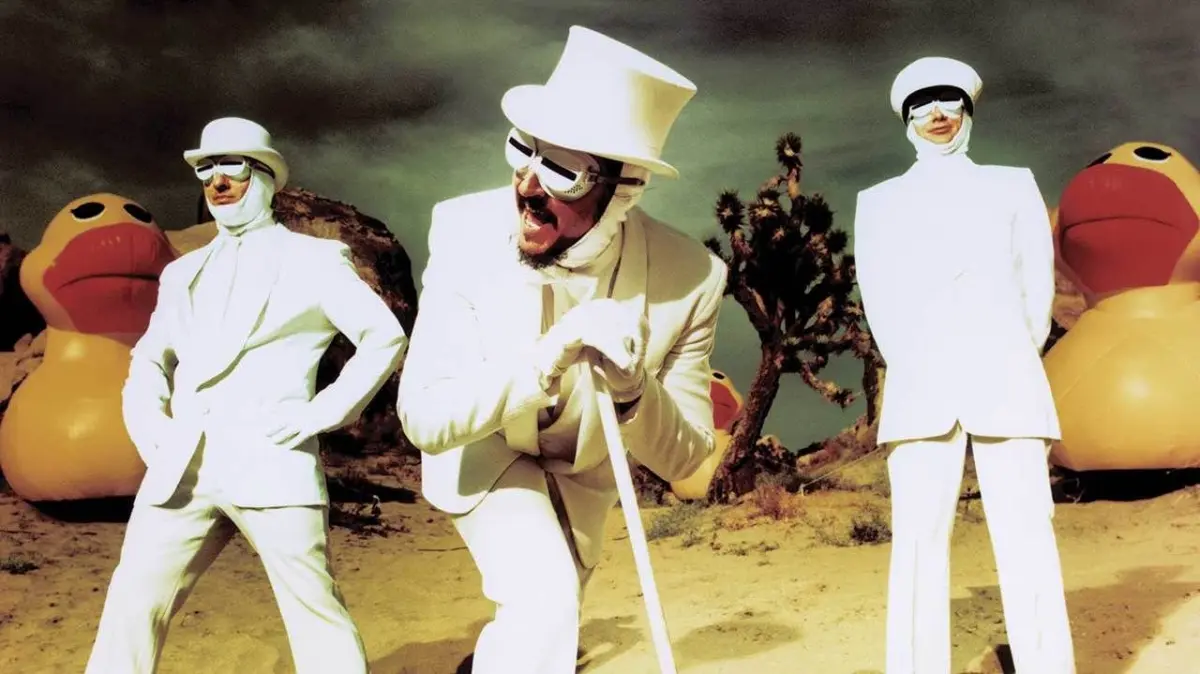
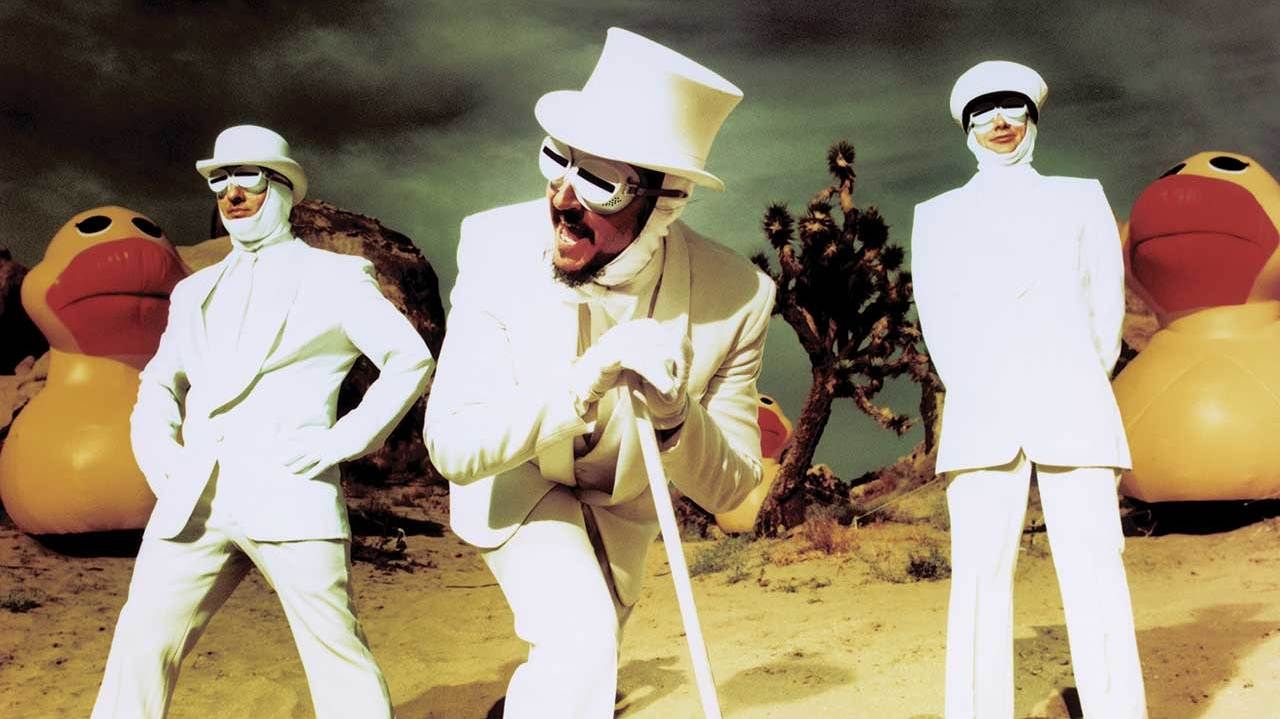
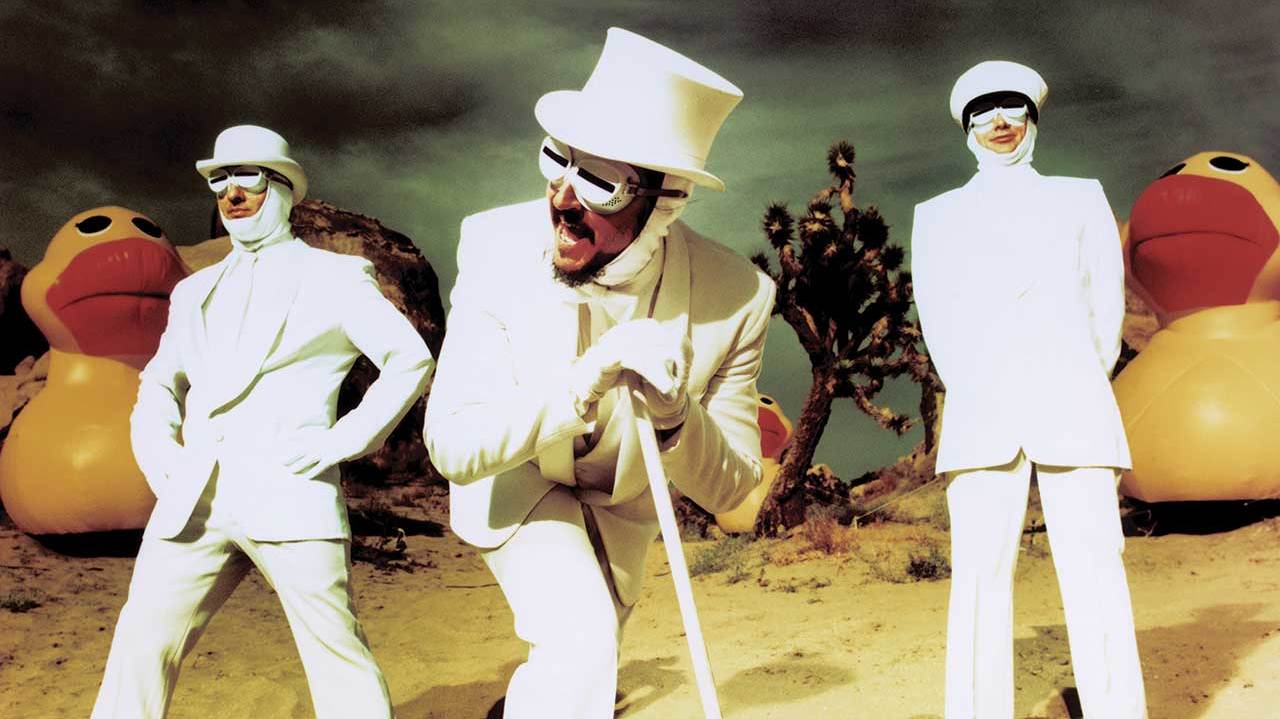
In September 2017, the legendary California funk-metal and progressive rock trio Primus released their ninth studio album, The Desaturating Seven. The project represented a significant milestone for the band: it was their first full-length album of original material featuring the classic line-up—bassist/vocalist Les Claypool, guitarist Larry "Ler" LaLonde, and drummer Tim "Herb" Alexander—since 1995’s Tales from the Punchbowl.
Rather than relying on their traditional formula of eccentric character sketches and slap-bass satire, Primus crafted an immersive narrative concept work. The album was directly adapted from The Rainbow Goblins, a dark, magnificently illustrated 1978 children’s book by Italian artist Ulderico Conte Gropplero di Troppenburg, published under the pseudonym Ul de Rico. The narrative follows seven insatiable, color-eating goblins who capture and devour the spectrum of the rainbow, draining the natural world of its vitality until nature rises up to punish them.
+-------------------------------------------------------------------------------+
|                        THE DESATURATING SEVEN AT A GLANCE                     |
+-------------------------------------------------------------------------------+
|  Primary Source Material : "The Rainbow Goblins" by Ul de Rico (1978)         |
|  Band Line-Up           : Les Claypool, Larry LaLonde, Tim Alexander         |
|  Guest Narrative Voice  : Justin Chancellor (Tool)                            |
|  Total Album Runtime    : ~34 Minutes (Optimized for Single LP Vinyl Quality) |
|  Key Musical Touchstones: 1980s King Crimson, Rush ("Hemispheres")            |
|  Recording Location     : Claypool's Home Studio, Sonoma County, CA           |
+-------------------------------------------------------------------------------+
The Desaturating Seven stands as a masterclass in conceptual musical translation. Claypool and his bandmates reimagined Ul de Rico’s vibrant yet eerie imagery through a sonic palette dominated by interlocking polyrhythms, liquid basslines, staccato guitar motifs, and eerie spoken-word passages. Bridging avant-garde jazz, prog-rock virtuosity, and political allegory, the album demonstrates how children’s literature can be repurposed to mirror modern ecological and sociopolitical anxiety while upholding the technical rigor of progressive rock.
Detailed Chronology
[1978] -------------------> [1990s–2000s] ------------> [2016] ------------------> [2017]
Ul de Rico publishes        Claypool family reads       Claypool collaborates      "The Desaturating Seven"
"The Rainbow Goblins",      "Rainbow Goblins";          with Sean Lennon;          is recorded and released;
establishing its dark       conceptual ideas begin      refines vocal harmony      world tour features full
allegorical narrative.      to germinate.               and narrative focus.       theatrical stage show.
1. The Literary Foundation (1978)
Italian artist Ulderico Conte Gropplero di Troppenburg (Ul de Rico) publishes The Rainbow Goblins. Featuring oil paintings rendered directly onto wood panels, the book depicts seven gluttonous goblins—Red, Orange, Yellow, Green, Blue, Indigo, and Violet—who hunt rainbows across fictitious lands, using lassos to strip them of color and consume them. The tale culminates in a violent environmental rebellion where the flowers and earth trick the goblins, drowning them in a deluge of liquid color. Ul de Rico later worked as a conceptual illustrator for cinema classics, including Flash Gordon (1980) and The NeverEnding Story (1984).
2. Domestic Incubation (Late 1990s–2010s)
The book entered Les Claypool’s orbit when his wife, Chaney Claypool, regularly read it as a bedtime story to their young children at their home in Sonoma County, California. Claypool was struck by the contrast between the lush aesthetic beauty of the oil paintings and the ominous, unsettling nature of the narrative, recognizing its potential as a musical concept.
3. Harmonic Refinement and Side Projects (2016)
Prior to recording The Desaturating Seven, Claypool formed The Claypool Lennon Delirium with Sean Lennon. The duo released their debut album, Monolith of Phobos (2016), followed by the 2017 covers EP Lime and Limpid Green, which featured renderings of Pink Floyd’s "Astronomy Domine," The Who’s "Boris the Spider," and King Crimson’s "The Court of the Crimson King." Working alongside Lennon pushed Claypool to expand his vocal arrangement techniques, providing a melodic toolkit that would prove crucial during the writing sessions for Primus’s next record.
4. Storyboarding and Studio Production (Early to Mid-2017)
Reunited with LaLonde and Alexander at his home studio ("Rancho Relaxo") in Sonoma County, Claypool developed visual storyboards to communicate the narrative trajectory of The Rainbow Goblins to his bandmates before instrument tracking began. To establish the album’s fairy-tale cadence, Tool bassist Justin Chancellor was recruited to perform spoken-word narration on the introductory track, "The Valley."
5. Licensing and Release (Late 2017)
Primus management established direct communication with Ul de Rico to secure official rights to use his original artwork for the album packaging and stage design. On September 29, 2017, The Desaturating Seven was officially released via ATO Records, launched alongside an elaborate North American and international tour featuring specialized stage production and multi-screen visual projections.
Supporting Context & Technical Metrics
Vinyl Engineering and Audio Fidelity Philosophy
In an era when streaming platforms and compact discs encourage extended album runtimes, The Desaturating Seven runs for just over 34 minutes. This deliberate brevity was guided by both artistic discipline and physical sound dynamics.
   VINYL MASTERING OPTIMIZATION CURVE

   High Audio Fidelity / Maximum Bass Dynamic Range
   |=====================
   |                        Slight High-End Attenuation
   |                       =====================  Groove Compression & Bass Loss
   |                                              ==========================
   +-----------------------+----------------------+--------------------------+
   0 min                  20 min                 30 min                     45+ min
                          (Ideal LP Side)       (Threshold)              (Quality Drop)
Claypool aimed to optimize the physical pressing of the vinyl record. On a standard 12-inch vinyl disc cut at 33⅓ RPM, exceeding 20 to 22 minutes per side forces the mastering engineer to narrow the physical distance between the grooves (groove pitch). Because low-frequency bass notes require wider physical grooves to accommodate large stylus excursions, squeezing too much audio onto a single LP degrades the low-end frequency response and overall dynamic range.
By capping the album’s length at approximately 34 minutes, Primus ensured that the master could be cut across two sides of a single LP without sacrificing dynamic range or low-end punch—an essential consideration for a bass-driven band. Claypool cited Rush’s 1978 progressive rock masterpiece Hemispheres (which runs at 36 minutes and 8 seconds) as a primary structural benchmark.
Parameter / Dynamic
The Desaturating Seven
Standard Modern Rock LP
Hemispheres (Rush, 1978)
Total Runtime
~34 minutes
50–70 minutes
36 minutes, 08 seconds
Disc Format
Single 12-inch LP
Double LP (2×12") or Compressed Single LP
Single 12-inch LP
Low-End Preservation
High (Wide Groove Pitch)
Variable / Compressed
High
Pacing / Compositional Bloat
Low (Narrative Economy)
High (Filler Tracks Common)
Low
Musical Architecture and Avant-Garde Influences
Musically, The Desaturating Seven relies heavily on the structural language of 1980s progressive rock—specifically the interlocking guitar and bass arrangements perfected by King Crimson on their trilogy of albums (Discipline, Beat, and Three of a Perfect Pair).
"The Valley": Features aquatic, modulated vocal processing alongside a stumbling 5/4 bass pulse, capturing the creeping approach of the goblins toward the pristine realm of color.
"The Seven": Built around a shifting 5/4 meter, utilizing staccato guitar lines by Larry LaLonde that echo Adrian Belew’s work. The track introduces the main thematic motifs of the goblins while keeping the tempo nervous and urgent.
"The Storm": Functioning as the narrative’s climax, the track relies on explosive polyrhythmic drumming by Tim Alexander to recreate the chaotic downfall of the goblins as the natural environment turns against them.
Official Statements
Throughout interviews promoting the release, Les Claypool shared insights into his creative process, literary adaptation, technical gear choices, and family life:
On the Inspiration and Political Metaphor
"My wife used to read The Rainbow Goblins to my kids a lot when they were little. I remember going through it and thinking how amazing it was: the artwork, the colors, the beauty… and yet the darkness, and the creepiness, and the message. It was just an amazing piece of art. It was inspiring to me and I wanted to supplement it with my obscure interpretation and perspective. Obviously it’s also fairly relevant to what’s going on today. It just seemed like the right time."
On Avoiding Parody and Pacing
"The biggest challenge was to write lyrics about goblins and rainbows and it not to come off like a Tenacious D song. It could easily be interpreted as some form of parody, and if you look through the lyrics I don’t often mention goblins and very rarely mention rainbows. Instead I use the notion of the metaphors that are implied in the story."
"That, to me, is the folly of CDs. I don’t want to hear 20 songs by my favourite artist. I’d rather hear 10 songs and get to suck them in… One of my all-time favourite records as a kid—it was also my first concert—was Hemispheres by Rush, and this record is either a minute or 40 seconds shorter than that."
           +-------------------------------------------------------+
           |           THE "TENACIOUS D TRAP" AVOIDANCE            |
           +-------------------------------------------------------+
           |  Problem : High fantasy lyrics risk parody or satire. |
           |  Solution: Omit literal terms ("goblin", "rainbow").  |
           |  Strategy: Focus on thematic metaphors: gluttony,    |
           |            environmental decay, and hubris.           |
           +-------------------------------------------------------+
On Musical Lineage and King Crimson
"There are different eras of Crimson, but when I discovered them it was ’80s Crimson, the Adrian Belew, Tony Levin era. That, to me, was Crimson… They were very powerful for a young man to hear: Tony Levin and Bill Bruford playing those rhythms together, just the whole package. They’re one of the greatest bands ever."
On Collaborating with Sean Lennon
"Working with Sean, he and I pushed each other in directions that we probably wouldn’t go on our own. He has this incredible ability to form vocal melodies and harmonies, and that was very helpful for me on The Desaturating Seven."
On Home Recording and Eccentric Gear
"We do everything in my house, where I’ve assembled all this old vintage gear. Every now and then I need to kick things to keep them going, but I’m the only one who knows exactly where to kick them, so I’m the only guy who can run it."
On Family and Synaesthesia
"They’re adults now. And like everything else I do, my daughter thinks it’s incredibly weird, whereas with my son, it’s right up his alley. When I played The Residents in the car when they were little, my daughter would cry and say it was scary, while he loved it and wanted to hear it again."
(On synaesthesia) "I see music in the form of sandwiches… I’ve no idea what kind of music I play. Maybe I’ll start telling people I play Beatles music… but sideways."
Future Outlook
Stage Visuals and Live Theatrics
Following the blueprint set by their tour for Primus & The Chocolate Factory with the Fungi Ensemble (2014), Primus expanded their live shows into fully immersive theatrical productions. The tour for The Desaturating Seven integrated large-scale LED arrays, customized set pieces, and projection mapping that brought Ul de Rico’s wood-panel paintings to life in real time.
               PRIMUS LIVE PRODUCTION ARCHITECTURE

       +-----------------------------------------------+
       |             SET I: THE CLASSIC CATALOG        |
       |  - Stripped-down production setup             |
       |  - Rotated deep cuts & fan favorites          |
       +-----------------------+-----------------------+
                               |
                               v
       +-----------------------------------------------+
       |       INTERMISSION / CURTAIN RE-OPENING       |
       +-----------------------+-----------------------+
                               |
                               v
       +-----------------------------------------------+
       |       SET II: 'THE DESATURATING SEVEN'        |
       |  - Full narrative performance                 |
       |  - High-definition video projections of       |
       |    Ul de Rico's licensed artwork              |
       |  - Theatrical lighting depicting the spectrum |
       +-----------------------------------------------+
The band divided their concerts into two distinct sets: an opening set showcasing fan favorites from their broader catalog, followed by a theatrical performance of The Desaturating Seven in its entirety, illuminated by vibrant, color-shifting stage designs.
Legacy in the Primus Canon
The Desaturating Seven reinforced Primus’s standing as one of the most inventive outfits in modern alternative rock. By grounding their avant-garde compositions in literary narrative, Les Claypool, Larry LaLonde, and Tim Alexander proved that progressive rock can remain vital, concise, and conceptually rich. The album stands as a compelling example of how music, illustration, and social allegory can come together into a singular, dark, and mesmerizing experience.