Executive Overview
Long before the invention of the mechanical loom or the industrial machineries that defined modern textile manufacturing, ancient nomadic herders were already subduing raw sheep’s fleece. Through a fundamental alchemy of moisture, heat, and raw physical friction, they transformed loose animal fibers into dense, weather-proof shelters—inventing one of humanity’s oldest foundational craft techniques: felting.
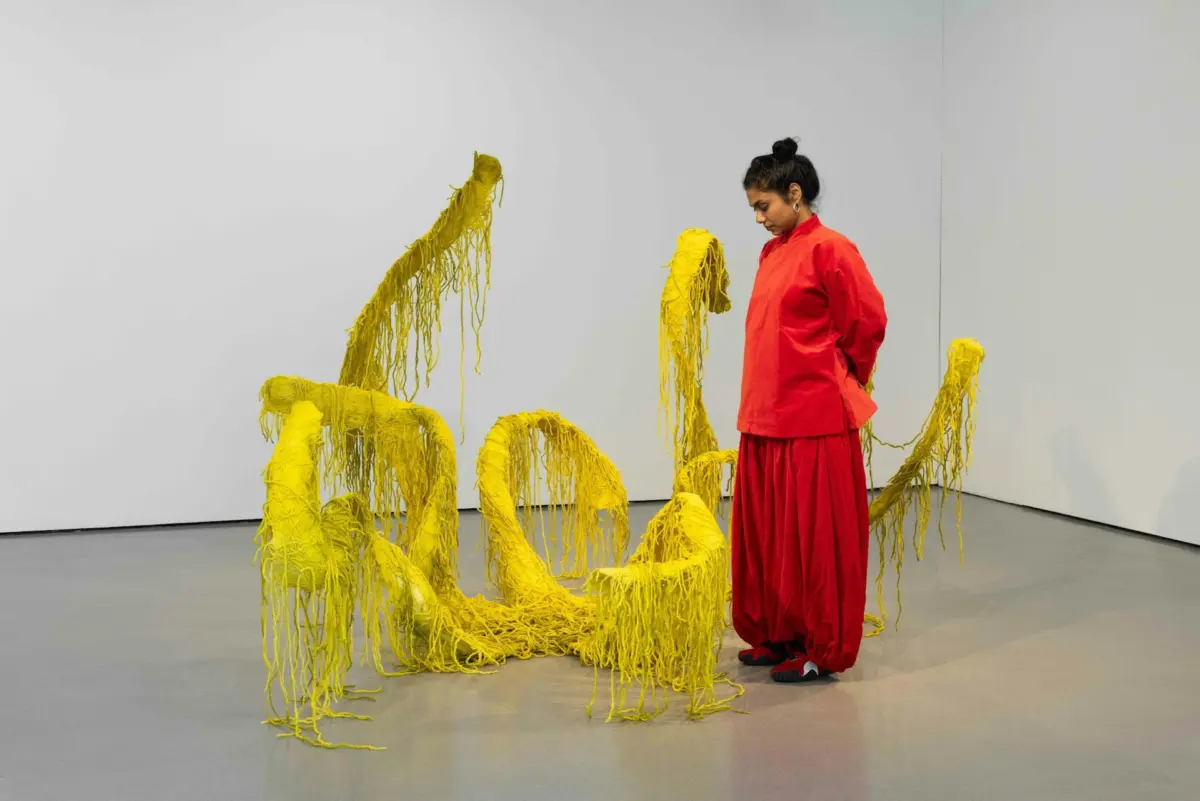
Today, this primeval process is being radically re-envisioned in Reservoir, a compelling solo exhibition by textile artist Sagarika Sundaram. Staged at the prestigious Henry Moore Institute in Leeds, the exhibition presents a series of dynamic, large-scale sculptural works that bridge raw material energy with exacting artistic control. Sundaram’s monumental forms oscillate between the organic unpredictability of nature and the disciplined intentionality of contemporary sculpture.
By pushing the limits of heavy, non-woven fabric, Sundaram challenges traditional divisions between sculpture and textiles. Her works evoke geological strata, ancient tectonic shifts, organic animal pelts, and primeval architectural shelters. Running until January 10, 2027, Reservoir stands as a masterclass in material history, offering viewers a profound meditation on how ancient craft traditions can be revitalized to address the concerns of modern contemporary art.
Detailed Chronology & Artistic Genesis
To understand the monumental presence of Sundaram’s current exhibition, one must trace the chronological evolution of her medium, her migratory production methods, and the physical realization of the pieces currently inhabiting the galleries of the Henry Moore Institute.
From Kutch to Leeds: The Making of Reservoir
The genesis of Reservoir lies primarily in Kutch, a region in northwestern India globally renowned for its deep-rooted textile heritage and master craft traditions. It is here, working alongside local artisans, that Sundaram produces the bulk of her heavy felt pieces. The production process itself is a monumental physical collaboration, necessitated not only by the sheer scale and weight of the materials but also by the complex techniques required to manipulate them.
Sundaram’s artistic process relies on a rigorous, rhythmic cycle: folding, tying, dyeing, cutting, and unfolding. Unlike woven or knitted fabrics, which inevitably unravel or fray when severed, the cut edge of heavy felt remains stable and self-contained. This unique physical property allows Sundaram to perform anatomical "surgeries" on her sculptures. By slicing through the dense material, she exposes the hidden interior of the fabric—compacted, colorful strata that resemble geological cross-sections or layers of biological skin.
The Anatomy of the Sculptural Series
Upon entering the Henry Moore Institute, visitors are immediately confronted by the exhibition’s anchoring masterwork, Blue Mountain (2026). Dominating the initial gallery space, this indigo-dyed behemoth evokes both the monumental scale of folding tectonic plates and the intimate sanctuary of a primitive cave or nomadic tent. It presents a dual identity: a formidable, hard geological formation from a distance, yet an inviting, soft architectural enclosure up close—complete with nooks and spatial recesses that tempt the viewer to step inside.
Moving deeper into the exhibition, works such as Looking Together (2026) and Dancer (2026) further demonstrate Sundaram’s mastery of form and negative space. Looking Together hangs against the wall like a massive, weathered animal hide. When the bindings used during the resist-dyeing process are severed, the thick felt "opens like a secret," blooming outward in a manner reminiscent of a sophisticated pop-up book.
Similarly, Dancer projects an arresting balance of lightness and structural solidity. Featuring a soft, spiraling movement, Sundaram describes the cutting of this piece as akin to "peeling an orange by hand"—except that scissors replace fingers. As the blade slices through the thick wool, it blurs the boundary between interior and exterior, allowing the cross-section of striated felt to shift dynamically before the viewer’s eyes.
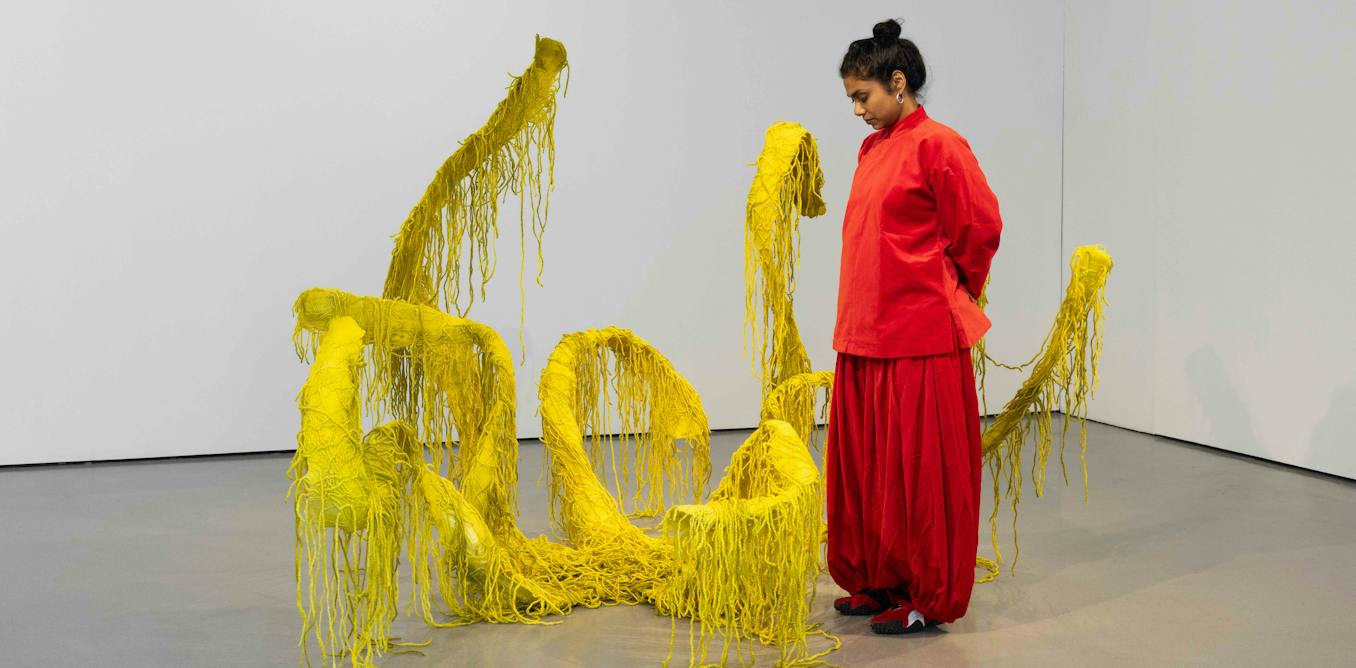
In Glossolalia (derived from the Greek term for "speaking in tongues"), Sundaram introduces a twisting fiber technique alongside traditional felting. The resulting organic mass closely resembles a thicket of branches blanketed in acid-colored moss and lichen. Finally, in Rope, the exhibition nods directly to the industrial wool heritage of Leeds and Yorkshire. Rather than presenting a clean, manufactured twist of yarn, Sundaram displays an oversized, multi-colored hank of fiber on the floor with raw, frayed ends trailing across the ground—a clear testament to human handiwork assisted by heavy machinery like tractors rather than sterile factory output.
Supporting Context & Metrics
The Intersections of Materiality, Architecture, and Craft
Sundaram’s sculptures do not exist in a vacuum; they sit at a complex crossroads of material science, anthropology, and architectural theory.
From a technical standpoint, the works in Reservoir engage deeply with traditional global dye practices, including Indian bandhani and leheriya, Japanese shibori, and Indonesian ikat. While these historical methods typically strive for tightly controlled, predictable geometric resist-patterns, Sundaram intentionally relinquishes absolute control. She permits the heavy, stubborn nature of thick felt to dictate the final outcome of the dye penetration, yielding organic, irreproducible gradients.
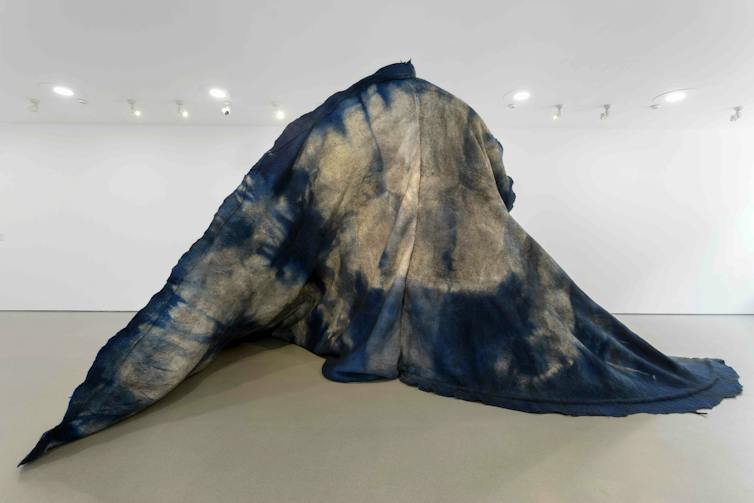
Architecturally, the exhibition breathes new life into the theories of 19th-century German architect Gottfried Semper. Semper famously posited that the origins of human building and architecture are inextricably bound to the textile arts—arguing that "the beginning of building coincides with the beginning of textiles," rooted in the foundational act of spatial enclosure. Blue Mountain and its companion pieces actualize this theory, transforming soft wool into hard architectural boundaries that define space, offer psychological protection, and evoke primordial dwellings.
The Anthropological View of Materials
Prominent anthropologist Tim Ingold has famously argued that "the properties of materials […] are not attributes but histories." Sundaram’s sculptures embody this philosophical stance. The wool used in her works carries the biological, ecological, and cultural histories of the animals, herders, and artisans who shaped them across generations. By acknowledging the collective labor involved in producing these heavy, unwieldy objects, Sundaram connects contemporary art practice to an unbroken ancestral chain of making.
Official Statements & Curatorial Perspectives
The significance of Reservoir within the contemporary art landscape has been underscored by critics, curators, and the artist herself.
Reflecting on her retrospective yet forward-looking methodology, Sagarika Sundaram has encapsulated her creative philosophy with a striking metaphor:
"It’s like walking backwards into the future."
This sentiment speaks directly to her methodology of employing ancient, seemingly obsolete craft techniques to forge entirely unprecedented contemporary forms. By looking backward to the deep roots of nomadic felting and traditional dye practices, she equips herself with a vocabulary advanced enough to challenge modern sculptural paradigms.
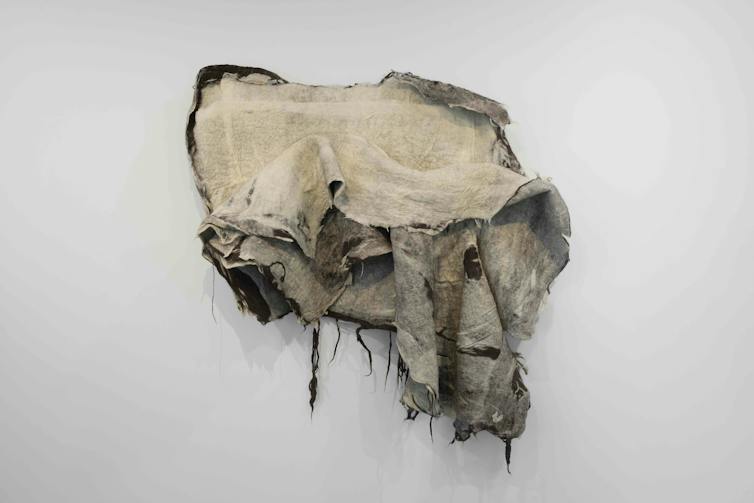
Discussing the generative nature of her cutting technique—where bindings are violently or delicately sliced to reveal the interior strata of the wool—Sundaram likens the moment of unveiling to a natural bloom:
"The material opens like a secret… emerging and blooming like a pop-up book."
Curators at the Henry Moore Institute have positioned Reservoir as a vital exhibition that re-evaluates the boundaries of sculpture. By stripping away the traditional reliance on bronze, marble, or steel and replacing them with dense, dyed, hand-manipulated wool, Sundaram redefines what sculptural mass, weight, and volume can achieve in the 21st century.
Future Outlook & Cultural Legacy
As Reservoir remains on view at the Henry Moore Institute in Leeds until January 10, 2027, its broader implications for the worlds of contemporary sculpture, textile art, and craft-led research are already becoming apparent.
- The Rehabilitation of Craft in Contemporary Fine Art: For decades, elite contemporary art institutions frequently marginalized fiber arts and felting as "craft" rather than "high art." Sundaram’s exhibition serves as a powerful counter-narrative, proving that ancient craft techniques possess the conceptual depth, scale, and formal rigor required to dominate major museum spaces.
- Sustainable Material Futures: In an era marked by ecological anxiety and fast-fashion waste, Sundaram’s reliance on natural, biodegradable wool, traditional plant-based or natural dyes, and localized artisanal labor points toward a more sustainable future for artistic production. The work demonstrates that monumental art does not require synthetic polymers or environmentally damaging industrial processes to achieve arresting visual power.
- The Ongoing Evolution of Sundaram’s Practice: By reining in her color palettes in pieces like Looking Together and Dancer—allowing the raw, unadulterated tones of the sheep’s wool to take precedence alongside sharp flashes of pigment—Sundaram signals a maturing minimalist restraint in her body of work.
Ultimately, Reservoir is more than a display of exceptional textile sculptures; it is an active archive of human labor, geological memory, and material resilience. By forcing a dialogue between the primitive warmth of felt and the cold, institutional architecture of the modern gallery, Sagarika Sundaram has carved out a unique and enduring space in the landscape of contemporary art.