Executive Overview
In the contemporary landscape of neo-classical and global ambient music, few collaborations possess the deeply entrenched historical and geopolitical gravity of L’Antidote. Comprising master cellist Redi Hasa, Iranian percussionist Bijan Chemirani, and Lebanese pianist Rami Khalife, the trio functions not merely as an instrumental ensemble, but as a cultural nexus. Their latest offering, “A Quiet Pulse,” serves as the hypnotic second single from their upcoming sophomore album, Sound Sketches: Music Composed for the Giorgio Armani Privé 2005–2025 Exhibition. Scheduled for release on September 18 via Ponderosa Music Records, the album represents a monumental artistic statement bridging the worlds of high-fashion curation, avant-garde composition, and deeply personal diasporic storytelling.
From its opening moments, “A Quiet Pulse” establishes an atmosphere of suspended gravity. A low, looping cello refrain—instantly recognizable as the virtuosic handiwork of Hasa—anchors the composition with an insistent, cyclical heartbeat. Yet, this is not music designed for passive consumption. Recorded entirely live off the floor with no pre-written charts or sheet music, the track is a masterclass in intuitive musical dialogue. It captures three world-class virtuosos operating at the height of their powers, translating their respective cultural inheritances, migrations, and artistic philosophies into a singular, cohesive sonic language.
This article provides an exhaustive, multi-dimensional examination of “A Quiet Pulse” and the broader ecosystem of Sound Sketches. By exploring the artists’ tumultuous early lives, the conceptual origins of L’Antidote, the architecture of the Armani/Silos sonic exhibition, and the upcoming international tour, we unpack how sound can serve as both a historical archive and an emotional antidote to the fractures of the modern world.
Detailed Chronology: From State Conservatories to the Milanese Runway
To understand the profound emotional resonance of “A Quiet Pulse,” one must retrace the harrowing yet triumphant geographic and artistic trajectories of the trio’s members. Their music is inextricably linked to the landscapes of upheaval, displacement, and cultural renaissance that shaped their formative years.
Redi Hasa and the Legacy of The Stolen Cello
Redi Hasa’s musical education began under the rigorous, unforgiving gaze of the state-owned conservatory system in Tirana, Albania. By the age of thirteen, Hasa had mastered the classical European cello repertoire. However, his relationship with this tradition has always been complex. As Hasa frequently notes, he loves "betraying that training"—bending classical precision toward the expressive, untamed dialects of Mediterranean folk, jazz, and ambient experimentation.
Hasa’s trajectory was violently disrupted by the socio-political collapse of Albania during the 1997 civil war. Amidst the chaos of a collapsing state and the closure of institutions, Hasa made a defining escape, carrying with him a physical artifact of his training: a cello pilfered from the Tirana Conservatory. This instrument—the literal vessel of his musical survival—would later lend its name to his acclaimed 2020 solo record, The Stolen Cello. Arriving in Italy in 1998 on a scholarship to Lecce, Hasa began a slow process of artistic reconstruction, eventually becoming one of the most sought-after improvisational cellists in Europe, known for his work with Ludovico Einaudi and Robert Plant, among others.
Bijan Chemirani and Rami Khalife: Inheriting the Rhythm of Conflict
While Hasa’s foundations were forged in the Balkans, his co-conspirators in L’Antidote carry lineages equally steeped in the turbulent politics of the late 20th century. Bijan Chemirani inherited his mastery of the zarb—the traditional Persian goblet drum—from his father, the legendary Persian master Djamchid Chemirani. Growing up immersed in classical Persian modal systems (radif) while navigating European musical spaces, Bijan developed a percussive vocabulary that treats rhythm not merely as a time-keeping device, but as a fluid, melodic narrative force.
Rami Khalife, meanwhile, was born in Beirut during the harrowing depths of the Lebanese Civil War. The son of renowned Lebanese oud player and composer Marcel Khalife, Rami’s earliest sonic memories are framed by the acoustics of conflict. Trained as a classical pianist, Khalife infuses his instrument with a cinematic, impressionistic weight, often employing heavy reverb and echo to evoke vast architectural spaces and internal psychological landscapes.
When Hasa, Chemirani, and Khalife first converged as L’Antidote, they were not simply forming a band; they were synthesizing decades of diaspora, displacement, and cross-cultural dialogue. Though Sound Sketches is only their second official record, the trio deliberately positions it at the genesis of their collaborative timeline—the foundational moment where three distinct musical tributaries first emptied into a single, unstoppable current.
Supporting Context & Metrics: The Architecture of “A Quiet Pulse”
The recording methodology behind “A Quiet Pulse” reflects a radical commitment to immediacy and organic chemistry. Eschewing the clinical perfection of modern multi-tracking and grid-locked editing, Hasa, Chemirani, and Khalife convened in the studio with a blank slate.
[Opening Crama / Loop] --> Redi Hasa (Low Cello Refrain)
                                 │
[Textural Layering]      --> Bijan Chemirani (Zarb, Hand & Shaker Work)
                                 │
[Harmonic Expansion]     --> Rami Khalife (Reverb-Drenched Piano)
                                 │
[Climactic Release]      --> The Emotional Vocal/Instrumental "Cry"
The Micro-Compositional Breakdown
- The Foundation (0:00 – End): The track opens with Hasa’s cello. The refrain is deceptively simple yet relentlessly insistent, looping beneath the surface like an undercurrent in a deep sea. It creates a space of meditation, forcing the listener into a state of heightened attentiveness.
- The Percussive Skater (Mid-Ground): Bijan Chemirani enters on the zarb. Rather than imposing a rigid meter, Chemirani’s handwork and shaker textures skate effortlessly over the heavy cello foundation. The percussion acts as wind moving across the surface of still water, providing motion without disturbing the deep-seated calm.
- The Atmospheric Wash (Late Entry): Rami Khalife’s piano arrives deliberately late. Drenched in thick reverb and atmospheric echo, the piano notes do not strike; they bloom and fade into the acoustic environment, adding a melancholic, cinematic breadth.
- The Cathartic Cry: Piercing through the shimmering haze of piano and percussion comes an emotive, soaring vocal-like cry. This sonic rupture channels the ancestral grief and historical weight carried by both Chemirani and Khalife—a direct echo of Beirut’s wartime echoes and the ancient poetic traditions of Persia.
The Armani/Silos Commission
The genesis of Sound Sketches lies in a prestigious and unusual institutional commission. L’Antidote was approached to compose a comprehensive sonic environment for the Armani/Silos exhibition spaces in Milan. The resulting album, Sound Sketches: Music Composed for the Giorgio Armani Privé 2005–2025 Exhibition, was conceived to accompany visitors as they navigate two decades of haute couture.
Just as Giorgio Armani’s designs balance structural rigor with fluid, effortless draping, L’Antidote’s music mirrors this duality. The rigid classical training of the artists provides the skeleton, while spontaneous improvisation and global instrumentation drape the composition in luxurious, unpredictable textures.
Official Statements & Artistic Philosophy
The philosophy underpinning L’Antidote is embedded directly in its moniker. As Rami Khalife articulates, the ensemble takes its name from the precise function that music serves in their lives and in society: an antidote to reality.
"Music is an antidote to reality," Khalife explains, defining the ensemble’s core ethos. "It is something that soothes, alters perception, and ultimately shifts how you view the world around you."
In an era defined by geopolitical fragmentation, nationalist retrenchment, and information fatigue, L’Antidote offers a counter-narrative through total sonic integration. By uniting an Albanian political refugee, an Iranian-French percussion virtuoso, and a Lebanese-born pianist, the trio embodies a borderless humanity.
Redi Hasa echoes this sentiment when discussing his approach to his stolen instrument and classical background:
"When you learn the rules so thoroughly by the time you are a teenager, you spend the rest of your life learning how to break them gracefully. You have to betray the training to find the truth."
This commitment to "graceful betrayal" prevents Sound Sketches from sliding into academic pastiche or world-music pastiche. Instead, it honors traditional idioms by dragging them into the unpredictable present.
Future Outlook: The Autumn Tour and Global Resonance
With the release of “A Quiet Pulse” streaming now across all major digital platforms via Ponderosa Music Records, anticipation for the full-length album on September 18 has reached a fever pitch. To support the release, L’Antidote will embark on an extensive European tour this autumn, bringing their immersive, unscripted live alchemy to some of the continent’s most prestigious cultural and experimental venues.
Tour Dates & Venues At-a-Glance
- October 22, 2025: Santeria Toscana 31 — Milan, Italy
- October 27, 2025: Théâtre des Bouffes du Nord — Paris, France
- October 28, 2025: Teatro Cantiere Florida (HEARTbeat Festival) — Florence, Italy
- November 17, 2025: sPAZIO211 — Turin, Italy
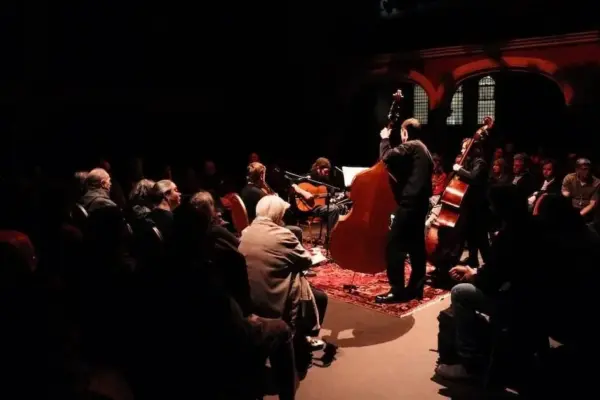
These live performances are expected to mirror the recording process of Sound Sketches—fluid, highly improvisational, and deeply responsive to the architecture of each room. Audiences attending these dates will not merely witness a concert; they will step inside an evolving acoustic installation where past traumas are alchemized into present beauty.
As “A Quiet Pulse” demonstrates, L’Antidote has crafted a rare artistic alchemy. By synthesizing the heavy baggage of their individual histories into music of breathtaking lightness and space, Hasa, Chemirani, and Khalife have delivered a masterwork of contemporary global composition—one that will resonate long after the final echo fades.