Executive Overview
In the contemporary intersection of electronic music and socio-political memory, few projects resonate with as much visceral urgency as "Gamachume," the latest collaborative single from Georgian musical innovators Tamada and DillaNext. Released via the forward-thinking independent label Deep Douqan, the track serves as both a hypnotic masterclass in modern electronic production and a poignant, politically charged elegy for a lost homeland.
Tamada—the moniker of Tbilisi-based singer, songwriter, and producer Lasha Chkhapelia—has carved out a singular niche in the global electronic underground. By fusing forward-looking club rhythms with the ancient, ceremonial traditions of the Georgian supra (the traditional, highly structured banquet feast) and ancient Georgian vocal stylings, Chkhapelia has continually redefined what modern folklore can sound like. Following the conceptual depth of his albums Dionysus vs Tamada and 2024’s 9 Deadly Sins for Tamada, his latest release teams him up with novelist, poet, and sonic artist Zura Jishkariani, who records under the moniker DillaNext.
"Gamachume"—a Georgian word translating directly to "silence me"—operates on multiple emotional and cultural frequencies. Released strategically on September 27, an emotionally heavy anniversary carrying profound historic weight for displaced Georgians, the track dives deep into the generational trauma, enduring resilience, and unshakeable identity of those uprooted by the 1992–1993 Abkhaz conflict. More than just a club track, "Gamachume" is an act of sonic reclamation. It transposes the rituals of the supra into the modern digital age, raising a metaphorical glass of wine not just in celebration, but in mourning, resistance, and defiant remembrance of Sukhumi, the capital of Abkhazia.
Detailed Chronology: From the Shores of the Black Sea to the Studios of Tbilisi
To fully understand the cultural resonance of "Gamachume," one must examine the historical and personal timeline that shaped its creators. The narrative of Tamada and DillaNext is inextricably linked to the geopolitical fractures of the post-Soviet collapse in the early 1990s.
The 1992–1993 Abkhaz Conflict and Displacement
Following the dissolution of the Soviet Union, ethnic and political tensions in the Georgian autonomous republic of Abkhazia erupted into a brutal, full-scale war. Backed by Russian military support, Abkhaz separatist forces fought against the Georgian government and local loyalist militias. The conflict was characterized by severe violence, widespread devastation, and massive demographic cleansing.
By the time a fragile ceasefire was brokered in late 1993, an estimated 250,000 ethnic Georgians had been systematically driven out of their homes in Sukhumi and across the region, forced to flee across the Caucasus mountains or down the Black Sea coast as destitute internally displaced persons (IDPs). Among these child refugees were Lasha Chkhapelia and Zura Jishkariani. They grew up separated from their ancestral homes, retaining only fragmented memories, family heirlooms, and generational storytelling as their connection to the Black Sea coast.
The Evolution of the Tamada Project
Decades later, Chkhapelia channeled this background into his musical alter ego, Tamada. Named after the tamada—the designated toastmaster who presides over the traditional Georgian supra—Chkhapelia’s artistic output mirrors the role of the traditional host. At a supra, the tamada dictates the emotional and philosophical trajectory of the gathering, proposing structured toasts to God, peace, family, the homeland, and the deceased, while the company drinks and occasionally breaks into spontaneous, multi-voiced traditional polyphonic singing.
Chkhapelia recontextualized this ancient framework. On releases like Dionysus vs Tamada and 9 Deadly Sins for Tamada, his lyrics are structured explicitly as toasts. However, instead of being spoken over a banquet table, they are chanted in ancient Georgian scales and poetry, set against a backdrop of brooding, contemporary electronic beats, deep basslines, and hypnotic synth textures.
The Road to "Gamachume"
The collaboration between Chkhapelia and Jishkariani represents a convergence of two literary and musical minds intimately shaped by the tragedy of displacement. Last year, the duo laid the groundwork for their current sonic explorations with the release of "Sokhumeli Bichi" ("Sukhumian Boy"). That track introduced a recurring, striking motif: a young boy carrying a pistol and a rose, with the turbulent currents of the Black Sea literally running through his genetic code.
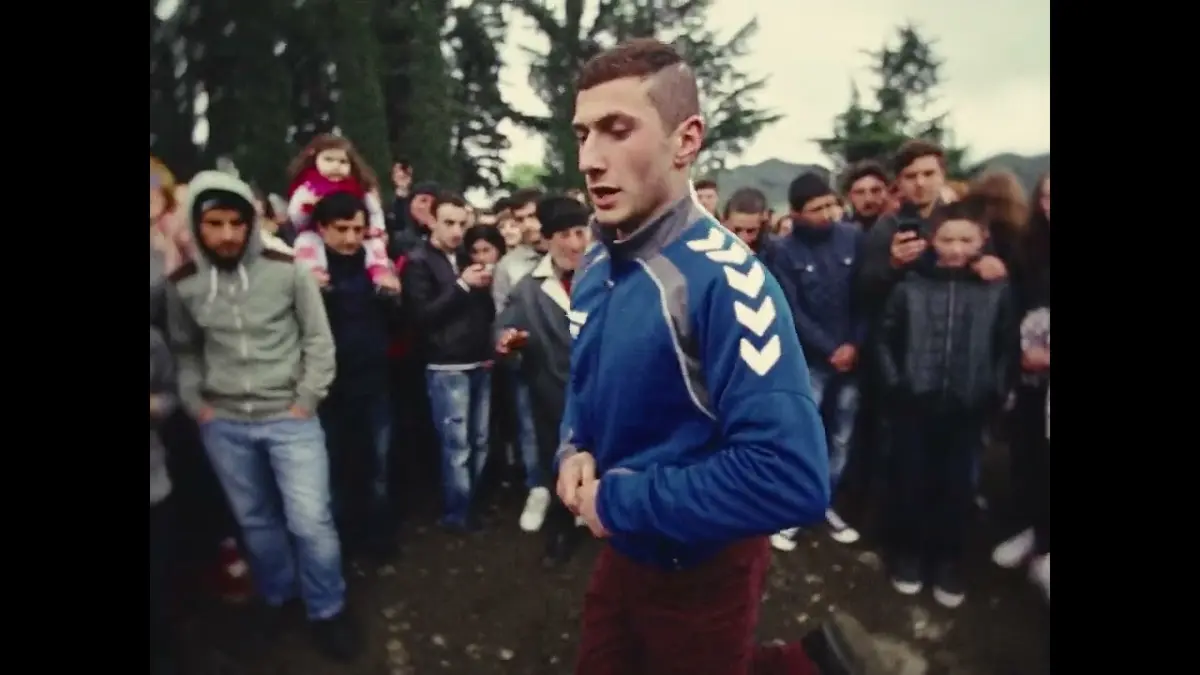
"Gamachume" builds directly upon this imagery, expanding it into a broader meditation on legacy, mortality, and cultural endurance. Released on September 27 via Deep Douqan, the single arrived with a visually striking music video that deepens the song’s themes of silence, command, and historical memory.
Supporting Context & Metrics: The Cultural and Geopolitical Architecture of the Track
The impact of "Gamachume" cannot be measured merely in streaming numbers or chart positions; it must be viewed through the lens of Georgian cultural preservation, diaspora studies, and the evolving landscape of Eastern European electronic music.
The Metaphor of the Supra in Modern Electronic Music
The supra is far more than a meal; it is a foundational pillar of Georgian civil society and social structure. It operates under strict unwritten rules where poetry, philosophy, and communal bonding intersect. By utilizing the framework of the tamada to address the loss of Abkhazia, Chkhapelia bridges a generational chasm.
[Traditional Georgian Supra] ---> (Presided over by the Tamada) ---> [Proposes Toasts to Peace, Homeland, Dead]
                                                                                      |
                                                                                      v
[Modern Electronic Production] ---> (Lasha Chkhapelia / Tamada) ---> [Translates Toasts into Ancient Georgian & Beats]
In traditional Georgian culture, drinking to the dead is a solemn, mandatory ritual. In "Gamachume," this ritual is scaled up to encompass an entire dispossessed population. The song asks listeners to remember a city—Sukhumi—that an entire generation of displaced youth grew up hearing about only in whispered recollections, folklore, and kitchen-table nostalgia.
The Poetics of the Soil and the Sea
In the lyrical structure of "Gamachume," the imagery shifts dramatically in the middle verses, turning a burial into an act of agricultural planting. As the lyrics recount, others dig the earth, but it is the protagonist who is laid within it. Yet, rather than signifying a permanent end, this act of internment confounds those who assumed the culture was dead. Instead of a grave, they discover they have planted a "tree of life."
This poetic turn is deeply symbolic of the 33-year passage of time since the war emptied Sukhumi of its Georgian population. Thirty-three years represents more than three decades of displacement—an entire generation born into exile. Yet, as Chkhapelia and Jishkariani demonstrate through their art, the cultural DNA of the region cannot be bulldozed or legislated out of existence. Two children driven from their homes as refugees are now transforming the memory of Sukhumi into cutting-edge electronic anthems within the thriving underground clubs of Tbilisi.
The Linguistic and Sonic Climax
The title of the track, "Gamachume" ("Silence me"), acts as a powerful structural framing device. Near the end of the song, the phrase is repeated five times in succession by the same vocalist who, earlier in the track, boldly claims an ability to "break armies apart." This juxtaposition highlights the duality of the tamada’s power: the master of ceremonies holds absolute authority over the room, possessing the vocal and rhetorical force to rouse armies, yet retains the ultimate prerogative to command absolute, respectful silence. At a traditional supra, it is the tamada who decides when the rowdy toasts subside and the room falls quiet. In the context of the song, it suggests a weary exhaustion with geopolitical conflict—a desire for the noise of war to be silenced once and for all.
Official Statements and Artistic Intentions
While operating within the underground club circuit, both Tamada and DillaNext have been vocal about the underlying socio-political weight driving their creative output. Speaking on the collaborative ethos behind their recent works, the artists have emphasized that electronic music in Tbilisi is inextricably tied to the sociopolitical reality of the nation.
"Dancing has its time, mourning has its time,"—a foundational thematic line echoed in the promotional rollout of "Gamachume"—encapsulates the emotional dichotomy of modern Georgian youth culture.
In interviews surrounding his recent projects, Lasha Chkhapelia has frequently noted that his adoption of the tamada persona was designed to reclaim traditional idioms from nationalist dogmatism and infuse them with contemporary emotional honesty. By addressing the unresolved trauma of Abkhazia through the medium of club music, Chkhapelia and Jishkariani are bypassing traditional, often stagnant political discourse, opting instead for a direct, visceral emotional transmission that resonates deeply with younger Georgians who frequent Tbilisi’s renowned techno and electronic venues like Bassiani and Khidi.
Zura Jishkariani, bringing his background as a prominent avant-garde novelist and poet into the fold as DillaNext, infuses the project with a literary density rare in dance music production. His poetic contributions ensure that every track functions simultaneously as a dancefloor weapon and a piece of high-literary modernism, exploring themes of memory, geographic loss, and phantom limbs of the Georgian national consciousness.
Future Outlook: The Ongoing Resonance of Post-Conflict Sonic Art
As "Gamachume" circulates through global radio stations, independent music platforms, and underground DJ sets, its release marks a significant milestone in the evolution of Eastern European electronic music.
Expanding the Global Reach of Georgian Electronica
Over the past decade, Tbilisi has emerged as a globally recognized hub for underground electronic music, celebrated for its industrial soundscapes, fierce independence, and counter-cultural resilience. However, much of the international attention has focused purely on the sonic aesthetics of the scene. With projects like Tamada’s Dionysus vs Tamada, 9 Deadly Sins for Tamada, and now the DillaNext collaboration "Gamachume," artists are actively injecting deep socio-political narratives, indigenous folk histories, and localized geopolitical trauma back into the global electronic music discourse.
The Unresolved Horizon of Abkhazia
More than three decades after the 1992–1993 war, the political status of Abkhazia remains frozen, recognized by only a handful of nations globally while remaining legally and internationally acknowledged as an integral, occupied region of Georgia. For the quarter of a million displaced Georgians, physical return remains an elusive dream.
Yet, as "Gamachume" powerfully illustrates, memory is a resilient terrain that cannot be effectively blockaded by military checkpoints or geopolitical stalemates. By embedding the landscape, the bloodline, and the sorrow of Sukhumi into hypnotic basslines and ancient poetic cadences, Tamada and DillaNext have ensured that the memory of their lost home continues to live, breathe, and echo across dancefloors and sound systems worldwide.
In a world increasingly prone to historical amnesia, "Gamachume" stands as a towering reminder that music can serve as a sanctuary for the displaced, a monument to the unreturned, and a commanding voice calling for both remembrance and ultimate, enduring peace.
Stream "Gamachume" via Deep Douqan on major digital streaming platforms, and explore Tamada’s and DillaNext’s complete discographies via their official Bandcamp and artist portals.