Executive Overview
Few cultural figures of the late 20th century navigated the volatile intersections of music, theatre, modeling, and literature with the fierce autonomy of Marsha Hunt. Born in Philadelphia in 1946 and transplanted to the crucible of 1960s London, Hunt defied the rigid categorizations of the entertainment industry. Whether gracing the West End stage in the landmark countercultural musical Hair, posing provocatively for Patrick Anson (the Earl of Lichfield) in American Vogue as a powerful act of racial empowerment, or working alongside premier architects of rock, soul, and disco, Hunt was a vanguard of identity and expression.
Her creative footprint spans collaborative and romantic histories with blues and rock royalty—including John Mayall, Jimi Hendrix, Marc Bolan, and Mick Jagger—as well as an eclectic musical discography produced by luminaries like Tony Visconti and Pete Belotte. Yet, Hunt’s relentless versatility often confounded commercial gatekeepers who struggled to market a Black female artist unwilling to conform to archaic archetypes.
Transitioning from music into a critically acclaimed literary and theatrical career, Hunt authored candid memoirs, poignant novels, and resilient personal histories. This retrospective explores the multifaceted life and enduring legacy of an artist whose refusal to be pigeonholed made her as vital to the definition of her era as her contemporaries, cementing her status as an uncompromising icon of artistic integrity.
Detailed Chronology
1966–1968: Arrival in Swinging London and the Blues Circuit
Marsha Hunt’s journey across the Atlantic in February 1966 dropped her directly into the hyper-creative epicenter of Swinging London. Possessing striking features honed by modeling, she initially secured extra work in Michelangelo Antonioni’s generation-defining film Blow-Up. However, her magnetic presence quickly drew her into the capital’s vibrant music scene.
Transitioning to music, Hunt became a backing singer for Alexis Korner’s Free At Last before embarking on a brief, highly creative relationship with British blues pioneer John Mayall. Her impact on Mayall was immediate; on his landmark 1967 album The Blues Alone, he dedicated both "Marsha’s Mood" and "Brown Sugar" to his fleeting muse.
Before long, Hunt moved on to join Bluesology—a collective that featured a young Long John Baldry and a hirsute Reg Dwight, who would later find global fame as Elton John. Following a brief, uninspired stint with the soul ensemble Ferris Wheel, Hunt stepped into the theatrical light that would alter the trajectory of her career.
1968–1970: Hair, Vogue, and the Track Records Era
Hunt’s breakthrough into national prominence arrived with the original London cast of Hair. As the first bona fide rock musical built around hippie culture, Hair championed peace, love, and the celebratory liberation of the naked body—an artistic statement that drew swift criticism from conservative corners while deeply empowering its cast. Hunt took the lead on "White Boys," a biting Supremes send-up that showcased her vocal dynamism and theatrical timing.
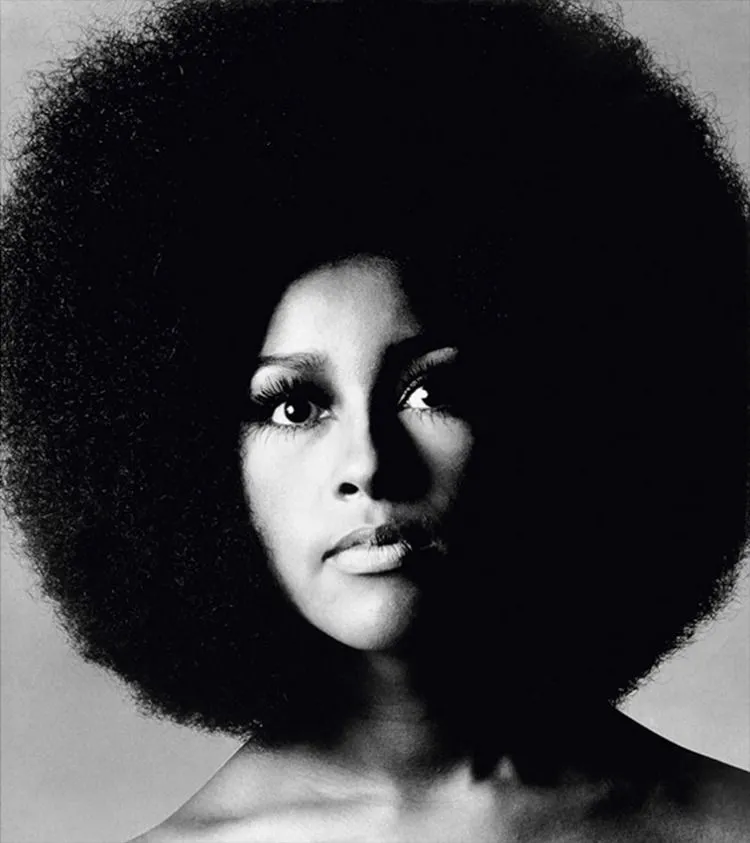
Her striking face on promotional posters caught the eye of Patrick Anson, the Earl of Lichfield, leading to an invitation to pose nude for American Vogue. At a time when Black models rarely graced the glossy pages of high-fashion magazines, Hunt accepted the challenge not merely as a modeling job, but as a profound act of self-ownership and racial empowerment.
Simultaneously, Hunt signed a recording contract with Track Records, then the powerhouse home to The Who and The Jimi Hendrix Experience. Hunt felt a deep kinship with Hendrix, admiring his ability to channel complex sociopolitical and emotional truths directly through his lyrics and guitar.
Her debut single, a cover of Dr. John’s "Walk On Gilded Splinters" (1969), was produced by Tony Visconti. The resulting track was a superlative slice of swampy, atmospheric rock that became a minor hit, arguably elevating Dr. John’s profile more than her own, yet establishing Hunt as a serious musical force.
1970–1975: Bolan, Jagger, and Woman Child
Working alongside Visconti brought Hunt into London’s elite creative circles. A passionate dalliance with Marc Bolan led her to record two Tyrannosaurus Rex songs and a striking cover of Bolan’s "Desdemona" (originally a hit for John’s Children in 1967) while she gathered material for her debut solo album.
During this period of intense media scrutiny, Hunt engaged in a high-profile relationship with Mick Jagger, resulting in the birth of their daughter, Karis. The pregnancy was planned, and Jagger initially agreed to function as an "absent father." Following a hard-fought paternity suit, Jagger eventually established a lasting relationship with both Hunt and Karis. It is widely understood that Jagger’s authorship of the Rolling Stones’ anthem "Brown Sugar" was inspired by Hunt, a testament to her defiant, captivating independence.
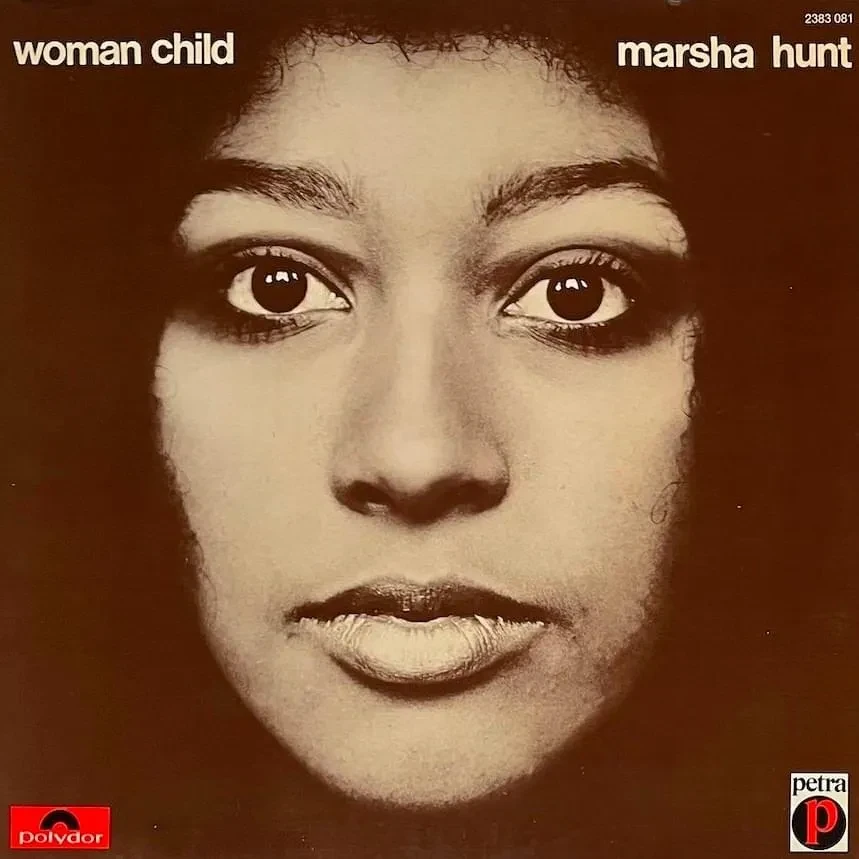
Hunt’s debut solo album, Woman Child, was ultimately released in 1971. Produced by Visconti, the record showcased her remarkable range as an interpreter of material. It featured arresting reinventions of Traffic’s "No Face, No Name, No Number," Bessie Smith’s "Moan You Moaners," and the contentious title track penned by Bobby Goldsboro and Kenny O’Dell. Despite critical praise, the album struggled commercially—an early casualty of the music industry’s confusion over how to market her multifaceted talent.
1972–1980: Marsha Hunt’s 22, Disco Explorations, and the Stage
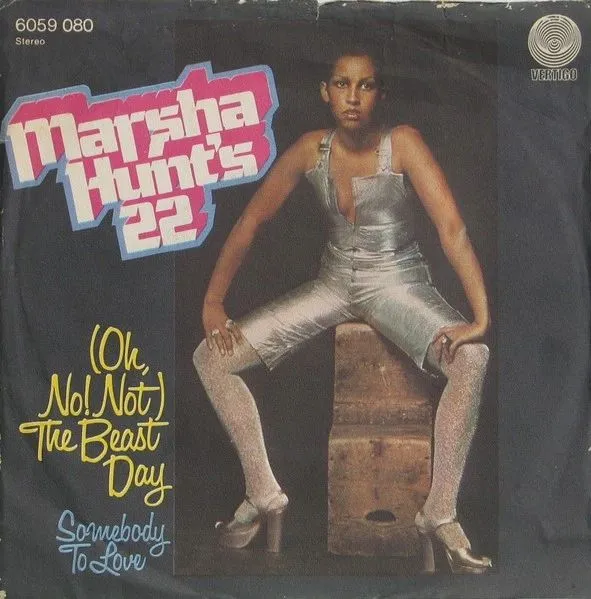
Undeterred, Hunt signed with Phonogram and assembled a four-piece outfit named Marsha Hunt’s 22. In 1972, they released "(Oh, No! Not) The Beast Day," produced by Steve Rowland. The single delivered another potent dose of Louisiana swampland hoodoo, complemented by a rousing, unruly cover of Grace Slick’s "Somebody To Love." A follow-up single, "Medusa / Bop City"—co-written by Hunt and guitarist Hugh Burns—was an infectious slab of psych-funk that suffered, like its predecessor, from a critical lack of label promotion.
A second album, Attention! Marsha Hunt! (1973), patched together from demo sessions with her band, received a restricted European release—leaving Hunt herself entirely unaware of its existence for over four decades.
Pivoting back to acting, Hunt embraced dynamic stage and screen roles. She appeared alongside PJ Proby and Dana Gillespie in Jack Good’s Catch My Soul, a rock-infused adaptation of Othello. She then tackled Melvyn Bragg’s musical Mardi Gras during its six-month West End run. By 1976, she secured a definitive dramatic milestone, starring as Sabina (a role famously originated by Vivien Leigh) in Thornton Wilder’s The Skin of Our Teeth at the newly opened Royal Exchange Theatre in Manchester.
As the decade turned, Hunt embraced the burgeoning electronic dance revolution. In 1977, she traveled to Munich to record the disco-heavy album Marsha 77, produced by Pete Belotte, a close creative associate of Giorgio Moroder who co-wrote era-defining hits like Donna Summer’s "I Feel Love" and "Hot Stuff."
Simultaneously, Hunt maintained a steady presence on the silver screen. Her film credits expanded to include roles in Dracula AD 1972 alongside horror icons Christopher Lee and Peter Cushing, Britannia Hospital (1982), Never Say Never Again (1983), and Beyond Soho (1989) opposite Ray Winstone.
1982 Onward: Literary Triumphs and Later Life
In 1982, Hunt wrote and produced Man To Woman, a musical set in a London nightclub exploring the complex dynamics between four women and the men in their lives. Staged at the now-defunct Zig Zag Club, the production struggled financially. This setback proved to be a turning point, prompting Hunt to step away from the music industry to dedicate herself entirely to writing.
It was an inspired vocational pivot. Her candid, unflinching 1986 autobiography, Real Life, laid bare the triumphs and tribulations of her extraordinary trajectory. A second memoir, Repossessing Ernestine (1996), charted her deeply personal quest to uncover the history of her paternal grandmother, who had spent half a century confined to a psychiatric asylum. In 2005, she published Undefeated, documenting her courageous battle against breast cancer.
Hunt also established herself as a respected novelist. Works such as Joy (1990), Free (1992), and Like Venus Fading (1998)—the latter heavily influenced by the legendary lives of Josephine Baker and Adelaide Hall—earned her moderate yet well-deserved literary acclaim.
Supporting Context & Metrics
To fully understand Marsha Hunt’s cultural placement, one must examine the metrics of her reception and the aesthetic environment of her peak creative years:
- Multidisciplinary Output: Over a career spanning more than five decades, Hunt worked across four distinct artistic pillars: modeling, music, acting, and literature. She released approximately half a dozen studio albums and singles across prestigious labels including Track Records and Phonogram, published three memoirs, three novels, and starred in over a half-dozen feature films and landmark West End stage productions.
- The Industry Paradigm Shift: During the late 1960s and early 1970s, record labels heavily favored compartmentalized acts. Producer Tony Visconti famously noted that the record company viewed Hunt through the reductive lens of a "Black Marilyn Monroe," completely missing her intellectual approach to music and desire to craft a credible, psychedelic "guy record."
- Critical Retrospective Impact: Hunt’s lost recordings and rare European releases, such as Attention! Marsha Hunt!, have become holy grails for record collectors, championed by publications like Record Collector for their genre-blending audacity, fusing swamp blues, psych-funk, and proto-disco.
Official Statements and Reflections
The artistic mindset of Marsha Hunt is best understood through the perspectives of those who collaborated with her in the studio, as well as her own reflections on her public persona.
Producer Tony Visconti, who helmed her work on Woman Child and her early singles, offered a profound assessment of her intellectual rigor in the studio:
"Marsha was very smart. She approached her music very intellectually. She was totally confident in her innate beauty, but she was also into how we could interpret the material for her album in a very hip, almost psychedelic way. She wanted to make a credible ‘guy’ record, and not come off as a Black Marilyn Monroe, which is how the record company saw her."
Hunt herself frequently reflected on the double-edged sword of her boundless versatility. Never willing to conform to a single mold, she acknowledged late in life that her lack of continuous, singular branding often left cultural gatekeepers and audiences confused:
"No one could ever pigeonhole Marsha Hunt—she was as much an accomplished actress and singer as she was an author. But in some respects, her versatility was her undoing."
Future Outlook and Legacy
As contemporary cultural discourse increasingly values intersectionality, boundary-pushing autonomy, and the reclamation of historical narratives, Marsha Hunt stands out as a trailblazer who was simply decades ahead of her time.
Her life and career continue to undergo a vital critical re-evaluation. Archivists, music historians, and feminist scholars now recognize Hunt not merely as a footnote in the romantic histories of rock icons like Mick Jagger or Marc Bolan, but as an autonomous creative force. Her transition from the defiant countercultural stages of Hair and the high-fashion vanguard of Vogue to the deeply introspective pages of her memoirs confirms her status as a survivor, a survivor-artist, and an intellectual heavyweight.
The re-release of her classic recordings—such as the Original London Cast recording of Hair via Polydor—ensures that new generations of listeners can experience the raw, unadulterated power of her vocal instrument. Marsha Hunt remains a wild child, a willful rebel, and a principled woman of unconditional integrity whose indelible fingerprints are woven into the very fabric of modern popular culture.