Executive Overview
To define Marsha Hunt by a single medium is to misunderstand the very essence of her remarkable career. Born in Philadelphia in 1946, Hunt emerged as an indelible cultural force across the latter half of the 20th century, seamlessly traversing the worlds of high fashion, underground blues, psychedelic rock, West End theatre, commercial cinema, and critically acclaimed literature. Moving to London in February 1966 at the height of the Swinging Sixties, Hunt quickly embedded herself in the beating heart of the British counterculture.
Yet, her journey was far from a straightforward ascent to stardom. Hunt’s fierce intelligence, unyielding artistic vision, and unwavering personal integrity frequently collided with an entertainment industry ill-equipped to handle a Black woman who refused to be pigeonholed. Whether she was shattering racial barriers in the pages of Vogue, anchoring the original London cast of the ground-breaking rock musical Hair, collaborating with visionary producers like Tony Visconti, or inspiring rock royalty such as Jimi Hendrix and Mick Jagger, Hunt carved out a path entirely of her own making.
This retrospective examines the extraordinary trajectory of an artist whose versatility—while occasionally viewed by contemporaries as a lack of commercial continuity—cemented her status as a defining architect of her era. Through triumphs, institutional resistance, personal battles, and a triumphant transition to letters, Marsha Hunt’s life remains a testament to the power of unbridled self-determination.
Detailed Chronology: From Philadelphia to the London Underground
The Arrival and Early Musical Apprenticeships (1966–1968)
Marsha Hunt’s transatlantic migration in February 1966 marked the genesis of a nomadic, intensely creative life. Initially arriving with a background in modeling and acting, she quickly found herself swept into the burgeoning London arts scene. Early footsteps included an uncredited appearance as an extra in Michelangelo Antonioni’s seminal swinging-London film Blow-Up. However, the music world proved an immediate and magnetic draw.
Hunt joined Alexis Korner’s ensemble, Free At Last, as a backing singer. Her distinct presence and burgeoning vocal talents soon caught the attention of American bluesman John Mayall. During a brief romance, Hunt served as Mayall’s muse; his 1967 album, The Blues Alone, featured tracks explicitly written for and dedicated to her, namely "Marsha’s Mood" and "Brown Sugar."
From Mayall’s orbit, Hunt transitioned to join Bluesology, a band featuring Long John Baldry and a notoriously hirsute keyboardist named Reg Dwight—who would later adopt the moniker Elton John. Following a brief, unfulfilling stint with the soul outfit Ferris Wheel, Hunt found the vehicle that would launch her into the national consciousness.
The Phenomenon of Hair and High-Fashion Defiance
Hunt secured a role in the original London cast of Hair, the era-defining rock musical that celebrated hippie culture, pacifism, and the radical act of public nudity as a form of bodily liberation. Tasked with singing lead on "White Boys"—a satirical send-up of girl-group tropes à la The Supremes—Hunt’s striking visage quickly dominated promotional materials.
This visibility caught the eye of Patrick Anson, the Earl of Lichfield. The aristocratic photographer enlisted Hunt to pose nude for American Vogue. At a time when Black models were systemic anomalies in high-fashion publications, Hunt recognized the assignment not merely as a modeling job, but as a deliberate political act of empowerment and visibility.
Simultaneously, Hunt signed a recording contract with Track Records, the prestigious home of The Who and The Jimi Hendrix Experience. Hunt felt a profound kinship with Hendrix, deeply admiring his rare ability to articulate complex sociopolitical and emotional landscapes through his virtuosic musicianship and lyricism.
The Visconti Collaboration and Woman Child (1969–1971)
Hunt’s burgeoning solo career took a definitive shape when she paired with visionary producer Tony Visconti. Her debut single, a blistering 1969 cover of Dr. John’s "Walk On Gilded Splinters," became a minor chart hit. While the track perhaps did more commercial favors for Dr. John (the "Night Tripper") than for Hunt herself, it established her credentials as a formidable, avant-garde interpreter of roots music.
Through Visconti, Hunt crossed paths with Marc Bolan. Their passionate affair yielded collaborative sessions in which Hunt recorded two Tyrannosaurus Rex songs alongside a cover of Bolan’s "Desdemona"—a track previously popularized by John’s Children in 1967.
Simultaneously, Hunt engaged in a high-profile, intense relationship with The Rolling Stones frontman Mick Jagger. The union resulted in a planned pregnancy and the birth of their daughter, Karis. Following a well-documented, hard-fought paternity suit, Jagger maintained a long-term association with both Hunt and Karis. It is widely acknowledged that Jagger’s composition of "Brown Sugar" was heavily inspired by—and a tribute to—Hunt’s fierce, unbending independence.
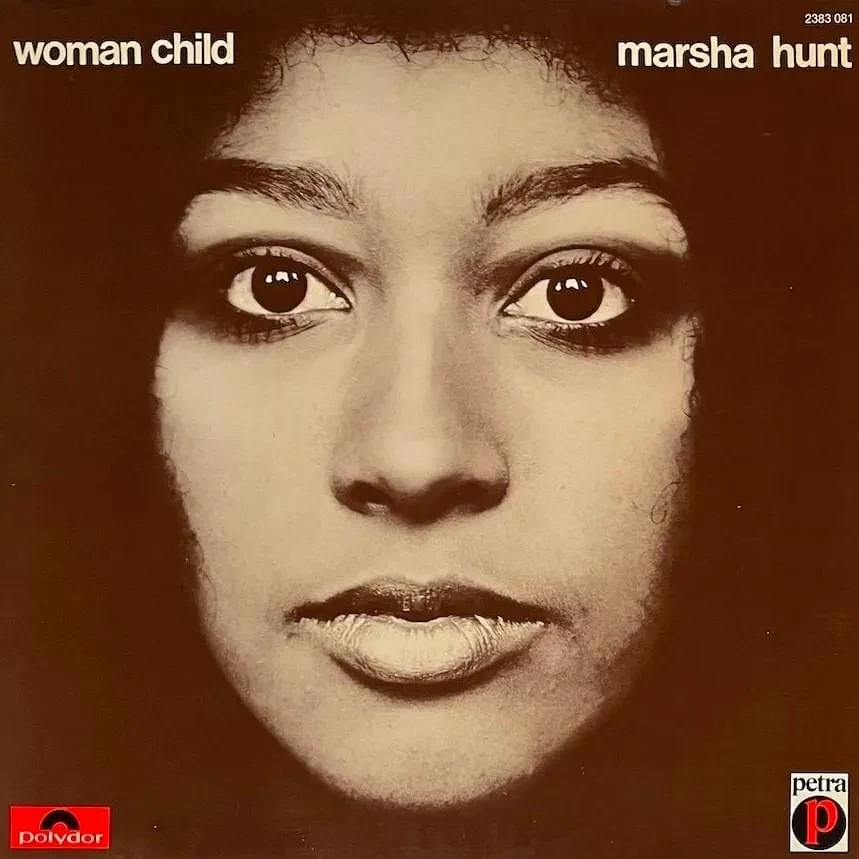
Hunt’s debut solo album, Woman Child, was eventually released in 1971. Produced by Visconti, the record showcased her interpretive brilliance, featuring arresting reinventions of Traffic’s "No Face, No Name, No Number," Bessie Smith’s "Moan You Moaners," and the controversial title track originally written by Bobby Goldsboro and Kenny O’Dell. Despite critical acclaim, the album suffered from poor commercial performance—an injustice that signaled mounting frustrations with the music industry.
Genre-Shifting, Swamp Funk, and Disco (1972–1977)
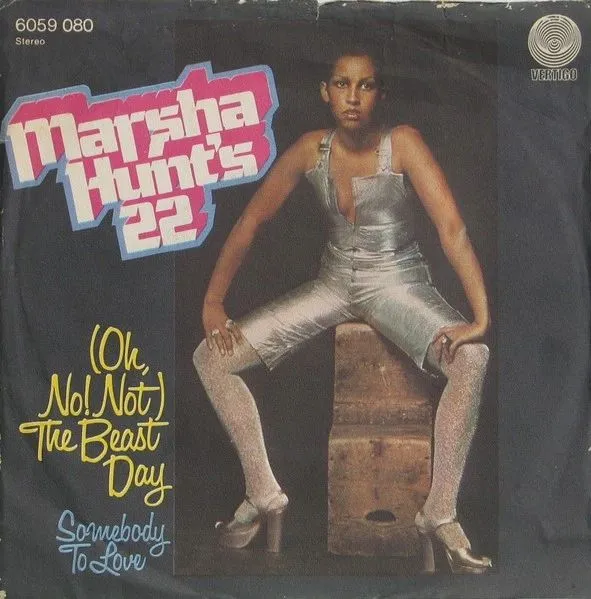
Undeterred by industry headwinds, Hunt pivoted to Phonogram Records, fronting a four-piece rock outfit known as Marsha Hunt’s 22. In 1972, they released "(Oh, No! Not) The Beast Day," a Louisiana swampland hoodoo track produced by Steve Rowland, paired with an unruly, high-energy cover of Grace Slick’s "Somebody To Love." A subsequent single, "Medusa / Bop City," co-written by Hunt and guitarist Hugh Burns, offered a potent dose of psych-funk. Once again, a lack of institutional promotion hampered its commercial reach.
A second album, Attention! Marsha Hunt! (1973), cobbled together from early demos with the 22, received only a limited European release—a project so poorly managed that Hunt remained entirely unaware of its existence for over four decades.
As the 1970s progressed, Hunt successfully diversified her artistic output by returning to acting. She starred alongside PJ Proby and Dana Gillespie in Jack Good’s rock-opera adaptation of Othello, titled Catch My Soul. She also completed a six-month West End run in the Melvyn Bragg musical Mardi Gras. In 1976, she conquered classical theatre, landing the prestigious role of Sabina (originally made famous by Vivien Leigh) in Thornton Wilder’s The Skin of Our Teeth at Manchester’s newly opened Royal Exchange Theatre.
Demonstrating her relentless adaptability, Hunt entered the burgeoning euro-disco landscape in 1977. She recorded Marsha 77 in Munich, working alongside Pete Belotte, a close associate of Giorgio Moroder who co-wrote era-defining anthems like Donna Summer’s "I Feel Love" and "Hot Stuff."
Cinematic Ventures and the Transition to Literature (1980s–2000s)
Hunt’s magnetic screen presence translated successfully to film. Her cinematic CV includes standout roles in horror classic Dracula AD 1972 (alongside horror icons Christopher Lee and Peter Cushing), Britannia Hospital (1982), the James Bond film Never Say Never Again (1983), and Beyond Soho (1989) opposite Ray Winstone.
In 1982, Hunt wrote, produced, and starred in Man To Woman, a musical staged at the now-defunct Zig Zag Club exploring the complex dynamics of four women and their romantic relationships in a London nightclub. When the production faced financial failure, it prompted a profound re-evaluation of her career. Opting to step away from the music industry entirely, Hunt transitioned to a literary career—a decision that yielded immediate, profound dividends.
Her 1986 debut autobiography, Real Life, won widespread acclaim for its unvarnished, candid prose. This was followed by Repossessing Ernestine (1996), a poignant chronicle of her exhaustive search for her paternal grandmother, who spent half a century institutionalized in an asylum. In 2005, she published Undefeated, a courageous account of her successful battle against breast cancer.
Alongside her non-fiction work, Hunt established herself as a respected novelist. Her fiction output included Joy (1990), Free (1992), and Like Venus Fading (1998)—the latter deeply influenced by the historical struggles and triumphs of legendary Black performers like Adelaide Hall and Josephine Baker.
Supporting Context & Metrics
To fully appreciate Marsha Hunt’s footprint in cultural history, it is vital to examine the metrics of her output and the structural challenges she navigated:
- Multidisciplinary Reach: Hunt officially conquered four distinct entertainment sectors: modeling (appearing in top-tier publications like Vogue), music (releasing multiple studio albums and charting singles across 10 years), theatre (starring in West End musicals and classical repertory), and literature (publishing three memoirs, three novels, and multiple essays).
- The "Versatility Penalty": Music industry executives in the late 1960s and 1970s struggled to categorize Hunt. As producer Tony Visconti noted, record labels frequently attempted to market her as a "Black Marilyn Monroe"—a passive sex symbol—whereas Hunt insisted on crafting intellectual, psychedelic, and socially charged "guy records." This misalignment directly contributed to the underperformance of records like Woman Child.
- Literary Longevity: Unlike many pop-culture figures whose writing careers rely on ghostwriters, Hunt established herself as a literary voice of consequence, with her six published books spanning critical explorations of mental health, systemic institutional failures, historical fiction, and personal survival.
Official Statements and Industry Reflections
The complexities of Marsha Hunt’s artistic identity and work ethic have long been championed by those who worked closest with her.
Reflecting on their time in the studio together during the late 1960s and early 1970s, producer Tony Visconti offered a clarifying assessment of her intellectual approach to music:
"Marsha was very smart. She approached her music very intellectually. She was totally confident in her innate beauty, but she was also into how we could interpret the material for her album in a very hip, almost psychedelic way. She wanted to make a credible ‘guy’ record, and not come off as a Black Marilyn Monroe, which is how the record company saw her."
Hunt herself frequently reflected on the double-edged sword of her boundless curiosity and multi-talented nature. Rather than regretting her eclectic resume, she acknowledged that her refusal to remain static or conform to a singular commercial blueprint frequently confounded audiences who craved easy categorization. Looking back on her journey from Philadelphia expatriate to British countercultural icon, Hunt embraced the label of the ultimate outsider: a wilful rebel whose uncompromising personal integrity superseded fleeting pop charts.
Future Outlook & Enduring Legacy
As cultural historians continue to excavate the untold stories of the 1960s and 1970s counterculture, Marsha Hunt stands out as a pioneering figure whose contributions far outstripped her commercial tallies. Long before intersectional feminism became a common framework in cultural critique, Hunt lived it—navigating the treacherous intersections of race, gender, high fashion, and rock-and-roll misogyny with a fierce, aristocratic defiance.
Today, re-evaluations of her recorded output—spearheaded by archival releases such as Polydor’s reissues of the Hair original London cast recordings and retrospective deep-dives into albums like Woman Child—point to a critical renaissance. Scholars, musicologists, and contemporary artists increasingly view Hunt not as a footnote in the biographies of rock legends like Jimi Hendrix or Mick Jagger, but as a central protagonist of the era.
Marsha Hunt’s legacy is secure. She was an actress, singer, model, novelist, and memoirist who refused to be contained by boundaries of race, genre, or expectation. In doing so, she did as much to define the radical spirit of her generation as any guitar hero or chart-topping balladeer.