Executive Overview
The fundamental saw wave has anchored electronic music production for decades, serving as the raw, buzzing building block for everything from heavy Reese basses to the iconic, euphoric "supersaws" that defined trance. Originally popularized by the Roland JP-8000 in the late 1990s, the stacked-oscillator sawtooth sound has undergone several reinventions. Its latest and most forward-thinking evolution arrives via SuperStarSaw, a collaborative software instrument developed by industry giant Native Instruments and Grammy-winning producer A. G. Cook.
As the founder of the pioneering PC Music label in 2013 and a principal creative architect behind Charli XCX’s boundary-pushing pop sound, Cook has quietly rewritten the rules of modern chart production. His signature sonic palette—characterized by hyper-detailed sound design, extreme dynamic contrast, and crystalline digital textures—now sits inside a dedicated plugin.
SuperStarSaw aims to make Cook’s idiosyncratic production style accessible to a wider audience, but it is far more than a simple imitation tool. Built around dual 16-oscillator "swarms," an advanced harmony engine, and a tactile X/Y Morpher, this plugin challenges traditional subtractive synthesis workflows. It offers a specialized, deeply characterful environment designed to push the humble saw wave into uncharted sonic territory.
Detailed Chronology & Workflow Analysis
First Impressions: Aesthetics and Interface Design
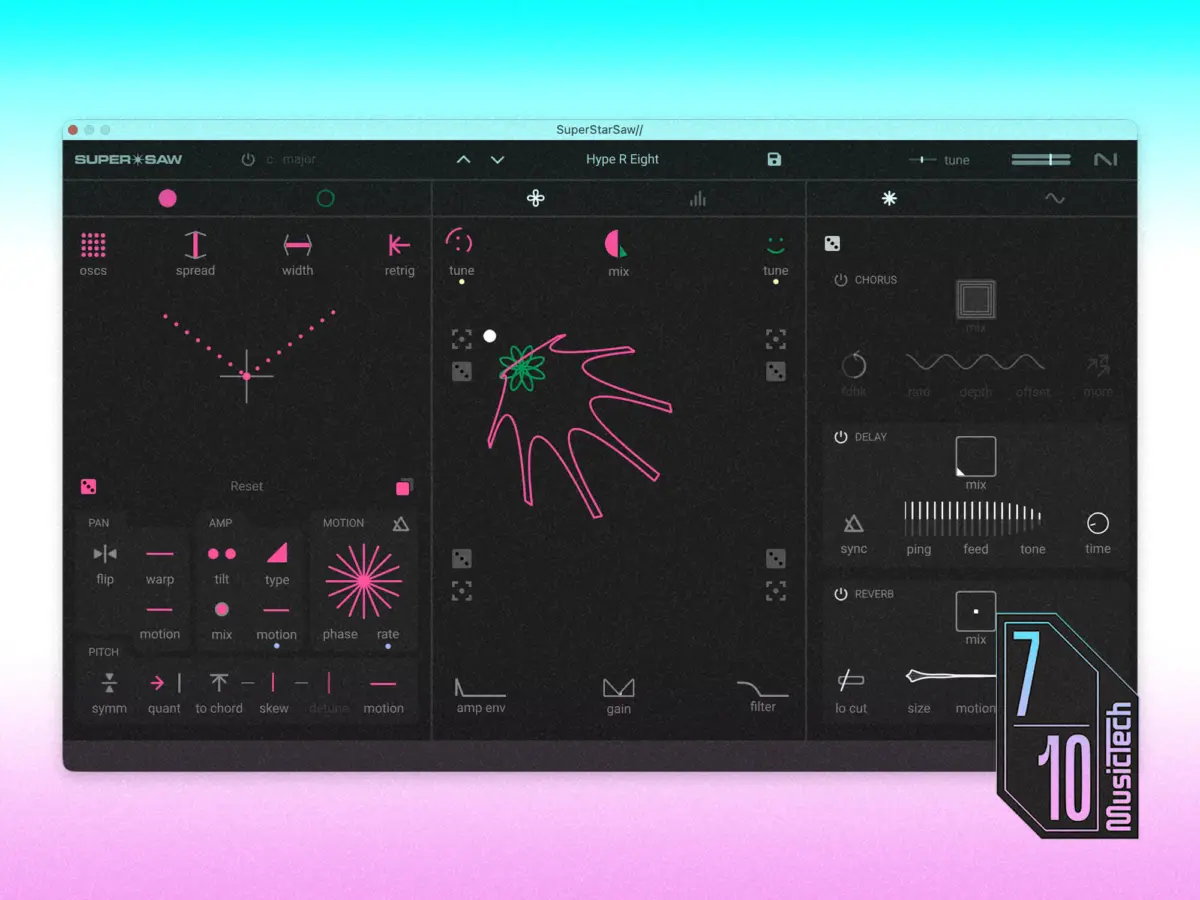
Before emitting a single frequency, SuperStarSaw makes a distinct visual statement. Borrowing the vibrant pink-and-green geometric design language from Cook’s Britpop album campaign, the plugin utilizes a clean, single-page interface.
At the center of the workspace sits a floral Morpher, which immediately draws the eye and encourages hands-on experimentation. However, hardware ergonomic choices are not without criticism; critical components like the amplitude envelope and filter sections are presented in a footprint that feels somewhat cramped. A fully resizable graphical user interface would vastly improve the long-term usability of the instrument.

Presets and Cinematic Range
Navigating through the instrument’s 235 built-in presets reveals a surprising degree of versatility. The library successfully encapsulates signatures of Cook’s eclectic discography—ranging from glassy glissando keys and dense, cascading plucks to aggressively pitch-enveloped percussive stabs.
Interestingly, the plugin also excels in cinematic sound design. This pivot aligns with Cook’s recent expansion into film scoring, including his work on the mockumentary The Moment, starring Charli XCX. Unlike vintage-obsessed retro-wave scoring tools inspired by Drive or Blade Runner 2049, SuperStarSaw leans heavily into a future-facing ethos. Patches range from intimate, fragile ambient timbres to crushing, high-velocity sci-fi soundscapes.
Under the Hood: The 32-Oscillator Swarm Architecture
In traditional synthesis, a supersaw combines multiple detuned saw waves to create a thick, warm, and drifting ensemble effect. SuperStarSaw reinterprets this concept by deploying two independent "swarms" of 16 oscillators each, totaling 32 voices of unmitigated sonic power per note.
Initializing a blank patch begins with the fundamental control: Spread. This parameter dictates the range of detuning applied across the oscillator bank. Parameter management is compartmentalized by function, separating stereo panning controls from individual amplitude balances.
While the exact mathematical result of tweaking these dense controls is not always immediately obvious by ear, the interface provides robust visual feedback. A real-time graphic display maps the oscillators’ distribution around the root note, while helpful tooltips along the bottom margin ease the learning curve for intermediate producers.

For users seeking instant results, the onboard Randomizer offers a shortcut, though its hit-and-miss nature can yield unpredictable results. Many randomized states are unharmonious or nearly inaudible until heavily processed. A system allowing users to lock specific parameters or constrain random ranges would streamline this process significantly.
The Harmony Engine: Taming the Chaos
Because stacking dozens of detuned oscillators can quickly devolve into a cacophonous wall of noise, Native Instruments integrated a powerful harmony engine to maintain musicality.
At its core, this engine filters incoming MIDI data according to a vast library of scales. Standard major and minor keys sit alongside exotic modal choices, including Super Locrian, Dorian #4, and the traditional Japanese Hirajoshi scale.
Activating pitch quantization within the oscillator swarm unlocks the true depth of the engine. Individual oscillators are forcefully reined into the confines of the chosen scale, generating tense, complex tone clusters as the Spread parameter increases. Producers can also apply pitch quantization via specific chord shapes, turning a single monophonic input into a harmonically rich, rhythmically pulsating texture.
Morphing and Motion
A. G. Cook has frequently described his production philosophy as a deliberate play between "extreme contrast, minimalism, [and] maximalism." SuperStarSaw translates this philosophy into hardware-style tactile control via its central X/Y Morpher.

By assigning unique parameter snapshots to each of the four corners of the grid, users can smoothly or abruptly transition between vastly different timbres. Morphing a delicate, five-note chord into an abrasive, chaotic breakdown before letting it reassemble into an airy, fluttering pad takes mere seconds—a process that would normally require tedious automation lanes across dozens of individual plugin parameters.
Additional movement can be injected via onboard LFOs and two assignable ADSR envelopes. Notably, however, the Morpher itself lacks an internal path recorder or dedicated LFO modulation source, meaning users must manually draw automation within their digital audio workstation (DAW) to keep the crosshairs drifting across the grid autonomously.
Supporting Context & Metrics
- Plugin Architecture: Dual 16-oscillator swarms (32 oscillators total per voice).
- Preset Library: 235 factory presets spanning hyperpop, ambient, and cinematic scoring.
- Scale Engine: Includes major, minor, modal variations (Super Locrian, Dorian #4), and traditional ethnic tunings (Hirajoshi).
- Modulation Sources: 1x X/Y Morpher, 2x ADSR envelopes, assignable LFOs, and swarm-level motion controls.
- Pricing & Compatibility: Available via Native Instruments for an MSRP of £90, requiring a compatible DAW environment.
Official Statements and Industry Reception
Industry analysts and beta testers have noted that SuperStarSaw occupies a very specific niche in the current software market. Unlike general-purpose flagship synthesizers—such as Xfer Records Serum 2 or Arturia Pigments—SuperStarSaw does not aim to teach or execute standard subtractive synthesis workflows.
Representatives from Native Instruments have positioned the instrument as a creative catalyst rather than a workhorse tool. By imposing strict architectural parameters, the plugin intentionally forces sound designers out of their comfort zones.
Early reviews from the electronic music community emphasize that while the learning curve can be steep—and the risk of a homogenous "default" sound is present for those who rely entirely on unedited presets—the instrument rewards patience. Producers who invest time into exploring its harmonic quantization and morphing capabilities frequently find themselves building entire tracks around a single, striking patch generated in under five minutes.

Future Outlook
The release of SuperStarSaw signals a broader industry trend toward hyper-specialized, artist-driven software instruments. As music production software matures, developers are increasingly moving away from "do-it-all" plugins in favor of focused ecosystems that capture the distinct workflow and aesthetic identity of contemporary hitmakers.
For A. G. Cook and Native Instruments, this collaboration proves that the decades-old saw wave still holds untapped potential. While SuperStarSaw is unlikely to replace a producer’s primary wavetable synth, it successfully bridges the gap between chaotic avant-garde sound design and accessible pop production.
As electronic music continues to favor emotional extremes and high-definition sonic textures, specialized tools like SuperStarSaw point the way forward. They demonstrate that artificial limitations, when paired with thoughtful interface design, can serve as one of the most powerful engines for genuine creative discovery.