As the cultural landscape of the United Kingdom prepares for its late-summer artistic highlights, the prestigious Vache Baroque festival is gearing up for its most ambitious undertaking to date. From August 29 through September 6, 2026, the historic estate of The Vache in Chalfont St Giles will serve as the enchanted, metaphorical island for a brand-new, immersive production of William Shakespeare’s The Tempest.
Rather than relying on a standard theatrical staging or a conventional operatic adaptation, this production draws its inspiration from the 1674 Restoration-era spectacular originally produced by Thomas Betterton. Known in the 17th century as a "dramatic opera" and recognized today as a pioneering "semi-opera," this hybrid artistic form seamlessly fuses spoken text, elaborate choreography, traditional folk elements, and Baroque masterworks.
The production brings together a formidable roster of vocal talent—including Stephanie Hershaw, Isabelle Peters, Camilla Seale, Conor Prendiville, and Ross Cumming—alongside the dynamic actors of the physical theatre company Out of Chaos. Under the joint creative direction of stage director Paul O’Mahoney and musical director Jonathan Darbourne, who leads the period-instrument Vache Baroque Band, the staging promises to break traditional boundaries between actors and singers.
At the heart of this collaborative maelstrom is mezzo-soprano Camilla Seale, who steps into the role of Stephano. In an exclusive interview, Seale sheds light on the intricacies of the rehearsal process, the evolving nature of Baroque performance practice, and how staging an open-air production by a lakeside breathes new life into Shakespeare’s final, profoundly philosophical masterpiece.
Detailed Chronology: From Restoration Splendor to Modern Revival
To fully appreciate the scope of Vache Baroque’s 2026 festival, one must look backward through the centuries to examine the unique theatrical lineage of the semi-opera.
The 1674 Restoration Milestone
When Thomas Betterton and his contemporaries revived Shakespeare’s The Tempest at the Dorset Garden Theatre in London in 1674, they did not merely perform the text as written. Influenced by continental European tastes, the production incorporated lavish stage machinery, flying effects, transformative scenery, and substantial musical interpolations.
The musical landscape of this 1674 version was a collaborative tapestry crafted by some of the finest composers of the English Baroque, most notably Henry Purcell, Matthew Locke, and Pelham Humfrey. In these 17th-century productions, music was not decorative; it was functional, serving as the literal sonic manifestation of the magical forces governing Prospero’s island.

The 2026 Reimagining at The Vache
Vache Baroque’s current production honors this historical hybridity while injecting fresh contemporary energy. The score retains the foundational works of Purcell, Locke, and Humfrey, but expands its sonic vocabulary to include European contemporaries of the period, authentic sea shanties, contemporary musical improvisations, and a fully realized masque by Purcell.
The rehearsal process, which began weeks prior to the August 29 opening night, has been characterized by intense cross-disciplinary pollination. By uniting the text-driven approaches of Out of Chaos’s actors with the vocal precision of classical singers and the rhythmic propulsion of the Vache Baroque Band, the creative team has constructed a fluid, organic ecosystem where boundaries between disciplines dissolve entirely.
CHRONOLOGICAL TIMELINE OF "THE TEMPEST" ADAPTATION:
===================================================
1611  : Shakespeare writes "The Tempest" as his final solo-authored play.
1674  : Thomas Betterton debuts the operatic/spectacle adaptation at Dorset Garden Theatre.
2025  : Camilla Seale performs in "Dido and Aeneas" at Longborough Festival Opera.
2026  : Vache Baroque announces its festival staging of the 1674 semi-opera version.
Aug 29: Opening night of Vache Baroque's "The Tempest" at The Vache, Chalfont St Giles.
Sep 6 : Final performance of the 2026 summer festival run.
Supporting Context & Metrics: Inside the Rehearsal Room with Camilla Seale
Mezzo-soprano Camilla Seale brings a wealth of specialized early music experience to her role as Stephano, having recently captivated audiences as Dido in Purcell’s Dido and Aeneas at the Longborough Festival Opera alongside Barokksolistene. Speaking on the collaborative dynamics of the current production, Seale offers profound insights into the creative friction and harmony between actors and singers.
Bridging Disciplines: Actors Versus Singers
"It’s such a pleasure to be in a room with open, curious performers from different creative backgrounds—from the actors, to the band, to the singers," Seale notes. While traditional operatic environments often silo vocalists away from physical theatre practitioners, this production deliberately breaks down those partitions.
"I can’t really say that any one person is only really of one discipline, and that’s how it should be," Seale explains. "The actors bring so much intelligence and authenticity, and I think the music brings them a different kind of emotional input that has definitely provided some surprises in rehearsal."
The 50:50 Balance of Word and Music
In a semi-opera, the division between spoken dialogue and sung composition must be carefully calibrated. For Seale, portraying Stephano does not feel like a compromise between two distinct art forms, but rather an organic continuum.
"The role definitely feels like it’s 50:50," she observes. "Even within the musical masque, Purcell as a composer has a very text-led musical imagination, so even for the instrumentalists, they are speaking and dancing rather than just playing beautiful musical lines. I don’t think though, even when singing pure opera, that I have ever let go of words and thoughts. Specifically in The Tempest, music has a clear role as magic on the island, so it fits like a glove here."

The Legacy of Experimental Collectives
Seale’s fearless approach to genre-bending performance is rooted in her past collaborations. As a co-creator and performer with the New Renaissance Collective—where she took part in an innovative adaptation of Shakespeare’s Venus & Adonis—she developed a resilience and playfulness that directly informs her work at The Vache.
"The time I spent with friends in research and development with New Renaissance Collective… allowed all of us to fearlessly and idiotically explore and create theatre in a way that I’ve surely held on to in every creative environment I’ve been in since," she reflects. "I can remember laughing so hard in some workshops that it hurt. I’ll be forever grateful for those experiences."
Official Statements & Production Logistics
Setting the Scene: Nature as Co-Creator
The choice of venue is far from incidental. Staged outdoors by the lake on the historic grounds of The Vache, the production uses its natural environment as an active participant in the storytelling.
"Shakespeare loves a metatheatrical reference," Seale points out, quoting Prospero’s famous lines: ‘Be cheerful, sir. Our revels now are ended. These our actors, As I foretold you, were all spirits and Are melted into air […] And—like the baseless fabric of this vision […] shall dissolve.’
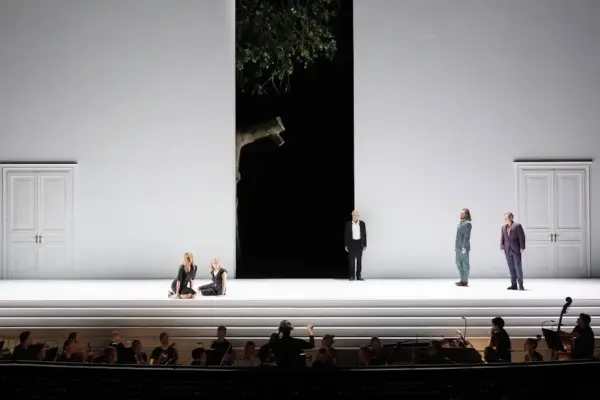
The staging has been meticulously engineered to harness this thematic resonance. The open-air design allows audiences to gaze across the lake and surrounding trees directly through the back of the stage. As characters stumble across the island in the afternoon light, the transition into the second half sees the performance tent gorgeously illuminated against the backdrop of the twilight sky.
Festival Details and Performance Schedule
Vache Baroque’s The Tempest represents a landmark cultural event for the South East of England, merging world-class historical performance practice with contemporary environmental theatre.
- Venue: The Vache, Chalfont St Giles, Buckinghamshire
- Opening Performance: Saturday, August 29, 2026
- Subsequent Dates: August 30, September 5, and September 6, 2026
- Key Creative Personnel:
- Director (Theatre): Paul O’Mahoney (Out of Chaos)
- Director (Music): Jonathan Darbourne (Vache Baroque Band)
- Cast: Stephanie Hershaw, Isabelle Peters, Camilla Seale, Conor Prendiville, Ross Cumming
Tickets and comprehensive visitor information are available directly through the official Vache Baroque Website.

Future Outlook: The Evolution of Baroque Performance Practice
The success of productions like Vache Baroque’s The Tempest points toward a broader, highly encouraging trend in contemporary classical music: the democratization and reinvention of early music repertoire.
For too long, classical performance practices were viewed through an ultra-conservative lens, prioritizing academic reconstruction over visceral emotional connection. However, ensembles like Barokksolistene and Vache Baroque are demonstrating that Baroque music—by its very genesis as a kinetic, dance-based, community-focused art form—invites reinvention, improvisation, and cross-genre fertilization.
Why Baroque Music Resonates Today
As Camilla Seale notes, the inherent "grooviness" of Baroque repertoire creates an immediate, tactile connection with modern audiences that is distinct from later classical eras. By stripping away the velvet-rope formality traditionally associated with opera and relocating it to festival grounds, lakeside tents, and community-driven spaces, organizations like Vache Baroque are securing a vibrant future for 17th-century masterworks.
Furthermore, Shakespeare’s final meditation on mortality, reconciliation, and artistic legacy finds a resonant home in these multidisciplinary experiments. As the last notes of Purcell’s masque fade across the waters of The Vache this September, audiences will not merely be witnessing a historical museum piece; they will be participating in a living, breathing theatrical alchemy that bridges four centuries of human creativity.