By 1993, the sonic landscape of European nightlife had undergone a profound and high-octane transformation. Dancefloors from Frankfurt to Ibiza were gripped by a relentless, high-energy phenomenon known simply as Eurodance—a synthesized hybrid genre that fused the lush, sweeping arpeggios of Italo-disco, the driving, mechanical pacing of Belgian New Beat, and the skeletal, industrial drum arrangements of Detroit techno. At the epicenter of this continental cultural movement sat the Captain Hollywood Project, helmed by New Jersey-born visionary Tony Dawson-Harrison.
Their 1992 breakout hit, "More and More," taken from the debut album Love Is Not Sex, remains an absolute masterclass in commercial electronic music composition. The track achieved a rare alchemy: it successfully pitted Harrison’s gritty, urgent rap verses against Nina Gerhard’s soaring, soulful vocal hooks, underpinned by a heavy-hitting production collaboration with German powerhouses DMP and Cyborg.
Today, as contemporary club culture experiences a widespread resurgence of "neo-trance" and ’90s-inspired throwbacks that capture that exact post-Wall Berlin energy, producers are looking backward to move forward. Rather than drafting a cookie-cutter copy of a bygone era, this feature deconstructs the foundational rhythmic blueprint of "More and More." We will explore how to build a modern, high-energy Eurodance beat from the ground up using Ableton Live, examining everything from foundational kick drums and off-beat hi-hats to surgical master bus processing.
Detailed Chronology: From Barracks Breakdancing to Continental Domination
The genesis of the Captain Hollywood Project cannot be understood without examining the eclectic career of its creator. Tony Dawson-Harrison was a U.S. soldier stationed in West Germany during the vibrant, politically charged 1980s—an era when the geopolitical friction of a divided Berlin provided the ultimate backdrop for electronic music innovation.
Harrison earned his moniker not in a recording studio, but on the concrete floors of military barracks, where he honed his craft as a competitive breakdancer. He quickly parlayed this underground street-cred into a high-level choreography career, eventually mentoring pop icons like Paula Abdul and Eurodance pioneer DJ BoBo.
The Birth of "Crew Lock"
Harrison’s signature performance style, known as "Crew Lock," was a calculated, strategic synthesis of styles:
Military Precision: The rigid, unforgiving counts and spatial awareness of military drill routines.
Street-Level Popping and Locking: Fluid, isolated muscle contractions mapped precisely to the transient peaks of electronic beats.
This disciplined visual and physical aesthetic swiftly became the visual blueprint for the entire Eurodance stage. When Harrison transitioned from choreography to full-time music production, he brought this exact rhythmic discipline with him. The tracks weren’t just meant to be heard; they were engineered to dictate physical movement down to the millisecond.
By the time "More and More" dominated European charts in late 1992 and early 1993, it stood as a monument to cross-cultural collaboration. While Harrison provided the American hip-hop cadence and physical charisma, German production teams DMP and Cyborg injected the trademark continental melodic sheen and speaker-shredding transient weight.
Supporting Context & Metrics: Anatomy of a Eurodance Rhythm Section
To recreate the driving, infectious momentum of 1992 Eurodance for modern club systems, a producer must understand how each element occupies both the frequency spectrum and the stereo field. Below is the step-by-step technical breakdown of how to construct a neo-Eurodance rhythm section from scratch.
Step 1: The Foundation Kick
Every powerful dance track begins with a robust low-end anchor.
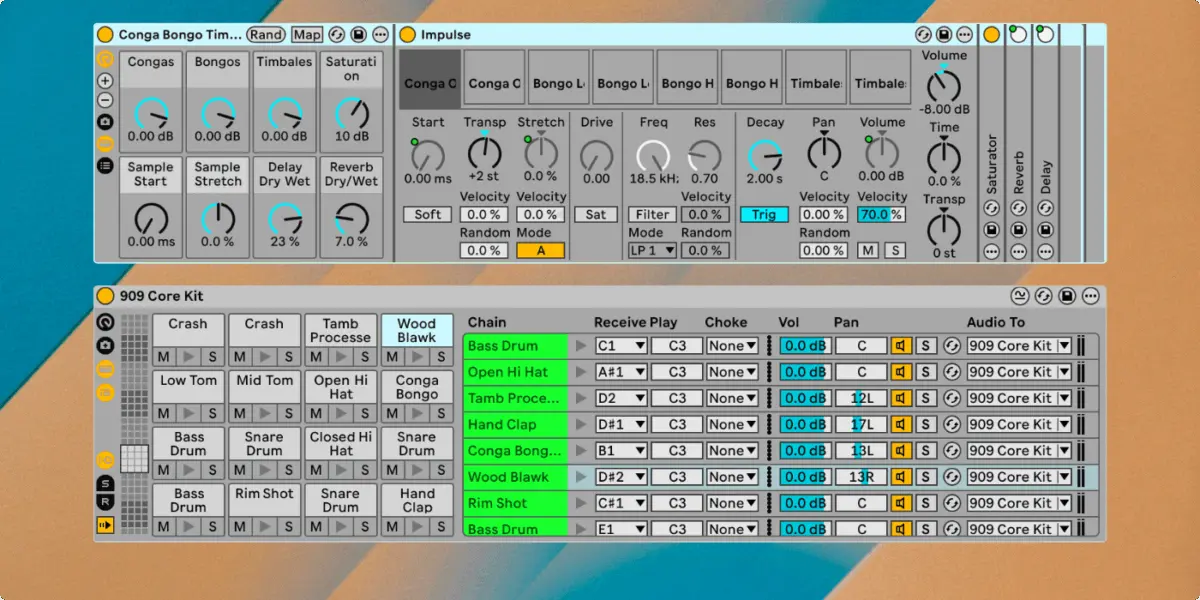
Routing & Setup: Create a new MIDI track in your DAW and load the ’909 Core Kit’ Drum Rack. Set the channel’s Track Volume to -6.0 dB as a golden rule of thumb for headroom management. Ensure your main output reads around -3.0 dB, leaving at least -6.0 dB of headroom if you are routing directly into a mastering chain.
Programming: Insert an empty MIDI clip and program a driving, four-to-the-floor pattern on the Bass Drum pad.
Sound Design & Processing: Tune the kick to 127 to tighten up the characteristic 909 Eurodance thump, allowing it to slice cleanly through a dense mix. Lower the volume of the individual pad to -10.0 dB. Right-click the Release parameter, select "unmap from decay," and dial it in precisely to 173ms to shorten the tail and prevent low-end mud. Finally, insert an EQ Eight to carve out conflicting sub-frequencies.
Step 2: Off-Beat Hi-Hats and Rolling Tambourines
Eurodance relies heavily on rhythmic propulsion between the kicks—the classic uplifting "oonce-oonce" cadence.
Open Hi-Hat: Program your MIDI pattern for an off-beat hi-hat on steps 3, 7, 11, and 15 across a four-bar loop. Shorten the sample tail to achieve that crisp, biting ’90s characteristic, and set the volume to -10.0 dB.
Rolling Sleigh Bells / Tambourine: To establish continuous forward motion, navigate to your Ride pad and load a processed tambourine sample (e.g., Tamb Processed 2.wav). Program a hit on every single step to create a seamless, galloping percussion roll. Pan this track 12L to widen the stereo image and make room for central elements.
Step 3: The Warehouse Hand Clap
A dry clap will sound lifeless in a high-energy dance track; it needs space, weight, and grit.
Placement & Panning: On your 909 Hand Clap pad, program beats precisely onto the 5th and 13th steps. Pan the channel volume 17L for an off-center, organic feel.
Spatial Processing: Insert a convolution or algorithmic reverb (such as Corridor.adv). Adjust the Stereo Width to 120% and the Dry/Wet mix to 71% to impart a wide, sonically gritty warehouse character.
Step 4: Syncopated Congas and Metallic Wood Blocks
To break up the rigid four-to-the-floor monotony and add an infectious bounce, introduce world percussion elements.
Conga Counterweight: Place a Conga Bongo Timbales.adg rack onto your Hi Tom pad. Copy a syncopated MIDI pattern that plays against the kick drum. Turn the Delay Dry/Wet down to 0%, transpose the pitch +2 semitones, and pan the track 13L.
Metallic Wood Block: Load Wood Blawk.wav onto your Ride pad. Transpose it +5 semitones, drop the volume to -14.0 dB, and pan it 13R. Add a damped plate reverb (Plate Damped.adv) alongside an EQ Eight to strip away muddy low-mids, transforming a standard tropical rhythm into a cold, metallic European industrial pulse.
Official Producer Insights & Mixing Guidelines
When working on dense, high-tempo electronic arrangements, ear fatigue is the producer’s silent enemy. Maintaining objectivity across long mixing sessions requires strict workflow discipline.
Top Production Tip:To prevent listening fatigue and maintain sharp creative focus, set hard break timers. If frequency bands begin to blur together in your monitors, step away from the desk—sometimes sleeping on a mix overnight (or even leaving it for a few days to breathe) is the only way to regain objective perspective.
Step 5: Master Bus Processing & Signal Security
To glue your rhythm section together and impart commercial loudness without destroying transients, a multi-stage master processing chain is required.
Saturation & Drive: Start with an aggregate processing device like Master Dance Aggressive.adg to glue the mix elements.
Multiband Compression: Insert a multiband compressor to target and balance frequency bands independently. Set the High Input to +2.00 dB, Mid Input to +3.00 dB, and Low Input to +4.00 dB. Pull the overall Amount back to 70% to maintain dynamic range.
Glue Compression: Apply subtle glue compression (Glue Compressor) using these parameters: Attack: 0.3ms, Ratio: 10, Threshold: -14.0 dB, Makeup Gain: +6.00 dB, and Dry/Wet Mix: 46%.
Limiting: Finish with a Lookahead limiter (Lookahead.adv) as a safety guard against rogue inter-sample peaks. Set the Lookahead time to 3ms for ultra-fast transient catch behavior.
Mastering Warning:Always leave sufficient headroom in your mix to prevent digital clipping. While intentional distortion can work for noise shows, it will quickly melt a clean Eurodance mix. Whether you are mixing in the studio or streaming a live PA set, keep your meters safely in the green, occasionally touching yellow at most. No artificial intelligence or mastering plugin can salvage a track that has been severely clipped at the mixing stage.
Future Outlook: The Enduring Legacy of ’90s Soundscapes
As modern dance music continues to cycle through historical touchpoints, the influence of early ’90s Eurodance extends far beyond nostalgic club nights. Producers operating at the intersection of modern techno, neo-trance, and hard dance are discovering that the genre’s underlying structural rules—tight transients, wide percussive panning, uncompromised low-end mono compatibility, and an aggressive, physical groove—provide a foolproof formula for floor-filling energy.
By taking apart the machinery behind tracks like Captain Hollywood Project’s "More and More," modern electronic musicians gain a vital technical toolkit. It is a reminder that timeless club music is built not on over-complication, but on the precise, mechanical interplay of rhythm, space, and disciplined dynamic control.