Executive Overview
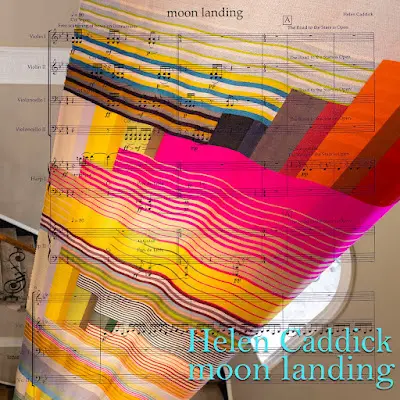
At the intersection of contemporary soundscape composition and master-class textile artistry lies moon landing, a groundbreaking, immersive cross-genre installation that bridges two seemingly disparate worlds. Initially unveiled to critical acclaim at Collect 2024 hosted within London’s prestigious Somerset House, the collaborative masterpiece by composer Helen Caddick and textile artist Margo Selby has since found a renewed home at the renowned Saatchi Gallery. Featured as a centerpiece of the expansive thematic exhibition The Sun and Moon – Art inspired by the Celestial—which runs through September 8—the work transcends traditional disciplinary boundaries, offering viewers a profound sensory and intellectual experience.
At its core, moon landing is much more than an aesthetic convergence of woven thread and acoustic resonance. It serves as a vital historical reclamation project. Caddick and Selby’s collaborative vision is anchored in a lesser-known, yet revolutionary, chapter of space-race history: the indispensable labor of Navajo weavers and female factory workers at the Raytheon plant. These women meticulously wove the copper-wire memory cores and integrated circuits for the Apollo 11 guidance computer—the very technology that safely guided humanity to the lunar surface in July 1969.
By fusing a specialized chamber music composition for dual harps, cellos, and violins with a monumental, highly complex woven textile structure, the artists have engineered an environmental piece that honors industrial craftsmanship, mathematical precision, and feminist history. This article explores the genesis of this cross-genre marvel, the intricate technical methodologies employed by Caddick and Selby, the historical scaffolding of the Apollo mission’s female workforce, and the broader implications of art inspired by celestial phenomena in the twenty-first century.
Detailed Chronology: From Concept to Gallery Space
The Genesis of a Cross-Disciplinary Dialogue
The artistic partnership between Helen Caddick and Margo Selby did not materialize overnight. It was born from a mutual, long-standing fascination with the structural analogies linking musical composition to textile production. Both disciplines rely heavily on grids, repeating patterns, rhythm, pitch, and algorithmic sequences. Mathematics and science served as the universal languages that catalyzed their initial conversations, evolving quickly from theoretical musings into a concrete desire to collaborate.
Selby, renowned internationally for her ability to push the boundaries of Jacquard weaving by treating yarn with the spatial awareness of an architect, found a kindred spirit in Caddick. Caddick approaches contemporary classical composition with a structural rigor that mirrors the warp and woof of a loom. Together, they sought to create a piece where sound and fabric would not merely occupy the same room, but actively converse with one another, creating an immersive feedback loop of sensory stimuli.
The Debut at Collect 2024 (Somerset House)
The fruition of this creative dialogue premiered at Collect 2024, the leading international fair for modern craft and design, held at London’s historic Somerset House. Placed within this bustling hub of contemporary making, moon landing immediately drew attention for its ability to stop visitors in their tracks.
The installation did not present music as a passive background soundtrack, nor did it present the textile merely as a static visual backdrop. Instead, the installation envelops the audience. The acoustic frequencies of Caddick’s score—scored specifically for an ensemble of two harps, two cellos, and two violins—were designed to resonate physically within the gallery space, vibrating against and alongside Selby’s massive, intricately patterned textile piece. The presentation at Somerset House established the work as a triumph of contemporary collaboration, proving that cross-genre art could carry immense narrative weight.
The Saatchi Gallery Exhibition: The Sun and Moon
Building upon its initial momentum, moon landing was selected for inclusion in The Sun and Moon – Art inspired by the Celestial at the Saatchi Gallery. This expansive exhibition explores humanity’s eternal obsession with celestial bodies, charting how artists throughout history have interpreted the sun, moon, and cosmos.
Running through September 8, the exhibition at Saatchi Gallery has provided moon landing with a broader platform, contextualizing it alongside other contemporary works dealing with astronomy and spatial philosophy. Here, the installation takes on an almost artifactual weight. Visitors stepping into the gallery are invited to stand before Selby’s textile creation while bathed in Caddick’s ethereal acoustic arrangement, bridging the gap between ancient celestial wonder and modern technological triumph.
Supporting Context & Metrics: Unweaving the Apollo 11 Narrative
To fully appreciate the emotional and conceptual heft of moon landing, one must examine the historical reality that inspired it. The narrative of the 1969 Apollo 11 moon landing is typically dominated by male astronauts—Neil Armstrong, Buzz Aldrin, and Michael Collins—alongside the legion of engineers at NASA mission control. However, the hardware that made the mission possible relied on a manufacturing process so delicate and complex that it could only be executed by hand.
The Navajo Weavers and the Raytheon Workforce
The core of the Apollo Guidance Computer (AGC)—specifically its rope memory—was famously known as "LOL memory," an acronym for "Little Old Ladies memory." This moniker, while affectionate in its era, masked the profound industrial skill and labor-intensive precision required to construct the computer’s read-only memory.
At the Raytheon plant in Waltham, Massachusetts, teams of women threaded copper wires through magnetic ring cores. A wire threaded through a core represented a binary "1"; a wire routed around the core represented a "0." Because a single misplaced wire could lead to catastrophic navigational errors during spaceflight, the work demanded faultless concentration. Many of these women were recruited from Native American communities, particularly Navajo women whose traditional weaving backgrounds had already equipped them with an extraordinary spatial awareness, fine motor skills, and an intimate understanding of complex grid systems and tension management.
| Parameter | Historical Detail / Technical Specification |
|---|---|
| Mission | Apollo 11 (July 1969) – First crewed lunar landing |
| Critical Hardware | Apollo Guidance Computer (AGC) – Rope Memory / Core Rope Memory |
| Labor Force | Predominantly female manufacturing workers (Raytheon plant), including Navajo weavers |
| Manufacturing Method | Hand-threaded copper wires through tiny magnetic ring cores |
| Consequence of Error | Potential navigational failure; absolute precision required |
| Artistic Translation | moon landing by Helen Caddick and Margo Selby |
Helen Caddick’s primary motivation in conceiving moon landing was to pull these women out of the shadows of historical footnotes and thrust them into the center of public consciousness. By linking the rhythmic, repetitive mechanical actions of the loom to the meticulous threading of the AGC memory cores, the installation honors the invisible labor that laid the groundwork for human space exploration.
The Anatomy of the Artwork: Sound and Structure
Margo Selby’s Textile Mastery
Margo Selby’s contribution to moon landing is a masterclass in contemporary textile design. Utilizing advanced digital Jacquard weaving techniques alongside traditional hand-craft principles, Selby constructs surfaces that manipulate light, shadow, and depth. In the context of moon landing, the textile acts as a visual map of orbits, circuits, and cosmic landscapes. The tension of the warp threads mirrors the structural rigidity of technological scaffolding, while the dynamic interplay of color and pattern evokes the shifting surfaces of the moon and the vastness of interstellar space.

Helen Caddick’s Acoustic Architecture
Helen Caddick’s musical composition is tailored specifically to amplify the themes of precision, rhythm, and spatial voyage. Written for an intimate yet potent ensemble of two harps, two cellos, and two violins, the score avoids lush, romantic excess in favor of a crystalline, textural minimalism.
- The Harps: Provide a shimmering, celestial backdrop, evoking both the twinkling of distant stars and the plucked precision of digital code.
- The Cellos: Anchor the piece with deep, resonant grounding, symbolizing the immense gravitational pull of celestial bodies and the heavy industrial labor of the factory floor.
- The Violins: Weave intricate, interwoven melodic lines that mimic the visual patterns of Selby’s textiles and the complex wiring diagrams of the Apollo guidance computer.
While the music is available globally for digital download via Bandcamp, both artists emphasize that the true power of moon landing is realized when the audio is experienced live within the physical footprint of Selby’s installation. The sound waves actively engage with the fabric, creating a synesthetic environment where sight and sound become indistinguishable.
Official Statements and Artistic Philosophy
Reflecting on the collaborative journey behind moon landing, both artists have articulated a shared desire to break down silos between fine art, craft, music, and historical storytelling.
"Margo Selby and Helen Caddick had long been fascinated about the crossovers between music and textiles, mathematics and science which sparked our initial conversations and desire to collaborate," notes the collaborative framework statement for the project.
This intersectional philosophy challenges the traditional art-world hierarchy that often separates "fine art" (painting, sculpture) from "craft" (weaving, textile design) and "applied performance" (musical composition). By placing a woven textile on equal footing with a contemporary classical chamber work, Caddick and Selby assert that material culture and auditory culture share a common root system.
Furthermore, Caddick has repeatedly emphasized the socio-political imperative behind the work:
"By creating moon landing, the goal is to bring the extraordinary story of the Navajo weavers and the Raytheon women to greater public consciousness. History has a habit of erasing the hands that built the machines; this installation is our way of giving them permanence."
Curatorial responses at both Somerset House and the Saatchi Gallery have echoed these sentiments, praising the installation for its ability to transform raw historical data and feminist critique into an emotionally resonant, visually stunning masterwork.
Future Outlook: The Legacy of moon landing
As The Sun and Moon – Art inspired by the Celestial exhibition at the Saatchi Gallery draws toward its September 8 conclusion, the long-term trajectory of moon landing points toward an influential legacy in contemporary interdisciplinary art.
Expanding the Cross-Genre Horizon
The success of Caddick and Selby’s collaboration demonstrates a growing appetite among audiences for works that defy categorization. In an era dominated by digital isolation and hyper-specialization, moon landing offers a masterclass in synthesis—proving that music, craft, history, and science can be woven into a singular, cohesive narrative.
Potential Future Exhibitions and Archival Life
Given the widespread critical acclaim garnered at both Collect 2024 and the Saatchi Gallery, discussions are reportedly underway regarding the future life of the installation. Cultural institutions dedicated to both contemporary craft and science-art integration have expressed interest in acquiring or hosting future iterations of the piece. Additionally, the availability of Caddick’s score on Bandcamp ensures that the auditory component of the project will continue to reach international audiences long after the physical exhibition closes.
A Blueprint for Feminist Historiography Through Art
Beyond its aesthetic and technical merits, moon landing establishes an important methodological blueprint for artists seeking to correct historical omissions. By utilizing tactile and sonic mediums to memorialize marginalized laborers, Caddick and Selby have proven that contemporary art can serve as a powerful vehicle for historical justice. The women who wove the Apollo 11 memory cores may have remained unsung for decades, but through the enduring resonance of strings and threads, their legacy is now permanently etched into the cultural firmament.
For further details, visitor information, and ticketing regarding the final days of the exhibition, visit the official Saatchi Gallery website. To experience Helen Caddick’s musical composition, visit the Helen Caddick Bandcamp page.