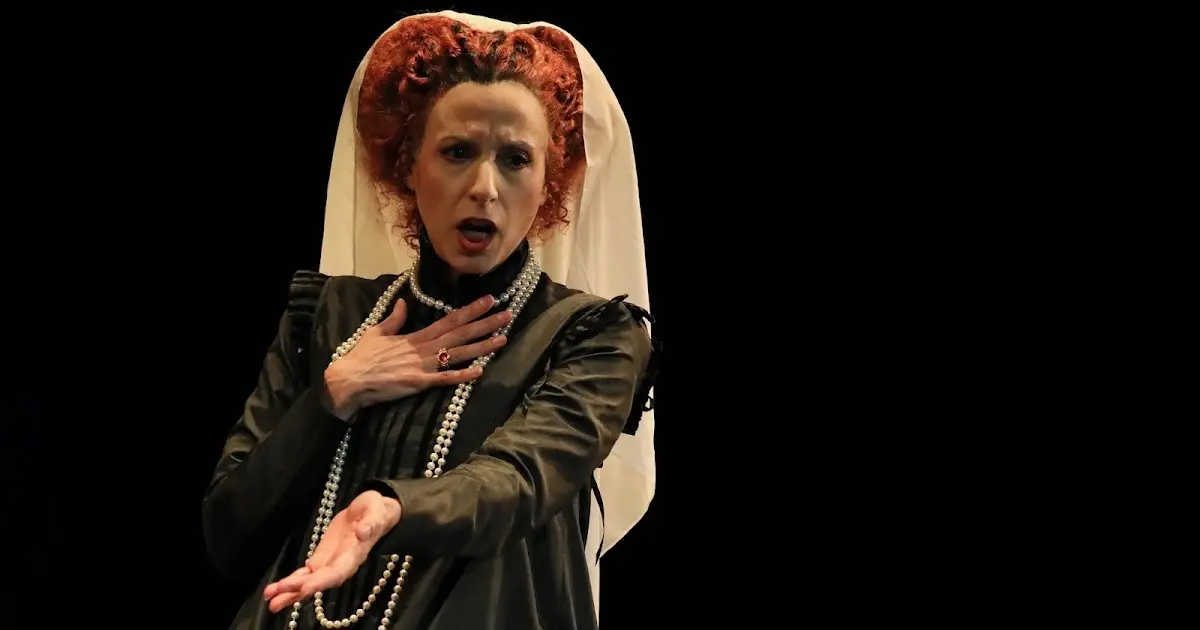
In the contemporary landscape of chamber opera, few composers match the prolific output and relentless creative curiosity of Louis Mander. On September 9, 2026, the venerable Cockpit Theatre hosted the eagerly anticipated world premiere of Mander’s fourteenth operatic work, Eight Days, staged as part of the acclaimed Tête à Tête: The Opera Festival. Produced by Cantata Dramatica, the chamber piece focuses intensely on the final, agonizing days of Mary, Queen of Scots. With a libretto crafted by Louisa Petaïr—who also delivers a commanding solo performance in the title role—Eight Days eschews grand historical spectacle in favor of an intimate, psychologically harrowing exploration of royal captivity, isolation, and inner turmoil.
Scored for a specialized chamber ensemble comprising a single violin, viola, cello, and double bass, the opera leverages a dark-toned, tonal harmonic palette. Mander’s orchestration artfully shapes Petaïr’s continuous lyric arioso, wrapping the tragic queen’s epistolary confessions in a rich, autumnal acoustic. Yet, despite the undeniable power of its atmospheric score and Petaïr’s compelling physical and dramatic incarnation, the production encountered notable hurdles—principally relating to vocal diction and the legibility of its text-driven narrative in the absence of surtitles. As the production prepares for a deeply resonant upcoming performance on September 19, 2026, at St Mary’s Church in Fotheringhay, Eight Days stands as a compelling case study in chamber opera’s capacity to distill sweeping historical tragedy into concentrated psychological drama.
Detailed Chronology and Production Anatomy
The genesis and realization of Eight Days trace a meticulous path through historical research, collaborative artistic development, and specialized performance execution. The production’s structural timeline unfolded across several distinct phases leading up to its Autumn 2026 premiere.
[Historical Archive & Letters] ➔ [Libretto Development by Petaïr] ➔ [Composition & Orchestration by Mander]
                                                                        │
[Upcoming: Fotheringhay Performance] ◄─ [World Premiere: Cockpit Theatre] ◄─ [Ensemble Rehearsals & Sound Design]
The Source Material: Archival Genesis
The narrative architecture of Eight Days is drawn directly from the historical documentary record—specifically, the surviving letters penned by Mary, Queen of Scots, during the twilight of her life. Librettist Louisa Petaïr synthesized these primary sources into a chronological structure divided into eight discrete scenes, each mapping to one of the final days leading to the monarch’s execution. Eschewing a conventional linear narrative of political plotting, the libretto isolates thematic psychological focal points:
- The Cat and Mouse Motif: A metaphorical reflection on Mary’s fraught, adversarial relationship with Queen Elizabeth I, highlighted through the Queen’s satirical embroidery.
- The Maternal Plea: An intimate prayer and testament directed toward her son, King James VI of Scotland.
- Matrimonial Reckoning: Analytical and emotional confrontations regarding her tumultuous marriages to Lord Darnley and the Earl of Bothwell.
- The Continental Appeal: A desperate final plea addressed to her brother-in-law, Henri, King of France (brother to her first husband, Francis II).
The Performance and Sound World
At the Cockpit Theatre, the performance relied on a synthesis of live execution and recorded soundscapes. Kieran Rayner contributed foundational work as a voice actor, dramaturg, and sound designer, weaving spoken-word recordings of Mary’s letters into the acoustic fabric of the production. This juxtaposition of live singing, spoken delivery, and pre-recorded epistolary readings established a fractured, memory-driven atmosphere.
Louis Mander conducted the instrumental ensemble from the score, directing a string quartet devoid of upper-register brilliance. The inclusion of just a single violin balanced against a cello and double bass ensured that the music rarely soared above Petaïr’s mezzo-soprano register. Instead, the instrumental framing hugged the lower frequencies, evoking the austere, reedy textures of an Elizabethan consort of viols while integrating fluid, folk-inflected melodic fragments that hinted at period aesthetics without descending into pastiche.

Supporting Context & Metrics
To fully appreciate the weight of Eight Days within the broader operatic ecosystem, it is necessary to examine both its art-historical lineage and the quantifiable parameters of its staging and production credits.
Thematic and Musical Metrics
| Production Parameter | Specification |
|---|---|
| Composer & Conductor | Louis Mander |
| Librettist, Producer, & Lead | Louisa Petaïr (as Mary, Queen of Scots) |
| Operatic Milestone | Mander’s 14th completed operatic work |
| Premiere Venue | The Cockpit Theatre, London |
| Festival Context | Tête à Tête: The Opera Festival |
| Ensemble Instrumentation | Violin, Viola, Cello, Double Bass (Cantata Dramatica ensemble) |
| Sound Design & Dramaturgy | Kieran Rayner |
| Costume Design | Natalia Zinkevych (Fiorentina Costuming) |
| Wig Design | Brandon Marchant |
| Make-up Consultant | Sara Sorrenti |
Contextualizing the Chamber Aesthetic
Mander’s career has long demonstrated an affinity for chamber-scale narrative works. His 2016 operetta The Dowager’s Oyster, presented at Grimeborn, similarly showcased his ability to compress social tension and psychological intrigue into tight instrumental parameters. In Eight Days, this economy of scale is pushed further. By stripping the orchestral apparatus down to four string instruments, the composer forces the audience’s attention onto the micro-dynamics of breath, intonation, and textual delivery.
However, this instrumental minimalism introduced distinct artistic challenges. Music critics and audience members alike noted that the absence of surtitles placed an immense burden on Petaïr’s vocal diction. Because the work is fundamentally text-driven—relying on the precise wording of historical letters to convey narrative progression—obscured syllables occasionally threatened to detach the emotional delivery from its historical moorings. When Mander deliberately thinned the instrumental textures, the text achieved crystalline clarity, illuminating the dramatic heights the work was capable of reaching when words and music achieved absolute equilibrium.
Official Statements and Artistic Perspectives
The collaborative ethos behind Eight Days reflects a shared commitment among its creators to reinterpret historical iconography through deeply human, subjective lenses. While formal press conferences were minimal, production notes and program statements from Cantata Dramatica and the principal creators shed light on their artistic intentions.
Louis Mander has frequently emphasized the malleability of chamber forces in contemporary vocal writing. In statements accompanying the production, the composer noted his desire to create a sonic environment that feels "archival yet immediate"—avoiding the traps of cinematic historical pastiche in favor of a stark, internal landscape. By denying the violin its traditional soaring register, Mander deliberately cultivated a claustrophobic, earthbound acoustic that mirrors the literal and metaphorical imprisonment of the Scottish queen.
Louisa Petaïr, approaching the dual role of librettist and performer, focused on reclaiming Mary Stuart from centuries of polarized historical myth-making. Rather than engaging directly with the tangled web of Catholic conspiracies and Elizabethan espionage—which are touched upon strictly as external pressures—Petaïr’s libretto positions Mary as a psychological refugee. In rehearsal notes provided by the production team, Petaïr stressed that the character’s primary agency lies in her desperate retention of dignity through the written word. Every letter becomes an act of psychological self-preservation, transforming the stage into a theater of memory where the queen argues not merely with her jailers, but with her own legacy.

Future Outlook and Upcoming Performances
Following its successful world premiere at the Cockpit Theatre, 2026 continues to be a landmark year for Eight Days, with strategic touring dates designed to maximize the site-specific resonance of the work.
The Fotheringhay Pilgrimage
The most anticipated upcoming milestone for the production is scheduled for September 19, 2026, at St Mary’s Church in Fotheringhay. This venue choice elevates the performance from a standard theatrical run to a profound historical pilgrimage. St Mary’s Church stands immediately adjacent to the site of Fotheringhay Castle—the very location where Mary, Queen of Scots, spent her final night on earth before facing the executioner’s block in February 1587.
┌────────────────────────────────────────────────────────┐
│             UPCOMING PERFORMANCE HIGHLIGHT             │
├────────────────────────────────────────────────────────┤
│ Date: September 19, 2026                               │
│ Venue: St Mary’s Church, Fotheringhay                  │
│ Significance: Final night quarters of Mary Stuart,     │
│ situated directly adjacent to Fotheringhay Castle site. │
└────────────────────────────────────────────────────────┘
Performing Eight Days within the sacred, stone-carved acoustics of St Mary’s Church promises to cast Mander’s dark-toned chamber score and Petaïr’s intense monodrama in an entirely new light. In such a historic setting, the spatial and historical convergence between the art and the actual topography of the tragedy may well mitigate earlier criticisms regarding text legibility, enveloping the audience in an immersive memorial tribute.
Long-Term Legacy and Artistic Growth
As Louis Mander advances his prolific career—now standing firmly past his fourteenth operatic milestone—Eight Days signals a maturation in his approach to historical drama. The production highlights the viability of micro-ensemble opera in intimate spaces, proving that vast historical narratives do not require mammoth orchestras to achieve emotional resonance.
For Cantata Dramatica and the creative team behind the project, the lessons learned from the Cockpit Theatre premiere—particularly concerning acoustic balance and textual projection—will undoubtedly inform future stagings. As the production travels to Fotheringhay and beyond, Eight Days remains a striking testament to the power of collaborative chamber opera, reminding contemporary audiences that history is written not just by the victors, but in the echoing, unheeded letters of the defeated.