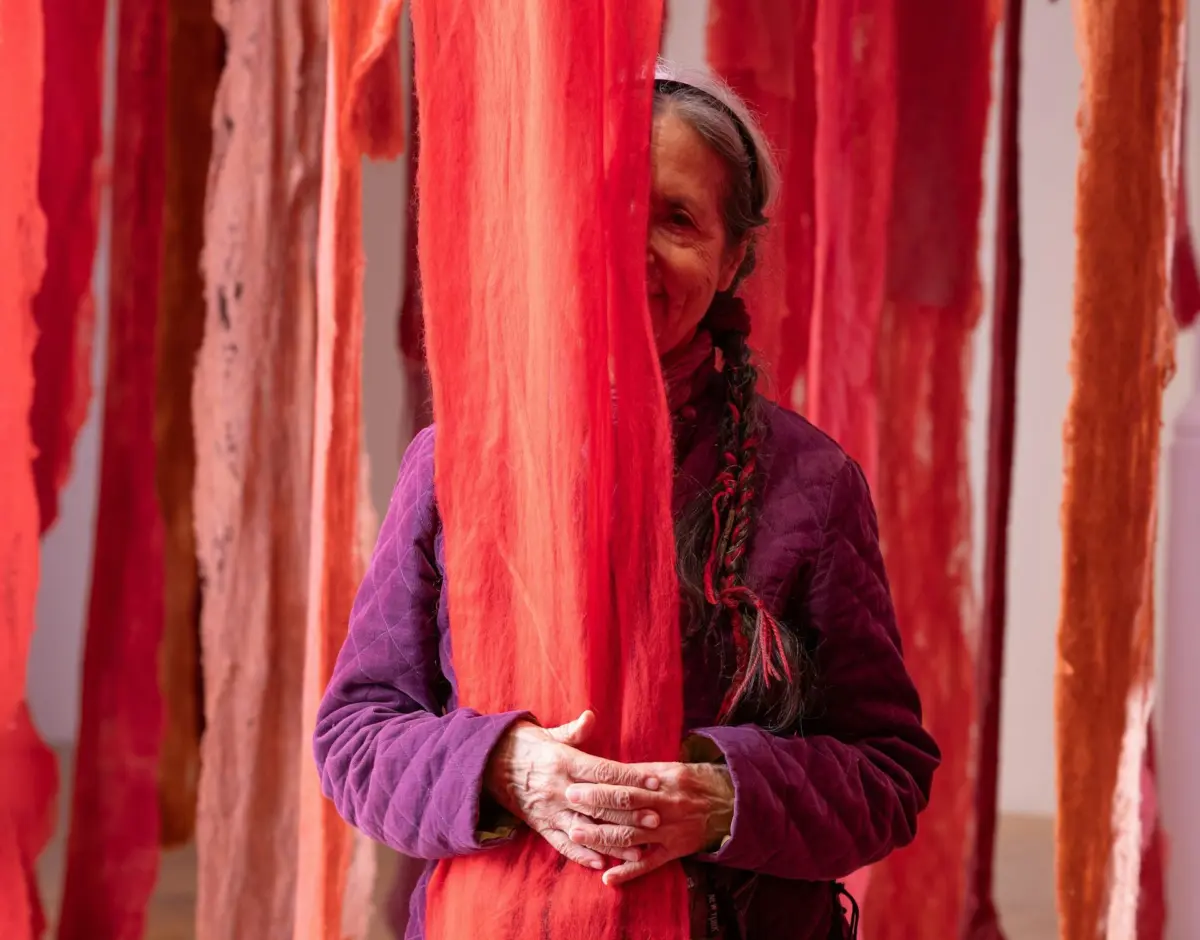
Executive Overview
London’s historic Whitechapel Gallery is currently hosting Living Threads, a landmark exhibition that marks the first major United Kingdom solo institutional presentation of the internationally celebrated eco-feminist activist, poet, and contemporary artist Cecilia Vicuña. Born on the periphery of Santiago, Chile, in 1948, Vicuña’s career spans over five decades of multidisciplinary output—bridging the tactile intimacy of fiber arts with the urgent political demands of human rights advocacy and environmental stewardship.
While her avant-garde contributions remained largely under-recognised by the commercial art world for decades, the global cultural establishment has recently begun to honor her profound impact. Vicuña was awarded the prestigious Golden Lion for Lifetime Achievement at the 59th Venice Biennale in 2022, followed by the Icon Artist Gold Medal at Art Basel Miami Beach in 2025. Living Threads serves as both a retrospective testament to her turbulent biographical journey—shaped by exile, displacement, and unwavering political resistance—and a living, breathing manifesto of ecological interconnectedness.
Running until February 14, 2027, the exhibition transforms the Whitechapel Gallery into a dynamic ecosystem. Through monumental wool installations, surrealist paintings recreated from lost works of her youth, and participatory community-driven projects, Vicuña invites visitors to step away from western art’s obsession with permanent stone monuments and enter a fragile, shifting realm of communal existence. Her art does not merely hang on walls; it breathes, decays, sways, and interacts directly with the bodies moving through its space, positioning the viewer as an essential, living thread in a larger planetary web.
Detailed Chronology: From the Slopes of Santiago to Global Acclaim
The trajectory of Cecilia Vicuña’s life reads as a testament to the resilience of the artistic spirit in the face of geopolitical upheaval. Her chronology is deeply anchored in moments of profound historical trauma and geographical displacement.
Early Years and the London Awakening (1948–1973)
Vicuña’s artistic and environmental philosophies took root during her teenage years on the outskirts of Santiago, where she first developed an obsession with the vitality of fiber and the invisible ties binding humans, plants, animals, and the natural world. In 1972, seeking to expand her formal training, she moved to London to study at the renowned Slade School of Fine Art.
Her stay in the British capital coincided with a watershed moment in modern Latin American history. On September 11, 1973, Chile’s democratically elected Marxist president, Salvador Allende, was violently deposed in a U.S.-backed military coup led by General Augusto Pinochet. The subsequent installation of a brutal military junta plunged Chile into decades of state-sponsored terror, censorship, and human rights abuses. For Vicuña, the coup meant instant exile; returning to her homeland became an immediate threat to her life and safety.
The Years of Wandering: Bogotá and New York (1975–Present)
When her UK visa expired in 1975, Vicuña relocated to Bogotá, Colombia, finding temporary refuge among the region’s intellectual and artistic communities. By 1980, she moved to New York City, where she has maintained her primary base of operations to the present day.
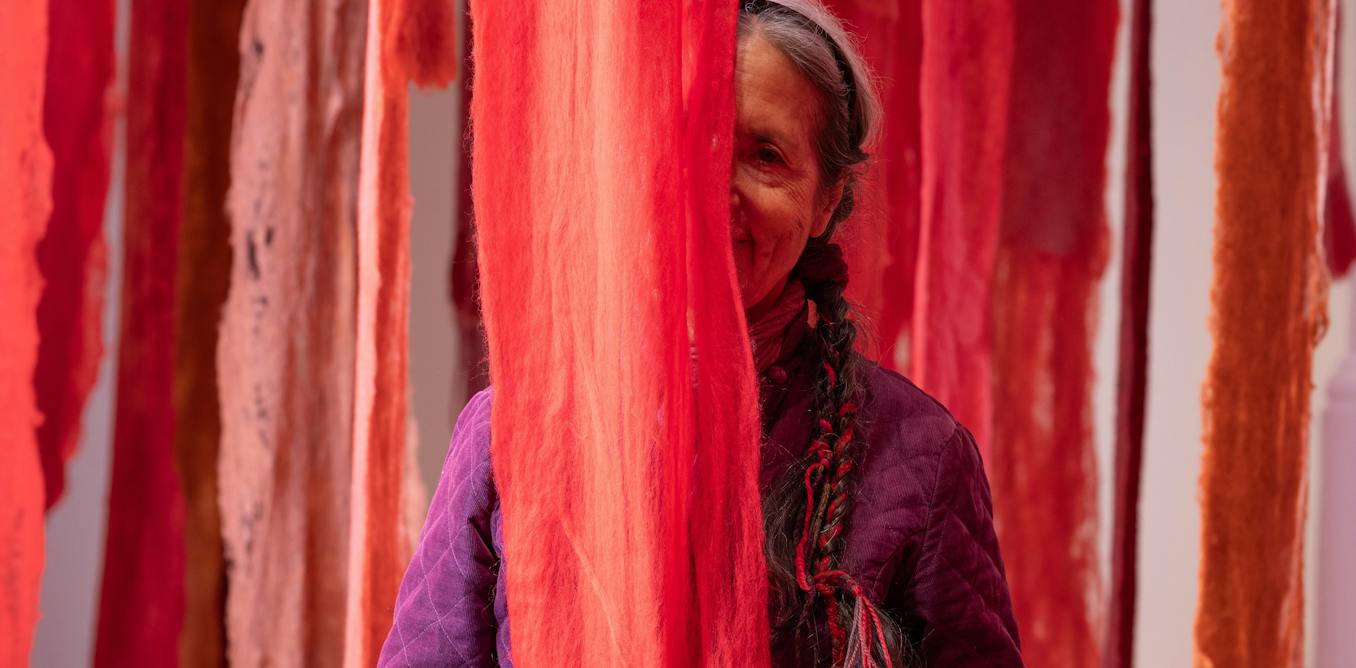
Navigating decades of displacement, Vicuña poured her grief, political outrage, and longing for home into her art. Yet, for many years, the institutional art market—largely euro-centric and focused on traditional mediums—overlooked her avant-garde innovations. It was not until the 2020s that the international art world began correcting this oversight, culminating in her 2022 Venice Biennale Golden Lion and her 2025 Icon Artist Gold Medal at Art Basel Miami Beach. Living Threads at the Whitechapel Gallery represents the pinnacle of this long-overdue institutional embrace in the UK.
Supporting Context & Metrics: The Philosophy of "Living Threads"
To fully comprehend the weight of Vicuña’s Whitechapel exhibition, one must examine the conceptual architecture underpinning her work. Her practice rejects inert materiality in favor of what she terms the "living thread"—a philosophy that views fibers, wool, and natural matter as living entities possessing their own agency.
The Monumental Scale of Quipu Menstrual 1
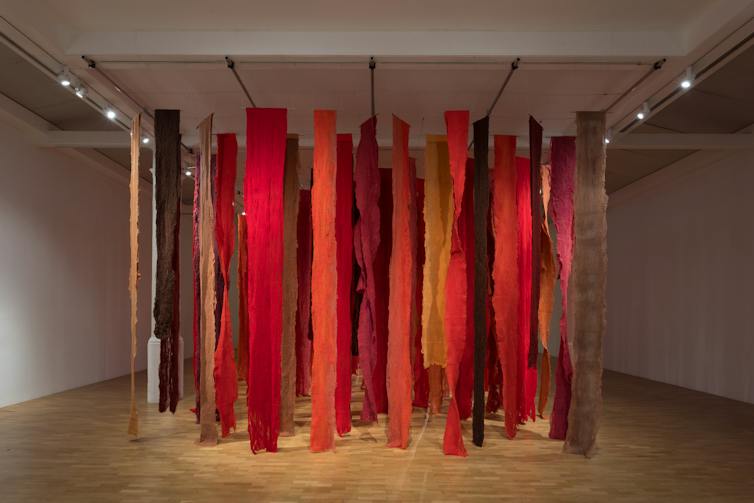
Upon entering the gallery’s first major space, visitors are immediately confronted by Quipu Menstrual 1 (unknotted) (2006–2024). This room-filling installation features cascading streams of raw wool dyed in deep, visceral reds, vibrant oranges, and soft pinks.
- Architectural Impact: While some wool strands drape all the way to the floor, others trail off at a third of that length, appearing frayed and worn under their own weight.
- Thematic Subversion: Through this monumental scale, Vicuña launches a direct critique of western sculptural traditions, which historically favored permanent, heroic stone statues and metallic monuments designed to withstand the ravages of time. In contrast, Quipu Menstrual embraces vulnerability, impermanence, and biological decay.
- Kinetic Interaction: Standing immobile before the installation reveals a subtle, constant movement. Air currents within the gallery glide across the raw wool, causing it to sway gently like branches in a breeze. As visitors circulate through the room, their physical presence stirs the fibers into an organic dance, entangling airborne dust, human hair, and clothing fibers with the artwork itself.
The Concept of the "Not Yet"
Central to Vicuña’s artistic vocabulary is the notion of the "not yet"—an open-ended, philosophical framework that champions becoming over being. Vicuña perceives existence as an ongoing, infinite process rather than something fixed or finite. By leaving her installations untethered and mobile, she intentionally resists imposing rigid, authoritarian meanings on her audience.
By embracing the "not yet," Vicuña surrenders artistic control, handing the ongoing evolution of the work over to the elements and the public. The installation breathes in tandem with the room, reacting dynamically to every human presence that crosses its threshold.
Official Statements and Institutional Perspectives
Art historians, curators, and critics have long pointed to the historical erasure of female artists of color from the foundational narratives of 1970s political art movements. The Whitechapel Gallery’s presentation of Living Threads actively rectifies this marginalisation, particularly regarding Vicuña’s role in transnational political solidarity.
Artists for Democracy (AFD)
Gallery Three of the exhibition offers a comprehensive look at Vicuña’s pivotal, yet historically understated, role as a founding member of Artists for Democracy (AFD). Established in London, AFD was an influential international artist collective—cofounded alongside Guy Brett, John Dugger, and David Medalla—dedicated to raising global awareness about the suffering of the Chilean people and supporting liberation and human rights struggles worldwide.
While existing art historical literature has occasionally cast Vicuña in a secondary or supporting role during the formation of AFD, Whitechapel’s curation firmly reinstates her as a central pillar of the movement. Photographic documentation from 1974 captures a smiling, resilient Vicuña at an exhibition showcasing her series Objects for the Chilean Resistance, 1973–74.
These objects—crafted from overlooked, discarded, and everyday items—reflect an intense desire for social equality and an underlying anxiety born of geographic separation from a homeland gripped by totalitarian violence. Curatorially, the exhibition highlights how Vicuña transformed personal trauma into collective political mobilization.
Recreating the Lost Canvases of Exile
The exhibition also showcases Vicuña’s surrealist-inflected paintings, presented in a dedicated gallery space. These works are modern recreations of early canvasses that were tragically lost, abandoned, or destroyed during her decades of forced migration between London, Colombia, and New York.
Rather than viewing these losses through a purely tragic lens, the Whitechapel exhibition frames them through Vicuña’s belief in cyclic time and invisible networks of connection. The rebirth of these paintings serves as a creative catalyst, proving that cultural erasure and forced displacement cannot fully extinguish an artist’s creative lineage.
Future Outlook: Foraging Quipu and the Legacy of Communal Art
As the art world looks toward the future of sustainable, participatory curation, Vicuña’s latest works offer a compelling blueprint for how galleries can engage with local communities and ecological themes.
The journey through Living Threads culminates with Foraging Quipu (2025–2026). This installation encapsulates Vicuña’s lifelong commitment to communal engagement and viewer participation by actively inviting members of the public to contribute natural and organic items encountered during their daily urban routines.
- Ephemerality in Action: Principally composed of biological and botanical matter, Foraging Quipu is in a constant state of decomposition and transformation.
- Relational Aesthetics: Because the piece changes with the natural passage of time and the shifting configurations of visitor contributions, no two viewing experiences are identical. It stands as a physical manifestation of relationality—a reminder that human beings are inextricably linked to the natural world and to one another through unseen threads.
A Legacy Set in Motion
Cecilia Vicuña: Living Threads remains on view at the Whitechapel Gallery in London through February 14, 2027. More than a standard museum retrospective, the exhibition functions as a living archive of resistance, a masterclass in eco-feminist aesthetics, and a timely reminder that art need not be permanent to be monumental. By shifting the focus from rigid structures to fluid, breathing networks of wool, memory, and community, Vicuña has secured her place not only in the history books, but in the living fabric of contemporary global culture.