Executive Overview
When Purling Hiss mastermind Mike Polizze unleashed his second solo LP, Around Sound, in the summer of 2025, critics scrambled to contextualize its restless trajectory. Writing for KLOF Mag, reviewer Danny Neill captured the prevailing sentiment of awe and bewilderment with a fittingly prophetic appraisal: "Where he travels next may be as hard to predict as ever, but if the results are as fine as this, then we must follow him."
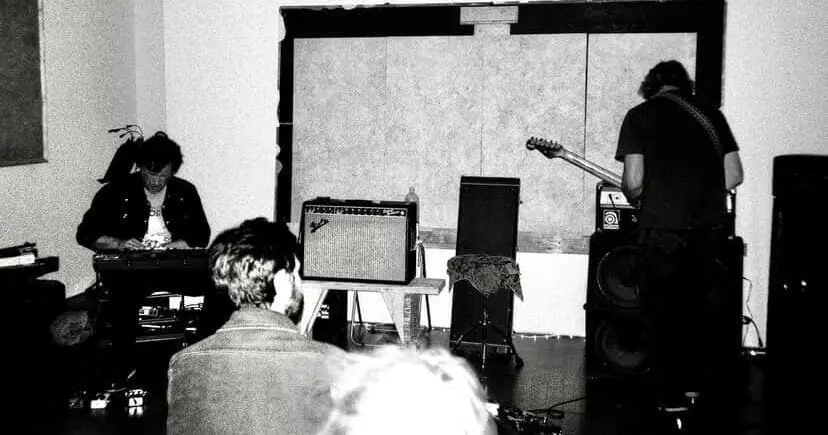
As it turns out, following Polizze did not require a leap across decades or continents, but rather a short trip to the Pageant: Soloveev gallery in Philadelphia, Pennsylvania. There, beneath the austere, contemplative lights of a contemporary art space, Polizze did something entirely unprecedented. Joined by avant-garde guitar virtuoso Bill Nace—celebrated for his work in Body/Head alongside Sonic Youth’s Kim Gordon—Polizze stepped into unchartered territory.
Presented by Open Mouth Records, the evening was structured as a multi-act, cross-pollinated bill featuring exploratory sets from Strapping Fieldhands’ Jacy Webster and Mission of Burma’s legendary Roger Clark Miller. Yet, the emotional and sonic apex of the night occurred dead center in the lineup: a first-time-ever collaboration pairing Nace’s idiosyncratic, textural approach with Polizze’s fiery fretwork. Even more exotic, the performance featured Polizze wielding a taishogoto—a traditional Japanese string instrument often colloquially and crudely described as a hybrid between a guitar and a typewriter—pitting it directly against Nace’s heavily prepared electric guitar.
Thanks to the ubiquitous alchemy of modern smartphone technology, this lightning-in-a-bottle encounter was preserved from the front row via an iPhone voice memo. What began as a quick-and-dirty archival field recording quickly revealed itself to be a document of rare historical and sonic significance. Mixed, mastered, and prepared for widespread distribution, this momentous performance is now slated for a physical and digital release on October 23 via Sea Note Records under the title Live at Pageant.
Described by purveyors of the underground as an unhindered exhibition of full-spectrum free string playing in its rawest, most volatile form, the album bridges the gap between molten noise-rock and high-art improvisation. It summons the spectral, ecstatic energies of guitar demigods like Glenn Branca and Jimi Hendrix, filtering them through the lens of contemporary minimalism and free jazz. For noise freaks, avant-garde enthusiasts, and guitar acolytes alike, Live at Pageant is not merely a live album; it is a masterclass in spontaneous composition.
Detailed Chronology: From Gallery to Wax
The Genesis of an Unlikely Partnership
To understand the gravity of the Pageant: Soloveev performance, one must examine the divergent yet complementary paths that brought Bill Nace and Mike Polizze to the same Philadelphia stage. Polizze, long revered as the driving force behind the psych-noise rock powerhouse Purling Hiss, has spent well over a decade carving out a distinct space within American guitar music. His catalog balances the raw, speaker-shredding distortion of early-90s indie rock with an encyclopedic knowledge of classic psych, power pop, and folk traditions. With his 2025 sophomore solo outing, Around Sound, Polizze intentionally dismantled expectations, favoring exploratory soundscapes, nuanced songcraft, and stylistic fluidity over straightforward verse-chorus-verse structures.
Bill Nace, meanwhile, operates within the upper echelon of the global avant-garde and free-improvisation communities. A master of extended techniques, Nace treats the electric guitar not as a tool for playing riffs or chord progressions, but as a living, breathing sculptural mass capable of infinite timbral variations. His high-profile partnerships—most notably his ongoing work with Kim Gordon in the searing noise-drone duo Body/Head, as well as collaborations with luminaries like Thurston Moore, Chris Corsano, and Paul Flaherty—have cemented his status as a premier architect of modern sonic destruction.
When Open Mouth Records began curating the bill for the Philadelphia gallery space, the intention was to foster an environment where genre boundaries could safely dissolve. The inclusion of Strapping Fieldhands’ Jacy Webster and Mission of Burma founding member Roger Clark Miller ensured that the evening would be steeped in independent music royalty. However, the decision to pair Nace and Polizze as a direct duo represented a high-stakes gamble. Neither artist had previously shared a stage in this specific configuration, nor had they extensively rehearsed material. They arrived at the venue armed only with their instruments, mutual respect, and an implicit understanding of how to navigate the unknown.
The Performance: Fire, Typewriters, and Feedback
As the evening progressed toward its midpoint, the atmosphere inside the Pageant: Soloveev gallery shifted palpably. The crowd, comprising underground cognoscenti and local scene fixtures, pressed in close, acutely aware that they were about to witness a singular event.
When Nace and Polizze took their positions, the instrumentation immediately set the performance apart from standard guitar-duo tropes. While Nace anchored his setup in his characteristic approach to the electric guitar—utilizing bowing, preparation, physical object manipulation, and amplifiers pushed to the brink of feedback—Polizze introduced an unexpected element to the sonic palette: the taishogoto. Originating in Japan in the early 20th century, the taishogoto features strings stretched over a wooden body, played by depressing typewriter-like keys or buttons with one hand while plucking or strumming with the other. In Polizze’s hands, the instrument ceased to be a historical novelty and instead functioned as a microtonal noise machine, slicing through the air with mechanical percussion and eerie, singing frequencies.
From the first moments of their set, the performance defied easy categorization. Rather than relying on rhythmic grooves or predictable song structures, Nace and Polizze engaged in a deep, telepathic dialogue of tension and release. Nace’s contributions were oceanic and enveloping—sheets of abrasive drone, weeping harmonics, and metallic scrapes that seemed to bend the architecture of the gallery itself. Countering this, Polizze’s guitar and taishogoto work provided sharp, jagged counter-melodies and relentless rhythmic pulses.
The resulting sound was neither purely ambient nor strictly heavy metal; it occupied a hyper-vibrant middle ground where melody and chaos became indistinguishable. Spectators noted how the duo seemed to feed off the intimacy of the gallery setting. Without the barrier of a traditional rock club stage or a towering stack of monitor speakers, the soundwaves ricocheted off the white walls, enveloping the audience in a visceral, physical bath of string-wrought energy.
Capturing the Ephemeral: The iPhone Genesis
In the modern era of high-fidelity recording suites, pristine microphone arrays, and digital workstation perfection, some of the most vital musical documents are still born of pure happenstance. Recognizing the unique chemistry of the evening before taking the stage, Mike Polizze took a pragmatic, thoroughly contemporary approach to archival preservation: he pulled out his iPhone, hit record, and placed the device strategically in the room to capture the acoustic environment of the gallery.
At the time, the recording was intended merely as a personal keepsake—a sonic snapshot of an unrepeatable evening. However, upon reviewing the audio file after the event, both artists realized they had captured something extraordinary. The lo-fi nature of the iPhone recording, far from being a technical limitation, actually worked to the performance’s distinct advantage. It compressed the room’s natural reverberation, lent a gritty authenticity to the midrange frequencies, and captured the raw, unfiltered intensity of the amplifiers pushing against the gallery’s hard surfaces.
This archival document bypassed the traditional, often sanitized mixing desk process, retaining the exact spatial dynamics and unfiltered urgency of the live room. Recognizing its potency, the recordings were curated, polished just enough to honor the source material without losing its grit, and routed to Sea Note Records for a formal release strategy.
Supporting Context & Metrics: The Avant-Garde Guitar Ecosystem
Bill Nace’s Collaborative Continuum
To fully appreciate the significance of Live at Pageant, one must contextualize Bill Nace’s relentless pursuit of cross-pollination within the broader ecosystem of experimental guitar music. Nace is, at his core, a collaborative artist whose distinct voice is forged precisely through friction with others. His work alongside Kim Gordon in Body/Head has continually redefined the parameters of noise-rock, stripping the genre down to its psychological and textural bones. Their critically acclaimed albums—such as Coming Apart (2013) and The Switch (2018)—showcase an uncanny ability to create sprawling, cinematic narratives out of pure spontaneous improvisation.
Furthermore, Nace’s collaborative discography extends into landmark pairings with heavy-hitting contemporaries. His 2023 collaboration on Three Lobed Recordings, Glass Band, alongside virtuoso guitarist Steve Gunn and master percussionist/synth technician John Truscinski, serves as a prime example of his methodology. On that release, Nace’s abrasive, sculptural contributions acted as a brilliant disruptor, injecting a fresh, unsettling bent into Gunn and Truscinski’s pastoral, cyclical rhythmic foundations.
This penchant for integration explains why Nace’s partnership with Mike Polizze feels so natural yet electrifying. Polizze, coming from a background steeped in the garage-psych lineage of Purling Hiss, shares Nace’s appetite for timbral exploration. When placed in a stripped-down duo format, Nace’s institutional mastery of free improvisation acts as a catalyst, pushing Polizze away from traditional song structures and directly into the molten core of pure sound.
The Legacy of Free String Playing: Branca and Hendrix
In promotional materials and critical dispatches surrounding Live at Pageant, the performance has been explicitly framed through the lineage of guitar avant-garde pioneers like Glenn Branca and the incendiary, boundary-shattering spirit of Jimi Hendrix. This is not casual hyperbole; it is an accurate invocation of the aesthetic genealogy at play.
Glenn Branca, legendary for his massive guitar symphonies utilizing custom-built instruments, alternate tunings, and microtonal dissonance, fundamentally altered how the electric guitar was viewed in contemporary composition. Branca proved that the guitar could orchestrate monumental architectural spaces through sheer volume, harmonics, and harmonic overtone manipulation. In the interplay between Nace and Polizze—particularly in the way their frequencies lock, clash, and generate phantom overtones—one hears the direct ghost of Branca’s maximalist spatial experiments.
Simultaneously, the raw, visceral energy connecting the performance back to Jimi Hendrix lies not in derivative blues licks, but in the radical philosophy of total sonic liberation. Hendrix famously treated the guitar amplifier not as a passive playback device, but as an active instrument of feedback, distortion, and elemental control. On Live at Pageant, Nace and Polizze channel this same shamanistic approach. They do not merely "play" their instruments; they wrestle with them, coaxing violent, beautiful, and transcendent expressions from taut steel strings and trembling speaker cones.
Official Statements & Critical Reception
While full-length review cycles for Live at Pageant are ramping up ahead of its October 23 release via Sea Note Records, early responses from underground tastemakers and the artists themselves highlight the recording’s rare stature.
Danny Neill’s prophetic review in KLOF Mag, which initially set the stage for Polizze’s post-Around Sound trajectory, has taken on new life among fans tracking the guitarist’s unpredictable movements. Observers within the Philadelphia art-rock scene have similarly lauded the Pageant: Soloveev gallery performance as a watershed moment for local cross-genre programming.
Promoters from Open Mouth Records noted the unique atmosphere of the evening:
"When you bring artists of this caliber together in an intimate gallery setting rather than a traditional rock club, the social contract changes. There is no barrier between the audience and the act. Bill and Mike didn’t just play a set; they created an acoustic ecosystem for one night only. Capturing that on an iPhone and turning it into a physical release is the ultimate DIY triumph."
Musicologists tracking the trajectory of modern improvised music have emphasized the tactile nature of the recording. By stripping away multi-track studio artifice, Live at Pageant relies entirely on the interplay between acoustic space and electronic amplification.
Critics who have previewed the Sea Note Records pressing have described the listening experience as:
"An unhindered exhibition of full-spectrum free string playing in its rawest form. It is wild molten rock designed to keep noise freaks spinning for eternity, invoking the holy ghosts of Branca and Hendrix while remaining thoroughly rooted in the immediate, sweat-soaked reality of the present moment."
Future Outlook: The Road Ahead for Polizze and Nace
As the October 23 release date for Live at Pageant approaches, the underground music community is turning its attention to what this unexpected collaboration portends for the future careers of both Mike Polizze and Bill Nace.
For Polizze, the release caps off an extraordinarily dynamic period marked by the critical success of Around Sound and a deliberate pivot toward unscripted sonic exploration. Having proven that he can effortlessly transition from structured psych-rock and garage anthems to radical free-string improvisation without losing his artistic identity, Polizze’s next moves remain wonderfully, exhilaratingly unpredictable. Whether this collaboration remains a singular, lightning-in-a-bottle gallery event or evolves into an ongoing side-project remains to be seen, but the appetite among fans for further encounters is palpable.
Bill Nace, meanwhile, continues his relentless crusade across the frontiers of contemporary music. With a touring schedule that frequently spans international art spaces, noise festivals, and underground iteration hubs, Nace remains one of the most vital improvisational thinkers working today. His ability to elevate the work of collaborators—whether established icons like Kim Gordon and Steve Gunn or garage-rock innovators like Polizze—underscores his status as a master facilitator of sonic discovery.
The release of Live at Pageant on one-sided vinyl and digital formats via Sea Note Records ensures that this fleeting Tuesday evening in Philadelphia will not be lost to the ether. Instead, it stands as a permanent monument to what happens when two visionary guitarists leave their safety nets at the door, pull out an iPhone, and let the strings speak for themselves. For listeners willing to follow them into the white-hot center of the noise, the journey promises to echo for eternity.