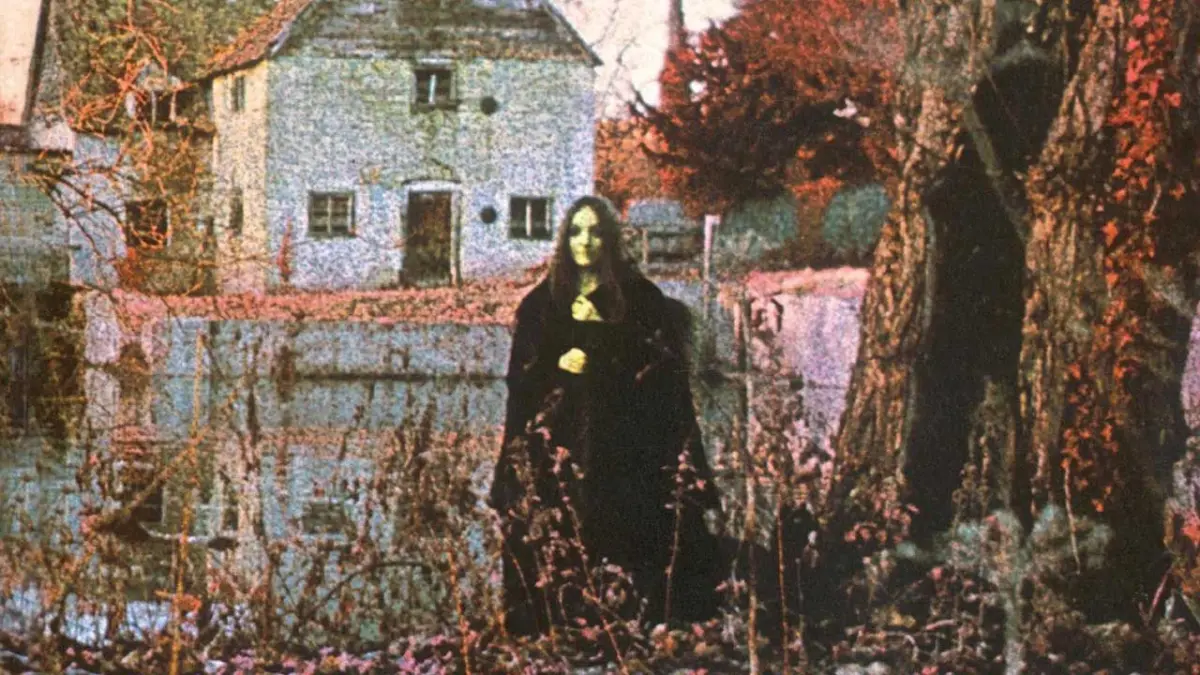
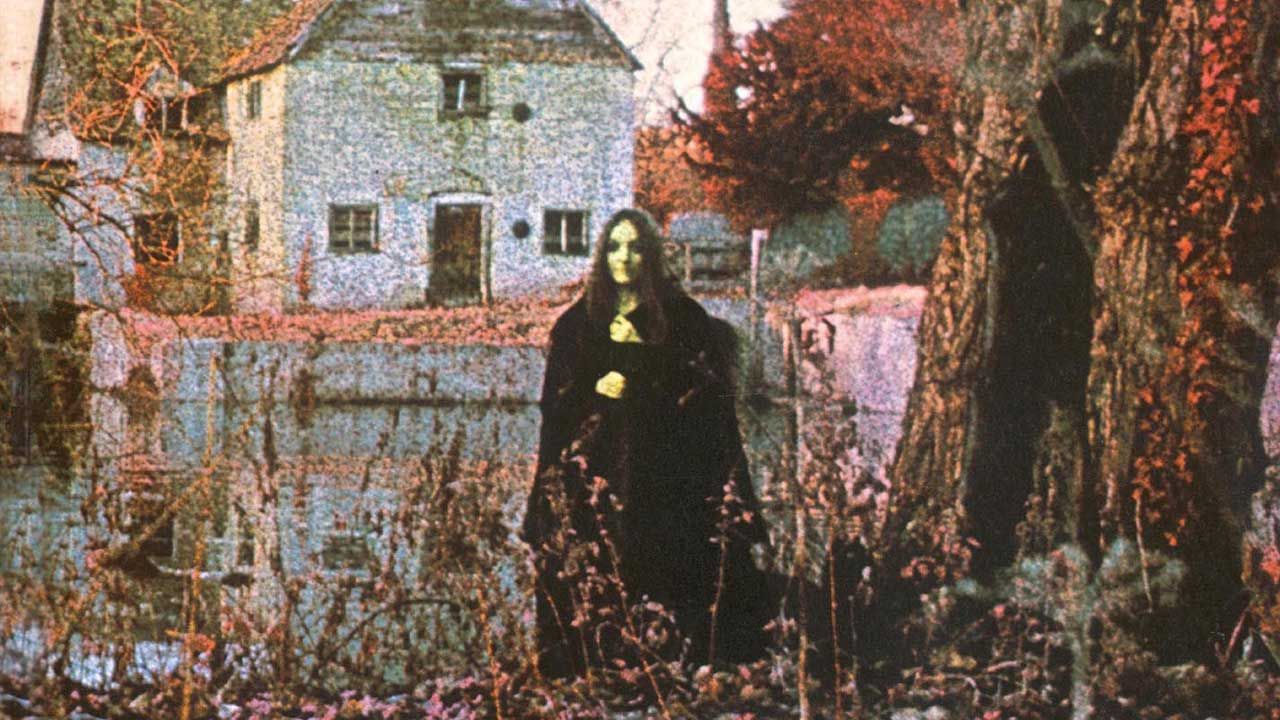
For more than half a century, the haunting, hooded figure standing motionless before the overgrown banks of Mapledurham Watermill served as the ultimate visual enigma in rock music history. Gracing the sleeve of Black Sabbath’s self-titled 1970 debut album, the mysterious woman in the black cloak came to embody the dark, occult aesthetic that birthed the heavy metal genre.
In 2020—five decades after the album’s release—the mystery was finally solved when journalists identified the cover model as Louisa Livingstone. Today, Livingstone has transitioned from an enigmatic pop-culture artifact into an active creative force. Performing under the musical moniker Indreba (an acronym for the Incredible Dream Band), Livingstone has officially released Alice, a conceptual, five-track psychedelic rock opera available via Bandcamp.
                      [ HISTORICAL CONTINUUM ]
                                 │
     1970: Model on Black Sabbath's Iconic Album Cover
                                 │
     2020: Identity Publicly Unmasked After 50 Years
                                 │
     2024: Emergence of Musical Alias "Indreba"
                                 │
     Present: Release of AI-Assisted Rock Opera 'Alice'
Alice reimagines Lewis Carroll’s classic Victorian literature through a satirical, modern lens, sending its titular protagonist into the hyper-connected landscape of 2026. Assisted by artificial intelligence music technology, the project directly addresses contemporary anxieties regarding algorithmic addiction, social media echo chambers, and synthetic intelligence. By blending 1960s psychedelic rock sensibilities with cutting-edge digital production tools, Livingstone has forged a unique artistic narrative that bridges the dawn of heavy metal with the frontier of music technology.
Detailed Chronology: From Thameside Mystery to Algorithmic Odyssey
The journey from a freezing Oxfordshire photo shoot in 1969 to an AI-driven rock opera in the mid-2020s represents one of the most eccentric visual and musical evolutions in contemporary rock lore.
+-------------------------------------------------------------------------------+
|                           CHRONOLOGY OF EVENTS                                |
+-------------------------------------------------------------------------------+
|  1969        │ Keith "Keef" McMillan shoots cover art at Mapledurham Watermill |
|  Feb 13, 1970│ Vertigo Records releases 'Black Sabbath'; mystery figure debuts |
|  1970–2020   │ Decades of urban legends, fan speculation, and public silence   |
|  Feb 2020    │ Kerrang! / music press officially identifies Louisa Livingstone |
|  Early 2024  │ Livingstone launches Indreba; releases "Witch Woman" singles   |
|  Late 2024   │ Release of 'Alice' EP—a 5-track AI-assisted rock opera        |
+-------------------------------------------------------------------------------+
1969–1970: The Mapledurham Shoot and Metal’s Visual Genesis
In late 1969, photographer Keith "Keef" McMillan transported an 18-year-old model and aspiring actress named Louisa Livingstone to the historic Mapledurham Watermill on the River Thames in Oxfordshire. McMillan, working under assignment for Vertigo Records, sought to craft a sleeve that matched the ominous, blues-driven heavy rock recorded by four young musicians from Birmingham: Ozzy Osbourne, Tony Iommi, Geezer Butler, and Bill Ward.
Wearing a long black cloak and holding a small black cat (a detail long debated by rock historians), Livingstone stood still against the chilly, desaturated backdrop of the mill. When Black Sabbath was released on Friday, February 13, 1970, the album reached the UK Top 10, propelled not only by its earth-shattering riffage but also by its atmospheric sleeve. For fifty years, Livingstone remained uncredited, leaving fans to speculate whether the woman on the cover was a witch, a ghost, or an apparition conjured by the band.
2020: The Unmasking After Five Decades
On the 50th anniversary of the album’s release, retrospective investigations by music journalists brought Livingstone’s identity to light. Breaking her long-standing silence, Livingstone revealed details of the cold morning shoot, her subsequent career in acting and modeling, and her move into electronic and experimental music. Rather than remaining a trivia answer, the revelation galvanized Livingstone to embrace her historical connection to rock music’s heavy metal lineage.
2024: The Birth of Indreba and Fan Reconciliation
Operating under the banner Indreba, Livingstone began publishing music specifically designed to connect with the fanbase that had revered her image for decades. Earlier in 2024, she released two singles:
"Witch Woman": A heavy, riff-laden tribute explicitly crafted within the metal genre, addressing her image on the album sleeve.
"The Woman By The Mill": A reflective, atmospheric composition referencing the Oxfordshire geography of the 1969 photoshoot.
The positive reception from the heavy metal and classic rock communities paved the way for her most ambitious project to date: the thematic, AI-assisted EP Alice.
Supporting Context & Structural Analysis
The Structural Design of Alice
The five-track EP Alice operates as a linear rock opera, tracking the journey of Lewis Carroll’s heroine as she falls through a modern, digital rabbit hole into the year 2026. The narrative contrasts Victorian innocence with contemporary technological anxiety, utilizing dramatic musical shifts to reflect the disorientation of internet culture.
+-------------------------------------------------------------------------------+
|                         'ALICE' EP TRACKLIST & THEMES                         |
+-------------------------------------------------------------------------------+
| Track | Title           | Primary Theme & Satirical Focus                     |
+-------+-----------------+-----------------------------------------------------+
|   1   | Feed Your Head  | Algorithmic dopamine loops; Jefferson Airplane homage |
|   2   | Digital Rabbit  | Down the rabbit hole of targeted social feeds       |
|   3   | The Mirror Web  | Dysmorphia, self-perception, and online vanity      |
|   4   | Machine Logic   | Synthetic AI consciousness vs. human emotion       |
|   5   | Awakening 2026  | The realization of trapped attention economies     |
+-------------------------------------------------------------------------------+
The opening track, "Feed Your Head," explicitly riffs on Jefferson Airplane’s 1967 psychedelic anthem "White Rabbit," originally penned by Grace Slick. While Slick’s lyrics referenced hallucinogenic counterculture and pharmacological exploration, Livingstone’s 2026 iteration redirects the narrative toward digital consumption:
"One pill makes you scroll for hours…" "If you go chasing white rabbits down the algorithms of your mind…"
Through these altered motifs, Livingstone substitutes the psychedelic escape of the 1960s with the compulsive doomscrolling of the 2020s.
The Role of Generative Artificial Intelligence
The production methodology behind Alice reflects a growing movement among independent legacy artists who utilize AI tools to bypass traditional studio constraints. Rather than relying on standard instrumentation alone, Livingstone employed AI audio models to generate complex arrangement shifts, synthetic backing instrumentation, and vocal textures.
This approach allows an independent creator to orchestrate full rock operas featuring rapid tempo adjustments, symphonic overlays, and multi-instrumental passages that would otherwise require significant orchestral and studio budgets.
Official Statements and Strategic Analysis
Livingstone on Fan Connection and Genre Pivots
Speaking in an interview with Rolling Stone, Livingstone addressed her decision to engage directly with heavy metal fans through her preliminary musical releases before branching into experimental psychedelic operas:
"Witch Woman came out of nowhere as a sudden idea of what I could do," Livingstone explained. "Black Sabbath fans loved the songs, which was gratifying as it was aimed at them and definitely deliberately in the metal genre for that reason."
This initial goodwill provided Livingstone with a dedicated audience, enabling her to pivot toward more avant-garde thematic terrain with Alice.
   "Witch Woman"          Heavy Metal Homage         Targeted Sabbath Audience
 ─────────────────  ────────────────────────────  ───────────────────────────────
      "Alice"          Psychedelic Rock Opera        Generational Digital Satire
Navigating the Ethics of Artificial Intelligence
Addressing the broader industry controversy surrounding machine learning in art, Livingstone offered a pragmatic perspective on how creators can utilize emerging technologies without sacrificing artistic integrity:
"I used to be very judgmental about AI like many people," Livingstone revealed to Rolling Stone. "But it’s a tool that you can use to create either absolute rubbish or ‘slop’ as it’s called, to something really good and interesting."
Describing the structural mechanics of the EP, Livingstone emphasized that narrative cohesion remains dependent on human authorship:
"Tracks one to five tell the story in sequence with an abundance of captivating musical changes. The lyrics are a key element in this rollercoaster ride of a music trip."
+-------------------------------------------------------------------------------+
|                       AI IN MUSIC: SLOP VS. ARTISTRY                          |
+-------------------------------------------------------------------------------+
| Category      | Method                                 | Outcome              |
+---------------+----------------------------------------+----------------------+
| AI "Slop"     | Automated, mass-generated filler       | Generic noise        |
| Conceptual AI | Human-guided lyrics, prompts & curation| Cohesive rock opera  |
+-------------------------------------------------------------------------------+
Future Outlook
Louisa Livingstone’s transformation from an iconic cover figure into an active, tech-forward composer reflects broader shifts in how legacy cultural icons navigate the modern music industry. By combining independent distribution platforms like Bandcamp with generative technology, artist-creators can maintain total creative ownership while producing ambitious, long-form thematic works.
+-------------------------------------------------------------------------------+
|                          FUTURE TRAJECTORY MAP                                |
+-------------------------------------------------------------------------------+
|  • EXPANSION OF INDREBA CATALOGUE: Continued narrative release cycles on      |
|    Bandcamp utilizing hybrid human-AI production workflows.                  |
|                                                                               |
|  • BRIDGING ROCK LEGACY & FUTURE TECH: Serving as a case study for legacy     |
|    cultural figures leveraging generative tools for late-career expression.   |
|                                                                               |
|  • LIVE VIRTUAL PERFORMANCES: Potential adaptation of 'Alice' into immersive   |
|    digital or multimedia performance environments.                            |
+-------------------------------------------------------------------------------+
As artificial intelligence continues to reshape the parameters of music production, Alice demonstrates that the value of generative technology ultimately depends on the vision of the artist guiding the prompts. For an individual whose image helped define heavy metal’s initial visual mythos, Livingstone’s reinvention ensures that her contribution to rock culture is no longer static, but actively evolving alongside the technologies of the 21st century.