Executive Overview
In an era where classical music frequently looks backward to preserve its rich heritage, bold contemporary initiatives continuously challenge the boundaries of historical instruments. Enter acclaimed British-Polish harpsichordist Katarzyna Kowalik and her groundbreaking international project, Meditations for Harpsichord. Slated for its world premiere in the autumn of 2026, this ambitious cross-cultural undertaking bridges artistic traditions between the United Kingdom and Poland. It boldly reimagines the harpsichord—an instrument historically pigeonholed within the rigid stylistic parameters of the Baroque era—as a vibrant, contemporary medium capable of profound sonic exploration.
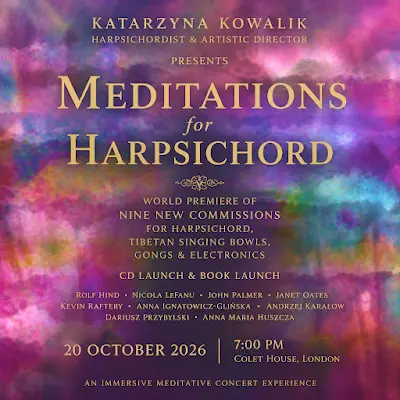
At its core, Meditations for Harpsichord is a collaborative synthesis of nine newly commissioned works written by a diverse group of five British and four Polish composers. Rather than treating the harpsichord as a museum piece designed solely to replicate the acoustic aesthetics of the seventeenth and eighteenth centuries, Kowalik and her cohort of visionary composers treat the instrument as an active participant in an immersive, acoustic landscape. By integrating Tibetan singing bowls, gongs, and sophisticated live electronics with the distinctive plucking mechanism of the harpsichord, the project shatters traditional expectations. It forces listeners to reconsider the nuances of resonance, the artistic gravity of silence, and the delicate balance between structural composition and spontaneous improvisation.
The project’s grand unveiling is scheduled for October 20, 2026, at the historic Colet House in London, followed swiftly by its Polish premiere on October 24 at the cutting-edge Hashtag Lab in Warsaw. These landmark events form the launchpad for an extensive international concert series spanning the 2026–2027 season. Notable stops on the tour include prestigious institutions such as New College, Oxford, the National Centre for Early Music (NCEM), POSK under the auspices of the Confraternity of Polish Artists in Great Britain, and the renowned Warsaw Music Encounters Festival.
Simultaneously, the project establishes a multi-layered publishing and recorded footprint. October 2026 will mark the commercial release of the complete recorded repertoire via Prima Facie Records, alongside an accompanying critical volume published by Vision Edition. Co-edited by Katarzyna Kowalik and composer John Palmer, the book features analytical essays and artistic reflections from all nine contributing composers, offering deep insight into the creative genesis, commissioning mechanics, and philosophical underpinnings of this unique trans-European enterprise.
Detailed Chronology: From Concept to Concert Hall
The genesis of Meditations for Harpsichord did not happen overnight; it is the culmination of years of meticulous research, cross-border artistic dialogue, and rigorous instrumental experimentation. To fully understand the magnitude of Kowalik’s vision, one must trace the developmental timeline that brings this trans-national project to fruition.
[Phase 1: Conceptualization & Commissioning]
       │
       ▼
[Phase 2: Recording Sessions & Editorial Compilation]
       │
       ▼
[Phase 3: World Premiere (London, Oct 20, 2026)]
       │
       ▼
[Phase 4: Polish Premiere & Album Release (Warsaw, Oct 24, 2026)]
       │
       ▼
[Phase 5: Extended International Tour (2026–2027 Season)]
Phase 1: Conceptualization and Commissioning (2023–2025)
The foundational stage of Meditations for Harpsichord required identifying composers capable of looking past the historical baggage of the harpsichord. Kowalik handpicked a stellar roster representing diverse compositional schools across Britain and Poland. The British contingent comprises Rolf Hind, Janet Oates, John Palmer, Kevin Raftery, and Nicola LeFanu. Representing Poland are Anna Ignatowicz-Glińska, Andrzej Karałow, Dariusz Przybylski, and Anna Maria Huszcza.
Over a multi-year commissioning window, Kowalik worked closely with each artist. Rather than dictating how to write for the instrument, she opened her studio to experimentation, encouraging them to test the limits of mechanical action, register shifts, and manual coupling. Crucially, the integration of non-Western acoustic elements—namely Tibetan singing bowls and gongs—was tested alongside bespoke electronic patches to ensure that these secondary sonic layers would complement, rather than overpower, the inherently delicate acoustic profile of the harpsichord.
Phase 2: Studio Production and Editorial Realization (Late 2025–Mid 2026)
As the compositional scores were finalized, production pivoted toward preservation and intellectual contextualization. Recording sessions captured the spatial and microtonal intricacies of the newly minted repertoire for Prima Facie Records. Simultaneously, Kowalik and co-editor John Palmer finalized the manuscripts for Vision Edition. This companion publication was conceived not merely as a standard program booklet, but as an academic and artistic resource. It collects analytical essays, personal statements from all nine composers, and detailed performance notes regarding the expanded instrumental setup.
Phase 3: The World Premiere at Colet House, London (October 20, 2026)
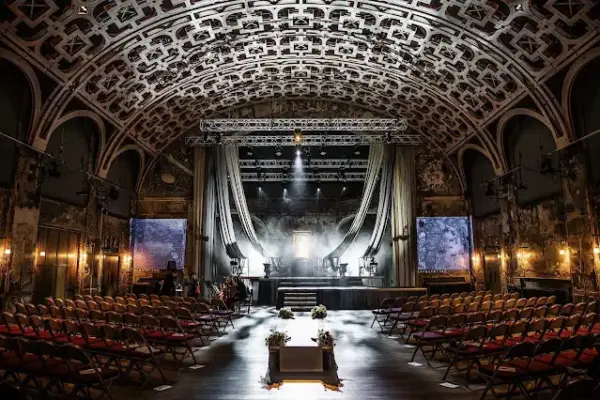
The live rollout begins in the spiritual and artistic sanctuary of Colet House in Hammersmith, London. Known for its rich history of esoteric and cultural programming, Colet House provides an ideal architectural and acoustic backdrop for a program designed around meditation, resonance, and spatial awareness. The London audience will experience the complete nine-work cycle, framed by historical works that anchor the modern pieces in a deep-rooted lineage of introspection: Louis Couperin’s evocative unmeasured prelude and Johann Jakob Froberger’s deeply poignant Méditation sur ma mort future.
Phase 4: The Polish Premiere and Album Drop (October 24, 2026)
Four days after the London showcase, the production moves to Warsaw for its Polish premiere at Hashtag Lab, a vital hub for contemporary and experimental music in Central Europe. This evening marks both the physical homecoming of half of the featured compositional cohort and the official commercial release date of the Prima Facie Records album. The parallel release strategy ensures that attendees at Hashtag Lab can immediately engage with the physical recording while experiencing the spatial reality of the live performance.
Phase 5: The 2026–2027 International Concert Series
Following the dual premieres, Meditations for Harpsichord embarks on an extended concert tour throughout the UK and Poland. Key dates already confirmed on the itinerary include recitals and academic lecture-concerts at New College, Oxford, where the dialogue between historical performance practice and avant-garde technique will be dissected. Performances at the National Centre for Early Music (NCEM) will place contemporary explorations of the harpsichord directly alongside early music repertoires, challenging traditional audiences to expand their listening habits. Further events hosted by The Confraternity of Polish Artists in Great Britain at POSK (The Polish Social and Cultural Association) in London, alongside a prominent showcase at the Warsaw Music Encounters Festival, solidify the project’s bi-national cultural significance.
Supporting Context & Metrics
To appreciate the radical departure represented by Meditations for Harpsichord, one must examine the acoustic challenges and historical realities of the instrument. The harpsichord produces sound through a mechanical quill or plectrum plucking a string when a key is depressed. Unlike the modern piano, whose hammers strike strings with variable force dependent on finger velocity, the traditional harpsichord offers virtually no dynamic variation via touch alone. Every note is struck at a uniform volume, forcing composers to rely on register changes (adding or subtracting sets of strings, known as stops), manual shifting, and ornamentation to create expressive contrast.

For centuries, this mechanical limitation consigned the harpsichord to the footnotes of music history following the rise of the pianoforte in the late eighteenth century. While the twentieth-century early music revival—championed by pioneers like Wanda Landowska—successfully restored the harpsichord to performance halls, it largely cemented the instrument’s status as a vessel for authentic interpretations of Bach, Scarlatti, and Rameau. Modern repertoire has historically treated the instrument as an exotic coloristic effect rather than a primary vehicle for deep, meditative discourse.
| Project Metric / Attribute | Specification | |
|---|---|---|
| Total Newly Commissioned Works | 9 works | |
| Geographic Compositional Split | 5 British composers / 4 Polish composers | |
| Featured British Composers | Rolf Hind, Janet Oates, John Palmer, Kevin Raftery, Nicola LeFanu | |
| Featured Polish Composers | Anna Ignatowicz-Glińska, Andrzej Karałow, Dariusz Przybylski, Anna Maria Huszcza | |
| Enriched Instrumentation | Harpsichord, Tibetan singing bowls, gongs, live/recorded electronics | |
| Historical Framing Works | Louis Couperin (Unmeasured Prelude), Johann Jakob Froberger (Méditation sur ma mort future) | |
| World Premiere Venue & Date | Colet House, London | October 20, 2026 |
| Polish Premiere Venue & Date | Hashtag Lab, Warsaw | October 24, 2026 |
| Record Label Partner | Prima Facie Records | |
| Publishing Partner | Vision Edition (Co-edited by Katarzyna Kowalik and John Palmer) |
Kowalik’s project upends this traditional paradigm by inviting composers to exploit the harpsichord’s inherent acoustic properties—specifically its rich upper-partial overtones and rapid decay—and marry them with resonant percussion. Tibetan singing bowls and gongs share complex harmonic profiles with the harpsichord; when struck or bowed in proximity to the open soundboard of the instrument, sympathetic vibrations are naturally induced. This acoustic phenomenon blurs the boundary between the percussive attack of the harpsichord and the sustained, halo-like resonance of the metal bowls.
Furthermore, the introduction of live electronics allows sound engineers to sample, time-stretch, and spatialize the harpsichord’s plucked transients. This transforms the dry, immediate character of the instrument into an enveloping, ambient soundscape. By placing these modern sonic experiments between Louis Couperin’s unmeasured prelude—where rhythm is fluid and left entirely to the performer’s inner pulse—and Froberger’s programmatic contemplation of mortality, Kowalik establishes a philosophical continuity. She demonstrates that the desire for existential introspection through keyboard music is as vital in the twenty-first century as it was in the mid-seventeenth.
Official Statements & Artistic Perspectives
The intellectual rigor driving Meditations for Harpsichord is anchored in the collaborative synergy between its protagonist and the nine creators who built its repertoire. While promotional materials outline the structural bones of the tour and album releases, the deeper artistic motivations are revealed through the philosophical framework shared by Kowalik and co-editor John Palmer.
"The harpsichord has long suffered from a historical identity crisis, viewed primarily as a museum artifact rather than a living, breathing voice of contemporary sonic art," notes project founder and performer Katarzyna Kowalik. "By pairing the instrument with the sympathetic resonance of Tibetan singing bowls, gongs, and subtle electronics, we are not masking the harpsichord’s mechanical nature; rather, we are opening doors to rooms within the instrument that historical composers never had the technological or stylistic freedom to enter. This project is an invitation to listen differently—to let go of expectations regarding virtuosity and speed, and instead tune into the profound micro-worlds of timbre, silence, and resonance."
Co-editor and contributing composer John Palmer expands upon the structural coherence of the program, emphasizing the bridging of historical and contemporary idioms:
"Framing these nine new commissions with the timeless voices of Louis Couperin and Johann Jakob Froberger was an intentional curatorial choice. The unmeasured prelude and the meditative lament are historical containers for deep personal reflection. By bringing our contemporary British and Polish composers into dialogue with this lineage, we illustrate that the search for quietude, structural mystery, and spiritual resonance transcends national borders and centuries. The companion book published by Vision Edition serves as a vital map for this journey, ensuring that scholars, performers, and inquisitive listeners alike can trace the precise mechanics of how these acoustic and electronic worlds intertwine."
The nine participating composers represent a fascinating cross-section of European contemporary music, each bringing a distinct aesthetic lens:
- Rolf Hind brings his extensive experience as a pioneering contemporary pianist and composer, focusing on tactile resonance and interiorized sound production.
- Nicola LeFanu, a towering figure in British contemporary music, contributes a mastery of linear counterpoint and dramatic vocal pacing adapted here to keyboard textures.
- Janet Oates and Kevin Raftery explore the spatial possibilities of the hall, integrating electronics that bounce plucked transients across the listening environment.
- John Palmer infuses his contribution with a deep understanding of meditative structures and acoustic ecology.
- On the Polish side, Anna Ignatowicz-Glińska and Anna Maria Huszcza explore textural coloration and the blending of acoustic folk and ritualistic timbres with the modern harpsichord.
- Andrzej Karałow and Dariusz Przybylski lean into the dramatic, avant-garde traditions of Polish spectralism and church acoustics, harnessing the monumental sustain of gongs and singing bowls to challenge the listener’s perception of musical time.
Future Outlook & Legacy
As the cultural landscape looks ahead to the autumn 2026 launch of Meditations for Harpsichord, the project’s long-term implications for contemporary keyboard performance are already becoming clear. By commissioning a substantial body of work that treats the harpsichord as a peer to modern electronic and acoustic sound sculpture, Kowalik has created a permanent, extensible repertoire that future generations of early-music specialists and contemporaryists can draw upon.
The dual-hemisphere strategy—anchored by premieres in London and Warsaw, supported by prestigious institutional residencies at Oxford, the NCEM, and POSK—ensures that the project will reach diverse audiences ranging from academic researchers to casual seekers of ambient and experimental sound art. Furthermore, the simultaneous publication of the Prima Facie Records commercial album and the Vision Edition critical volume guarantees that the project’s intellectual and artistic footprint will endure long after the final concert of the 2026–2027 tour fades into silence.
Ultimately, Meditations for Harpsichord serves as a powerful reminder that historical instruments do not need to be locked behind glass to be preserved. By injecting them with new ideas, global acoustic influences, and collaborative cross-border energy, artists like Katarzyna Kowalik prove that the past and the future can share a single, resonant stage.
Tickets for the world premiere on October 20, 2026, at Colet House, London, are currently available via TicketTailor.