Executive Overview
In a development bridging two distinct eras of British musical history, legendary Smiths guitarist Johnny Marr has announced a massive auction featuring nearly 100 instruments from his personal archive. The collection, which reads like a curated museum of modern rock innovation, is set to go under the hammer at Christie’s in London on September 17. Among the standout pieces is a historic 1982 Rickenbacker 330 Jetglo—an instrument intimately tied to the foundational mythos of both The Smiths and Oasis.
The decision to liquidate a significant portion of his working arsenal has sparked widespread conversation across the music industry, not least because of Marr’s own pragmatic rationale for the sale: a desire to prevent his creative sanctuary from calcifying into a monument of past glories. Yet, it is the personal and cultural weight of these instruments that has dominated headlines.
To mark the momentous auction, fellow Manchester icon Noel Gallagher joined Marr for an exclusive promotional feature orchestrated by Christie’s. The ensuing dialogue offered a rare, nostalgic glimpse into the chaotic, high-stakes ecosystem of 1990s Britpop and the deep, enduring camaraderie between two architects of the modern guitar sound. Through recollections of borrowed gear, frantic recording sessions, and mutual respect forged in the crucible of Manchester’s musical landscape, the encounter underscored the profound cultural legacy these pieces of wood and steel represent. As collectors, investors, and nostalgic fans prepare for the September 17 auction, the event promises to be a watershed moment for the market of contemporary rock memorabilia.
Detailed Chronology
The Genesis of a Collection: From Suburbia to Stardom
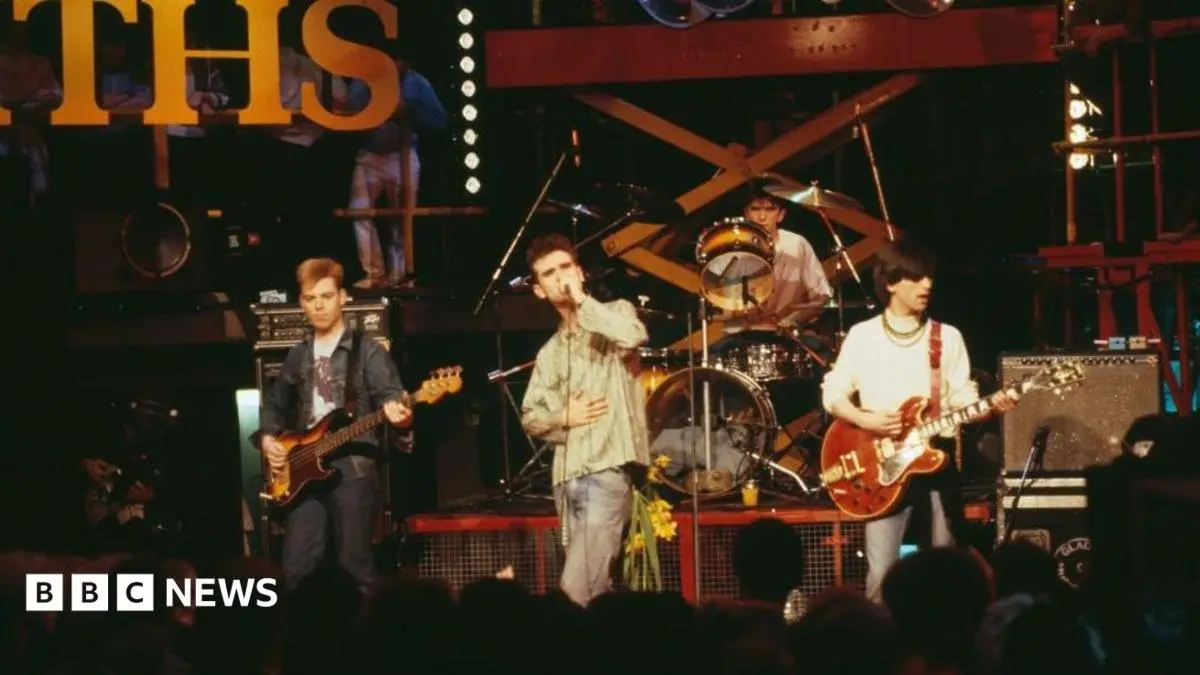
To understand the significance of the 100 instruments heading to Christie’s, one must retrace Johnny Marr’s trajectory from a prodigious teenager in Ardwick and Wythenshawe to the architect of jangle-pop. Born John Maher in 1963, Marr’s relationship with the guitar was obsessive from the outset. Alongside vocalist Morrissey, bassist Andy Rourke, and drummer Mike Joyce, Marr formed The Smiths in 1982. Armed primarily with a succession of Fender Jaguars, Rickenbackers, and ES-335s, Marr rewrote the vocabulary of indie guitar playing, favoring shimmering textures, intricate arpeggios, and melodic counterpoint over traditional heavy-rock pyrotechnics.
As The Smiths soared to critical and commercial acclaim through classics like This Charming Man, What Difference Does It Make?, and How Soon Is Now?, Marr’s collection naturally expanded. However, unlike many of his contemporaries who locked their vintage gear away behind glass, Marr maintained a working relationship with his tools. Guitars were heavily played, modified, toured, and, crucially, shared within the tight-knit fraternity of Manchester’s burgeoning music community.
The 1994 Oasis Encounter: The Rickenbacker’s Perilous Journey
The narrative of the upcoming Christie’s auction was recently illuminated during a retrospective video conversation between Marr and Oasis songwriter Noel Gallagher. The focal point of their shared reminiscing was a specific instrument: a black 1982 Rickenbacker 330 Jetglo.
In early 1994, Oasis was hooping and hollering in the studio, preparing to unleash their debut album, Definitely Maybe, upon a largely unsuspecting British public. At the time, the band’s resources were lean; Gallagher has frequently recounted how early gear setups were minimal, with band members often scraping together whatever equipment they could find. Sensing an opportunity to support his fellow Mancunians, Marr generously dispatched a selection of his own guitars down to the studio.
Among them was the 1982 Rickenbacker—an instrument Marr had famously used to write and record defining Smiths tracks, including What Difference Does It Make?. When the crate arrived at the studio, however, the reception among the emerging Oasis lineup was a mixture of awe and sheer panic.
Gallagher recalled the moment vividly during the Christie’s interview:
"I remember the day when Oasis was recording Definitely Maybe for the first time and you sent down some guitars, because we had one guitar each. Someone took it out and just put it on the floor so it would look like we were a working band. It’s on the cover of Supersonic."
The iconic 1994 debut single Supersonic featured the Rickenbacker prominently in its promotional imagery, leaning casually against a wall—a stylistic choice that sent shivers down the spine of its actual owner. Gallagher admitted he looked at the priceless piece of musical history resting on a studio floor and experienced immediate vertigo, noting:
"I remember looking at it on the floor going, ‘that can not be The Smiths’ guitar, there’s no way he’s sent that down here to a load of geezers from Longsight.’ I was like ‘you better take that back, mate’—what if someone stands on it."
Marr, reflecting on his characteristically relaxed approach to lending out high-value items, prompted Gallagher’s good-natured teasing. "You’ve always been a bit gung-ho with your guitars," Gallagher told him, summarizing a lifelong philosophy where instruments are meant to be instruments, not museum pieces.
The Catalyst for the Auction: Preventing the Museum Trap
Decades after the Supersonic sessions, Marr found himself confronting an existential dilemma familiar to veteran musicians: the sheer accumulation of gear. Over a career spanning four decades—encompassing The Smiths, Electronic, The The, Modest Mouse, The Cribs, and a prolific solo career—Marr’s studio had transformed from a creative laboratory into a storage facility.
In interviews leading up to the auction announcement, Marr articulated his core motivation for parting with nearly a hundred items from his archive:
"I didn’t like the idea of my studio space becoming a museum."
For an artist who prides himself on ongoing creative evolution and forward motion, the presence of idle, historically freighted artifacts represented an emotional and physical anchor. By choosing to auction the collection through Christie’s, Marr is effectively democratizing the instruments, allowing them to find new homes where they can either be played or appreciated by dedicated custodians of rock history.
Supporting Context & Metrics
The Anatomy of the Collection
The upcoming auction at Christie’s on September 17 is not merely a clearance sale; it is a meticulously curated cross-section of modern music history. The catalog features nearly 100 guitars, amplifiers, and associated musical equipment, each carrying a provenance that links it directly to pivotal moments in alternative rock.
- The Crown Jewel: The aforementioned 1982 Rickenbacker 330 Jetglo stands as the marquee item of the sale. Pre-auction estimates place the value of this single instrument at up to £80,000. Its dual significance—having birthed critical Smiths anthems and lent authenticity to the birth of Oasis—places it in a rarified tier of rock memorabilia.
- The Working Arsenal: The remaining inventory comprises a diverse array of solid-body and semi-hollow electrics, acoustics, and custom builds that Marr accumulated across various collaborative eras. Brands synonymous with Marr’s signature tone—particularly Rickenbacker, Fender, and Gibson—dominate the offering.
- Exhibition Phase: Before the gavel falls on September 17, the entire collection has been placed on public exhibition in London. This allows fans, musicologists, and prospective bidders to inspect the wear, tear, and patina accumulated across decades of live touring and intense studio sessions.
The Economics of Rock Memorabilia
The market for high-end rock-and-roll instruments has experienced exponential growth over the past decade. Items associated with British alternative royalty routinely command staggering sums at auction houses like Christie’s, Sotheby’s, and Julien’s Auctions.
When instruments carry double provenance—such as being owned by one foundational artist (Johnny Marr) and utilized by another generational phenomenon (Noel Gallagher)—their market valuation is significantly amplified. Industry analysts suggest that the convergence of Smiths nostalgia and the ongoing cultural resonance of 1990s Britpop will drive fierce competitive bidding among international collectors and institutional buyers alike.
| Collection Metric / Detail | Specification |
|---|---|
| Auction House | Christie’s, London |
| Auction Date | September 17 |
| Total Items in Sale | Nearly 100 guitars and related equipment |
| Flagship Item | 1982 Rickenbacker 330 Jetglo |
| Estimated Value (Flagship) | Up to £80,000 |
| Key Provenance Link | The Smiths recordings & Oasis Supersonic cover |
Official Statements
The dialogue between Johnny Marr and Noel Gallagher, captured on video by Christie’s, provides the definitive emotional and contextual framework for the auction. Rather than a dry corporate press release, the narrative was driven by the authentic banter of two peers who shaped the sonic identity of modern Britain.
Johnny Marr on Archival Philosophy
Explaining his decision to downsize his collection, Marr emphasized the psychological weight of material accumulation:
"I didn’t like the idea of my studio space becoming a museum."
This statement captures the tension every enduring artist faces: balancing the preservation of a legendary past against the necessity of maintaining an unencumbered, forward-looking creative workspace. By releasing the guitars into the wild, Marr reclaims his studio as a site of active experimentation rather than a shrine to former glories.
Noel Gallagher on the Manchester Ethos and "Gung-Ho" Gear Management
Gallagher’s reflections during the Christie’s feature highlighted both the humor and the sheer audacity of early-90s rock culture. His recollections serve as a testament to Marr’s generosity and the interconnected nature of the Manchester music scene:
"You’ve always been a bit gung-ho with your guitars… I remember the day when Oasis was recording Definitely Maybe for the first time and you sent down some guitars, because we had one guitar each."
Gallagher’s comedic disbelief upon seeing a priceless Smiths artifact resting carelessly on a studio floor—and his immediate instinct to protect it from clumsy bandmates—adds a human, grounded element to an otherwise high-finance auction event:
"I remember looking at it on the floor going, ‘that can not be The Smiths’ guitar, there’s no way he’s sent that down here to a load of geezers from Longsight.’ I was like ‘you better take that back, mate’—what if someone stands on it."
Future Outlook
The September 17 Auction: What Lies Ahead
As the countdown to September 17 continues, attention turns to the Christie’s saleroom in London. The event is projected to draw intense international interest, attracting high-net-worth collectors, museum curators, and devout fans of alternative rock.
The sale of the 1982 Rickenbacker 330 Jetglo will undoubtedly be the evening’s dramatic centerpiece. Whether it shatters its £80,000 pre-sale estimate remains to be seen, but the fierce sentimental and historical attachment attached to the instrument guarantees robust bidding.
Legacy and Afterlife of the Instruments
Beyond the financial transactions, the dispersal of Johnny Marr’s collection marks the beginning of a new chapter for these historic instruments. For decades, they existed primarily within the orbit of one of Britain’s most innovative guitarists, contributing to tracks that defined generations of alternative music lovers.
As these guitars transition into private collections or public displays, their stories will continue to evolve. Yet, the overarching narrative established by Marr—rejecting stagnation in favor of clearing the slate—ensures that his creative journey remains untethered. As Marr looks toward future musical horizons, free from the physical constraints of an over-crowded archive, the guitars that built the sound of modern Manchester are ready to pass the torch to a new generation of custodians.