Executive Overview
On a brisk Saturday night under the world-famous arch of Wembley Stadium, a watershed moment in contemporary global music history unfolded. Five words rang out into the London night air, electrifying a crowd of tens of thousands: "Punjabi Aa Gaye Wembley Oye!"
With this triumphant exclamation, Indian megastar Diljit Dosanjh did more than simply kick off another high-octane concert; he shattered glass ceilings, rewrote the record books, and officially ushered Punjabi music into the upper echelon of the global pop mainstream. According to venue management, Dosanjh is the first-ever Punjabi singer in history to headline Wembley Stadium, placing his name alongside musical titans like Madonna, Michael Jackson, Taylor Swift, and Coldplay.
For over two decades, the singer, actor, and cultural icon has methodically built a massive, cross-continental fanbase. From humble beginnings as a boy growing up in a small village in Punjab, India, Dosanjh’s meteoric rise has taken him from local bhangra circuits to the historic stages of Coachella, the Met Gala, and now, the hallowed turf of London’s 90,000-capacity national stadium.
This landmark performance was not merely a commercial triumph or a personal milestone; it was a profound cultural celebration. Blending traditional Bhangra rhythms with contemporary hip-hop and rap, Dosanjh delivered a masterclass in live performance. Yet, beyond the flashing lights, pyrotechnics, and chart-topping anthems like G.O.A.T., Lover, and Born to Shine, the evening served as an emphatic statement of representation. For the South Asian diaspora in the United Kingdom and millions of fans worldwide, Wembley Stadium transformed into a monument of cultural pride, proving that language, geography, and cultural barriers are increasingly irrelevant in the modern, borderless music ecosystem.
Detailed Chronology: Anatomy of a Historic Night
The Build-Up and Afternoon Hype
The energy surrounding Wembley Stadium began to build hours before the doors officially opened. By early Saturday afternoon, the sprawling concourses and surrounding transport hubs were flooded with a sea of color, anticipation, and devotion. While the crowd was predominantly South Asian—representing a vibrant cross-section of the British-Asian diaspora—it was far from exclusive, drawing music lovers from diverse cultural backgrounds eager to witness history.
Fans arrived early to secure their positions, many decked out in traditional Punjabi attire, turbans, and modern streetwear hybrids that mirrored Dosanjh’s signature fashion sense. The atmosphere outside the venue bore the hallmarks of a major global pop event, combined with the communal warmth and vibrancy of a traditional Punjabi celebration.
In backstage interviews conducted exclusively with the BBC ahead of the show, Dosanjh reflected on the gravity of the occasion. Describing the milestone as an absolute "dream," the singer revealed the internal negotiations and external skepticism he faced when booking the venue.
"When we were going to book this venue, everyone said, ‘Think again before you book, it’s a big stadium,’" Dosanjh shared. "I said: ‘We’ll see whatever comes. I want that our people are happy and can say yes, we can do this too!’"
The Spectacular Entrance and Musical Journey
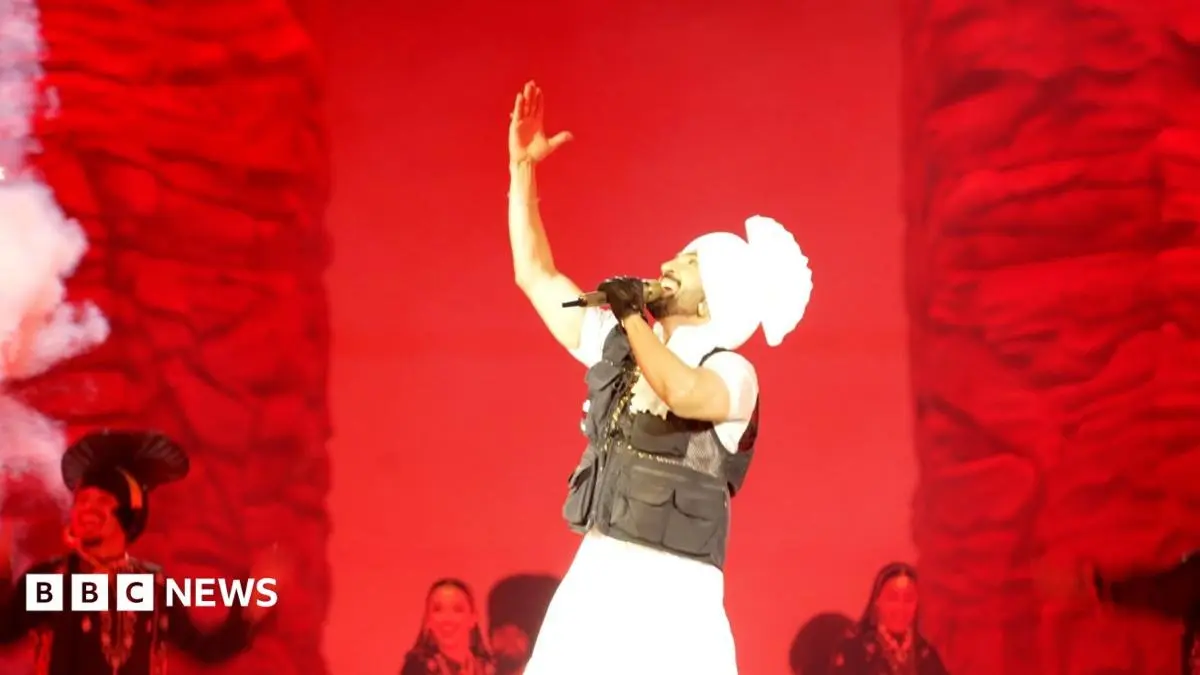
Shortly after 8:00 PM, the lights dimmed, and a deafening roar erupted across the 90,000-seater venue as Dosanjh took to the stage. Dressed in striking traditional attire that paid homage to his heritage, the performer launched immediately into a high-energy set that barely paused for breath over the next two and a half hours.
The concert was a seamless sonic journey through Dosanjh’s extensive catalog. Backed by pounding Bhangra beats, heavy rap basslines, and intricate choreography, he treated fans to electrifying renditions of fan-favorites including Hass Hass, Born to Shine, G.O.A.T., and Lover. His versatile vocals effortlessly bridged traditional folk stylings with contemporary urban sounds, demonstrating the broad musical range that has set him apart from his contemporaries.
Throughout the performance, the audience’s engagement was relentless. Waving illuminated wristbands, singing lyrics back in unison, and executing intricate dance routines, the standing area closest to the stage frequently transformed into a scene reminiscent of a joyous Indian wedding.
Intimate Connections in a Vast Arena
Despite the sheer scale of Wembley Stadium—a venue capable of swallowing up performers in its cavernous architecture—Dosanjh maintained an intimate, deeply personal connection with his audience. Eschewing the detached persona often adopted by global megastars, he frequently paused to interact directly with the crowd.
In one of the evening’s most touching segments, Dosanjh brought a diverse group of fans onto the stage, ranging from young children to an elderly woman. He took selfies, distributed gifts, and shared warm embraces, embodying the humility that has endeared him to millions.
Moreover, the singer made a concerted effort to ensure that those sitting in the furthest reaches of the stadium felt seen and valued. Addressing the upper tiers, he remarked that the fans in the back rows were "full of heart," leading the entire stadium in a wave of applause for them. This egalitarian approach to showmanship reinforced his reputation as an artist of the people.
The Emotional Crescendo and Finale
As the concert neared its conclusion, the emotional resonance of the evening reached its peak. Dosanjh performed his poignant track Main Hoon Punjabi (meaning "I am Punjab"), accompanied by a breathtaking, synchronized firework display that lit up the London sky above the Wembley arch.
The final notes of the night left an indelible impression on everyone in attendance. For longtime concertgoers like Amit and Rani—who spoke to the BBC after the show—the experience transcended standard entertainment.
"What an incredible show, the energy and vibe was unparalleled!" they shared. "We love Diljit and have been to all his shows in the UK. This was something else, a moment in time we won’t forget being a part of… It was not only a privilege, but a moment to celebrate for Punjabi culture."
Supporting Context & Metrics: The Rise of a Global Phenom
Charting the Ascent: From Punjab to Coachella and Beyond
Diljit Dosanjh’s journey to Wembley Stadium is the culmination of a deliberate, two-decade career built on authenticity, relentless work ethic, and cross-genre experimentation. Hailing from a small village in Punjab, Dosanjh began his career singing religious hymns in local gurdwaras before breaking into the mainstream Punjabi music scene in the mid-2000s.
Over the years, his trajectory has been defined by groundbreaking "firsts":
- Coachella 2023: Dosanjh made history by becoming the first Punjabi-language artist to perform at the prestigious US music festival, introducing traditional sounds to a mesmerized desert crowd.
- The Met Gala Debut: He made waves in the fashion world by stepping onto the iconic Met Gala red carpet proudly clad in majestic Punjabi attire, utilizing high-fashion platforms to celebrate his cultural identity.
- Global Collaborations: His cross-cultural appeal has led to high-profile collaborations with international superstars such as Ed Sheeran, Sia, and American talk show host Jimmy Fallon—the latter of whom enthusiastically labeled Dosanjh "the biggest Punjabi artist on the planet" following a memorable television appearance featuring traditional Bhangra lessons.
The Power of Authenticity
In an era where pop stardom often demands homogenization and Westernization to achieve global reach, Dosanjh has taken the opposite approach. His superpower is his unwavering authenticity. He consistently wears his turban as a profound sign of personal and cultural pride, performs exclusively in his mother tongue of Punjabi, and integrates traditional aesthetics into every facet of his public persona.
Beyond his musical output, Dosanjh is a dominant force in Indian cinema as a celebrated Bollywood actor, and a digital phenomenon. His viral social media presence—ranging from humorous Instagram videos, such as his exasperated interactions with an Amazon Alexa device struggling to process his Punjabi accent, to behind-the-scenes tour diaries—has humanized him for a global audience that extends far beyond traditional music consumers.
Comparing the Scale: What Wembley Means
To contextualize the magnitude of Dosanjh’s achievement, one must examine the roster of artists who have headlined Wembley Stadium. Historically dominated by Western pop, rock, and roll royalty—including Queen, Bon Jovi, Adele, Taylor Swift, and Beyoncé—the stadium has rarely opened its doors to non-Western language acts on a headlining basis.
As Dosanjh noted in his pre-show interview, the psychological weight of this venue differs significantly depending on the artist’s background:
"It may not mean as much for someone like Harry Styles, as much as it means for us. He has performed on such stages, but for us, it’s very special. Coming from a village to here—it’s very special. I feel good. I feel happy. And I feel good for my people. I feel good for the next generation."
Official Statements and Industry Impact
The cultural shockwaves generated by Dosanjh’s Wembley concert reverberated throughout the international music industry, prompting reflections on the shifting demographics of global pop music consumption.
Industry analysts point out that the success of the concert signals a structural shift in how streaming platforms and live touring markets operate. No longer is global chart dominance restricted to English-language acts based in North America or the UK. Driven by digitally connected diasporas and increasingly curious cross-cultural listeners, regional genres—most notably Punjabi music, Latin pop, and K-pop—are demanding, and receiving, prime real estate in the world’s premier entertainment venues.
Cultural commentators have praised Dosanjh for refusing to dilute his art for foreign markets. By staying fiercely rooted in his identity, he has paradoxically opened doors to a broader, more universal audience. Educators and community leaders in the UK have also highlighted the positive psychological impact of the concert on young British-South Asians, who saw their language, fashion, and heritage validated on one of the world’s grandest stages.
Future Outlook: The Global Takeover Continues
With the Wembley triumph now firmly etched in history, Diljit Dosanjh shows no signs of slowing down his global expansion. True to his relentless work ethic, the megastar wasted no time looking toward his next major milestone during the London concert.
Midway through the evening, Dosanjh delivered thrilling news for his fanbase in South Asia, officially announcing a massive stadium concert scheduled for November at the colossal Narendra Modi Stadium in Ahmedabad, India—the largest cricket stadium in the world, boasting a staggering seating capacity of 132,000. This upcoming fixture indicates that while Dosanjh is actively conquering Western markets, his commitment to scaling new heights in his homeland remains absolute.
Furthermore, industry insiders whisper of potential upcoming cross-continental collaborations, expanded North American and European touring legs, and cinematic ventures designed to further elevate his multi-hyphenate career.
As the echoes of Saturday night fade from Wembley Stadium, the cultural legacy of Diljit Dosanjh’s performance endures. He has proven that regional music, when delivered with uncompromising passion, world-class production, and genuine human connection, possesses the power to unite tens of thousands of people under a single banner.
As the lights went down and the crowds filtered out into the cool London air, the closing words of the night served as both a personal sign-off and a prophecy for the future of global music:
"We are here. Punjabi Aa Gaye Oye!"