Executive Overview
In the contemporary landscape of improvised and cross-cultural music, few artists possess the geographic and stylistic breadth of Italian reed player and composer Enzo Favata. Born in Alghero, Sardinia, in 1956, Favata has spent more than four decades building a singular sonic architecture—one that bridges the ancient, wind-swept folk traditions of the Mediterranean with the avant-garde sensibilities of modern jazz, African rhythms, and the sprawling magical realism of South America.
His latest release, Ritornare (released via ECM Records in early 2026), represents a major milestone in a storied career. Produced by the legendary Manfred Eicher and recorded at Munich’s Bavaria Studios in January 2026, Ritornare marks Favata’s debut on the prestigious ECM label. More importantly, it serves as the triumphant comeback album for Atlantico, the visionary trans-oceanic ensemble that Favata originally founded in 1999. Following an eighteen-year recording hiatus, the quintet has reconvened with an astonishing sense of ease, generosity, and emotional resonance.
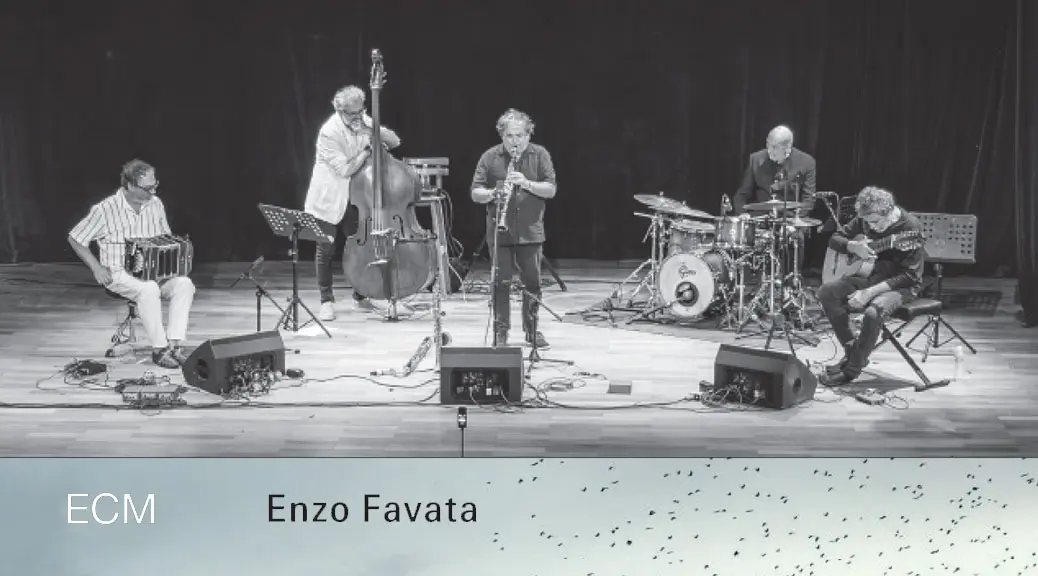
Across eight meticulously crafted compositions, Ritornare manages to dissolve the boundaries between the Old World and the New. It is an album fueled by warmth, togetherness, and an infectious sense of joy. Eschewing technical ostentation in favor of organic storytelling, the record showcases a mature artist returning to a creative space where he has always belonged, backed by a tight-knit collective of master improvisers: Marcello Peghin on ten-string guitar, Daniele Di Bonaventura on bandoneon, Salvatore Maltana on double bass, and U.T. Gandhi on drums and percussion.
Detailed Chronology: From the Shores of Sardinia to the Southern Cone
To fully understand the artistic weight of Ritornare, one must trace the evolutionary trajectory of Enzo Favata’s musical life—a journey characterized by relentless curiosity, literary immersion, and geographic cross-pollination.
Roots and the Alghero Genesis (1956–1980s)
Growing up in the historic Catalan-influenced coastal town of Alghero in northwestern Sardinia, Favata was immersed from an early age in a distinct regional soundscape. Sardinian folk music—characterized by complex microtonal vocal polyphony (such as cantu a tenore), hypnotic reed instruments like the launeddas, and rustic festive dances—left an indelible mark on his musical consciousness.
However, as a young musician coming of age in a rapidly modernizing Europe, Favata’s ears were equally attuned to the transatlantic shockwaves of American jazz. He immersed himself deeply in the discographies of jazz icons John Coltrane, Miles Davis, and Ornette Coleman. Rather than treating these as competing artistic idioms, Favata began to view them through a comparative lens. He recognized that the modal explorations of Coltrane and the free-flowing architectural liberties of Coleman shared a primal, expressive kinship with the ancient modal structures of his native Mediterranean.
The Literary Catalyst and the Birth of Atlantico (1990s–1999)
By the 1990s, Favata’s creative pursuits expanded beyond musical transcription into the realm of literature. He developed a profound fascination with South American culture, catalyzed not merely by physical travel, but by the labyrinthine magical realism found within the pages of writers like Jorge Luis Borges and Gabriel García Márquez. For Favata, South America was initially an imaginary geography constructed through ink, paper, and narrative tension.
This literary exploration culminated in 1999 with the formation of Atlantico, a groundbreaking cross-cultural ensemble designed to map the emotional and stylistic bridges connecting the Mediterranean basin to the Southern Cone of South America. The original Atlantico album, released at the turn of the millennium, was celebrated for its seamless integration of Sardinian folk motifs, Latin rhythms, and contemporary chamber jazz. The project toured extensively across international festivals, establishing Favata as a premier voice in European world-jazz fusion.
Intervening Years and Explorations (2000s–2023)
Following the initial wave of Atlantico’s success, Favata temporarily retired the moniker to explore disparate creative avenues. Over the next two decades, his discography expanded into startlingly diverse territories. He dove deeper into traditional Sardinian polyphony, integrated cutting-edge live electronics into his acoustic setups, and spearheaded ambitious multimedia and theatrical productions, most notably The Crossing project—an adventurous endeavor that combined music, literature, and video to explore themes of migration and cultural exchange.
Despite these myriad detours, the fundamental grammar of Atlantico—the delicate equilibrium between European chamber jazz and South American folk forms—remained dormant in the background, waiting for the right moment to reawaken.
The Reunion and the ECM Genesis (2023–2026)
That moment arrived almost instinctively in 2023. Sensing an unfulfilled dialogue and a renewed creative chemistry among his long-standing collaborators, Favata reconvened the Atlantico ensemble. The reunion was not engineered as a calculated nostalgic comeback, but rather as an organic continuation of a conversation that had been paused eighteen years prior.
The culmination of this reunion was captured in January 2026 at Bavaria Studios under the watchful ear of producer Manfred Eicher. The partnership with ECM Records—a label globally revered for its pristine acoustic transparency, spatial awareness, and championship of atmospheric, cross-genre artistry—proved to be an ideal match for Favata’s expansive sonic vision. Ritornare (Italian for "to return") became the definitive artifact of this homecoming.

Supporting Context & Metrics: The Ensemble and Sonic Architecture
At the heart of Ritornare lies an extraordinary synergy among five seasoned instrumentalists. Each member brings a distinct timbre and cultural vocabulary to the ensemble, resulting in an acoustic palette that is remarkably rich yet effortlessly light on its feet.
The Quintet Lineup and Instrumentation
- Enzo Favata (Soprano Saxophone, Bass Clarinet, Clarinets): Favata’s soprano saxophone work on Ritornare avoids the aggressive, shrill upper registers sometimes associated with the instrument. Instead, he cultivates a beautifully rounded, warm tone. His playing frequently shifts between a gently sustained lyricism and an earthy, almost vocal quality that mirrors human speech. His use of clarinets introduces darker, woody shades to the ensemble’s harmonic middle.
- Marcello Peghin (Ten-String Guitar): Peghin is far more than a standard rhythm guitarist. Utilizing a specialized ten-string instrument, he weaves intricate counter-melodies and shimmering textural colors that provide the music with structural depth without relying on conventional chord-chart backing.
- Daniele Di Bonaventura (Bandoneon): Bringing an unmistakable South American inflexion, Di Bonaventura’s bandoneon breathes life into the proceedings. His instrument sighs, swells, and weeps, anchoring the album’s emotional connection to the Argentine tango and milonga traditions while remaining entirely fluid within an improvisational jazz context.
- Salvatore Maltana (Double Bass) & U.T. Gandhi (Drums, Percussion): Together, Maltana and Gandhi construct a rhythmic foundation that defies the heavy-handedness often found in fusion projects. Their work is characterized by an airy, nimble agility, driving the compositions forward with subtle syncopation and organic pulse.
Track-by-Track Breakdown of Ritornare
The album’s eight compositions form a cohesive narrative journey across eight distinct emotional landscapes:
- "Tukuman": The opening track immediately establishes the album’s cross-continental atmosphere. A gently rolling rhythm coupled with Di Bonaventura’s evocative bandoneon places the listener directly in a liminal space bridging the Mediterranean and Argentina.
- "El Sur" & "Escuchame": These tracks develop the conversational, interactive quality of the quintet. The instruments trade melodic fragments in real-time, resembling old friends catching up after years apart.
- "Donde nace el viento": Exhibiting a particularly graceful, floating character, this piece highlights Favata’s airy soprano saxophone lines and Peghin’s delicate guitar filigree.
- "Sine nomine": Composed by Daniele Di Bonaventura, this track is wonderfully spacious, leveraging the pristine acoustic acoustics of Bavaria Studios to allow individual notes to hang suspended in the air.
- "Milonga del Sol": A direct nod to Atlantico’s historical roots, this piece naturally revisits one of the ensemble’s most enduring musical languages, updating it with the maturity of twenty years of accumulated life experience.
- "Ventana" & "Albatros": The album closes with these two pieces, maintaining a consistent sense of forward momentum and purposeful movement without ever lapsing into restlessness or urgency.
Official Statements and Critical Reception
The arrival of Ritornare has sent ripples through the European and international jazz communities, drawing praise for its unpretentious beauty and emotional transparency.
Reflecting on the motivations behind the project, Enzo Favata has noted in recent interviews that the album is fundamentally about the recovery of a shared artistic voice:
"When you spend decades travelling between musical worlds—exploring electronic music, ancient polyphony, or contemporary jazz—you occasionally realize that certain bonds never truly fray. Atlantico was never just a band; it was an imagined geography. Bringing these musicians back together felt as natural as breathing. We didn’t need to force a concept; the music simply remembered who it was."
Producer Manfred Eicher, whose curatorial vision at ECM has shaped the ECM sound for over half a century, praised the ensemble’s rare ability to blend structural rigor with organic warmth:
"What makes Enzo’s music with Atlantico so compelling for ECM is its transparency. There is no artificial weight here. The acoustic interplay between the bandoneon, the ten-string guitar, and the reeds possesses a natural breath and space that allows every listener to enter the music directly."
Early critical notices have echoed these sentiments, highlighting the album’s refreshing resistance to cynical complexity. Reviewers have pointed out that in an era where modern jazz frequently leans toward cerebral abstraction or technical overload, Ritornare achieves its profound impact through melody, warmth, and an infectious, life-affirming joy that refuses to let the listener walk away untouched.
Future Outlook: A New Chapter for Atlantico
With Ritornare successfully launched into the world via ECM Records, Enzo Favata and the Atlantico ensemble are looking toward a busy touring cycle throughout the remainder of 2026 and into 2027. International festival organizers across Europe and South America have expressed intense interest in bringing the newly reconstituted quintet to major stages.
Industry analysts suggest that Favata’s alignment with ECM will significantly elevate his global profile, introducing his unique blend of Mediterranean soul and South American lyricism to a broader, audiophile-focused listenership. Furthermore, the creative spark reignited during the Ritornare sessions has already prompted discussions regarding future collaborative recordings—potentially expanding the Atlantico framework to include guest artists from North Africa and beyond.
Ultimately, Ritornare is more than a triumphant comeback album; it is a masterclass in cultural synthesis. It proves that artistic traditions do not need to be kept behind glass museum cases to be preserved. Instead, when handled by musicians of Favata’s caliber, they can be set into motion, traveling across oceans, bridging worlds, and bringing an involuntary smile to the face of anyone willing to listen.